IT Risk Management for Executives: 2026 Strategic Guide
What if your most sophisticated cybersecurity tools are actually creating a false sense of security while leaving your boardroom exposed to personal liability? As we approach 2026, implementing a high-level IT risk management framework for executives is no longer a technical choice; it's a foundational business requirement. You likely feel the pressure of looming regulatory fines and the complexity of AI-driven threats, yet finding a clear path through the technical jargon feels impossible. It's a common frustration; many leaders struggle to translate digital vulnerabilities into concrete business impact.
This strategic guide clarifies the process. You'll learn how to select a framework that protects your core assets, ensures rigorous compliance, and aligns every technology investment with your broader business goals. We provide a definitive roadmap for IT governance that reduces liability, improves your cyber insurance eligibility, and secures your operational continuity. From navigating the latest NIST revisions to mastering AI compliance, this is your blueprint for maintaining total control over your digital environment and ensuring your organization remains the calm in the storm.
Key Takeaways
- Learn why a robust IT risk management framework for executives is your most critical business blueprint for aligning technology with long-term growth.
- Evaluate the flexibility of NIST and the global standards of ISO 27001 to ensure your framework meets rigorous international supply chain requirements.
- Implement a strategic roadmap that uses proactive cyber risk analysis to define your risk appetite and eliminate operational uncertainty.
- Address the emerging 2026 landscape by integrating AI compliance and security to defend against increasingly sophisticated digital threats.
- Protect your board from personal liability and improve insurance eligibility through a disciplined, end-to-end approach to corporate governance.
Understanding the Executive IT Risk Management Framework
An IT Risk Management Framework (RMF) is far more than a technical checklist; it's a strategic business blueprint. It functions as the master plan for identifying, assessing, and mitigating digital threats before they impact your bottom line. In the high-stakes environment of 2026, executive oversight is no longer optional. It's a mandatory pillar of modern corporate governance. By implementing a formal IT risk management framework for executives, you move away from the chaotic, reactive "break-fix" model. Instead, you embrace a proactive stance that builds enterprise value and drives down insurance premiums through demonstrated discipline.
The Business Value of Standardized IT Governance
Frameworks provide the essential bridge between technical operations and the boardroom. They establish a common language that allows you to evaluate digital risks through the lens of business impact. When you partner with managed IT services, a standardized framework ensures your provider’s priorities are perfectly synced with your growth objectives. The cost of doing nothing isn't just a missed opportunity; it's the high price of operational downtime and lost market trust. Investing in a framework delivers a clear ROI by stabilizing your digital infrastructure and providing the scalability you need to lead with confidence.
Fiduciary Duty and Cyber Liability in 2026
The legal landscape has shifted. By 2026, the expectation for executive due diligence regarding data protection is absolute. You have a fiduciary responsibility to treat digital risk with the same rigor as financial risk. A robust IT risk management framework for executives serves as a vital safe harbor during regulatory audits or litigation. It provides documented proof that you’ve exercised reasonable care and followed industry standards. Leveraging regulatory compliance IT support further solidifies this defense. It ensures your organization remains compliant with evolving standards, effectively shielding the board from liability and ensuring the long-term continuity of your operations.
Comparing Top Frameworks: Which is Right for Your Organization?
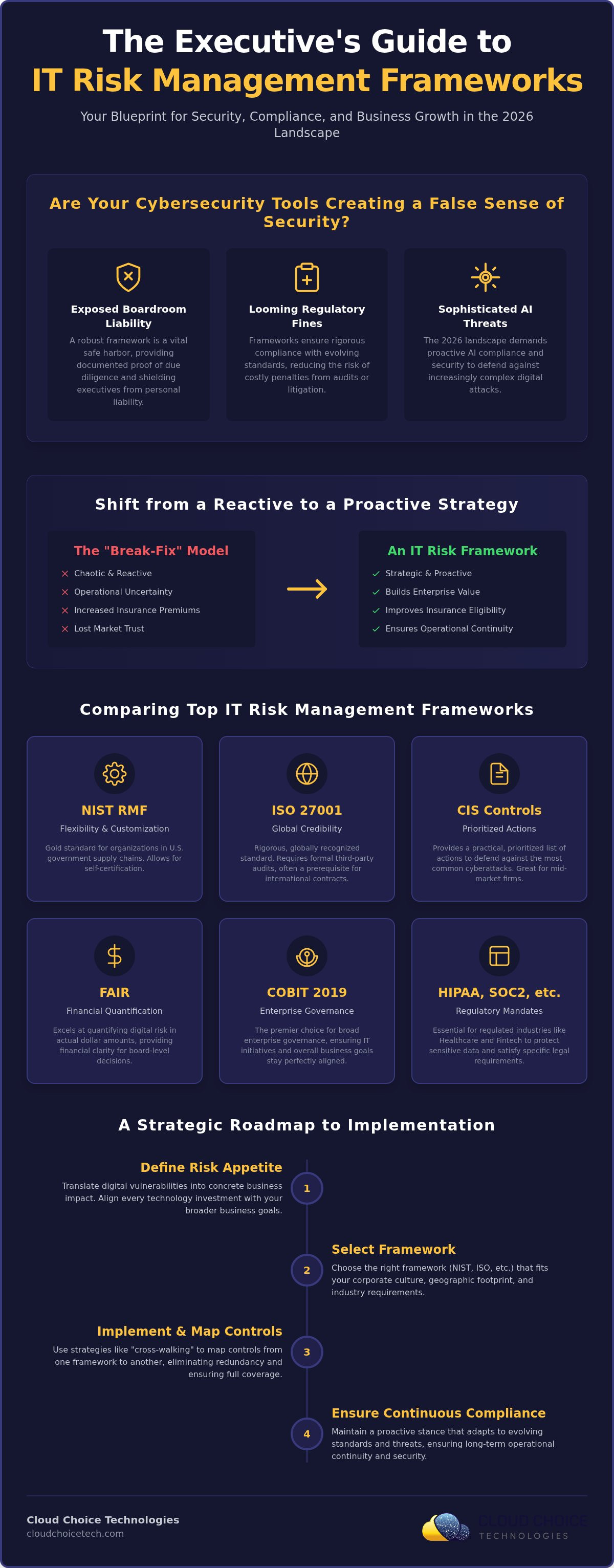
Choosing the right IT risk management framework for executives is a decision that dictates your operational agility for years. No single framework fits every corporate culture. NIST RMF offers unparalleled flexibility and is the gold standard for organizations working within U.S. government supply chains. For those focused on international credibility, ISO 27001 provides a rigorous, globally recognized structure. Mid-market firms often find their footing with CIS Controls, which provides a prioritized list of actions to stop the most common cyberattacks. If your board demands financial clarity, the FAIR framework excels at quantifying digital risk in actual dollar amounts. Meanwhile, COBIT 2019 remains the premier choice for broad enterprise governance, ensuring IT and business goals stay perfectly aligned.
NIST vs. ISO: The Global Standard Debate
The choice between NIST and ISO often comes down to your geographic footprint and auditing preferences. NIST allows for self-certification, making it a flexible choice for internal improvement. ISO 27001 requires a formal third-party audit, which is often a prerequisite for international contracts. Both frameworks provide the structural integrity needed to oversee managed cloud security services effectively. If your growth strategy involves global expansion, ISO’s rigorous standards offer the peace of mind that your security posture is respected worldwide. If you are unsure which path fits your 2026 roadmap, our experts at Cloud Choice Technologies can help you evaluate your specific requirements.
Industry-Specific Frameworks: HIPAA, SOC2, and Beyond
Regulated industries like Healthcare and Fintech must look beyond general frameworks to satisfy specific legal mandates. HIPAA and SOC2 are essential for protecting sensitive data and maintaining client trust. Many leaders utilize "cross-walking" to manage these overlapping demands. Cross-walking is the process of mapping controls from one framework to another to eliminate redundancy. This strategy allows you to use a single IT risk management framework for executives to satisfy multiple compliance requirements simultaneously. It streamlines your oversight and ensures that your team isn't wasting resources on duplicate efforts. By consolidating your controls, you maintain a leaner, more responsive security posture that protects your assets without slowing down your operations.
Implementing Your Framework: A Strategic Roadmap
Successful implementation of an IT risk management framework for executives transforms abstract technical fears into manageable business tasks. It isn't a one-time event. It's a continuous cycle of assessment and refinement that protects your most valuable assets. Your journey begins with a baseline cyber risk analysis to identify existing vulnerabilities and quantify their potential impact. From there, you must follow a disciplined roadmap:
- Define Risk Appetite: Establish clear boundaries for which risks you will accept, transfer, or mitigate based on your 2026 growth objectives.
- Appoint Champions: Select internal leaders to drive adoption and vet external partners who provide the elite readiness your brand demands.
- Inventory and Categorize: Document every digital asset and rank them by their criticality to business continuity.
- Establish Monitoring: Create a reporting cadence that keeps the board informed through high-level metrics rather than technical jargon.
Defining Your Organization's Risk Appetite
Deciding which risks to accept, transfer, or mitigate is a core executive function. You must balance absolute security with the operational agility required to remain competitive. Remember that 100% security is a myth; your true goal is organizational resilience. By defining your risk appetite early, you ensure that every security dollar spent aligns with your specific tolerance for potential disruption. This clarity allows your team to act decisively during a crisis, knowing exactly which systems must be restored first to maintain operations.
Resource Allocation and Budgeting for RMF
Shift the internal narrative from "IT spending" to "Risk Investment." Justifying these costs to the CFO requires quantifiable metrics that demonstrate reduced liability and improved insurance eligibility. Specialized consultants play a vital role here. They reduce implementation time and ensure your IT risk management framework for executives isn't just a document on a shelf, but a functional guardian of your enterprise value. To streamline your transition and ensure total oversight, partner with Cloud Choice Technologies to secure your organization's digital future.
The 2026 Landscape: AI Risks and Managed Solutions
The digital horizon has shifted. By 2026, the proliferation of AI-powered cyber threats has rendered traditional defense strategies insufficient. Your IT risk management framework for executives must now evolve to include rigorous AI compliance and security protocols. This isn't just about adding a new chapter to your policy manual. It's about fundamental structural changes to how you perceive and mitigate risk in an automated world. Without these updates, your organization remains vulnerable to sophisticated attacks that bypass legacy controls.
Adapting Frameworks for AI and Machine Learning
Large Language Models (LLMs) introduce unique data privacy concerns that standard frameworks often overlook. Ensuring secure AI deployment for business requires a granular understanding of how data flows through these models and where it's stored. To remain resilient, 2026 frameworks must account for "Model Inversion" and "Prompt Injection" as standard IT risks. These threats can compromise proprietary data or manipulate model outputs, making them primary concerns for the modern boardroom. You need a framework that treats AI as a core component of your infrastructure rather than a peripheral tool.
The Role of an MSP in Continuous Compliance
Manual compliance is obsolete. The speed of the 2026 digital environment demands a move away from static annual audits toward "Always-On" monitoring. A Managed Service Provider (MSP) functions as the vigilant guardian of your framework's integrity, providing the rapid response needed to counter emerging vulnerabilities. Cloud Choice Technologies provides the real-time visibility you need to maintain total control over your digital environment. We handle the complexities of technical oversight so you can focus on strategic growth, ensuring your IT risk management framework for executives remains robust and responsive.
Cloud Choice Technologies streamlines implementation and oversight, providing the elite readiness your organization deserves. We act as the calm in the storm, managing the intricate details of your security posture so you don't have to. Don't leave your digital future to chance in an increasingly automated world. Contact us today to secure your operations with a framework built for the specific challenges of 2026 and beyond.
Secure Your Digital Legacy for 2026 and Beyond
The transition from reactive IT support to a proactive, framework-driven strategy is no longer a luxury for the modern boardroom. It's a foundational requirement for protecting your assets and ensuring long-term operational continuity. By selecting the right IT risk management framework for executives, you align your technical investments with your core business goals while shielding your leadership from personal liability. Whether you're adapting to the emergence of AI-powered threats or navigating complex international regulations, a disciplined approach provides the peace of mind you need to lead with confidence.
You don't have to handle these digital complexities alone. Our team of elite AI security consultants and vigilant monitoring experts provide the end-to-end oversight required to maintain total control. With a proven compliance track record, we function as your fast-acting partner in an unpredictable landscape. Secure your enterprise with a proactive IT risk analysis from Cloud Choice Technologies today. Your organization's resilience is our highest priority, and we're ready to ensure your digital future remains stable, secure, and successful.
Frequently Asked Questions
What is the most widely used IT risk management framework for US businesses?
The NIST Cybersecurity Framework remains the gold standard for organizations operating within the United States. Its popularity stems from its exceptional flexibility and alignment with federal security requirements. It provides a clear, common language that allows leadership to bridge the gap between technical teams and the boardroom. This IT risk management framework for executives ensures that security measures stay focused on protecting critical business outcomes.
How much does it cost to implement an IT risk management framework?
Total investment varies based on your organization's size and current technical maturity. Rather than viewing this as a standard IT expense, it's more accurate to treat it as a strategic risk investment. Costs typically cover gap analysis, specialized consultant fees, and the deployment of monitoring software. Investing in a robust framework reduces long-term liability and can significantly lower your cyber insurance premiums.
Can a small business use the same framework as a Fortune 500 company?
Yes, most leading frameworks are designed with scalability in mind. A smaller firm might focus on a prioritized subset of controls, such as the CIS Critical Security Controls, while a global enterprise implements a full NIST or ISO 27001 suite. The core principles of identifying and protecting assets remain identical. This scalability ensures that your security posture grows alongside your business without requiring a total overhaul.
How often should executives review IT risk reports?
Strategic reviews should occur at least quarterly to ensure alignment with your broader business goals. However, the high-velocity threat landscape of 2026 favors monthly updates or real-time dashboards for high-level health metrics. This proactive cadence allows you to maintain total control over emerging vulnerabilities. It ensures that your leadership team isn't caught off guard by sudden shifts in the digital risk environment.
What is the difference between an IT framework and a compliance audit?
An IT framework is a continuous strategic blueprint used to manage and mitigate risk daily. A compliance audit is a point-in-time check to verify that you've met specific legal or industry requirements. Think of the framework as your organization's proactive health and fitness regimen. The audit is the mandatory annual physical that proves your systems are functioning exactly as they should under regulatory scrutiny.
How does AI change the way we manage IT risk in 2026?
AI introduces automated, high-speed threats that can bypass traditional, static defenses. In 2026, a modern IT risk management framework for executives must include specific controls for model integrity and data privacy. This shift requires moving away from manual oversight toward automated, continuous monitoring. You must account for new risks like prompt injection and model inversion to ensure your AI deployments remain secure and compliant.