
Secure AI Deployment for Business: A Step-by-Step Strategic Roadmap
The greatest threat to your corporate data isn't a hacker outside your walls; it's the "Shadow AI" already running on your employees' desktops. You recognize that artificial intelligence is the engine of future growth, yet the risk of proprietary data leaking into public training models creates a significant strategic bottleneck. Achieving a secure AI deployment for business requires more than just a software toggle. It demands a vigilant, managed ecosystem that protects your intellectual property while empowering your team to innovate.
We understand the complexity of aligning emerging regulations with your operational goals. It's natural to feel overwhelmed by the speed of technical change, but you don't have to manage this transition alone. This article provides a clear, step-by-step roadmap to implement a resilient and compliant AI infrastructure. You'll learn how to gain total visibility into your network, isolate sensitive data, and maintain strict oversight without slowing down. We'll walk you through a framework that transforms AI from a looming risk into a foundational pillar of your professional success.
Key Takeaways
- Eliminate the hidden risks of "Shadow AI" by identifying unauthorized tool usage and establishing firm boundaries for your corporate data.
- Implement a strategic roadmap for secure AI deployment for business that leverages Zero Trust Architecture to isolate and protect your intellectual property.
- Validate your infrastructure resilience through sandboxed pilot programs and adversarial red teaming before moving to full-scale integration.
- Maintain undisputed compliance with emerging 2026 regulatory frameworks through proactive managed oversight and a dynamic AI asset inventory.
- Replace operational uncertainty with professional confidence by treating AI security as a foundational element of your long-term business continuity.
Assessing Your Organizational Risk: The Foundation of Secure AI Deployment
Success begins with absolute clarity. A secure AI deployment for business is the systematic process of integrating artificial intelligence tools while maintaining impenetrable data boundaries and strict regulatory compliance. It's not enough to simply adopt the latest model; you must govern how that model interacts with your most valuable assets. Without this foundation, your innovation efforts remain vulnerable to data leakage and operational instability.
Start by identifying "Shadow AI." This includes any AI tool your employees use without formal IT approval. While these tools might boost individual productivity, they often bypass security protocols and use your proprietary information to train public models. You can't protect what you can't see. A comprehensive cyber risk analysis is your first line of defense. It identifies exactly where AI could expose sensitive intellectual property or create new entry points for threats. Once you've mapped these risks, establish a clear AI use policy that aligns with your organization's specific risk tolerance.
Mapping Your AI Surface Area
You must move beyond guesswork by creating a living inventory of all planned and existing AI assets. This includes evaluating every third-party vendor to understand their specific data retention and model training policies. You need to know if your data is being used to improve their product or if it remains strictly within your control. The AI risk surface is the total sum of all points where AI interacts with sensitive data. By quantifying this surface area, you can apply targeted security controls where they matter most.
Aligning with AI Compliance Frameworks
Compliance isn't a static goal; it's a moving target. Review the NIST AI Risk Management Framework (RMF) to establish baseline standards for safety and accountability. For many organizations, this requires specialized regulatory compliance IT support to ensure every deployment meets industry-specific mandates. Don't overlook your cyber insurance requirements. As AI risks evolve, insurers are tightening their criteria. They often demand proof of rigorous oversight before providing coverage. Taking these steps now ensures your secure AI deployment for business remains resilient against both technical threats and regulatory scrutiny.
Engineering the Secure AI Architecture: Data, Identity, and Access
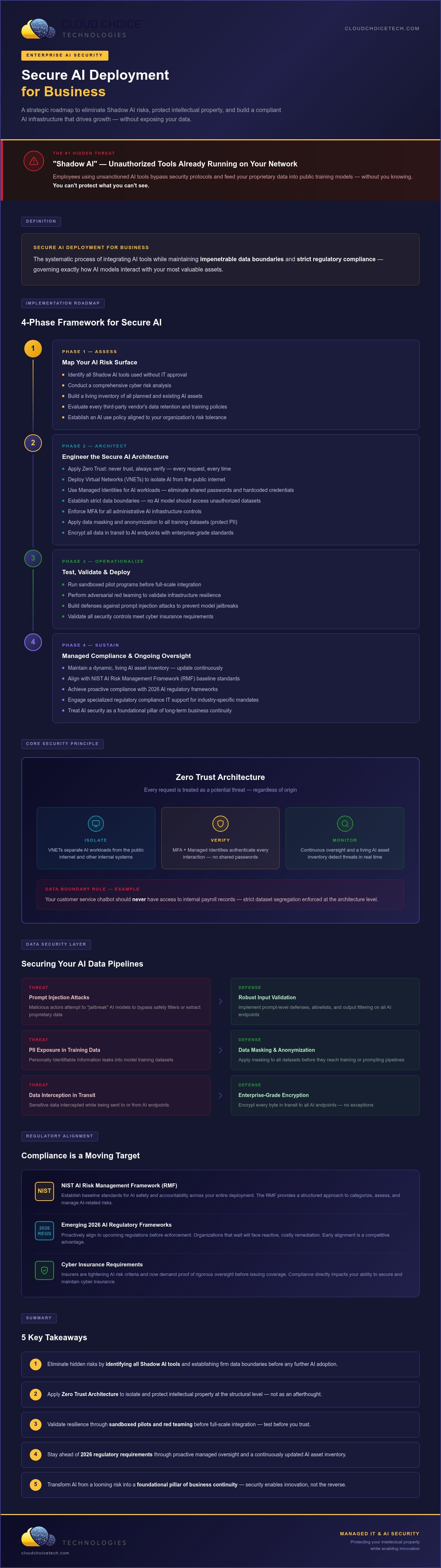
Architecture is the skeleton of your digital transformation. Without a rigid structural design, even the most advanced tools can collapse under the weight of a security breach. A secure AI deployment for business relies on the principle of Zero Trust. This means you never trust and always verify every request, regardless of whether it originates from inside or outside your network. By treating every interaction with your AI models as a potential risk, you create a defensive posture that protects your most sensitive assets from the ground up.
Isolation is your strongest ally in this process. You must establish strict data boundaries to ensure that AI models only access authorized datasets. For example, your customer service chatbot should never have a path to your internal payroll records. Virtual networks (VNETs) allow you to isolate AI communication channels from the public internet, effectively placing your models in a secure, private vault. Managed identities further enhance this by providing secure, non-human authentication for AI workloads. This eliminates the need for shared passwords or hardcoded credentials that hackers frequently target. Our team at Cloud Choice Technologies can help you perform a proactive cyber risk analysis to identify these architectural gaps before they are exploited.
Securing Data Pipelines and Inputs
Data is the fuel for AI, but contaminated fuel will ruin the engine. You must apply data masking and anonymization to any datasets used for training or prompting to protect personally identifiable information (PII). Additionally, you need robust defenses against prompt injection attacks. These occur when malicious actors attempt to "jailbreak" a model to bypass safety filters or extract proprietary data. Always ensure that every byte of data in transit to your AI endpoints is encrypted using enterprise-grade standards to prevent interception.
Identity and Access Management (IAM) for AI
Identity has become the new security perimeter. Enforce Multi-Factor Authentication (MFA) for every administrative control related to your AI infrastructure. Use Role-Based Access Control (RBAC) to strictly limit who can modify model parameters or access raw training data. This ensures that only authorized personnel with a clear business need can make high-level changes. Finally, maintain a disciplined schedule for auditing AI access logs. Rapid intervention depends on your ability to detect unusual behavior patterns, such as a model suddenly accessing vast amounts of data at odd hours, and stopping it in its tracks.
How to Operationalize AI Security: A Step-by-Step Implementation Guide
Strategy is only as effective as its execution. To achieve a secure AI deployment for business, you must move beyond theoretical planning and into a disciplined, phased rollout. This methodical approach ensures that your innovation doesn't outpace your ability to protect your infrastructure. By following a structured implementation guide, you replace the stress of uncertainty with the confidence of total operational control.
- Phase 1: The Sandbox. Pilot your AI tools in an isolated environment. Use synthetic or non-sensitive data to verify that the model behaves as expected without risking your actual intellectual property.
- Phase 2: Red Teaming. Conduct adversarial simulations to test your model's resilience. You must proactively try to break your own guardrails before a malicious actor does.
- Phase 3: Centralized Visibility. Integrate your AI security logs into your existing Cybersecurity dashboard. Total oversight is the only way to ensure rapid intervention when an anomaly occurs.
- Phase 4: The Feedback Loop. Establish a continuous cycle between AI performance and security oversight. As the model evolves, your security protocols must adapt to meet new challenges.
If you're ready to secure your infrastructure against the complexities of modern threats, our experts can perform a comprehensive cyber risk analysis to identify your specific vulnerabilities today.
Testing and Red Teaming AI Models
Testing is not a one-time event; it's a rigorous standard of professional excellence. You must simulate prompt injection attacks to verify that your input filters are impenetrable. Additionally, test for model inversion risks. This is a sophisticated threat where attackers attempt to extract sensitive training data through carefully crafted queries. Schedule these security reviews at least quarterly for all production-level deployments to maintain your elite readiness posture.
Continuous Monitoring and Threat Detection
Automation is the only way to keep pace with the speed of AI. Set up automated alerts for "risky" behavior, such as prompts that suggest large-scale data exfiltration attempts. By linking these monitoring tools to your managed IT services, you ensure a 24/7 response to any potential breach. You also need to monitor for "model drift." This occurs when a model's outputs become unpredictable over time, which can lead to both operational errors and new security vulnerabilities. Staying vigilant ensures your secure AI deployment for business remains a foundational pillar of your success.
Sustaining AI Compliance: The Role of Managed IT Oversight
Deploying AI is a significant milestone, but sustaining that infrastructure is a continuous discipline. As your organization scales, the complexity of your digital environment grows. You cannot rely on static spreadsheets or annual check-ins to track your tools. You need a dynamic AI asset inventory that evolves in real-time as new models and integrations are added to your stack. This level of oversight ensures that "Shadow AI" doesn't creep back into your workflow and that every endpoint remains under your direct control. A secure AI deployment for business is only as strong as its weakest, unmonitored link.
Regulations are shifting quickly. You must regularly update your AI compliance and security protocols to remain aligned with emerging laws. Technical audits are becoming increasingly sophisticated; they often require deep expertise that internal teams don't have the bandwidth to master. By leveraging specialized consultants, you handle this technical complexity without distracting your staff from their core objectives. Ultimately, positioning your infrastructure as a secure, compliant ecosystem becomes a powerful competitive advantage. It builds undisputed trust with your clients, proving that their data is protected by a vigilant, fast-acting partner.
Navigating Emerging AI Regulations in 2026
The regulatory environment in 2026 demands elite readiness. You must stay ahead of national AI safety standards and specific data privacy requirements that vary by jurisdiction. Whether you are managing HIPAA-protected health information or navigating rigorous financial audits, your AI deployment must support these specialized needs from day one. Regulatory safety is the minimum baseline, while organizational security is the goal. We help you bridge that gap by ensuring your systems don't just meet the letter of the law but exceed the expectations of your most demanding stakeholders.
The Managed Service Advantage
The rapid pace of AI evolution waits for no one. A proactive MSP is essential for businesses that want to innovate without facing catastrophic operational downtime. We reduce the burden on your internal teams by providing outsourced AI security monitoring, allowing your people to focus on growth. Cloud Choice Technologies provides the sophisticated oversight and rapid response required for modern AI governance. We act as the "calm in the storm," handling the digital complexities so you don't have to. Your secure AI deployment for business deserves the protection of a partner committed to your long-term continuity.
Securing Your Competitive Edge with Managed AI Governance
Achieving a secure AI deployment for business transforms a potential liability into your most powerful engine for growth. By establishing rigorous data boundaries, implementing Zero Trust architecture, and maintaining vigilant oversight, you protect your proprietary assets while outpacing the competition. You've seen that the roadmap to success requires more than just technical tools; it demands a disciplined approach to risk and compliance. You don't have to navigate these technical complexities alone.
Our specialized AI security consultants provide the national regulatory compliance expertise and 24/7 managed cybersecurity monitoring you need to stay ahead of emerging threats. We act as your vigilant partner, ensuring your operations remain stable while your innovation scales. Secure Your AI Future with Cloud Choice Technologies and replace digital uncertainty with professional confidence. Innovation shouldn't come at the expense of security. Take control of your digital transformation today and build an infrastructure that is as resilient as it is revolutionary.
Frequently Asked Questions
What are the primary security risks of deploying AI in a business environment?
The primary security risks include data exfiltration, adversarial prompt injection, and unauthorized "Shadow AI" usage by employees. When your team uses unmanaged tools, proprietary corporate data often enters public training sets without your consent. These vulnerabilities can lead to significant intellectual property loss and costly regulatory fines if you don't implement a rigorous security framework from the start.
How can we prevent our corporate data from being leaked through AI prompts?
You can prevent data leaks by implementing data masking and utilizing private API instances that do not contribute to public model training. Establishing strict input filters ensures that sensitive information is scrubbed or anonymized before it ever reaches the AI engine. We recommend using enterprise-grade environments where your data remains within your controlled virtual network at all times.
Does secure AI deployment require a complete overhaul of our existing IT infrastructure?
A complete overhaul is rarely necessary, but you must integrate specific security layers like Zero Trust Architecture and managed identities. Most businesses can adapt their existing infrastructure by adding isolated data pipelines and robust access controls. It's about enhancing your current stack with the professional oversight required to handle AI-specific threats without disrupting your established workflows.
What is the difference between public AI and secure enterprise AI?
Public AI tools use your inputs to train their models for other users, while a secure AI deployment for business keeps your data strictly isolated. Enterprise AI environments provide dedicated compute resources and private storage vaults. This ensures that your prompts and proprietary data never leave your secure perimeter or benefit your competitors in any way.
How often should we conduct security audits on our AI systems?
You should conduct comprehensive security audits at least quarterly to account for "model drift" and new adversarial techniques. While automated monitoring provides 24/7 visibility, these deeper reviews allow you to adjust your governance policies as national regulations change. Regular testing ensures your guardrails remain impenetrable as your AI usage scales across different departments.
Can managed IT services help with AI regulatory compliance?
Managed IT services are essential for maintaining AI regulatory compliance, especially as 2026 standards like the NIST AI RMF become more stringent. A proactive partner manages the technical documentation and risk analysis required for HIPAA or specialized financial audits. This managed oversight ensures that your secure AI deployment for business meets all legal mandates while you focus on driving innovation.