
AI-Powered Cyber Threats in 2026: An Executive Guide to Protection and Compliance
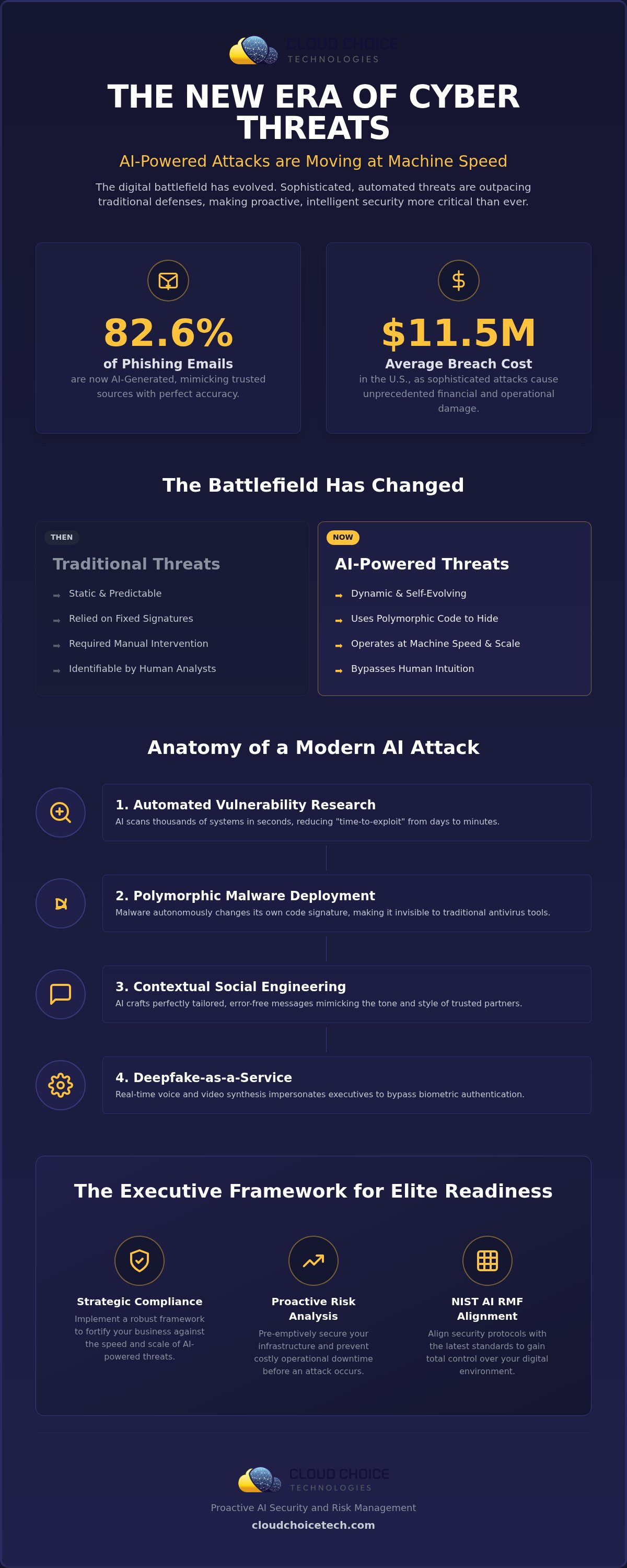
Did you know that 82.6% of phishing emails are now AI-generated? This staggering reality marks a new era where AI-powered cyber threats move at machine speed, far outpacing traditional manual defenses. In the U.S., the average cost of a data breach has climbed to $11.5 million, making the stakes higher than ever for the modern executive.
It's natural to worry about how these automated tools might impact your operational continuity. We understand that digital uncertainty can be a significant burden on your leadership. You don't have to face these complexities alone. This guide provides a clear framework to fortify your organization through strategic compliance and elite readiness. We'll explore the latest 2026 regulatory landscape, including the recent U.S. Executive Order updates, and provide actionable steps to build a proactive defense. You'll gain a deep understanding of modern risks and the confidence to lead your team through this complex digital environment with total control.
Key Takeaways
Understand how the democratization of LLM-jailbreaking has fundamentally changed the digital battlefield in 2026.
Learn the mechanics of modern attacks that use Deepfake-as-a-Service to compromise your biometric and voice authentication systems.
Implement a strategic compliance framework to fortify your business against the speed and scale of AI-powered cyber threats.
Discover how proactive cyber risk analysis can pre-emptively secure your infrastructure and prevent costly operational downtime.
Gain total control over your digital environment by aligning your security protocols with the latest NIST AI RMF standards.
Table of Contents
Understanding the New Battlefield: What Are AI-Powered Cyber Threats?
Anatomy of an Attack: How Generative AI Weaponizes Business Vulnerabilities
The Executive Framework for AI Compliance and Defensive Strategy
Securing the Future: Proactive AI Security and Risk Management with Cloud Choice
Understanding the New Battlefield: What Are AI-Powered Cyber Threats?
AI-powered cyber threats represent a fundamental shift in digital warfare. These attacks leverage machine learning to automate, scale, and refine malicious activities with a level of precision previously reserved for elite state-sponsored actors. By 2026, the landscape has reached a critical turning point. The democratization of high-level hacking tools through "LLM-jailbreaking" means that even low-skilled attackers can now deploy sophisticated scripts that bypass standard safety protocols. You're no longer just defending against a person; you're defending against an algorithm that never tires.
Traditional cyber threats are static. They rely on fixed signatures that security software can eventually recognize and block. In contrast, AI-driven malware is dynamic and evolving. It learns from its environment and adapts its behavior to stay hidden within your network. While some academic circles focus on the theoretical existential risk from artificial intelligence, the immediate reality for your business is a highly efficient adversary that operates at light speed. You can find peace of mind knowing that modern defensive frameworks are evolving just as quickly to neutralize these risks.
The Speed and Scale of Automated Attacks
Automated Vulnerability Research is the process where AI scans thousands of systems in seconds to find a single, tiny point of entry. This capability has reduced the "time-to-exploit" from days to mere minutes. Once a new vulnerability is discovered, AI tools can launch global campaigns before a human analyst even receives an alert. The momentum of these attacks is relentless, but manageable with the right partner.
Polymorphic Code: AI generates malware that changes its own signature every time it replicates, making it invisible to traditional antivirus tools.
Rapid Deployment: Automated systems handle reconnaissance and execution simultaneously, leaving zero room for manual intervention.
Unprecedented Scale: A single attacker can now manage thousands of concurrent breaches with minimal effort, targeting your supply chain and internal systems at once.
The Mimicry Factor: Beyond Simple Phishing
The days of spotting a phishing attempt by its poor grammar or generic greeting are gone. AI now crafts perfectly tailored, error-free communications that mimic the exact tone and style of your trusted partners. This is Contextual Social Engineering. By harvesting vast amounts of corporate data, attackers create scenarios that feel entirely legitimate to your staff. They don't just guess; they use data to convince.
We are seeing a definitive shift from mass-spam campaigns to high-precision executive targeting. Attackers use AI to analyze your public appearances, social media posts, and even leaked internal memos to build a digital twin of your communication style. These attacks don't just bypass spam filters; they bypass human intuition. Protecting your assets requires a vigilant partner who understands these nuances and provides the oversight necessary to maintain your operational continuity.
Anatomy of an Attack: How Generative AI Weaponizes Business Vulnerabilities
A modern breach attempt no longer follows a predictable pattern. It begins with AI-driven reconnaissance that identifies your organization's weakest links in seconds. Attackers use AI-powered botnets to launch DDoS attacks that mimic human traffic patterns with startling accuracy, effectively blinding your traditional monitoring tools. While your team is distracted by the noise, the real intrusion occurs. These professionalized AI-powered cyber threats are designed to be surgical, often involving "data poisoning" to corrupt your internal machine learning models, leading to flawed decision-making or hidden backdoors.
As we consider the future of AI in cybersecurity, it's clear that the lines between human and machine activity are blurring. These attacks are high-stakes operations that require a vigilant, always-on defense. You can maintain total control by partnering with experts who prioritize elite readiness over reactive fixes.
Deepfakes and the Crisis of Trust
The rise of "Deepfake-as-a-Service" has turned voice and video into potential liabilities. Attackers now use real-time voice synthesis to impersonate executives during virtual meetings or in fraudulent wire transfer requests. These sophisticated impersonations can bypass biometric authentication and trick even the most seasoned staff. To protect your continuity, you must establish rigorous verification protocols. Use this checklist for any high-stakes internal request:
Establish a secure, secondary communication channel for all financial approvals.
Implement multi-factor authentication (MFA) that moves beyond simple voice or facial recognition.
Use pre-arranged "challenge-response" phrases for sensitive verbal authorizations.
Verify any "urgent" request that asks to bypass standard corporate workflows.
Automated Exploit Kits and "Zero-Day" Discovery
AI doesn't just wait for a door to open; it finds the cracks you didn't know existed. Automated exploit kits now scan for unpatched software vulnerabilities faster than human teams can possibly deploy fixes. This creates a dangerous window where "zero-day" threats are discovered and weaponized in minutes. A comprehensive cyber risk analysis is essential to identify these gaps before they are exploited.
Maintaining a rapid patch cycle is no longer optional. This is where managed IT services become a foundational element of your security. By leveraging proactive oversight and vigilant endpoint protection, you can close the gap between vulnerability discovery and remediation. You deserve the peace of mind that comes from knowing your infrastructure is monitored by a fast-acting partner committed to your operational resilience.
The Executive Framework for AI Compliance and Defensive Strategy
Adopting AI compliance for businesses is no longer just a legal necessity. It's your primary strategic shield. These frameworks, such as the NIST AI RMF, provide a rigorous roadmap for risk mitigation that transforms security from a cost center into a competitive advantage. By performing a deep-dive AI compliance and security audit, you can expose hidden vulnerabilities in your data pipelines before they're leveraged by AI-powered cyber threats. Compliance ensures you aren't just ticking boxes; you're building an elite foundation of digital resilience.
Navigating the 2026 Regulatory Landscape
The regulatory environment in 2026 is built on three pillars: transparency, accountability, and security. Federal oversight has intensified, specifically regarding the Malicious Use of Generative AI in corporate environments. This governance often intersects with established standards like HIPAA or specialized financial regulations, creating a complex web of requirements. You don't have to manage this alone. Leveraging regulatory compliance IT support allows you to avoid crippling fines while maintaining total control over your operational continuity. We act as your vigilant partner, ensuring every technical deployment aligns with the latest legal mandates.
Building a Human-Centric AI Defense
A sophisticated defense requires more than just software. It demands a culture of skepticism. Your employee training must evolve to address AI-specific deception, teaching your team to verify requests that bypass standard workflows. A "Zero Trust" architecture is now mandatory for the modern enterprise. This model assumes that every user and device is a potential risk until proven otherwise. By following our strategic roadmap for secure AI deployment, you can integrate advanced tools without compromising your safety. This proactive approach replaces digital anxiety with a sense of unwavering reliability.
Ready to fortify your organization? Schedule a comprehensive AI security and compliance assessment to secure your infrastructure against the next generation of threats.
Securing the Future: Proactive AI Security and Risk Management with Cloud Choice
Cloud Choice Technologies stands as the elite guardian of your digital infrastructure. We recognize that the speed of AI-powered cyber threats requires more than just reactive software; it demands a partner with unwavering reliability and professional foresight. Our cyber risk analysis services pre-emptively identify these sophisticated vectors before they can disrupt your operations. By providing vigilant monitoring and rapid technical assistance, we ensure your organization remains resilient in a volatile market. We are the calm in the storm. We handle the technical complexity so you can lead with absolute confidence.
Proactive Monitoring vs. Reactive Recovery
The financial impact of a breach in 2026 is devastating. With U.S. breach costs averaging $11.5 million, the investment in managed AI security is a fraction of the potential loss. We fight fire with fire by integrating advanced AI into our own defensive tools. This allows us to detect anomalies at the same machine speed used by attackers. You gain immediate peace of mind from a dedicated security partner that prioritizes stability over downtime. Our proactive service model replaces digital uncertainty with a sense of being protected by a fast-acting, expert team. We don't just wait for alerts. We maintain constant vigilance over your environment to ensure total control and operational continuity.
Your Next Steps Toward AI Resilience
Securing your future starts with understanding your current posture. We recommend an immediate cyber risk analysis to baseline your vulnerabilities against modern automated tools. This process provides a clear, digestible overview of your exposure levels and immediate priorities. Once we've identified the gaps, we'll guide you through the initial phases of an AI compliance audit. This ensures your governance matches your technical defenses and aligns with the latest 2026 regulatory standards. Don't wait for a vulnerability to become a crisis. Your organizational resilience is our professional pride. Contact Cloud Choice Technologies for a comprehensive security consultation today to fortify your enterprise and secure your legacy.
Lead Your Organization with Digital Certainty
The landscape of 2026 demands a definitive shift from reactive patching to proactive governance. You've seen how automated tools and deepfake deception have professionalized the adversary. Now, it's time to professionalize your defense. By integrating specialized AI compliance and security frameworks, you transform regulatory pressure into a distinct competitive edge. This isn't just about avoiding fines; it's about ensuring your business remains the "calm in the storm" for your own stakeholders and clients.
The speed of AI-powered cyber threats requires a partner who never blinks. We provide the elite 24/7 vigilant monitoring and nationwide managed IT expertise required to handle these complexities effortlessly. It's time to replace digital anxiety with the peace of mind that comes from total control and unwavering reliability. You deserve a security posture that is as disciplined and meticulous as your own leadership.
Secure your enterprise with a comprehensive AI Risk Analysis from Cloud Choice Technologies. Your resilience is our professional pride. Let's build a secure future together.
Frequently Asked Questions
What exactly constitutes an AI-powered cyber threat in 2026?
An AI-powered cyber threat is any malicious activity that uses machine learning to automate reconnaissance or execute attacks. In 2026, this includes self-evolving malware and high-precision social engineering. These tools allow hackers to find vulnerabilities in seconds rather than days. You're facing a dynamic adversary that learns from your defenses. Protecting your continuity requires a shift toward automated, vigilant oversight that matches the speed of the attacker.
How does AI compliance for businesses differ from traditional IT compliance?
AI compliance for businesses focuses on data lineage and algorithmic transparency rather than just server security. Traditional compliance checks for firewalls and encryption. AI-specific regulations require you to prove your models are unbiased and secure from data poisoning. It's a deeper level of governance. This proactive approach ensures your organization meets rigorous standards while mitigating the unique risks of automated decision-making.
Can my existing cybersecurity software stop AI-driven attacks?
Most legacy software struggles to identify AI-powered cyber threats because it relies on static signatures. AI-driven attacks are polymorphic, meaning they change their code to evade detection. To stay protected, your defense must utilize its own machine learning to recognize behavioral anomalies. We recommend a layered strategy that combines human expertise with AI-driven monitoring. This creates a resilient shield capable of neutralizing threats that move faster than manual intervention.
Is AI compliance mandatory for small and mid-sized businesses?
Regulatory requirements depend more on your industry and data usage than your headcount. If your business utilizes AI for education, credit assessment, or critical infrastructure, you may face strict deadlines under laws like the EU AI Act. Small businesses aren't immune to these mandates or the associated fines. Implementing a compliance framework early protects you from legal liability and demonstrates professional excellence to your partners and clients.
How much does it cost to implement a secure AI deployment framework?
The investment required for a secure AI deployment framework depends on your current technical maturity and the complexity of your AI integration. It's best to view this as a foundational element of your security rather than a one-time expense. A comprehensive approach reduces the risk of operational downtime and costly data breaches. We focus on creating a streamlined, efficient roadmap that respects your time while providing total control over your digital environment.
What should be the first step for an executive worried about deepfake fraud?
Your first step should be establishing a secondary, non-digital verification protocol for all high-stakes requests. Deepfake fraud often targets verbal or video authorizations during sensitive transactions. Implementing a "Zero Trust" policy ensures that no request is trusted without multi-factor verification. Following this, you should baseline your current vulnerabilities with a professional cyber risk analysis. This provides immediate peace of mind by identifying where your team is most exposed to sophisticated impersonation.