
Cloud Security Compliance Services: The 2026 Executive Guide to Regulatory Adherence
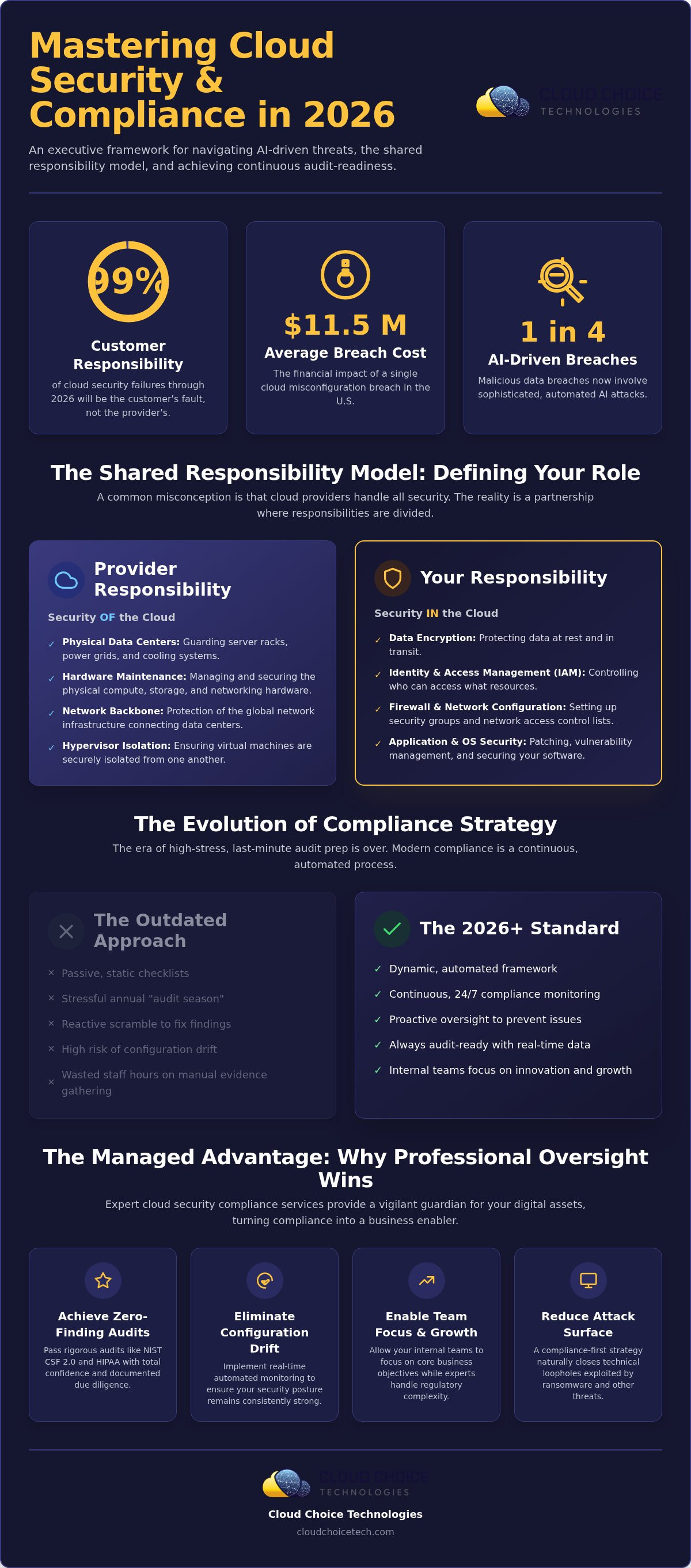
Did you know that through 2026, analysts predict 99% of cloud security failures will be the fault of the customer rather than the provider? This startling reality highlights the hidden risks within the shared responsibility model, where a single misconfiguration can lead to a breach costing an average of $11.5 million in the United States. You're likely feeling the pressure of a shifting landscape, from the rigorous "Govern" function of NIST CSF 2.0 to the finalized 2026 HIPAA Security Rule updates. It's natural to worry that your internal team can't keep pace with the speed of AI-driven threats while simultaneously satisfying meticulous auditors.
We understand the weight of this digital uncertainty, and we're here to provide the clarity you need. By leveraging expert cloud security compliance services, you can move from a reactive scramble to a state of continuous, automated oversight. This guide provides an executive framework to master 2026 regulations, protect your corporate data, and secure your digital future. We'll explore the latest shifts in global standards, the impact of AI on governance, and the exact steps required to achieve a zero-finding audit result with total confidence.
Key Takeaways
- Transition your strategy from passive checklists to a dynamic framework designed to neutralize 2026's most sophisticated AI-driven threats.
- Define the exact boundary of your security obligations to ensure you're protecting what's "in the cloud" while satisfying the latest NIST and ISO standards.
- Implement real-time automated monitoring through cloud security compliance services to eliminate configuration drift and ensure you're always audit-ready.
- Discover how professional oversight acts as a vigilant guardian, allowing your internal teams to focus on growth while experts handle regulatory complexity.
The Strategic Necessity of Cloud Security Compliance Services in 2026
Cloud security compliance isn't a static document buried in a drawer. It's a living framework of technical controls and policies designed to protect your most valuable digital assets. Understanding cloud security fundamentals is the first step toward establishing total control over your environment. In 2026, passive compliance is a dangerous liability. With one in four malicious data breaches now involving AI-driven attacks, simple annual checkups are no longer sufficient to protect your operations. You need managed cloud security services that operate with elite readiness and real-time oversight.
The era of the high-stress "audit season" has ended. Leading organizations have pivoted to a continuous compliance model that ensures infrastructure meets regulatory standards every hour of every day. By utilizing professional cloud security compliance services, you eliminate the gap between theoretical security policy and operational reality. This proactive stance provides immediate peace of mind, knowing that your systems are always aligned with the latest legal requirements. It's about foresight rather than reaction.
Why Compliance is Your Best Defense Against Downtime
Compliance isn't just about avoiding legal trouble; it's a blueprint for organizational resilience. There is a direct correlation between strict adherence to regulatory standards and a reduced attack surface for ransomware. When your systems align with rigorous frameworks, you close the technical loopholes that attackers exploit to disrupt your business. A compliance-first strategy naturally streamlines IT performance by removing redundant, insecure processes. Implementing regulatory compliance IT support doesn't just protect the network; it significantly reduces executive liability by proving documented due diligence.
The Cost of Non-Compliance: Beyond the Fines
Regulatory fines are only the tip of the iceberg. The real damage lies in the erosion of customer trust and the subsequent loss of market share that follows a public breach. A single failure can dismantle a reputation built over decades. Beyond the external fallout, consider the internal disruption. Preparing for an audit under duress wastes hundreds of staff hours and stalls vital innovation. We view compliance-as-a-service as a preventative business investment that safeguards your operational continuity. Professional cloud security compliance services ensure your team stays focused on growth while we handle the complexities of the digital world.
Understanding the Shared Responsibility Model and Frameworks
Who is truly responsible for your cloud data? It's a question that keeps many executives awake at night. A common misconception is that moving to a major provider like AWS or Azure offloads the entire security burden. That's a dangerous assumption. The "Shared Responsibility Model" is the foundational rule of the cloud. Your provider secures the "Cloud" itself, but you are solely responsible for everything you put "In the Cloud." Professional cloud security compliance services bridge this gap by ensuring your internal configurations are as robust as the provider's physical data center.
Misunderstanding this divide is a leading cause of accidental non-compliance. While the provider manages the hardware, your organization must manage the access. Utilizing cloud migration security services during your infrastructure transitions ensures these responsibilities are clearly mapped before you go live. It's about establishing a clear perimeter of accountability from day one.
CSP vs. Client: Who Owns What?
Cloud providers manage the heavy lifting of physical infrastructure. They guard the power grids, the cooling systems, and the physical server racks. However, your team must handle the "logical" layer. If a database is left unencrypted or an employee's credentials are stolen, the provider isn't liable. In 2026, the complexity of multi-cloud environments makes this distinction even more critical for your cloud security compliance services strategy.
- CSP Tasks: Physical security of data centers, hardware maintenance, network backbone, and hypervisor isolation.
- Client/MSP Tasks: Data encryption, identity and access management (IAM), firewall configuration, and endpoint security.
Navigating Global and Industry-Specific Standards
Frameworks have evolved rapidly to meet 2026 threats. The NIST Cybersecurity Framework 2.0 now includes a mandatory "Govern" function, demanding executive-level oversight of security strategies. ISO 27001:2022 has streamlined its controls to address modern cloud environments, while SOC 2 remains the gold standard for service organization trust. For healthcare, the finalized 2026 HIPAA Security Rule updates make encryption and multi-factor authentication non-negotiable safeguards.
If you're leveraging machine learning, integrating AI compliance and security into your framework is essential to manage the unique risks of algorithmic data processing. Organizations handling federal data must prioritize FedRAMP, while those with global customers must maintain strict data residency to satisfy GDPR and CCPA. If you're unsure where your provider's duty ends and yours begins, a specialized cyber risk analysis can provide the clarity you need to move forward with total confidence.
Best Practices for Maintaining Continuous Cloud Compliance
Static security checklists are a relic of the past. In 2026, the speed of cloud operations demands an "always-on" approach to regulatory adherence. Achieving this state of continuous compliance requires a shift from reactive patching to proactive governance. You must treat your cloud security compliance services as a central nervous system that monitors every change across your infrastructure. This begins with non-negotiable technical standards, such as universal encryption for data at rest and in transit. Under the finalized 2026 HIPAA Security Rule updates, these safeguards are no longer optional "addressable" items; they are mandatory requirements for protecting sensitive information.
Your identity perimeter is your first line of defense. Following the Cyber Essentials 3.3 "Danzell" update, multi-factor authentication (MFA) is now mandatory for every cloud service that supports it. We recommend conducting a comprehensive cyber risk analysis every quarter to identify new vulnerabilities before they can be exploited. This proactive rhythm ensures your organization remains ahead of the curve, rather than just keeping pace with it.
Automated Monitoring and Real-Time Remediation
Manual auditing is obsolete in a rapid-scaling cloud environment. When your infrastructure changes by the minute, a monthly report is already weeks out of date. Cloud Security Posture Management (CSPM) tools are essential for catching configuration drifts the moment they occur. These systems provide the visibility needed to maintain a "zero findings" audit status. While automation provides the vital data, expert human oversight provides the strategy necessary to interpret complex regulatory nuances. This combination creates a "calm in the storm" for executives who need to know their data is protected around the clock.
Incident Response and Documentation for Auditors
Auditors don't just want to know you're secure; they want proof. Maintaining a meticulous audit trail for every access request and system change is critical for a smooth review process. You should foster an "Audit-Ready" culture where documentation is an automated byproduct of your daily operations rather than a last-minute scramble. If a compliance event does occur, a dedicated rapid response team can mitigate damage and provide the forensic evidence required to satisfy regulators. This level of readiness reduces the burden on your internal staff and ensures that your business continuity remains uninterrupted even under scrutiny.
The Managed Advantage: Why Professional Oversight Wins in 2026
Your internal IT team is likely excellent at maintaining uptime and supporting your staff. However, expecting them to also master the intricate, shifting world of 2026 regulatory adherence is a high-risk strategy. Compliance isn't a side project; it's a full-time discipline that requires specialized knowledge and constant vigilance. Professional cloud security compliance services provide the dedicated expertise your organization needs to survive an era where 99% of failures are caused by customer misconfigurations. We act as the "calm in the storm," handling the technical complexities so you can focus on your core business objectives with total confidence.
Relying solely on generalist IT staff often leads to "compliance fatigue," where critical updates are missed because the team is overwhelmed by daily support tickets. By partnering with a dedicated provider, you ensure that security is never a secondary priority. We bring an authoritative, disciplined approach to your infrastructure, ensuring that every control is meticulously managed and documented. This isn't just about passing an audit; it's about establishing an elite level of readiness that protects your digital future.
Bridging the Cybersecurity Talent Gap
The national market for compliance-specialized IT professionals is tighter than ever. Finding, hiring, and retaining a single expert is expensive; building an entire internal department is often cost-prohibitive for most organizations. A managed service provider changes the equation. You gain immediate access to an elite team of guardians for a fraction of the cost of a full-time hire. While your internal staff goes home at the end of the day, our vigilant monitoring systems and expert analysts stay active 24/7. This ensures that configuration drifts or unauthorized access attempts are neutralized before they become headlines.
Future-Proofing with AI Compliance and Security
In 2026, you can't ignore the impact of artificial intelligence on your data perimeter. Cloud Choice Technologies integrates advanced AI safety measures directly into our standard cloud security compliance services. We don't just react to current laws; we maintain a proactive stance on emerging AI governance and regulatory shifts. This foresight ensures your infrastructure is ready for new requirements before they are even finalized. Don't leave your digital legacy to chance or an overwhelmed internal team. Secure your cloud future today and experience the peace of mind that comes with professional, unwavering protection.
Secure Your Strategic Advantage with Elite Compliance Oversight
In 2026, the margin for error in cloud environments has vanished. You've seen how the shared responsibility model places the burden of data protection squarely on your shoulders, and how manual audits fail to keep pace with AI-driven threats. Establishing a state of continuous compliance isn't just a regulatory requirement; it's a foundational pillar of your business continuity. By leveraging specialized cloud security compliance services, you replace digital uncertainty with the calm confidence of a vigilant guardian.
Don't let regulatory complexity stall your innovation or expose your organization to record-breaking breach costs. Our national managed IT expertise and dedicated AI security and compliance specialists are ready to implement a proactive risk analysis framework tailored to your unique needs. It's time to move beyond reactive patching and take total control of your infrastructure. Request Your Comprehensive Cloud Security Compliance Audit today to protect your data and satisfy auditors with ease. Your digital future is worth defending.
Frequently Asked Questions
What are cloud security compliance services?
Cloud security compliance services are specialized professional offerings that align your technical cloud infrastructure with specific legal and industry regulatory standards. These services provide a dynamic framework of policies and automated technical controls designed to protect sensitive data while satisfying the requirements of auditors. By utilizing professional oversight, your organization moves beyond basic security to a state of provable, documented adherence that stands up to rigorous scrutiny.
How does the Shared Responsibility Model affect my compliance status?
The Shared Responsibility Model dictates that while your cloud provider secures the underlying physical infrastructure, you are solely responsible for securing the data and configurations within that environment. Your compliance status depends entirely on how well you manage encryption, identity access, and endpoint security on your side of the divide. Because 99% of cloud failures through 2026 are projected to be the customer's fault, clear ownership of these tasks is vital for regulatory adherence.
Is cloud compliance different from general cybersecurity?
Yes, cloud compliance focuses on meeting specific legal requirements and proving that adherence to auditors, whereas general cybersecurity focuses on the technical defense against digital threats. While cybersecurity protects your network from intruders, compliance ensures that your protection methods meet the rigorous standards of frameworks like NIST CSF 2.0 or ISO 27001. Both are essential, but compliance provides the documented evidence of your due diligence and executive accountability.
Can cloud security compliance services help us pass a HIPAA or SOC 2 audit?
These services are specifically designed to help organizations achieve a "zero findings" result during complex HIPAA or SOC 2 audits. By implementing automated monitoring and maintaining meticulous audit trails, cloud security compliance services remove the stress of last-minute preparation. We ensure that every access request and configuration change is documented in real-time, providing the forensic evidence auditors require to verify your ongoing regulatory alignment.
How much do cloud security compliance services typically cost for a mid-sized business?
Pricing for these services is highly customized and depends on the complexity of your cloud environment and the specific regulations your industry must satisfy. We frame the cost as a strategic investment in risk reduction and operational continuity rather than a simple utility expense. Professional oversight typically costs significantly less than the record-breaking fines or reputational damage associated with a single non-compliance event or data breach in 2026.
What is continuous compliance monitoring and why is it necessary in 2026?
Continuous compliance monitoring is the real-time tracking of your cloud environment to detect and remediate configuration drifts the moment they happen. In 2026, this proactive approach is necessary because the speed of AI-driven attacks makes traditional point-in-time audits obsolete. You need constant visibility to ensure that your security posture remains unbroken as your infrastructure scales and your data processing requirements evolve to meet new AI governance standards.