
Managed IT Support: 2026 Executive Guide to Growth
What if your IT strategy wasn't just about preventing downtime, but about building the foundation for your company's AI future? You've likely felt the sting of unpredictable technology costs or the mounting pressure of rising cyber insurance premiums. It's exhausting to play catch-up with shifting compliance standards while worrying that your competitors are already mastering tools you haven't even vetted yet. You deserve a partner who acts as a vigilant guardian, not just a repairman. This is why managed IT support for business has evolved from a reactive help desk into a proactive, elite guardianship.
We'll show you how to transform your digital infrastructure into a secure, AI-ready engine that provides 24/7 technical peace of mind. By the end of this executive guide, you'll understand the shift toward automated regulatory compliance, predictable monthly spending, and the strategic oversight required to lead in a high-stakes digital economy. We'll break down how to stop treating IT as a cost center and start using it as a competitive advantage.
Key Takeaways
- Understand the shift from reactive repairs to an "always-on" guardianship model that ensures total operational continuity.
- Discover how modern managed IT support for business automates regulatory compliance and secures your foundation for future AI adoption.
- Learn to identify "elite readiness" in service providers to guarantee rapid technical intervention and predictable monthly spending.
- Transform your technology from a volatile cost center into a resilient engine designed for high-stakes business success.
What is Managed IT Support for Business in 2026?
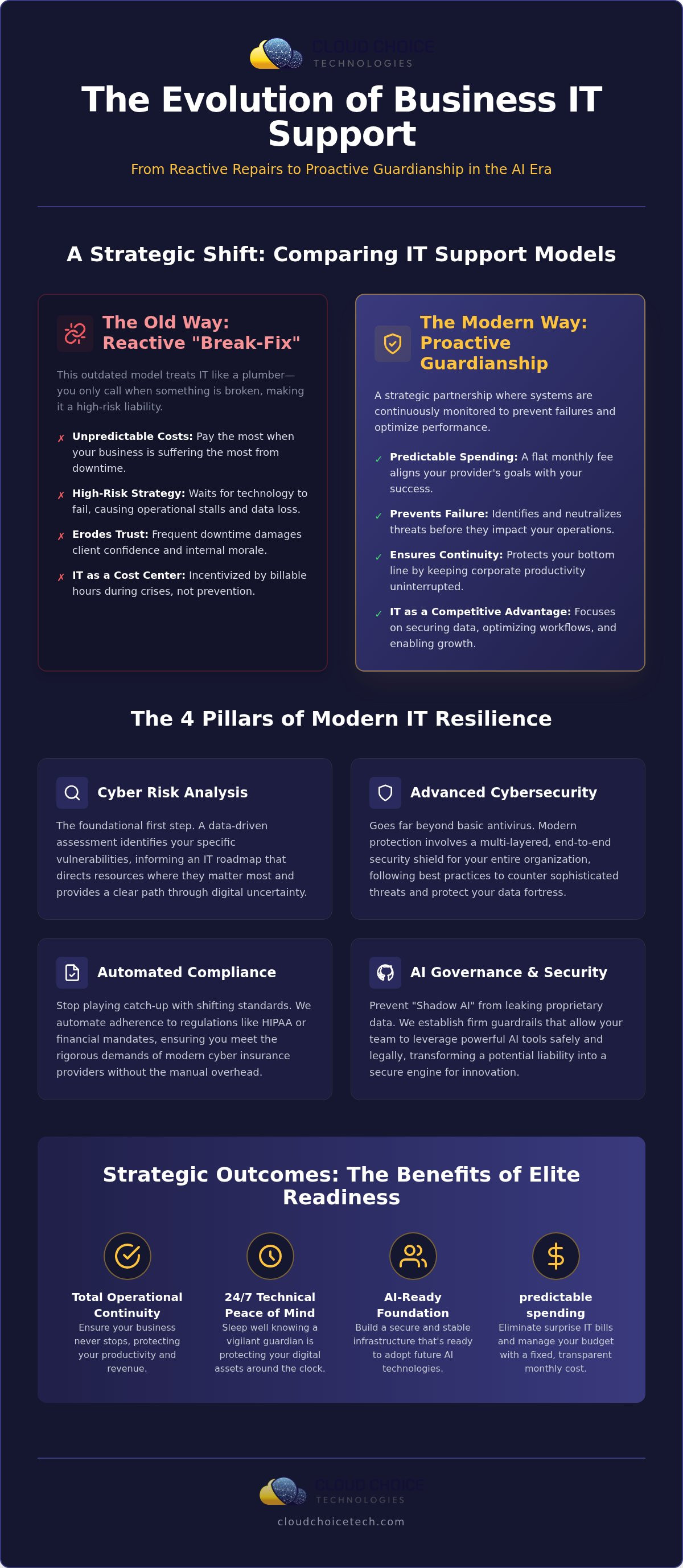
Managed IT support for business in 2026 isn't a utility. It's a strategic partnership. Historically, companies treated IT like a plumber; you called when the pipes burst. Today, that "break-fix" model is a liability. Modern businesses rely on an "always-on" guardianship where a Managed Service Provider (MSP) continuously monitors systems to prevent failure. This shift moves the focus from maintaining hardware to securing data and optimizing AI workflows. While internal IT staff provide valuable on-site presence, they represent fixed overhead. Managed services offer elastic scalability, giving you access to national-scale expertise without the burden of additional full-time salaries.
The Move from Reactive to Proactive Support
Waiting for technology to fail is a high-risk strategy. In 2026, downtime doesn't just stall work; it erodes client trust and compromises data integrity. Proactive monitoring identifies vulnerabilities before a user even notices a glitch. By the time a potential threat reaches your network perimeter, a vigilant partner has already neutralized it. This preventative approach protects your bottom line by ensuring that corporate productivity remains uninterrupted. It replaces the stress of digital uncertainty with a sense of being protected by a fast-acting partner who prioritizes your continuity.
Managed IT vs. Break-Fix: A Strategic Comparison
Choosing between managed services and the traditional break-fix approach often comes down to financial predictability. With the break-fix model, you pay the most when your business is suffering the most. Managed models flip this script. You pay a predictable monthly fee, aligning the provider's goals with your success. This ensures your partner is incentivized to keep your systems running perfectly, not just to bill hours when they fail. For a deeper look at the numbers, read our managed IT pricing vs break-fix executive cost-benefit analysis. Adopting managed IT support for business provides the stability needed to scale without the fear of hidden technical costs or sudden infrastructure collapses.
The Core Pillars of Modern Business IT Support
Reliable technology isn't just about uptime; it's about building a resilient fortress. Modern managed IT support for business rests on four critical pillars: cybersecurity, regulatory compliance, AI governance, and risk analysis. In 2026, basic antivirus is a relic of the past. You need end-to-end protection that follows cybersecurity best practices to shield your entire organization. This includes automating adherence to HIPAA or financial standards to meet the rigorous demands of modern cyber insurance providers. When these pillars are solid, your leadership team can focus on growth rather than disaster recovery.
Why Cyber Risk Analysis is the New Starting Point
Strategy shouldn't be based on guesswork. A modern risk assessment identifies your specific vulnerabilities before an attacker can exploit them. This data-driven approach informs your entire IT roadmap, ensuring resources are directed where they matter most. It identifies the "calm in the storm" by providing a clear path through digital uncertainty. If you're unsure where your gaps lie, understanding what is a cyber risk assessment is the first step toward total control. These insights provide the clarity needed to transition from a reactive posture to one of elite readiness. You can strengthen your security posture today by prioritizing this foundational analysis before threats materialize.
AI Governance and Security for 2026
AI adoption is moving faster than most security protocols. "Shadow AI" occurs when employees use unauthorized tools, inadvertently leaking proprietary corporate data into public models. This creates massive legal and security liabilities that can derail your growth. Managed IT support ensures your team uses AI safely and legally. We establish guardrails that protect your intellectual property while allowing your business to leverage these powerful tools. By securing your AI workflows, you transform a potential threat into a secure engine for business success. Our vigilant oversight prevents data leakage, keeping your sensitive information within your controlled environment. We handle the complexities of the digital world so you don't have to worry about accidental non-compliance.
Evaluating the Best Managed Service Providers
Selecting a partner to manage your infrastructure is a high-stakes decision that dictates your company's resilience. You need a guardian, not just a vendor. In 2026, the standard for excellence is "Elite Readiness." This means the provider must demonstrate the capability for rapid technical intervention at a moment's notice. Transparency is equally non-negotiable. You should receive regular performance reporting and strategic reviews that move beyond simple uptime metrics. Demand accessibility to human expert engineers. When a critical system fails or a security threat emerges, a chatbot is an unacceptable barrier. You deserve immediate access to a professional who understands the nuances of your business environment.
Vetting for National Scalability and Security
A national service model provides a level of threat intelligence that local boutiques simply cannot match. By monitoring networks across diverse industries and geographies, a larger provider identifies emerging attack patterns before they reach your perimeter. This scale is essential for maintaining true 24/7/365 remote support availability. If your team operates across multiple time zones, your technical support must be equally vigilant. Use this enterprise managed IT services checklist to verify if a potential partner has the depth and precision required to support your organizational complexity.
The Executive IT Support Checklist
Before finalizing any partnership for managed IT support for business, vet their AI security protocols specifically. Ask how they prevent sensitive corporate data from leaking into public AI models. Verify their credentials for regulatory compliance IT support; they must prove a deep understanding of the legal frameworks governing your specific industry. Finally, ensure they offer proactive network maintenance as a standard feature. If a provider's model relies on waiting for things to break, they aren't a partner; they're a liability. You can secure a vigilant IT partnership today to ensure your technology remains a secure engine for growth rather than a source of digital uncertainty.
Peace of Mind: The Cloud Choice Technologies Approach
At Cloud Choice Technologies, we function as the calm in the storm for corporate environments. We don't just fix problems; we eliminate the digital uncertainty that keeps executives awake at night. Our approach to managed IT support for business integrates cybersecurity into every layer of your infrastructure. This shift from technical debt to technical excellence ensures that your systems aren't just running, but are actively driving your success. We prioritize rapid remote support and specialized AI safety, providing the elite readiness required to handle high-stakes technical security with total control.
Vigilant Guardianship for Your Infrastructure
Our proactive remote monitoring and management (RMM) system acts as a silent, fast-acting partner. It detects anomalies in real time, allowing our engineers to intervene before a glitch becomes a crisis. This vigilance extends to your long-term strategy through our strategic cyber risk analysis. We use these data-driven insights to build a technology roadmap that anticipates regulatory shifts and emerging threats. Having a partner who looks around the corner gives you the professional confidence to scale without fear of hidden vulnerabilities or compliance failures.
Getting Started: Your Roadmap to Secure IT
The journey toward technical excellence begins with a comprehensive initial assessment. We identify immediate vulnerabilities and clear out existing technical debt to create a stable foundation. As your business grows nationally, our nationwide remote support capabilities scale alongside you. We ensure that every new office or remote workflow adheres to our rigorous standards for AI compliance and security. This methodical progression moves your organization from a reactive posture to one of unwavering reliability. For a complete breakdown of what to expect, explore our managed IT services executive guide. We handle the complexities so you can focus on leading your company into the future.
Secure Your Competitive Advantage for the AI Era
Transitioning to a proactive technology model is no longer optional for executives who prioritize growth. You've seen how modern managed IT support for business moves beyond simple repairs to provide specialized AI security and compliance frameworks. By choosing a partner with elite response times for remote support, you eliminate the stress of operational downtime. You gain a vigilant, fast-acting guardian that handles the complexities of the digital world so your leadership team doesn't have to.
Cloud Choice Technologies provides comprehensive nationwide IT guardianship designed to keep your infrastructure resilient. We ensure your data remains secure while your team leverages the latest AI tools safely and legally. It's time to stop treating technology as a cost center and start using it as a secure engine for business success. Secure your corporate infrastructure with Cloud Choice Technologies today and experience the peace of mind that comes from total technical control. Your future growth depends on a foundation of stability and precision. We're ready to protect your vision.
Frequently Asked Questions
What is the difference between managed IT and a standard help desk?
Managed IT is a proactive, strategic partnership, while a standard help desk is typically reactive and limited to troubleshooting existing issues. A help desk waits for you to report a problem. In contrast, managed IT support for business involves continuous monitoring and preventative maintenance to stop failures before they occur. This ensures your infrastructure remains resilient and aligned with your long-term growth objectives.
How does managed IT support for business improve cybersecurity?
It replaces basic antivirus with an end-to-end security framework that includes real-time threat detection and rapid intervention. By integrating cybersecurity into every layer of your network, a managed provider neutralizes vulnerabilities before attackers can exploit them. This vigilant guardianship includes regular risk analysis and automated patching. These proactive measures ensure your corporate data stays protected against evolving threats, providing immediate peace of mind for your leadership team.
Can managed IT services help our business with AI compliance?
Yes, modern providers offer specialized AI compliance and security to prevent data leakage and ensure legal tool usage. We establish strict guardrails that govern how your employees interact with AI models, protecting your proprietary intellectual property. This prevents "Shadow AI" from creating legal liabilities. By vetting every AI workflow against current regulatory standards, we transform these powerful tools into a secure, compliant engine for your business success.
Is managed IT support more cost-effective than hiring an in-house team?
Managed services provide a team of specialized engineers for a predictable monthly fee, eliminating the high overhead of multiple full-time salaries. Hiring an in-house team often means paying for limited skill sets and fixed benefits. A managed model offers elastic scalability and access to national-scale threat intelligence. You get elite technical readiness without the burden of training, equipment, or management costs associated with internal departments.
How does remote IT support work for a national company?
Remote support utilizes secure, high-speed management tools to monitor and repair systems across multiple geographic locations instantly. Our engineers access workstations and servers from a central hub, resolving most issues without needing an on-site visit. This ensures consistent service quality and rapid response times for every branch of your organization. It provides a unified technical standard across your entire national footprint, regardless of time zone or location.
What should be included in a standard managed IT service agreement?
A robust agreement must clearly define response time guarantees, cybersecurity protocols, and regular strategic reviews. It should outline the scope of proactive monitoring, data backup schedules, and regulatory compliance assistance. Look for transparency in performance reporting and a clear roadmap for infrastructure scaling. Most importantly, ensure the contract specifies access to human experts rather than just automated ticket systems, guaranteeing a partner who is accountable for your continuity.