
Data Breach Prevention Best Practices: The 2026 Corporate Security Checklist
When the average cost of a single security failure reaches $4.99 million, "good enough" security is no longer a viable business strategy. You likely feel the pressure of managing a landscape where one in four malicious breaches is now AI-enabled. It's overwhelming to balance complex regulatory requirements with the constant need for operational uptime. We understand the stress of digital uncertainty and the high stakes of protecting your brand reputation. This guide helps you master the essential data breach prevention best practices required to shield your organization from evolving threats.
You'll gain the technical and operational safeguards needed to ensure a rapid, compliant response if the unthinkable happens. We've broken down the 2026 corporate security checklist into actionable steps that replace fear with professional confidence. From AI-driven defense strategies to identity-centric perimeters, you're about to see exactly how to secure your assets and achieve lasting peace of mind. This is your roadmap to becoming the calm in the digital storm.
Key Takeaways
Transition to a proactive resilience model to address the 247-day average breach lifecycle and protect your organization's reputation.
Enforce technical non-negotiables like Multi-Factor Authentication and encryption to shield sensitive data at rest and in transit.
Master data breach prevention best practices by pairing sophisticated cyber risk analysis with continuous employee security training.
Establish a high-readiness response plan focused on rapid containment and forensic depth to ensure business continuity during a crisis.
Leverage AI-driven security frameworks to stay ahead of automated threats and meet the evolving regulatory demands of 2026.
Table of Contents
The High Stakes of Data Breach Prevention in 2026
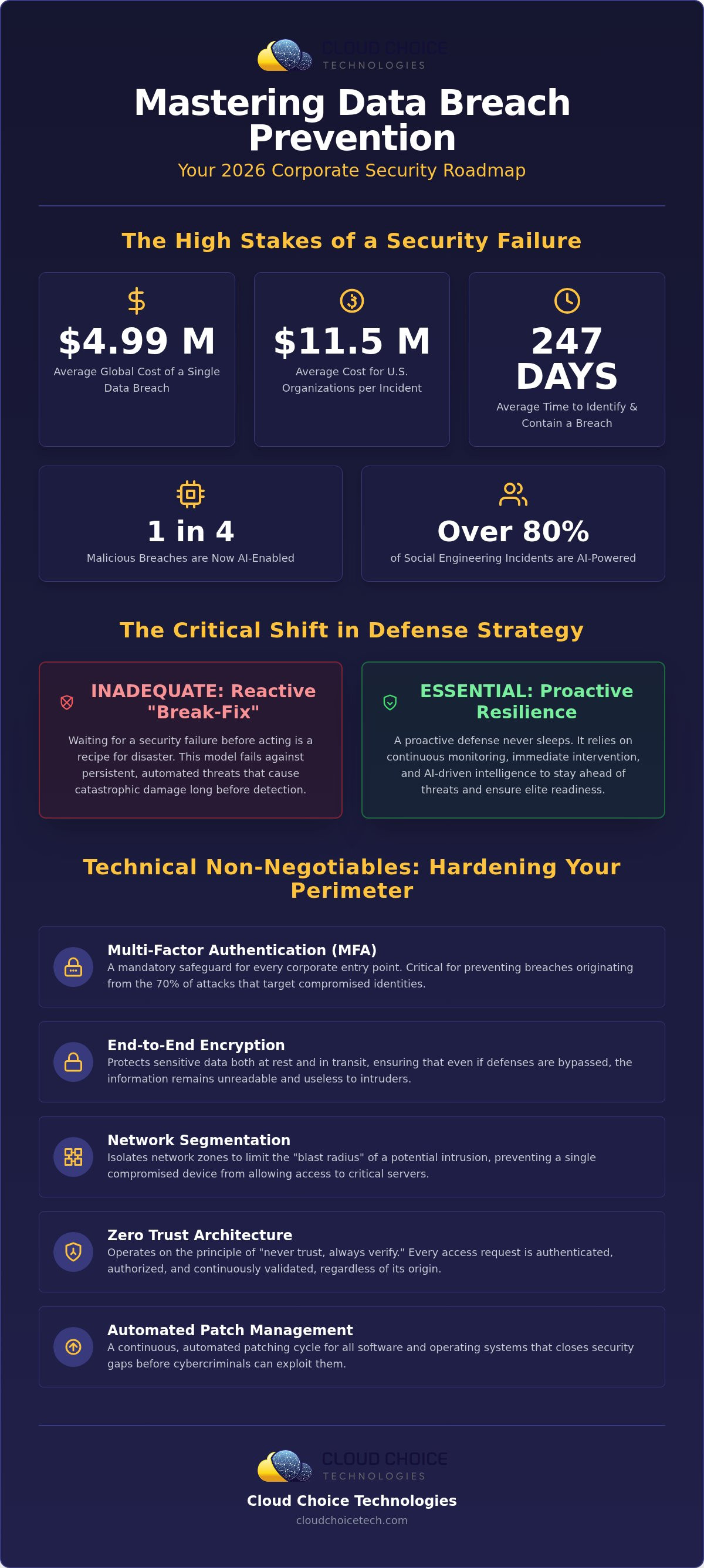
Data breach prevention is no longer a technical checkbox; it's a multi-layered business strategy. In 2026, the average time to identify and contain a breach has climbed to 247 days. This means an intruder could reside in your network for over eight months before detection. For a comprehensive overview of data breaches and their historical impact, one must look at how threats evolved from basic malware to sophisticated, AI-powered social engineering. These modern attacks now account for over 80% of social engineering incidents. Implementing data breach prevention best practices isn't just an IT task. It's a fundamental requirement for executive-level risk management that ensures your organization remains resilient against automated exploitation.
Understanding the Financial and Brand Impact
The true cost of a security failure extends far beyond the initial data loss. While the global average cost has reached $4.99 million, U.S. organizations face a staggering $11.5 million per incident. One slip costs millions. These figures include hidden drains like legal fees, regulatory fines under the SECURE Data Act 2026, and the devastating erosion of customer trust. Trust vanishes instantly. Operational downtime often proves more expensive than the data itself. When your systems halt, your revenue stops, but your overhead continues. Prioritizing prevention secures your long-term corporate stability and protects your hard-earned brand equity against the fallout of a public disclosure.
The Shift from Reactive to Proactive Defense
Waiting for something to break before fixing it is a recipe for disaster. The "break-fix" model fails because modern threats are persistent, automated, and capable of rapid lateral movement. Defense must be constant. You need a defense that never sleeps. Integrating robust business cybersecurity solutions ensures continuous monitoring and immediate intervention. This proactive approach relies on a vigilant, always-on security partner to handle the complexities of the digital landscape. By adopting these data breach prevention best practices, you replace digital uncertainty with the confidence of elite readiness. You aren't just reacting to the storm; you're staying ahead of it.
Technical Best Practices: Hardening Your Digital Perimeter
Technical resilience begins with identity. Since an estimated 70% of cloud breaches in 2026 originate from compromised identities, Multi-Factor Authentication (MFA) is no longer optional. It's a mandatory safeguard for every corporate entry point. You must also enforce end-to-end encryption for data both at rest and in transit. This ensures that even if an intruder bypasses your initial defenses, the information remains useless to them. These technical data breach prevention best practices form the core of a hardened digital perimeter. We've moved past the era where a simple firewall was enough to protect your assets.
Network segmentation is another critical layer for modern organizations. By dividing your network into isolated zones, you limit the "blast radius" of a potential intrusion. This prevents a single compromised device from allowing lateral access to your entire server farm. For a distributed workforce, rigorous endpoint protection is essential to maintain control over devices that operate outside the traditional office walls. You need total visibility into every laptop and mobile device that connects to your data.
Zero Trust Architecture as a Standard
Zero Trust moves away from the outdated idea of a "trusted" internal network. It operates on the principle of "never trust, always verify." Every access request is authenticated, authorized, and continuously validated regardless of where it originates. Robust Identity and Access Management (IAM) prevents unauthorized lateral movement, which is vital in an era where AI-powered attacks can mimic legitimate user behavior. Securing these remote connections often requires specialized remote IT support to ensure that every endpoint remains compliant with your security standards.
Automated Patch Management and Vulnerability Scanning
Unpatched vulnerabilities are a leading entry point for cybercriminals. You cannot rely on manual checks or annual audits to catch every flaw in your system. Modern data breach prevention best practices require a continuous, automated patching cycle for all software and operating systems. This proactive approach closes security gaps before hackers can exploit them. As noted in the FTC's data breach response guide, maintaining up-to-date software is a fundamental step in protecting consumer data. If managing these technical layers feels complex, partnering with an expert for cybersecurity services provides the elite oversight needed to keep your operations secure and stable.
Operational Best Practices: The Human and Process Element
Even the most advanced firewall can't stop a human error. You must establish a formal cyber risk analysis protocol to locate internal weak points before they're exploited. This proactive oversight is a cornerstone of data breach prevention best practices. It's about building a culture where security is everyone's responsibility. Regular security awareness training prepares your team to recognize sophisticated phishing attempts that bypass traditional filters. When your staff knows what to look for, they become your most effective defensive layer.
Planning is your greatest asset during a crisis. You should develop and test a comprehensive Incident Response Plan (IRP) at least once a year. This ensures every stakeholder knows their role when seconds count. Testing your plan through tabletop exercises reveals gaps in your communication and containment strategies. For a structured approach to these procedures, the U.S. Department of Education provides a Data Breach Response Checklist that outlines critical steps for containment and notification. Detailed preparation replaces panic with professional execution.
You can also significantly reduce your attack surface by implementing strict data lifecycle management. If you don't need the data, don't keep it. Deleting old records and minimizing data collection reduces the volume of sensitive information at risk. This directly lowers your potential legal liability and simplifies your compliance efforts. It's a simple, effective way to shrink the target on your organization's back.
Combating AI-Powered Social Engineering
Modern attackers use generative tools to create perfectly written, highly personalized emails. These AI-powered cyber threats make phishing harder to detect than ever before. Traditional red flags like poor grammar are vanishing. You must train employees to verify unusual requests through out-of-band communication, such as a quick phone call or a separate messaging platform. A "security-first" corporate culture encourages this skepticism, protecting your assets from even the most convincing deepfakes or spoofed messages.
Regulatory Compliance and Data Governance
Compliance isn't just about avoiding fines; it's about establishing rigorous standards for data handling. Aligning your IT infrastructure with frameworks like HIPAA, GDPR, or SOC2 creates a predictable, secure environment. Utilizing professional regulatory compliance IT support reduces audit stress and ensures your governance policies remain current with the latest 2026 standards. This alignment shields your brand from the legal fallout of a breach. If you're ready to identify your organization's hidden vulnerabilities, our team can perform a comprehensive cyber risk analysis to ensure you're fully protected.
Business Data Breach: Response Best Practices
Prevention and response are two sides of the same coin. Effective data breach prevention best practices must include a feedback loop that transforms every incident into a stronger defense. When a breach occurs, immediate containment is your priority. You must isolate affected systems to prevent the lateral spread of malware. A deep forensic investigation follows, identifying the source, scope, and duration of the intrusion. This clarity is essential for meeting the strict reporting timelines mandated by the SECURE Data Act 2026. Without a detailed record of the event, you risk heavy regulatory penalties and prolonged operational downtime.
A post-incident review is the final stage of a sophisticated defense cycle. You shouldn't just patch the hole and move on. Analyze the forensic data to understand exactly how the perimeter was breached. This allows you to update your prevention checklist based on real-world lessons. By integrating these findings into your long-term strategy, you ensure that the same vulnerability can't be exploited twice. This methodical approach turns a crisis into a catalyst for professional excellence and improved security standards.
The First 24 Hours: Critical Intervention Steps
Speed saves reputations. Within the first 24 hours, you must activate your Incident Response Team and secure all physical premises. Preserving digital evidence is vital for law enforcement and insurance claims. Don't touch files unnecessarily; you need a clean chain of custody for any future legal proceedings. Managing internal and external communications is equally critical. Transparent, professional messaging preserves brand reputation and prevents the spread of misinformation during a crisis. It's about maintaining control when the situation feels chaotic.
Leveraging Managed Services for Rapid Recovery
Recovery shouldn't be a manual struggle. Utilizing managed cloud security services facilitates faster backups and restoration through automated, off-site redundancies. Having a pre-vetted cybersecurity partner on retainer ensures you aren't searching for help while your systems are down. They provide the elite readiness required to transition from recovery back to a hardened state. This final step involves refining your data breach prevention best practices to address the specific threat encountered. You emerge from the incident more resilient, with a security posture that's better prepared for the evolving threats of 2026.
Securing Your Corporate Future in an AI-Driven Landscape
The digital landscape of 2026 demands more than just a passive defense. It requires a relentless commitment to identity security and continuous monitoring. You've seen how hardening your perimeter through Zero Trust and automating your patch management can neutralize threats before they escalate. By integrating these data breach prevention best practices into your operational DNA, you protect your revenue and your reputation simultaneously. Professional readiness is the only way to ensure lasting stability in a high-stakes environment.
True resilience comes from having a vigilant partner by your side. We provide the elite readiness and comprehensive regulatory compliance oversight needed to navigate today's complex security requirements. Don't wait for a vulnerability to become a crisis. Secure your enterprise with a professional cyber risk analysis from Cloud Choice Technologies. Our vigilant AI-driven security monitoring ensures you stay ahead of automated attacks while maintaining total control over your digital assets. You can move forward with confidence, knowing your organization is shielded by a fast-acting, professional guardian. Your operational continuity is our highest priority.
Frequently Asked Questions
What are the most common causes of data breaches in 2026?
Compromised identities and AI-powered social engineering are the primary drivers. Identity theft accounts for 70% of cloud breaches. Attackers use automated reconnaissance to find small gaps in your perimeter. Social engineering has evolved with deepfakes and perfectly written AI phishing emails. These methods often bypass traditional filters. Maintaining rigorous data breach prevention best practices requires addressing these human and technical vulnerabilities simultaneously to prevent unauthorized access.
How often should a business perform a cyber risk analysis?
You should perform a comprehensive cyber risk analysis at least annually or whenever significant changes occur in your IT infrastructure. New software deployments or shifts in remote work policies create fresh vulnerabilities. Waiting too long leaves you exposed to evolving threats like AI-enabled malware. Continuous monitoring is the modern standard. Regular assessments ensure your defense strategy remains aligned with current regulatory requirements and protects your operational continuity.
Is multi-factor authentication (MFA) enough to prevent a data breach?
No, Multi-Factor Authentication is a critical layer but not a complete solution. While it blocks most identity-based attacks, it doesn't stop sophisticated session hijacking or internal threats. You must pair MFA with Zero Trust architecture and end-to-end encryption. A multi-layered approach is the foundation of data breach prevention best practices. Relying on a single tool creates a false sense of security. True protection requires vigilant monitoring and proactive oversight.
What is the role of AI in modern data breach prevention?
AI serves as a vigilant, 24/7 guardian that processes vast amounts of network data to identify malicious patterns instantly. It automates the detection of anomalies that human analysts might miss. Today, 78% of organizations use AI in their cybersecurity efforts. These tools provide rapid intervention by isolating suspicious accounts before a breach can spread. AI-driven defense is essential to counter the increasing speed and scale of automated attacks.
How long does a business have to report a data breach to regulators?
Reporting timelines vary by jurisdiction, but new federal proposals like the SECURE Data Act 2026 emphasize rapid notification, often within 72 hours of discovery. State laws in places like Connecticut and New Jersey also have strict mandates. Failing to meet these deadlines leads to massive regulatory fines and legal liability. You must have a pre-vetted incident response plan. Quick reporting preserves your brand reputation and demonstrates compliance to oversight bodies.
Can a small business survive the average cost of a data breach?
Survival is difficult given that the global average cost of a breach has reached $4.99 million. For many small businesses, these financial losses and the resulting operational downtime are catastrophic. You don't just lose data; you lose customer trust and revenue. This is why proactive prevention is your most cost-effective strategy. Investing in managed security services provides elite protection at a fraction of the cost of a single security failure.