
Business Data Backup Solutions: The 2026 Executive Strategy for Resilience
What if your multi-million dollar backup infrastructure is actually just an expensive digital vault that refuses to open during a crisis? In 2026, the global average cost of a data breach has climbed to a record $4.99 million, yet many executives still struggle with a paralyzing recoverability gap. You likely feel the pressure of managing data across fragmented hybrid clouds while trying to satisfy the rigorous AES-256 requirements of the latest HIPAA Security Rule updates. It's a high-stakes environment where traditional safety nets often fail to catch the fall.
We understand that you need more than just storage; you need absolute certainty. This article reveals how to architect modern business data backup solutions that survive AI-powered threats and turn compliance into a strategic advantage. We'll provide a clear framework for evaluating vendors and aligning your IT security with regulatory oversight. You'll discover how to transition from a reactive posture to a state of elite readiness. This approach ensures your operations can resume in minutes, not days, after a failure.
Key Takeaways
- Understand why 2026 requires a shift from reactive copies to proactive resilience against AI-powered ransomware that targets your repositories first.
- Implement the evolved 3-2-1-1-0 Rule to ensure your business data backup solutions include immutable, air-gapped copies for absolute recovery certainty.
- Define precise Recovery Point and Recovery Time Objectives to guarantee operations resume in minutes; this prevents the devastating financial impact of prolonged downtime.
- Align your backup architecture with the latest regulatory standards, including the 2026 HIPAA updates and mandatory AES-256 encryption requirements.
- Learn why professional managed oversight is the critical link that prevents human error and ensures your last line of defense remains impenetrable.
The Evolution of Business Data Backup: Why 2026 Requires a New Approach
The days of treating backups as a passive insurance policy are over. In 2026, a simple copy of your data is no longer enough to protect your enterprise from sophisticated actors. Modern business data backup solutions must function as a proactive resilience strategy. This shift is driven by a harsh reality: AI-powered ransomware now specifically targets and deletes backup repositories before launching its primary encryption phase. Cyber Resilience is the ability to maintain operations during and after a sophisticated digital disruption. If your strategy doesn't account for these targeted strikes, you aren't protected; you're just waiting for the inevitable.
The High Cost of the "Recoverability Gap"
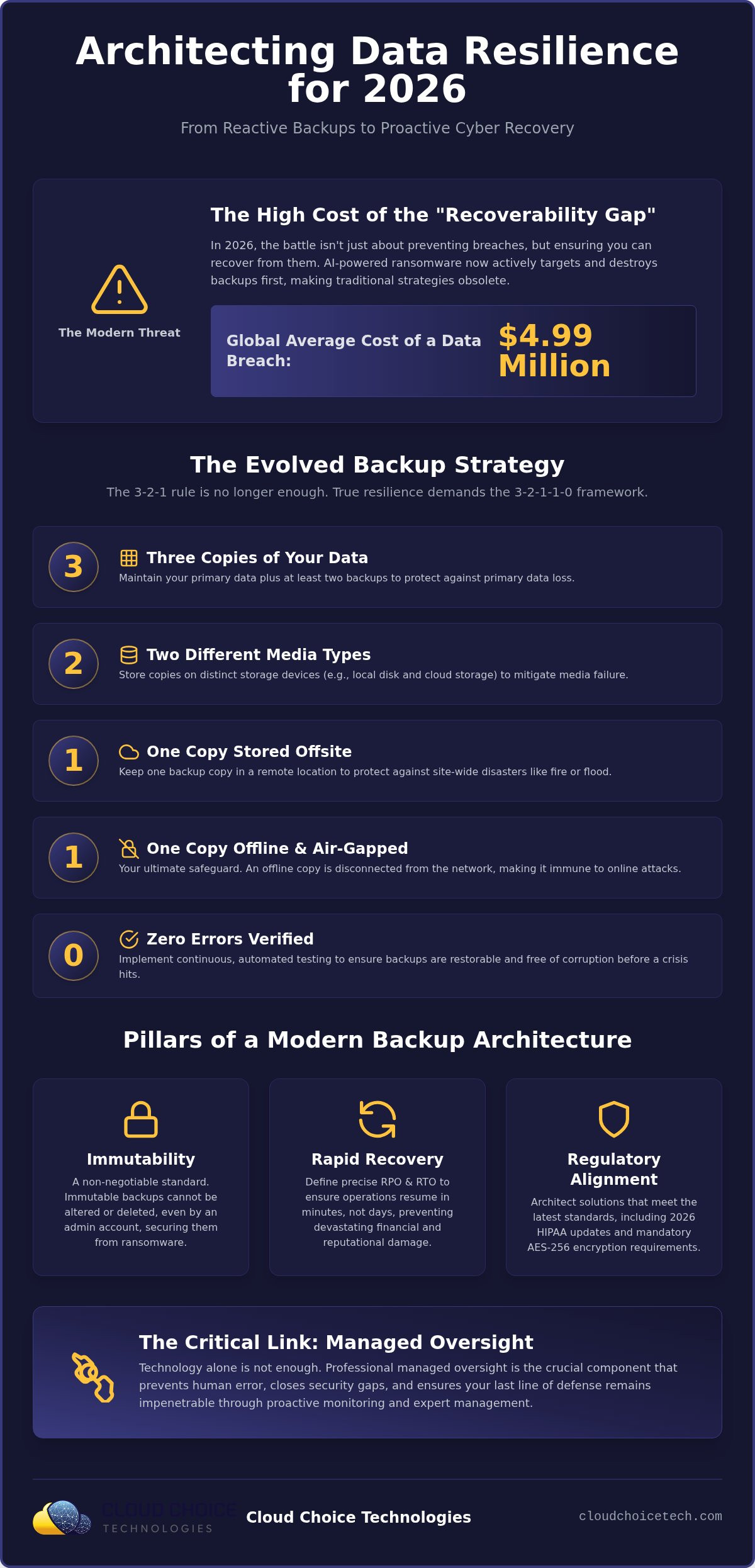
Many executives fall into the trap of the recoverability gap. This is the dangerous space between believing you have a backup and actually being able to restore it. According to 2026 data from Secureframe, 100% of technology companies experienced revenue losses from outages in the past year. These losses aren't just about missing files. They involve deep reputational damage, regulatory fines under updated compliance frameworks, and total operational paralysis. Manual backup checks are too slow and error-prone for this environment. You need automated, verified recovery that proves your data is ready for action before a crisis hits.
AI-Powered Threats and Your Data Integrity
Attackers now use machine learning to map your network and identify your most critical datasets with surgical precision. They look for your crown jewels and your backup admin credentials simultaneously. This is why immutability has become the non-negotiable standard for 2026. An immutable backup cannot be altered or deleted, even by an account with full administrative privileges. To achieve this level of protection, your backup infrastructure must be deeply integrated with your broader business cybersecurity solutions. This unified front ensures that your last line of defense is just as intelligent and vigilant as the threats it faces.
Architecting a Resilient Business Data Backup Strategy
The traditional 3-2-1 rule was once the gold standard, but in 2026, it is merely the bare minimum. True resilience now requires the evolved 3-2-1-1-0 framework. This strategy demands three copies of your data on two different media types, with one copy stored offsite and another kept completely offline or air-gapped. The final "0" represents zero errors, a standard that mandates automated, daily verification. Disaster Recovery as a Service (DRaaS) has become the backbone of this architecture, providing the automated failover needed to keep operations running during a site-wide failure. The cloud is not a backup strategy in itself; it is merely a destination that requires managed oversight.
The 3-2-1-1-0 Rule Explained
The "offline" or air-gapped copy is your ultimate safeguard against modern threats that linger in a network for weeks before striking. If an attacker cannot reach the data via any network connection, they cannot delete or encrypt it. Achieving "0 errors" requires more than just a green checkmark in a software dashboard. It involves continuous, automated testing to ensure the data is actually restorable and free of corruption. This level of precision is a fundamental component of managed cloud security services, where proactive monitoring replaces the dangerous "set it and forget it" mentality.
Cloud vs. Hybrid: Finding the Right Balance
Pure cloud business data backup solutions often face challenges with data sovereignty and the "egress trap," where high fees and latency slow down large-scale restores. Hybrid models provide a superior balance by keeping a local copy for near-instant Recovery Time Objectives (RTO) while duplicating that data to a secure cloud repository. You must align your storage choices with your cloud migration security services to ensure seamless protection during digital transitions. To determine which model best serves your regulatory requirements, a professional cyber risk analysis can identify vulnerabilities in your current storage architecture before they lead to an outage.
Critical Features to Evaluate in Modern Backup Solutions
Selecting business data backup solutions requires a move beyond checking boxes on a technical spec sheet. In 2026, the average cost of a data breach in the U.S. has reached $11.5 million; you cannot afford a recovery process based on guesswork. True resilience is built on specific, measurable features that guarantee data integrity. This includes granular recovery, which lets you restore a single corrupted file or executive email without the disruption of a full server rollback. It also requires sandboxed restoration, where backups are automatically booted in an isolated environment to verify they're functional and malware-free before you ever face a crisis.
Defining Your RPO and RTO Targets
Your strategy must start with a rigorous business impact analysis to define your Recovery Point Objective (RPO) and Recovery Time Objective (RTO). How much data loss is acceptable before your bottom line suffers? For mission-critical systems, your RPO should be measured in minutes. For operational data, a few hours might suffice. These metrics aren't just technical goals; they're the foundation of regulatory compliance IT support. Without defined targets, you can't prove to auditors or insurance providers that your business is capable of sustained operations during a disaster.
Compliance-Ready Backup Architectures
The 2026 regulatory landscape is more demanding than ever. New HIPAA Security Rule updates now make AES-256 encryption mandatory for all electronic protected health information at rest and in transit. Your backup architecture must automate this encryption while providing the audit-ready reporting required for SOC2 and GDPR adherence. Documentation must be precise, showing exactly when data was backed up, where it resides, and who has access. By leveraging cloud security compliance services, you can replace manual logging with automated oversight that satisfies even the most rigorous regulatory bodies. To ensure your current infrastructure meets these 2026 standards, contact our experts for a comprehensive compliance gap analysis today.
Why Managed IT is the Logical Conclusion for Data Protection
The "set it and forget it" mentality is a dangerous fallacy in 2026. Backup software is a tool, not a strategy. Without constant expert oversight, even the most expensive business data backup solutions eventually fail due to configuration drift, unpatched vulnerabilities, or human error. Real security requires a transition from the reactive "break-fix" mindset to a "responsive guardian" model. At Cloud Choice Technologies, we integrate data protection into a total managed IT services framework. This ensures your last line of defense isn't just a copy of your files, but a living, monitored shield that evolves alongside emerging threats.
Proactive Monitoring vs. Reactive Restoration
A 24/7 remote support team provides a level of vigilance that internal teams often can't sustain. We monitor backup success rates in real-time, catching a failed sync before it becomes a catastrophic data gap. AI-driven compliance tools further enhance this oversight by identifying critical datasets that aren't being backed up but should be. This proactive stance reduces the burden on your staff and ensures that your recoverability is never in question. By utilizing proactive cyber risk analysis, we often identify and neutralize vulnerabilities before a restore is even necessary.
The Executive Decision: Building a Resilient Future
Data backup is a foundational business strategy, not a line-item expense. In an era where ransomware is involved in 48% of all data breaches, your resilience is your reputation. The decision to move to a managed model provides the professional pride and accountability your operations deserve. It's time to stop worrying about digital uncertainty and start focusing on growth. We invite you to review your current posture with a comprehensive cyber risk analysis. This is the first step toward a fully managed, secure infrastructure that guarantees your business remains the calm in the storm.
Securing Your Digital Legacy in 2026
The high-stakes digital environment of 2026 allows no room for error. You've seen how AI-powered ransomware specifically targets your repositories; relying on unmanaged business data backup solutions is no longer a viable strategy for an executive who values operational continuity. By implementing the 3-2-1-1-0 framework and defining rigorous RPO/RTO targets, you move from a position of vulnerability to one of total control. This transition ensures that a digital disruption is merely a minor hurdle rather than a catastrophic event.
True resilience requires a vigilant partner who understands the complexities of modern compliance and security. It's time to bridge your recoverability gap with expert oversight. Secure your enterprise with Cloud Choice Technologies’ managed backup and cybersecurity solutions. Our team provides expert Cyber Risk Analysis to identify vulnerabilities before they become disasters. We maintain vigilant, 24/7 remote support and specialized AI compliance frameworks to protect your organization in the modern digital landscape. We handle the technical complexities so you can focus on leading your organization with unwavering confidence. Your path to absolute digital certainty starts today.
Frequently Asked Questions
What is the main difference between data backup and disaster recovery?
Data backup is the act of creating a copy of your files, while disaster recovery is the comprehensive plan and infrastructure used to restore your operations after a failure. Think of backup as the spare tire and disaster recovery as the roadside assistance team that gets you back on the road. In 2026, simply having the data isn't enough. You need the orchestration to resume business functions in minutes, not days.
How often should my business perform backup restoration tests?
You should perform automated verification daily and full-scale restoration tests at least quarterly. Modern business data backup solutions now feature automated sandboxing that boots backups every 24 hours to verify integrity. Relying on a "successful" status report without actual restoration testing is a major risk. Rigorous testing ensures that your RTO and RPO targets are realistic and achievable when a real emergency strikes.
Is cloud backup alone enough to protect against ransomware in 2026?
Cloud backup alone is insufficient because sophisticated ransomware can traverse network connections to encrypt cloud repositories. Additionally, the "egress trap" can make large-scale cloud restores prohibitively slow and expensive during a crisis. A resilient strategy requires an air-gapped or immutable copy that remains disconnected from your primary network. This multi-layered approach ensures you have a clean, unchangeable recovery point even if your primary cloud account is compromised.
What are the specific backup requirements for HIPAA compliance?
As of May 2026, HIPAA requires AES-256 encryption for all ePHI at rest and in transit using TLS 1.2 or higher. You must also implement multi-factor authentication for all systems accessing these backups. Beyond encryption, you're required to maintain a documented contingency plan that includes data prioritization and frequent testing. Failing to meet these specific technical standards can result in significant regulatory fines and operational liability.
How does AI impact the security of my business data backups?
AI serves as both a threat and a guardian. Attackers use machine learning to identify and delete backup repositories before launching ransomware. Conversely, elite business data backup solutions use AI to monitor for anomalies, such as unusual encryption patterns or unauthorized access attempts. This proactive detection allows your security team to neutralize threats before they reach your core datasets, significantly reducing the likelihood of a total system failure.
What is immutable storage and why does my business need it?
Immutable storage is a data security feature that prevents files from being altered or deleted for a set period. Even an administrator with full credentials cannot bypass these restrictions. Your business needs this because modern ransomware specifically targets backup deletions to force payment. By making your data immutable, you guarantee that a "gold copy" of your environment remains available for recovery, regardless of the attacker's level of access.