Which Laws Shape IT Compliance for Financial Institutions?
One federal rulebook doesn’t cover every financial institution. The IT compliance requirements for financial institutions depend on the institution’s activities, the customer information it handles, and the states where it does business. Federal requirements include the Gramm-Leach-Bliley Act (GLBA), which requires financial services firms to protect customer information and provide privacy notices, while payment card data can bring the Payment Card Industry Data Security Standard (PCI-DSS) into scope.
It’s also important to consider who oversees the institution and which services it provides. Non-bank financial institutions covered by the FTC Safeguards Rule have cybersecurity obligations, and state privacy and breach notification laws may add requirements when an institution serves residents in those states. This article explains what financial services compliance means, how federal laws shape it, and why state rules matter when customer data is exposed. It also shows how institution type, payment processing, and geographic reach affect which requirements apply, making the regulatory picture clearer and easier to manage.
Key Takeaways
- Compliance duties vary by institution type, business activities, customer data, and the states served.
- Understand how safety-and-soundness standards connect internal controls, information systems, record retention, and service-provider oversight.
- Federal laws address different risks, from customer data protection and financial reporting to anti-money-laundering controls and securities conduct.
- State privacy and breach notification laws may add obligations when an institution serves customers across state lines.
- Managed IT, cybersecurity, and cyber risk analysis can help strengthen the technology controls that support compliance.
What Is Financial Services Compliance?
Financial services compliance means meeting the laws, regulations, and standards that govern an institution’s operations, customer information, and technology. IT compliance requirements for financial institutions vary according to their activities, oversight, and the data they handle.
Preparedness and Risk Assessment
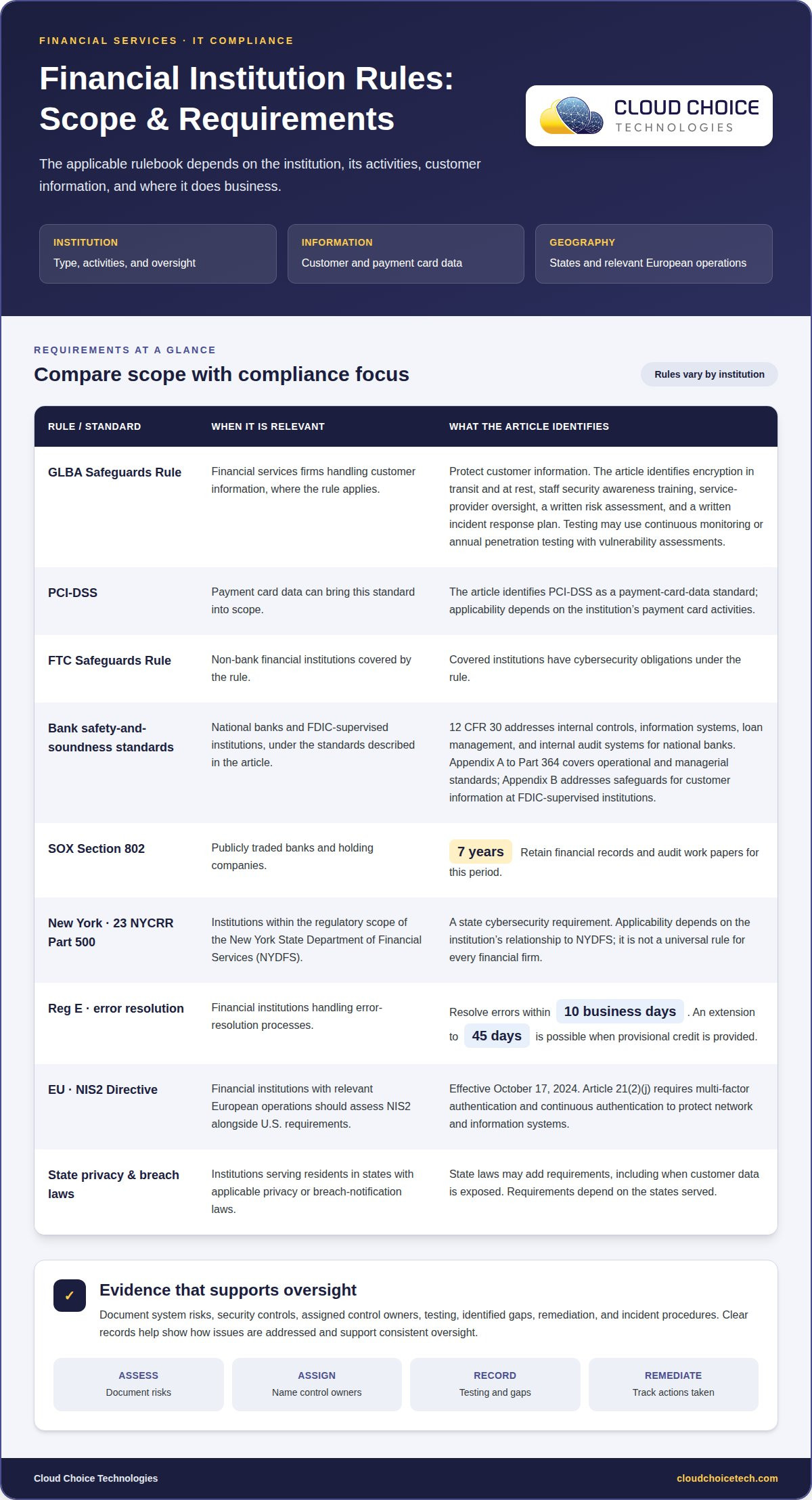
A cybersecurity risk assessment identifies threats to systems and customer information, then evaluates how existing controls address them. It matters because an unaddressed vulnerability can disrupt financial services or expose sensitive records. The GLBA Safeguards Rule calls for a written risk assessment, continuous monitoring or annual penetration testing with vulnerability assessments, and a written incident response plan.
For IT audits, institutions need documented risk assessments and security controls, as well as evidence that identified issues are addressed. Under the GLBA Safeguards Rule, annual penetration testing with vulnerability assessments is an alternative to continuous monitoring. Smaller firms may have fewer resources for oversight, making clear policies, assigned responsibilities, and documented remediation especially important.
Customer Data Protection
Protecting customer data requires technical safeguards and operating policies to prevent unauthorized access, disclosure, or loss. The GLBA Safeguards Rule calls for encryption of customer information in transit and at rest, staff security awareness training, and service-provider oversight. Together, these measures help protect customer records across the systems and relationships an institution relies on.
Preparedness also requires a written incident response plan with defined responsibilities. If an incident affects customer information, the plan helps teams coordinate their response and follow applicable notification requirements. Strong access controls and evidence of ongoing oversight make it easier to demonstrate how customer data is protected.
State Rules, Testing, and Error Resolution
New York’s cybersecurity regulation, codified as 23 NYCRR Part 500, is overseen by the New York State Department of Financial Services. For institutions within its regulatory scope, Part 500 is a state cybersecurity compliance requirement. Applicability depends on the institution’s relationship to NYDFS, so the regulation is not a universal rule for every financial firm.
Reg E requires financial institutions to resolve errors within 10 business days, according to the Consumer Financial Protection Bureau. An extension to 45 days is possible when provisional credit is provided. This makes error-resolution processes and supporting records part of operational compliance, not only customer service.
NIS2 and Smaller-Firm Preparedness
Financial institutions with relevant European operations should also assess NIS2 alongside U.S. requirements. The EU’s NIS2 Directive became effective on October 17, 2024. Article 21(2)(j) requires multi-factor authentication and continuous authentication to protect network and information systems. Institutions should include cybersecurity and incident reporting responsibilities in their compliance planning.
Smaller firms can make preparedness more manageable by documenting system risks, assigning control owners, and recording remediation. Keeping records of testing, identified gaps, and incident procedures supports consistent oversight when regulators examine cybersecurity practices.
What is Regulatory Compliance for Banks?
Bank regulatory compliance connects financial rules to operational controls, technology systems, records, and oversight. Safety-and-soundness standards help examiners assess whether those controls support reliable operations and sound risk management.
Safety, Soundness, and Internal Controls
Safety-and-soundness standards set expectations for controls that support reliable banking operations and information systems. Under 12 CFR 30, national-bank standards address internal controls, information systems, loan management, and internal audit systems. At FDIC-supervised institutions, Appendix A to Part 364 covers operational and managerial standards, including internal controls and information systems. Appendix B to Part 364 addresses safeguards for customer information. Together, these requirements connect technology oversight with institutional risk.
Retention and Audit Controls
Microsoft Purview can help organize retention policies and audit records across supported Microsoft environments. Retention settings can preserve or dispose of content according to an institution’s records schedule, while audit tools help locate recorded user and administrator activity. For publicly traded banks and holding companies, SOX Section 802 requires retaining financial records and audit work papers for 7 years. The system’s settings should align with applicable retention rules and record types.
Compliance Risk Assessments
A compliance risk assessment identifies where a bank’s processes, systems, or vendors could fail to meet applicable requirements. The FDIC’s Information Technology Risk Examination Program, known as InTREx, outlines risk-focused procedures for examining IT and cybersecurity risks. Banks and credit unions are also examined using FFIEC guidance and their primary regulators’ requirements. Documenting risks, control owners, remediation, and reporting gives management a clear view of unresolved exposure.
Access Controls and Data Safeguards
Access controls limit system and customer-data access to authorized users, while authentication helps verify identity. Financial institutions should use effective authentication and access risk-management practices for institutional systems and digital banking. Multi-factor authentication adds a verification step, while encryption helps protect information from unauthorized disclosure. Controls should reflect system sensitivity, user roles, and the customer information each system handles.
Technology service-provider contracts should clearly document security responsibilities, access limits, incident escalation, and the evidence a vendor must provide. Risk-based third-party management helps institutions assess and oversee provider relationships instead of treating outsourced technology as outside their control. The Bank Service Company Act requires notifying the FDIC within 30 days of certain defined third-party service relationships. Contract records help support that oversight and reporting.
Federal financial regulations, including GLBA, SOX, BSA/AML, and Dodd-Frank
Federal requirements comprise overlapping frameworks, not a single technology standard. GLBA, SOX, BSA/AML, and Dodd-Frank remain relevant parts of the broader landscape. Other federal rules may apply depending on securities activity, public-company status, foreign business dealings, or a bank’s community role. Mapping the institution’s activities to each framework helps clarify which obligations require technology-supported processes.
Public-company cybersecurity disclosures add a distinct reporting consideration. Cybersecurity disclosure obligations may be relevant to some institutions, so compliance planning should connect cybersecurity information with the disclosure process. For an affected institution, compliance planning should connect cybersecurity information with its disclosure process. Clear responsibility for collecting and reviewing relevant information can help avoid gaps between security oversight and corporate reporting.
The Foreign Corrupt Practices Act (FCPA) prohibits bribery of foreign officials and requires accurate books and records. Financial institutions with relevant international activity should account for these requirements in their governance and recordkeeping processes. IT compliance requirements for financial institutions can therefore extend beyond system security, linking technology-supported financial records to controls against improper payments and inaccurate reporting.
The Community Reinvestment Act (CRA) concerns banks’ obligations to serve underserved communities. Banks receive a CRA score on a four-point scale, providing a measure tied to their community reinvestment responsibilities. Technology and reporting processes that support relevant records can help keep these activities organized for internal review.
Investment firms and registered investment advisers also have recurring filing responsibilities. The framework cited in this article identifies Form ADV updates twice annually. That cadence makes clear ownership of filing information and supporting records important to compliance operations. Firms can align internal reporting calendars with the personnel responsible for maintaining accurate information.
These examples show why a single federal checklist can miss requirements triggered by a firm’s structure or activities. One institution may need to connect public-company disclosures with cybersecurity information, while another may focus on foreign business records or community responsibilities. A useful compliance map links each applicable framework to the relevant business activity, responsible team, and supporting records.
IT compliance requirements for financial institutions should therefore be assessed as connected obligations, not isolated technology tasks. Their scope depends on the institution’s legal status and operations. Clear ownership helps leadership identify which processes support each applicable federal framework and where documentation must be maintained.
State data protection and breach notification laws
State privacy and breach notification laws can add obligations beyond federal rules, especially for financial firms serving customers across state lines. A single incident may involve records connected to several states, so response processes need to account for different notification requirements. The institution’s location alone may not determine which state laws apply; customer residence and the information involved can also shape the analysis.
California’s CCPA/CPRA may apply to companies doing business with California residents when gross annual revenue exceeds $25 million, or when at least 50% of annual revenue comes from selling or sharing consumers’ personal information. The CCPA also applies to entities processing personal information of 50,000 or more people annually. It gives consumers the ability to opt out of the sale of their personal information. These thresholds make data volume, revenue, and business practices relevant to compliance planning.
State breach laws establish notification duties when certain personal information is compromised. Michigan’s Identity Theft Protection Act, for example, requires notification in specified circumstances. A practical response process identifies the affected data, determines which state laws may apply, preserves incident records, and coordinates notification decisions. Clear ownership helps institutions respond consistently when an incident involves customers in multiple jurisdictions.
For firms handling European customer data, the General Data Protection Regulation (GDPR) governs how that information is handled. GDPR also requires timely reporting of breaches affecting EU citizens. Its data protection framework makes disciplined data handling and clear accountability essential to operations. Financial firms serving customers in both the United States and Europe may need processes that account for GDPR and relevant U.S. state requirements.
GLBA provides a federal customer-data protection framework for financial services firms. It requires protection of customer information and privacy notices, while its Safeguards Rule addresses security controls. State privacy laws can add separate obligations, so customer-data processes should connect access, use, retention, and incident response to the institution’s applicable rules.
Consumer protection requirements also affect financial operations. The Fair Credit Reporting Act governs credit reporting, while the Equal Credit Opportunity Act addresses credit discrimination. The Electronic Fund Transfer Act, Truth in Savings Act, and rules on Unfair, Deceptive, and Abusive Acts and Practices add further consumer safeguards. Together, these requirements show why a single security standard cannot replace a coordinated compliance process.
Cloud Choice Technologies
Cloud Choice Technologies helps financial institutions strengthen the technology controls that support regulatory compliance. Its services are a fit when internal teams need clearer system oversight, practical cybersecurity support, or help identifying technology risks. The focus is on connecting regulatory concerns with safeguards and operating processes that protect business information.
For institutions managing day-to-day technology alongside compliance demands, Managed IT Services can support the consistent operation and oversight of business systems. Remote Support helps address technology issues as they arise, while cybersecurity work focuses on reducing exposure across systems and information. These services can help organizations maintain a more structured approach to technology responsibilities.
A cybersecurity assessment can help clarify where security controls need attention. This is useful when systems, access practices, or third-party relationships have changed, or when leadership needs a clearer view of cyber risks. Cyber Risk Analysis can help identify and assess technology-related exposures, giving decision-makers a practical basis for prioritizing work.
Compliance needs differ across banks, credit unions, and other financial firms. The relevant rules depend on activities, customer information, and applicable regulators. Cloud Choice Technologies helps connect those obligations to technology controls, risk findings, and security practices. This support can help internal teams understand how technical safeguards fit into a broader compliance program, without treating a tool or policy as a substitute for regulatory judgment.
Institutions may also need to review how their systems support access controls, monitoring, records, and incident response. Cloud Choice Technologies’ Cybersecurity and Remote Support services address technology concerns, while Managed IT Services support ongoing system oversight. When the main need is understanding exposure, Cyber Risk Analysis helps frame risks for informed planning. The next step depends on the institution’s priorities, systems, and current control environment.
For financial organizations seeking practical support with IT and cybersecurity risks, contact Cloud Choice Technologies to discuss your needs.
Frequently Asked Questions
Which U.S. laws and regulations set IT compliance requirements for financial institutions?
Applicable laws depend on the institution’s activities, structure, customers, and regulators. Federal frameworks include GLBA, the Bank Secrecy Act, SOX for publicly traded companies, and Dodd-Frank. Payment card processing can bring PCI DSS into scope, while securities firms face rules under the Securities Exchange Act and Regulation S-P. State privacy and breach notification laws may also apply based on customers’ residence and the information involved.
What cybersecurity requirements do GLBA and the FTC Safeguards Rule impose on financial institutions?
GLBA’s Safeguards Rule centers on a written information security program, risk assessment, safeguards, and oversight. For example, a firm can link risk findings to named control owners, staff training, and documented remediation. The FTC enforces the Safeguards Rule for many non-bank financial companies. Covered institutions should map each safeguard to the information and systems it protects, then preserve evidence for oversight and examination.
What are the FFIEC cybersecurity and IT examination requirements for banks and credit unions?
Banks and credit unions are examined using FFIEC guidance and requirements from their primary regulators. Examiners assess how technology creates or affects institutional risk, including the strength of controls and management oversight. The Uniform Rating System for Information Technology helps federal and state regulators assess IT risks at institutions and service providers. Preparing for examination includes organizing evidence of governance, risk decisions, control operation, and remediation.
What incident reporting deadlines apply to banks, credit unions, and other financial institutions?
Reporting duties depend on the event and the institution’s regulator. The Bank Service Company Act requires notification to the FDIC within 30 days of certain defined third-party service relationships. A separate computer-security incident rule requires banking organizations and bank service providers to notify regulators about significant incidents. Credit unions also have NCUA incident-reporting requirements. Institutions should maintain an incident process that identifies the applicable reporting trigger and responsible authority.
What data protection, encryption, access control, and retention requirements apply to financial institutions?
Safeguards vary by institution and record type. GLBA standards address protecting customer information, including encryption in transit and at rest; access should be managed according to user roles and system sensitivity. Credit unions must retain security-program records and incident reports for five years under NCUA Part 748. A retention schedule should distinguish those records from financial, transaction, and audit documents governed by other requirements.
What third-party risk management and vendor oversight requirements apply to financial institutions?
Institutions should identify, assess, and mitigate cybersecurity risks involving critical third-party service providers. For example, oversight can link a vendor’s system access to the services it performs, documented security responsibilities, and incident escalation processes. The Bank Service Company Act may also require FDIC notification for certain service relationships. Keep vendor inventories, risk decisions, contract responsibilities, and monitoring records together so management can review each relationship over time.