
What Cyber Insurance Underwriters Look For in Your Business
A cyber insurance application is a risk assessment, not just paperwork. Underwriters consider your company’s operations, industry, revenue, the amount and type of data it handles, and the safeguards in place. The application helps reveal what cyber insurance underwriters look for: evidence that you understand your exposure and can limit the impact of an incident.
It’s reasonable to expect a form and a quote, but the review can go deeper, examining how your business protects its systems and prepares to recover. Backups, access controls, security monitoring, and an incident response plan all help show how your organization manages cyber risk.
This article explains how underwriting works and what to prepare. You’ll learn how underwriters assess backups and recovery readiness, evaluate company and data details, and review security measures, giving you a clearer picture of what matters.
Key Takeaways
- Underwriting combines a review of your business exposure with an assessment of how well your security controls work together.
- Prepare to explain how your backups are protected and how your organization would restore systems after an incident.
- Clear records of your operations, technology, and the sensitive data you handle can make application responses more consistent.
- Access controls, security monitoring, system vulnerabilities, and incident response readiness can all shape an underwriter’s view of risk.
- Use the application process to identify security gaps and prioritize practical improvements before submitting your information.
1. What is Cyber Insurance Underwriting?
Cyber insurance underwriting is the review insurers conduct to assess an organization’s cyber exposure before offering coverage. The process combines business information, security questionnaires, and technical signals. Underwriters consider how the company operates, its industry and annual revenue, and the sensitive records it handles. They use this risk profile to evaluate potential losses and policy terms.
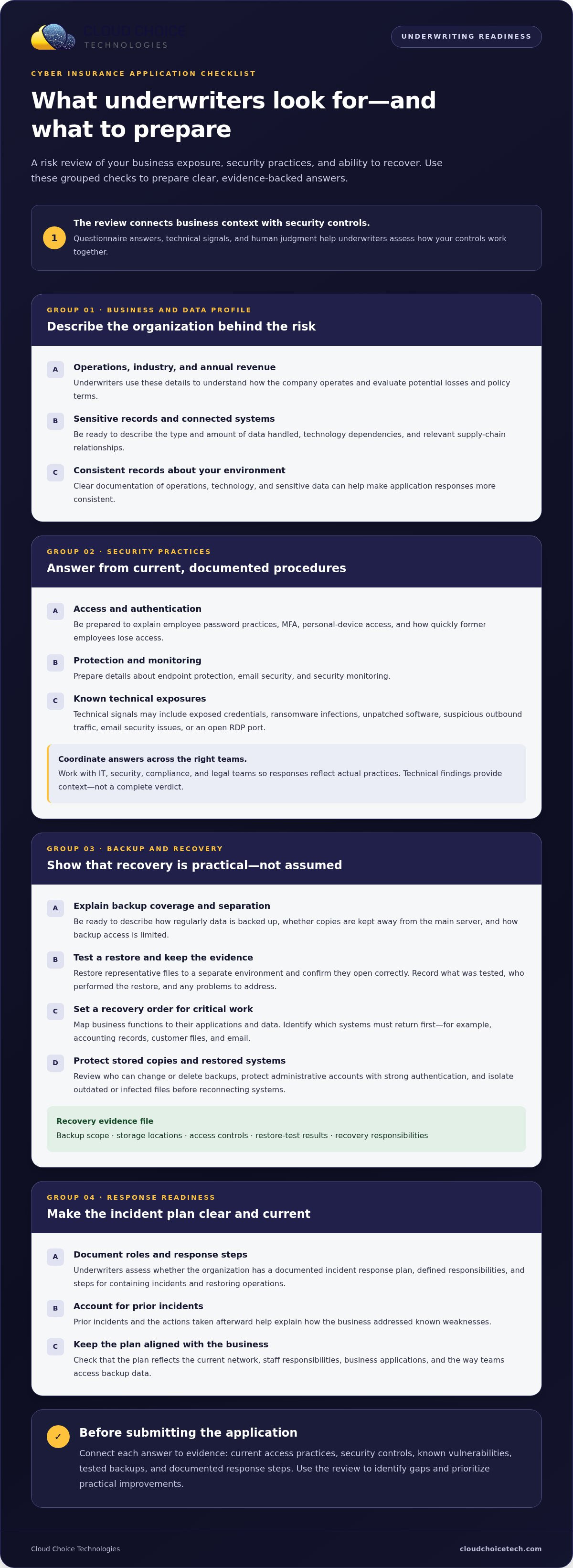
Questionnaires turn security practices into specific questions. An application may ask how employees use passwords, whether personal devices connect to work systems, and how quickly former employees lose access. It may also request details about MFA, endpoint protection, email security, and incident response. Prepare answers with the teams responsible for IT, security, compliance, and legal matters so responses reflect actual procedures.
Underwriting technology can analyze security data, identify exposures, and help compare an organization with others in its sector. Signals may include exposed credentials, ransomware infections, unpatched software, suspicious outbound traffic, email security issues, or an open RDP port. These findings provide context, not a complete verdict. Underwriters also use human judgment to assess how controls work together.
Benchmarking helps insurers judge whether a company’s risks, mitigation measures, and response plans align with those of similar businesses and industry standards. For example, a technology provider in a data-heavy sector may face different exposure than a company with fewer connected systems. Comparisons can also surface supply-chain dependencies, including reliance on cloud, financial technology, or IT governance providers.
How do requirements differ for small businesses and large companies? The core review areas are similar, but the organization’s operations, industry, revenue, technology dependencies, and volume of sensitive records shape the assessment. A larger company may have more complex systems and data flows to document; a smaller company still needs clear answers about its controls and practices.
What are typical U.S. coverage limits, deductibles, and prices? Limits and deductibles depend on an organization’s exposure, data, operations, and security measures. Prices vary by case, and a quote request is needed to get a price. Factors such as revenue, record count, industry, and controls can shape the quote.
What incident response plans and breach history do underwriters review? They assess whether the organization has a documented response plan, defined responsibilities, and steps for containing incidents and restoring operations. Prior incidents and the actions taken afterward help explain how the business addressed known weaknesses.
What exclusions or coverage restrictions may apply? Policy wording determines whether ransomware payments are covered, and state-sponsored cyberattacks may be excluded. Read the specific terms carefully, because coverage depends on the wording and restrictions in the policy offered.
To understand what cyber insurance underwriters look for, connect each questionnaire answer to evidence: current access practices, security controls, known vulnerabilities, and documented response steps. Clear, consistent records help explain how your organization manages risk. Unaddressed exposures can affect the quote or whether coverage is offered.
2. Backup testing and recovery readiness
Backups matter because an attack can encrypt or erase files across a connected network. Underwriters may ask whether the organization backs up data regularly, keeps backup copies away from its main server, and maintains a cyber disaster recovery plan. These details show whether recovery depends on the same computer systems an attacker could compromise.
A backup is useful only if the business can restore usable information. Test the process by selecting representative files, restoring them to a separate environment, and confirming they open correctly. For example, restore a financial spreadsheet and a shared customer document. Record what was tested, who performed the restore, and any problems to address.
Recovery readiness also means knowing which systems must return first. Map critical business functions to the applications and data they rely on. A company might prioritize access to accounting records, customer files, and email before restoring less urgent systems. Setting this practical order helps teams make decisions when the main network is unavailable.
Separate backup copies from everyday access wherever possible. If the same administrator credentials control both production systems and backups, stolen credentials could expose both. Limit backup access, protect administrative accounts with strong authentication, and review who can change or delete stored copies. These controls help reduce the chance that one compromised account disables recovery.
Handle confidential data carefully in recovery plans. Identify which backup sets contain sensitive records, restrict access to those sets, and document where they are stored. If a restore brings back outdated or infected files, the incident response team needs a process to isolate them before reconnecting systems. Clear responsibilities help prevent a recovery step from reopening the threat.
Underwriters may also consider whether backup copies are segregated from the main environment and whether the organization has a recovery plan for cyber incidents. A plan should name responsible roles, describe how teams access backup data, and explain how restored systems return to normal use. Keep it aligned with the current network, staff responsibilities, and business applications.
Build a simple evidence file before completing an application: backup scope, storage locations, access controls, recent restore-test results, and recovery responsibilities. Update it whenever the organization changes its systems or data. These records make answers more precise and reveal gaps, such as an application with no tested recovery path.
Connect recovery planning with broader cybersecurity safeguards so backup access, authentication, and incident response support the same recovery goals. A tested restore process turns a backup from a stored copy into a practical recovery resource.
3. Company and data information in applications
Application details help an insurer estimate what a breach could affect. Underwriters may consider your organization’s industry, operations, annual revenue, and the amount and types of information it stores. These details provide context: a company handling payment data faces different exposure from one holding only basic business records.
How do company size, industry, revenue, and data types affect cyber insurance premiums? They help insurers estimate exposure and potential losses. Annual revenue helps estimate possible first-party losses per day if a network goes offline, while the number of private records handled can influence rates because those records could be compromised in a breach.
Keep company details consistent across the application and supporting records. Confirm the legal business name, operating locations, industry description, annual revenue, and how the organization depends on technology. If a company has several business units, distinguish their operations and systems rather than grouping unlike activities under one broad description.
Data inventory is another practical step. The Indiana cyber insurance underwriting toolkit asks applicants whether they inventory hardware assets deployed across their organizations. It also asks whether they identify sensitive information and document its sensitivity and location within their systems. These records help connect business operations to the systems that store or process information.
Make the inventory useful for risk management by recording data categories, storage locations, access groups, and the systems that exchange information. For example, identify where employee records, customer details, health information, and payment card data reside. Map which applications can reach each data set. This can reveal unnecessary access or sensitive information stored in unexpected locations.
Payment and health information can trigger more specific application questions. If systems request or capture payment card information, the Indiana cyber insurance underwriting toolkit asks whether applicants self-attested to PCI compliance in the last twelve months. If systems request or capture medical records or personal health insurance information, it asks whether applicants comply with the HIPAA and HITECH Act.
A data management strategy should also explain how information is classified, protected, retained, and removed. Mature security programs can include multi-factor authentication, network segmentation, endpoint protection, and clear data-handling practices. For example, separating sensitive records from general shared files can reduce unnecessary access and make security controls easier to document.
Before submitting an application, compare each response with current asset and data inventories. If a ransomware incident affected a system, ensure the description reflects the data involved and the systems connected to it. Accurate records give underwriters a clearer view of exposure and help the organization identify gaps requiring attention.
4. How cyber insurance underwriters assess risk
Underwriters assess more than whether a control exists. They consider how it reduces exposure across the organization’s network, endpoints, accounts, and data. Multi-factor authentication, endpoint detection and response, privileged account management, and patching address different paths attackers may exploit. A gap in one area can weaken the protection provided by another.
Technical signals can reveal weaknesses a questionnaire may miss. Exposed credentials, ransomware infections, suspicious outbound traffic, open RDP ports, and misconfigured systems can indicate current exposure. Underwriters may also consider cyber rating tools that summarize external security signals. These indicators inform the review, while human judgment weighs the organization’s overall controls and response capability.
Patch management is one concrete measure. According to the Indiana cyber insurance underwriting toolkit, applicants are asked whether they apply critical and high-level security patches within 30 days of release. The toolkit also asks whether organizations continuously monitor networks and endpoints for unusual activity or unauthorized access, then retain and regularly review those records.
Monitoring is most useful when someone can act on the findings. The Indiana cyber insurance underwriting toolkit asks whether applicants use a SIEM monitored 24x7 by a SOC. Underwriters may also examine whether alerts lead to investigation, escalation, and documented response. A monitoring tool without a clear owner can leave suspicious activity undetected or unresolved.
Incident readiness is another part of the risk picture. Underwriters consider whether an organization has a response plan, assigned responsibilities, and procedures for containing an incident. The plan should connect security, IT, and business decision-makers. For example, staff should know who can disable a compromised account and who assesses potential liability if customer information is exposed.
How do underwriters evaluate ransomware risk and payment policies? They assess ransomware exposure through controls, vulnerabilities, backup readiness, and incident response planning. They also review policy wording to determine whether ransomware payments are covered and whether exclusions, such as those for state-sponsored cyberattacks, apply.
Technology dependencies can affect the assessment. Cloud platforms, financial technology, and IT governance providers may create supply-chain exposure. Mapping essential services to their providers helps show where disruption could affect the business. Annual revenue also helps insurers estimate potential first-party losses per day if a network goes offline.
The Indiana cyber insurance underwriting toolkit describes reasonable controls across 18 categories, including encryption and monitoring. Use its assessment approach to organize evidence, identify gaps, and prioritize fixes. A review of cyber exposure and security controls can help turn technical findings into practical risk-management actions.
Cloud Choice Technologies: Managed IT Services
Cloud Choice Technologies helps businesses turn cyber risk findings into practical security improvements. If insurance preparation exposes gaps in access controls, monitoring, or system maintenance, managed IT services can support ongoing technology oversight and remote support.
For a clearer view of vulnerabilities and priorities, Cyber Risk Analysis can help assess your environment and identify areas needing attention. Cybersecurity support can address security gaps that affect underwriting readiness, while AI Compliance and Security can help organizations consider emerging technology risks in their compliance approach.
These services can help when application answers are difficult to verify, safeguards need coordination, or technical risks need a prioritized plan. Stronger documentation and consistent controls can help your organization explain its security posture more clearly during underwriting.
Contact Cloud Choice Technologies to discuss your cyber risk priorities, or visit cloudchoicetech.com.
Make underwriting readiness part of your security routine
Insurance applications are snapshots, but your business and its technology keep changing. Build a repeatable review into your risk management process: update ownership records, document changes to systems and data, and assign someone to maintain the evidence behind application answers. This makes preparation an ongoing business practice, not a last-minute scramble at renewal.
Understanding what cyber insurance underwriters look for can also help you make stronger security decisions beyond the application. Prioritize improvements that protect operations, clarify responsibilities, and help your team respond confidently when conditions change.
Cloud Choice Technologies supports businesses with managed IT services, cybersecurity, and remote support. If you’re ready to discuss practical next steps for your organization’s technology and security, discuss cybersecurity readiness.
Take the next step with a clear plan and keep building a stronger foundation for your business.
Frequently Asked Questions
What is Cyber Insurance Underwriting?
Cyber insurance underwriting is how an insurer evaluates a business’s cyber exposure before deciding whether to offer coverage and on what terms. The review combines information about the organization, its systems, and its security practices. Underwriters use those details to estimate potential losses and assess risk. The result informs decisions about coverage, policy conditions, and whether the insurer will offer terms.
What are some of the non-security factors underwriters look at?
Underwriters also consider the organization’s business operations, industry, revenue, and the type and volume of records it handles. Technology dependencies matter, too: reliance on cloud platforms, financial technology, or external IT governance providers can affect the potential impact of disruption. For a useful application, distinguish core services from supporting operations and map the outside providers each service depends on.
What are the key security controls underwriters want to see in a business?
Underwriters commonly focus on multi-factor authentication, endpoint detection and response, patching, network monitoring, and incident response planning. Be ready to show how these controls work, not just name them. For instance, retain patch records, identify who reviews alerts, and document how access changes when an employee leaves. Specific evidence helps explain whether a control is active and consistently managed.
What does the typical underwriting engagement look like?
A typical engagement starts with an application describing the business, its exposures, and security controls. The insurer may then review supporting documents and technical security signals, such as exposed credentials or open network ports. An underwriter applies human judgment to the overall picture and may seek clarification about a control or response plan. The insurer uses that assessment to determine whether to offer terms and what they include.
Why does annual revenue matter to an underwriter?
Annual revenue helps an insurer estimate a business’s potential first-party losses per day if its network goes offline. That estimate frames the financial impact of interrupted operations, rather than measuring security quality by itself. To make the figure meaningful, connect critical revenue-generating activities to the systems they rely on, such as payment processing or customer access, and explain operational dependencies accurately.
What cybersecurity controls do cyber insurance underwriters require?
Control expectations vary by application and insurer, so read each questionnaire carefully. The Indiana cyber insurance underwriting toolkit asks whether applicants encrypt personal, sensitive, and confidential information both in storage and in transit. It also describes reasonable controls across 18 categories. Treat the application as a prompt to document applicable safeguards, including who owns them and how the organization can demonstrate their use.