Vulnerability Assessment vs Penetration Testing: How Often to Run Each
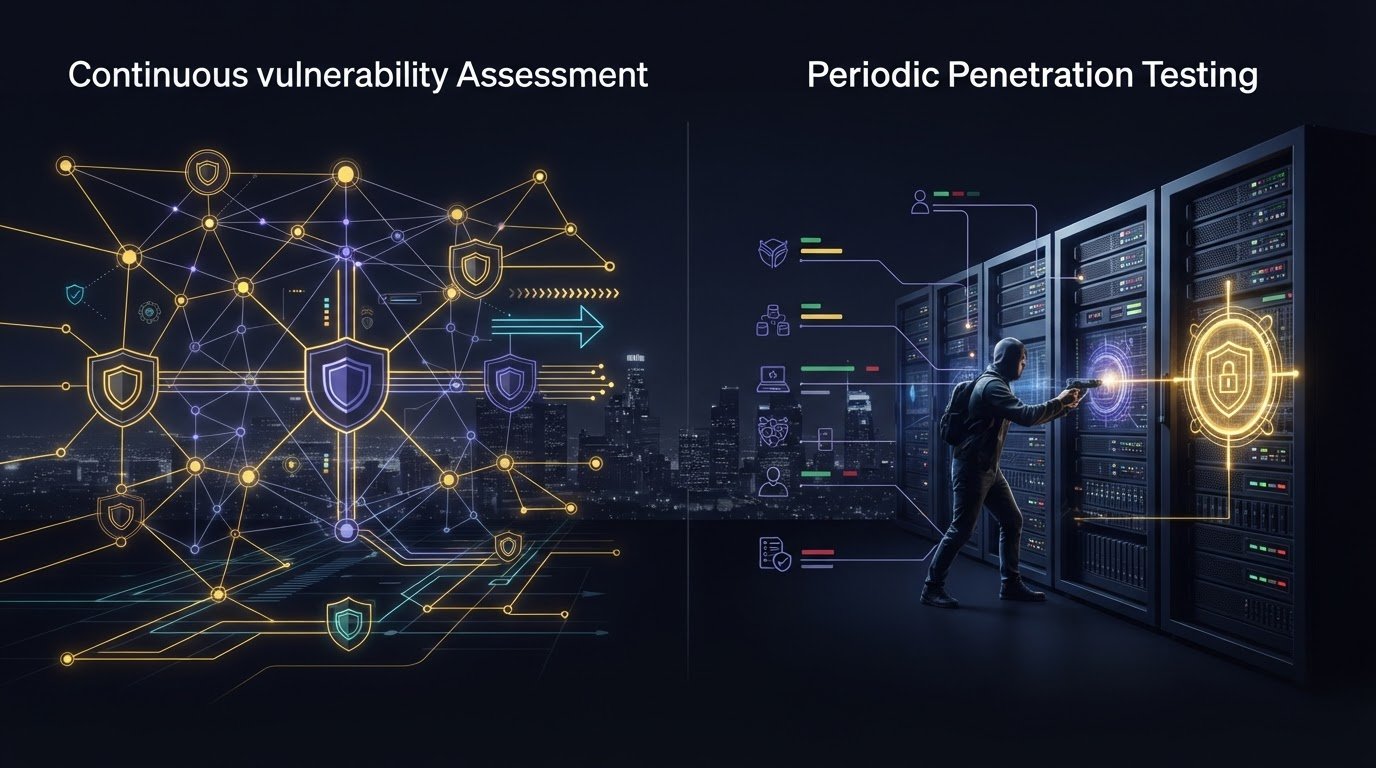
More scanning isn’t a substitute for a penetration test. For vulnerability assessment vs penetration testing, a practical schedule is to assess vulnerabilities continuously, with daily scans and additional scans after major system, network, application, or business-function changes. Run penetration tests periodically, such as annually or bi-annually. The right cadence also depends on your risk profile, environment, and compliance obligations.
Both methods uncover security weaknesses, but answer different questions. A vulnerability assessment identifies and prioritizes potential weaknesses; a penetration test safely evaluates whether attackers could exploit them and what they might reach. This guide explains how the approaches differ, when to use each, and how to set a testing schedule that keeps pace with change.
Key Takeaways
- Match the assessment to your goal: use vulnerability scanning to find and prioritize known weaknesses, and penetration testing to explore how they could be exploited.
- Treat scan results as leads to validate. Asset gaps, configuration context, and false positives can affect what automated tools report.
- Set testing schedules around risk, compliance needs, and significant changes to systems, networks, or applications.
- Combine automated assessments with targeted manual testing when you need both broad visibility and evidence of real-world exposure.
Vulnerability Assessment vs Penetration Testing: Which Do You Need?
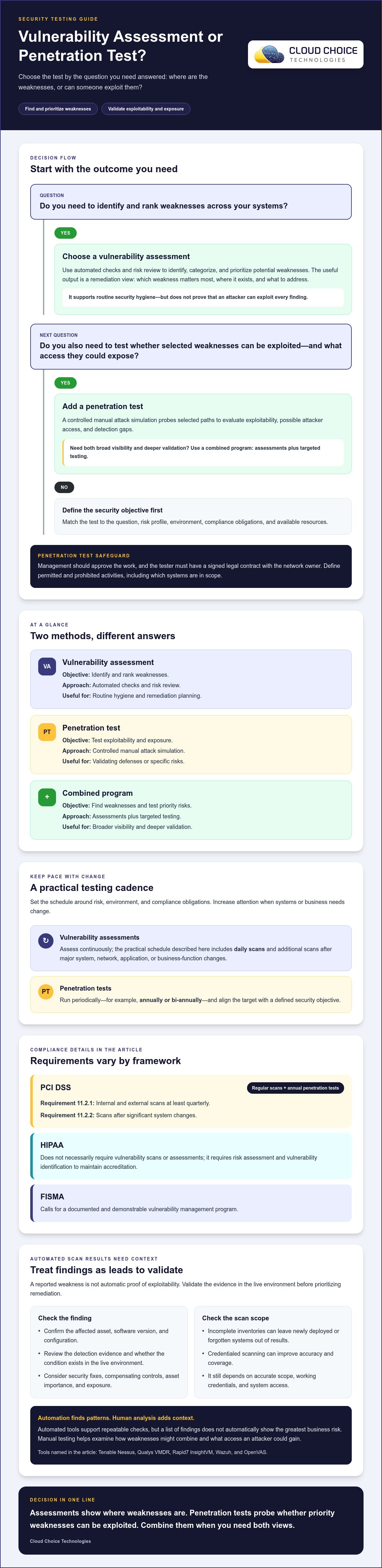
Choose based on the question you need answered: where are the weaknesses, or can someone exploit them? Organization size, security maturity, compliance duties, and available resources all shape the right approach.
Vulnerability Assessment Approach
A vulnerability assessment identifies, categorizes, and measures weaknesses across an organization’s systems. It helps teams compare severity, prioritize remediation, and maintain routine security hygiene. For example, an assessment can flag outdated software across employee devices and rank the findings by risk. This supports ongoing vulnerability management, but does not prove that an attacker can exploit every finding.
Use assessments to build a repeatable view of risk, especially when asset inventories change or teams need a prioritized remediation list. Smaller organizations can start with critical systems, while larger environments can organize findings by business function and exposure. The key output is actionable: which weakness matters most, where it exists, and what to address.
Penetration Testing Approach
A penetration test uses controlled attack techniques to determine whether security weaknesses can be exploited and what access they could expose. The National Institute of Standards and Technology (NIST) describes penetration testing as mimicking real-world attacks to identify ways around an application’s, system’s, or network’s security features.
Dynamic application security testing examines a running application for weaknesses and can help test its defenses against attempted attacks. It can be time-consuming, so align it with a defined target and security objective. Choose manual testing when you need evidence of exploitability, possible attacker access, or detection gaps. A scan lists potential issues; a penetration test probes selected paths under controlled conditions.
| Option | Primary objective | Approach | Useful when |
|---|---|---|---|
| Vulnerability assessment | Identify and rank weaknesses | Automated checks and risk review | Routine hygiene and remediation planning |
| Penetration test | Test exploitability and exposure | Controlled manual attack simulation | Validating defenses or specific risks |
| Combined program | Find weaknesses and test priority risks | Assessments plus targeted testing | Broader visibility and deeper validation |
Before a penetration test, management should approve the work, and the tester must have a signed legal contract with the network owner. The contract should define permitted and prohibited activities, including which systems are in scope.
For compliance, PCI DSS calls for regular vulnerability scans and annual penetration tests. PCI DSS Requirement 11.2.1 requires internal and external scans at least quarterly, while Requirement 11.2.2 requires scans after significant system changes. HIPAA does not necessarily require vulnerability scans or assessments, but it requires risk assessment and vulnerability identification to maintain accreditation. FISMA calls for a documented and demonstrable vulnerability management program.
How much do vulnerability assessments and penetration tests cost in the United States? Costs depend on scope, asset count, application complexity, and testing depth; pricing is provided after a quote request.
Choose an assessment for broad, repeatable visibility; choose a penetration test to find out whether priority weaknesses can be exploited. Organizations with mature security programs can combine both. Smaller teams can start with critical assets and expand as their objectives and capacity develop.
False positives and limitations of automated scanning
Automated vulnerability scanning speeds up the search for known weaknesses, but findings need context. A scanner may flag a vulnerable software version without accounting for a security fix, compensating control, or system configuration. Review the finding as a lead to validate, not as automatic proof that an attacker can exploit the asset.
False positives can waste remediation time when teams treat every alert as equally urgent. Review the affected asset, the evidence behind the detection, and whether the reported condition exists in the live environment. For example, confirm the software version and configuration on the named host, then compare them with the finding. Record the result so later scans don’t reopen a resolved issue without new evidence.
Vulnerability scanning can miss assets if an organization’s inventory is incomplete. A newly deployed server or forgotten external system won’t appear in the results if the scanner doesn’t know to look for it. Credentialed scanning of each host can produce more accurate, comprehensive results, but still depends on an accurate scope, working credentials, and access to the systems being assessed.
Automated tools and attack simulation
Tools such as Tenable Nessus, Qualys VMDR, Rapid7 InsightVM, Wazuh, and OpenVAS help identify known weaknesses across systems. They support repeatable vulnerability management and can run continuously or on a defined schedule. But a list of findings doesn’t automatically show which issue creates the greatest business risk. Security teams must assess severity alongside asset importance, exposure, and available controls.
Automated penetration testing and attack simulation can check selected systems against known attack patterns. These tools may identify exposed services or test how a control responds to a simulated attempt. They don’t replace manual penetration testing when the goal is to understand how weaknesses might combine or what access an attacker could gain. Automation is best for repeatable checks; human analysis adds context.
How scanning and manual testing work
Vulnerability scanning uses automated tools to compare system details with known security issues, then reports findings for review. Manual penetration testing uses controlled techniques to investigate selected targets, attempt exploitation, and determine what access a real attack could achieve.
Use scan results as a starting point: confirm the asset and evidence, validate the finding, assess its severity, and assign remediation. Then use targeted manual testing when a high-priority weakness needs to be tested for exploitability or an application requires contextual judgment. This keeps routine checks broad while reserving deeper investigation for the risks that matter most.
Vulnerability assessment and penetration testing frequency
Set each schedule according to how quickly assets change, how exposed they are, and what decisions the results need to support. Automated vulnerability scanning can run daily, while a penetration test requires a defined scope and focused analysis. A calendar helps, but changes to systems, applications, networks, or business functions should also trigger a review.
Daily vulnerability scans can help identify newly introduced weaknesses before they go unnoticed. Run additional scans after major system, network, application, or business-function changes. Because findings can become outdated quickly, connect each scan to remediation and continuous monitoring rather than treating a quarterly report as a complete security picture.
Penetration tests are periodic and may be annual or bi-annual, depending on organizational risk and testing objectives. Annual-only testing may not be sufficient to keep pace with cyber threats. Consider additional tests before or after major development updates, infrastructure changes, or new exposure. For example, a payment application may need focused testing after a substantial release, not only at its scheduled review.
| Activity | Typical cadence or trigger | Depth and intrusiveness | Output |
|---|---|---|---|
| Automated vulnerability assessment | Daily, plus major changes | Broad checks for known weaknesses | Findings prioritized for remediation |
| Penetration test | Periodic, such as annual or bi-annual; major updates | Focused attempt to validate exploitable paths | Methodology, vulnerabilities, and exploitation evidence |
| Remediation verification | After fixes to high-priority findings | Checks whether the weakness remains | Updated finding status and analysis |
The time required also differs. A vulnerability assessment may take a few minutes or hours, while penetration tests can take weeks. Scope affects both: a limited asset group is faster to review than a complex environment with multiple applications and access paths. Reports should identify affected assets, explain severity, and give teams enough detail to prioritize fixes.
Build a repeatable schedule with these steps:
- Maintain an asset inventory so new systems enter vulnerability scanning promptly.
- Run scans daily and after major changes, then track remediation to closure.
- Schedule penetration tests around risk, development releases, and exposed systems.
- Use follow-up analysis to verify high-priority fixes and update reports.
For organizations handling cardholder data, PCI DSS specifies scanning and testing intervals. Treat those obligations as a compliance floor, then set additional checks based on asset exposure and how often systems change. The practical goal is a continuous view of weaknesses, with deeper penetration tests focused on the assets and attack paths that matter most.
Vulnerability assessment versus manual penetration testing
Automated assessments and manual penetration tests answer different questions about the same infrastructure. A scan asks which known weaknesses appear across the target environment. A manual test asks whether an attacker could exploit selected weaknesses, combine them, and reach sensitive systems. Use the first for coverage and the second to evaluate realistic attack paths.
A vulnerability assessment compares discovered assets and configurations with known weaknesses. Its value depends on accurate scope: a server missing from the asset inventory cannot be assessed. Credentialed scanning can give a more complete view of each host, while reports help teams sort findings by severity. This supports detection and remediation, but doesn’t demonstrate that a weakness can cause a breach.
Manual penetration testing adds context. A tester can examine how a login flow, access control, or network boundary behaves under a controlled attempt. For example, a scan may flag a web application weakness, while manual testing explores whether it could expose another user’s records. The test evaluates potential impact, not just whether a known issue is present.
Threats rarely follow a single alert, which is why the distinction matters. A tester may connect a low-severity configuration issue with excessive account permissions and an exposed service. Each finding might seem limited on its own, but together they could create a path to restricted data. This analysis helps security teams prioritize risky combinations and assess whether existing controls detect or block the activity.
Neither method gives a complete picture if the target is poorly defined. Start by listing critical assets, such as customer-facing applications, identity systems, and sensitive data stores. Then match the test to the decision at hand:
- Use an assessment to identify and prioritize known weaknesses across an environment.
- Use manual testing to investigate whether selected weaknesses can be exploited.
- Use both when broad coverage and evidence of real-world exposure are needed.
Reports should support action. An assessment report should identify vulnerabilities, explain associated risk, and recommend remediation. A penetration test report should describe the methodology, list vulnerabilities, and show how each tested weakness could be exploited. Teams can then assign fixes, improve controls, and retest priority findings.
Choose the method based on the question you need answered. If you need to find unaddressed weaknesses across assets, start with an assessment. If you need to know whether a specific target can be breached through a realistic attack path, use manual testing. For structured help evaluating security exposure, consider a security risk analysis.
Cloud Choice Technologies: Managed IT Services
Cloud Choice Technologies helps businesses turn assessment findings into practical security priorities through Managed IT Services, Cybersecurity, Remote Support, and Cyber Risk Analysis. If your team needs consistent vulnerability oversight, help interpreting scan results, or a clearer view of organizational risk, these services can support the next steps after testing.
Choose managed IT services when ongoing technology oversight and support are part of the need. For targeted cybersecurity concerns, Cloud Choice Technologies can help assess risks and guide remediation priorities. A structured review can help connect technical findings with the systems and business operations they affect.
Turn security findings into a stronger next step
Make your next security review produce decisions, not just another document. Identify who owns each priority, what business process it affects, and how leadership will track progress. As you plan that work, compare your needs with the managed IT and cybersecurity support from Cloud Choice Technologies.
The vulnerability assessment vs penetration testing decision belongs in a broader security plan. Use findings to set priorities, assign responsibility, and decide when to review again. This keeps security work connected to business operations.
Start with a practical action: assign an owner to your highest-priority finding. Clear ownership turns the next step into measurable progress.
Frequently Asked Questions
Why might an organization need a vulnerability assessment?
An organization may need an assessment to make security decisions based on a current view of its environment. For example, leaders planning technology investments can use prioritized findings to compare exposure across business-critical resources. An assessment can also help security teams identify where existing safeguards need closer review. Its value is practical: decision-makers get evidence to direct attention and resources toward weaknesses that matter to their operations.
How does the reporting differ?
Assessment reports help compare findings across assets and track patterns over time. Penetration test reports are better suited to explaining a specific testing scenario and its implications for business operations. Look for clear explanations, not just technical output: business leaders need impact and priority, while system owners need enough context to investigate. A report is most useful when its intended audience can act on it.
How does vulnerability assessment work in an enterprise?
In an enterprise, teams can organize assessments by business unit or application owner, then use consistent categories to compare findings. A central security function can review trends, while each owner evaluates issues affecting their systems. For example, a shared classification scheme makes it easier to spot similar weaknesses across departments and coordinate a consistent response.
What is a penetration test?
A penetration test is a controlled, authorized exercise that evaluates security by attempting defined actions against systems in scope. Before testing begins, establish the target, permitted techniques, excluded systems, and conditions for pausing the work. For example, a test plan can specify whether testers may attempt to access a particular application feature. Clear boundaries keep the exercise focused and its results relevant.
What is the difference between a vulnerability assessment and a penetration test?
The two methods support different decisions. An assessment helps teams decide which weaknesses across their environment deserve attention; a penetration test evaluates a defined security scenario. If leaders need an overview to guide planning, an assessment is useful. If they need to evaluate a specific concern, such as how a control handles a defined attack attempt, a penetration test can provide focused evidence.
What are the goals and deliverables of vulnerability assessments versus penetration tests?
An assessment helps an organization plan and prioritize security work across its environment. A penetration test evaluates how a defined scenario interacts with existing defenses. The useful outcome is more than a completed document: asset owners can use assessment results to plan work, while security leaders can use test results to review whether controls behave as intended. Together, these findings can inform future security decisions.