
The Hidden Costs of Break-Fix IT Support: Why Reactive Tech is a Growth Gamble
Is your "pay-as-you-go" IT strategy actually a silent tax on your company’s growth? Many executives rely on reactive technicians because it feels like a cost-saving measure to only pay when something breaks. You want to keep overhead lean, and it's frustrating to imagine paying for support when your systems are currently operational. However, the hidden costs of break-fix IT support are often invisible until a major failure halts production or a security breach compromises your data. This growth gamble creates unpredictable monthly spending and leaves you wondering if critical security patches are actually being applied.
It's time to trade digital uncertainty for professional stability. This article uncovers the financial drains of the reactive model and demonstrates how a managed approach can save your business up to 40 percent compared to hourly contractors, or even 75 percent compared to hiring in-house staff. You'll learn how to achieve predictable budgeting, maintain HIPAA and AI compliance, and reclaim lost productivity. We will explore why a proactive partner acts as a vigilant guardian for your operations, starting with a Free Network Security Analysis to identify exactly where your current strategy is failing you.
Key Takeaways
- Learn why the "if it ain't broke, don't fix it" mindset creates structural liabilities and hidden technical debt for your organization.
- Identify the hidden costs of break-fix IT support, including the "Downtime Multiplier" that silently drains employee productivity and corporate profits.
- Discover how a fixed-fee proactive model can save your business 40% compared to hourly contractors and up to 75% compared to in-house staffing.
- Understand why reactive models leave your organization vulnerable to modern risks like HIPAA violations and AI security gaps that simple repairs can't fix.
- Learn how to leverage a Free Network Security Analysis to uncover system vulnerabilities before they cause catastrophic operational downtime.
The Illusion of Pay-As-You-Go: Defining the Break-Fix IT Model
The break-fix model is a reactive, transactional approach to technology that prioritizes repair over prevention. Under this system, you only call for help when a server crashes, a workstation freezes, or a network goes dark. It feels like a simple, honest way to do business. You pay for the hours worked and nothing more. However, this "pay-as-you-go" strategy is a dangerous fallacy. It treats your digital infrastructure as a series of isolated components rather than a unified engine for growth. Relying on this model means you're constantly operating in a state of technical debt, waiting for the next inevitable failure to disrupt your workflow.
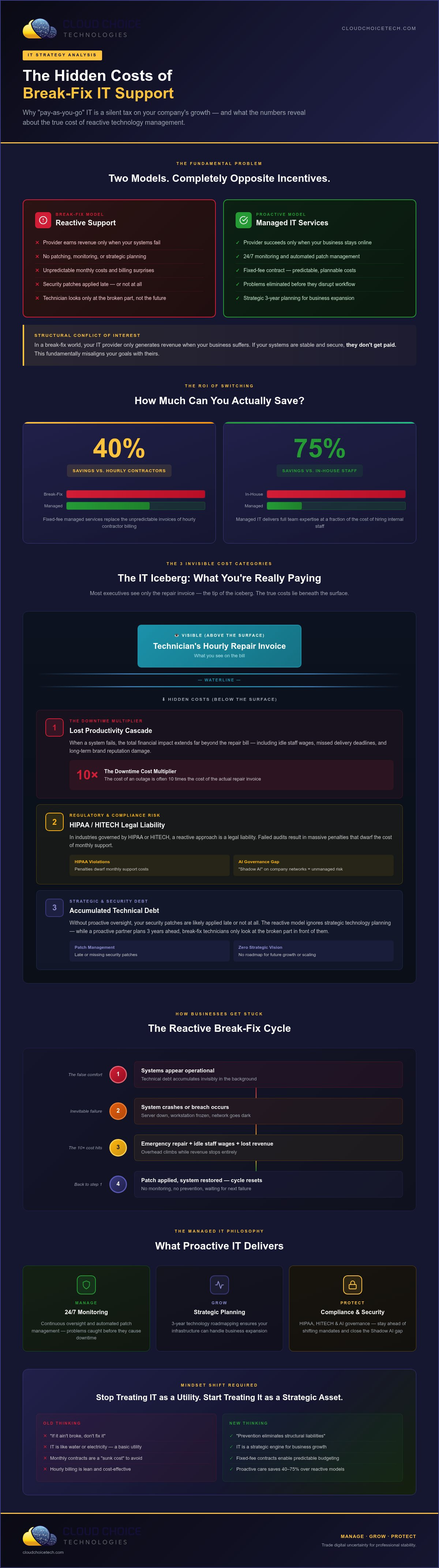
There is a fundamental conflict of interest baked into this relationship. In a break-fix world, your IT provider only generates revenue when your business suffers. If your systems are stable and secure, they don't get paid. This misaligns your goals with theirs. While you want total uptime, their business model thrives on your operational pain. This stands in stark contrast to the "Manage, Grow, Protect" philosophy of proactive care, where the goal is to eliminate problems before they manifest. Modern IT service management focuses on alignment, ensuring that your technology partner succeeds only when your business stays online and productive.
Why Businesses Get Stuck in the Reactive Cycle
Many executives hesitate to switch to a proactive model because they fear the "sunk costs" of a monthly service agreement. They view IT as a basic utility, similar to water or electricity, rather than a strategic asset. This perspective ignores the cumulative hidden costs of break-fix IT support, such as the thousands of dollars lost during even a single hour of downtime. Without a fixed-fee contract, you lose visibility into the true cost of "small" repairs. You might think you're saving money, but research shows that managed IT services can actually save you 40% compared to the unpredictable invoices of hourly contractors.
The True Definition of Reactive Support
Reactive support is support that begins only after a failure has already occurred. It lacks the essential layers of modern business protection, such as 24/7 monitoring and automated patch management. If you aren't paying for proactive oversight, your security patches are likely being applied late or not at all. This model also ignores strategic technology planning. While a proactive partner looks three years ahead to ensure your tech can handle business expansion, a break-fix technician only looks at the broken part in front of them. A Free Network Security Analysis is often the first step in realizing just how much of your budget is being wasted on these temporary, short-sighted fixes.
The 3 Invisible Cost Categories Draining Corporate Profits
Visualizing IT expenses requires looking beneath the surface of your monthly ledger. Most executives focus on the repair invoice, but that is only the tip of the "IT Iceberg." The true hidden costs of break-fix IT support lie in the operational disruptions that follow a system failure. While the visible cost is the technician's hourly rate, the invisible costs include lost production, missed opportunities, and regulatory exposure. This reactive cycle forces your business to absorb financial shocks that a proactive model would have neutralized before they reached your bottom line.
The Downtime Multiplier: Calculating Lost Productivity
When a system fails, the financial impact extends far beyond the repair bill. The cost of an outage is often 10 times the cost of the actual repair invoice. You must account for idle staff wages, missed delivery deadlines, and the long-term damage to your brand reputation. If your team cannot work, your overhead continues to climb while your revenue stops entirely. The Downtime Multiplier serves as a definitive metric for executive risk assessment, revealing the total revenue loss relative to the cost of the technical fix.
Regulatory and AI Risks: The New Compliance Nightmare
In industries governed by HIPAA or HITECH, a reactive approach is a legal liability. Failed audits result in massive penalties that dwarf the cost of monthly support. Utilizing a proactive cybersecurity risk management framework ensures your organization stays ahead of shifting mandates. This is especially vital as we face the "AI Governance Gap." Many employees use ungoverned AI tools on company networks, creating "Shadow AI" risks that lead to catastrophic data privacy fines. Investing in regulatory compliance IT support protects your firm from these high-stakes financial dangers. Proactive AI consulting prevents these leaks by establishing clear guardrails for emerging tech usage.
Technical Debt: The Compound Interest of Neglect
Ignoring infrastructure creates technical debt. This neglect functions like compound interest on a high-interest loan. Deferred maintenance leads to catastrophic system failures that eventually require emergency facility buildouts or total system overhauls. These "band-aid" fixes are temporary and fragile. Eventually, the patchwork architecture collapses, forcing you into an expensive, unplanned capital expenditure that could have been avoided with consistent oversight. A Free Network Security Analysis can help you identify these vulnerabilities before they turn into a profit-draining crisis.
Structural Misalignment: Why Break-Fix Incentivizes Failure
The break-fix model operates on a "Profit from Pain" foundation. This creates a fundamental misalignment where your technology provider succeeds only when your systems fail. In contrast, a proactive partner utilizes a "Profit from Performance" model. Here, the provider's goal is to keep your environment stable; the less they have to intervene, the more profitable the relationship becomes for both parties. This alignment is the only way to eliminate the hidden costs of break-fix IT support that stem from recurring, unresolved technical issues.
Why would a reactive technician dig for a root cause? If they can charge you for the same temporary fix every few months, their business thrives. They lack the financial incentive to implement permanent resolutions. This neglect often extends to your digital perimeter. Reactive patching is essentially a race against time that you're destined to lose. Without the continuous "White-Hat" testing found in comprehensive business cybersecurity solutions, your network remains a collection of open doors waiting for an intruder. These structural gaps are invisible until a breach forces them into the light.
The High Price of Reactive Security
Waiting for a breach to occur is the ultimate growth gamble. Today's AI-powered cyber threats can penetrate a network in seconds; this is far faster than a human technician can respond to an emergency ticket. Vulnerability identification must happen before the attack occurs. Reactive support is obsolete because it starts the clock only after the damage is done. You need a guardian that anticipates threats rather than one that merely cleans up the wreckage.
Missing the Strategic Roadmap
Break-fix support offers no vision for your future. It prevents your organization from effectively leveraging cloud technology solutions because there's no one planning your long-term expansion. You miss out on the large-company level support that a dedicated help desk provides, leaving your staff to struggle with "small" issues that drain their focus. Don't let a transactional mindset limit your potential. Take the first step toward operational excellence and request your Free Network Security Analysis to uncover the vulnerabilities holding your business back.
Achieving IT Success: The ROI of the Proactive Model
Transitioning from a reactive stance to a proactive partnership is a strategic financial decision. The hidden costs of break-fix IT support often stem from the lack of a predictable budget, leaving you vulnerable to sudden spikes in technical spending. By switching to a fixed-fee model, your organization gains total control over its technology overhead. This shift allows you to move capital from emergency repairs to growth-focused initiatives. A managed approach provides a clear financial advantage, offering a vigilant guardian for your digital assets while stabilizing your bottom line.
The data supporting this transition is definitive. Implementing managed IT services can save your business 40% compared to the erratic billing of hourly technical contractors. If you're currently maintaining an internal IT department, the savings potential is even higher. Professional managed support can reduce your expenses by up to 75% compared to the high costs of hiring and training in-house technicians. These savings aren't just theoretical; they're the result of high-efficiency monitoring and preventative oversight that stops problems before they require expensive intervention.
Predictable Budgeting and Scalability
A single, all-inclusive monthly fee provides immediate peace of mind. It eliminates the anxiety of "billable hours" and allows your leadership team to plan for the future with confidence. This model facilitates rapid facility buildouts and seamless network updates because the technical foundation is already optimized for expansion. Additionally, 24/7 remote IT support ensures that your modern distributed workforce remains productive, regardless of their location or time zone. You're no longer paying for time; you're paying for results.
The Final Line of Defense: Backup and Recovery
Proactive cloud backup is significantly cheaper than emergency data recovery. If a disaster strikes, a dedicated "backup cloud" allows for rapid restoration, minimizing the downtime that sinks unprepared companies. Business continuity planning prevents the "Iceberg" costs discussed earlier from becoming fatal liabilities. This comprehensive oversight ensures that your data is not only protected but also immediately accessible when you need it most. To see exactly where your current model is leaking capital, a Free Network Security Analysis serves as the ultimate tool for transparency and professional excellence.
Secure Your Competitive Advantage Through Proactive IT
Staying tethered to a reactive model is no longer a viable business strategy. We have uncovered how the hidden costs of break-fix IT support act as a silent drain on your revenue, from the "Downtime Multiplier" to the high-stakes risks of AI non-compliance. Trading unpredictable invoices for a stable, fixed-fee partnership doesn't just protect your perimeter; it fuels your expansion. With the ability to save up to 40% compared to hourly technical contractors, you can finally redirect capital into innovation while we handle the complexities of digital security.
Our proprietary HIPAA and HITECH monitoring solutions, combined with expert AI governance, ensure your organization remains compliant and resilient in an evolving landscape. It's time to stop gambling on your growth and start building a foundation of elite readiness. Take the first step toward total operational control by choosing a partner that succeeds only when you do. Your business deserves a guardian that never blinks.
Schedule Your Free Network Security Analysis Today
Frequently Asked Questions
What is the difference between break-fix and managed IT services?
Break-fix is a reactive, transactional model where support only begins after a failure occurs. Managed IT is a proactive partnership that focuses on continuous monitoring and preventative care. Under a managed contract, your provider succeeds when your systems remain stable and secure. This shifts the focus from repairing broken parts to maintaining operational continuity, ensuring your technology acts as a strategic asset rather than a recurring and unpredictable liability.
How much can a business save by switching from hourly contractors to managed IT?
Businesses typically see immediate financial benefits by moving away from transactional billing. Adopting a fixed-fee managed model can save your organization 40% compared to hourly technical contractors. These savings are achieved by eliminating emergency service premiums and reducing the frequency of major system failures. It allows for predictable budgeting while ensuring your infrastructure receives the professional oversight necessary for long-term stability and business growth.
Why is downtime considered a 'hidden cost' of break-fix support?
Downtime is a silent profit killer because it encompasses far more than the cost of a technical repair. It represents the hidden costs of break-fix IT support by including lost employee productivity, missed sales opportunities, and potential damage to your brand reputation. While your staff sits idle waiting for a reactive technician to arrive, your overhead costs remain constant. A proactive model eliminates these invisible drains by preventing outages before they occur.
Does a break-fix IT model cover HIPAA or AI compliance requirements?
Traditional break-fix providers generally lack the tools and expertise required for rigorous regulatory adherence. They focus on functional repairs rather than complex frameworks like HIPAA/HITECH or AI governance. Proactive managed services include proprietary audit and security-monitoring solutions designed specifically for regulated industries. This ensures your data remains protected and your organization avoids the massive fines associated with non-compliance, which a reactive model simply isn't equipped to prevent or manage.
What is included in a free Network Security Analysis?
A free Network Security Analysis is a comprehensive technology assessment that includes white-hat testing and professional vulnerability identification. We examine your current infrastructure to find security gaps and performance bottlenecks that a reactive technician might ignore. This analysis provides a clear roadmap for improvement, showing you exactly where your network is at risk. It's an essential tool for identifying the hidden costs of break-fix IT support within your specific digital environment.
Can managed IT services really replace an in-house IT department?
Managed IT services provide a more cost-effective alternative to maintaining a full-time internal staff. This approach can deliver savings of up to 75% compared to hiring in-house technicians. You gain access to a dedicated help desk and a deep pool of specialized expertise that is available 24/7. This ensures your business receives elite-level support and sophisticated security oversight without the logistical burden and high overhead of internal department management.