
Small Business Data Breach Costs: 2026 Executive Guide
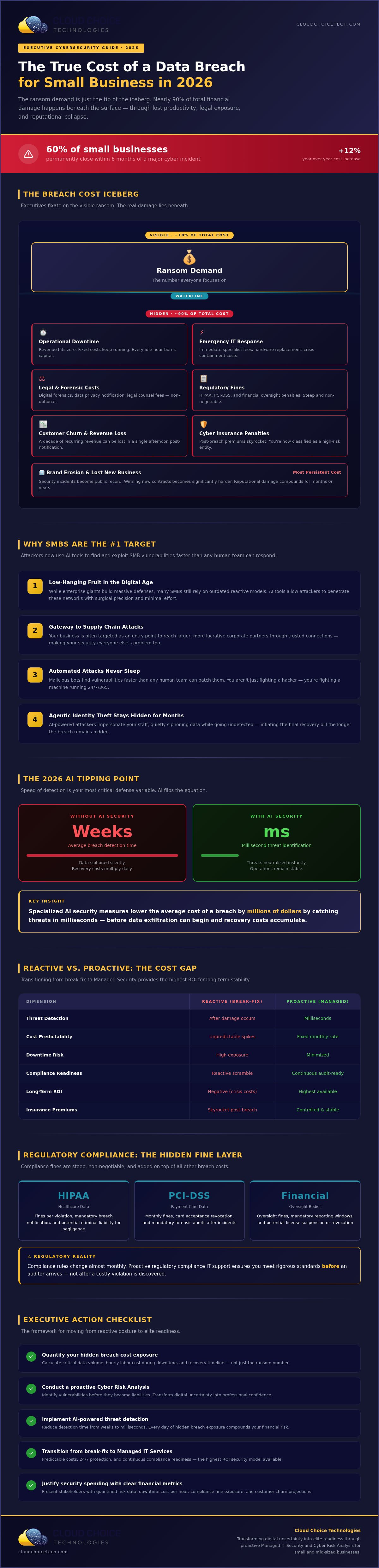
If your business is hit by a cyber incident in 2026, the ransom demand is just the tip of a very dangerous iceberg. Most executives focus on the immediate payout, yet industry data suggests that nearly 90 percent of the total financial damage happens beneath the surface through lost productivity and reputational collapse. You likely already know that the cost of a data breach for small business operations can be devastating, often leading to permanent closure within months of an attack. It's a high-stakes environment where unpredictable IT expenses and the fear of business-ending downtime keep even the most seasoned leaders awake at night.
You need more than just a vague warning; you need a strategy to protect your continuity. This executive guide provides a clear framework to quantify your financial risk and justify necessary security spending to your stakeholders. We'll examine the latest 2026 cost projections, the rising price of regulatory non-compliance, and how proactive Cyber Risk Analysis transforms digital uncertainty into professional confidence. By the end of this article, you'll understand how to move from a reactive posture to one of elite readiness, ensuring your business remains stable and secure in an increasingly complex digital world.
Key Takeaways
- Understand why 60 percent of small firms fail within six months of an attack and how AI-enabled malware has redefined the 2026 threat landscape.
- Learn how to calculate the true cost of a data breach for small business operations by uncovering the "iceberg" of hidden expenses like operational downtime and productivity loss.
- Master a practical framework to quantify your financial risk using specific metrics like critical data volume and hourly labor loss.
- Discover why transitioning from a reactive "break-fix" model to proactive Managed IT Services provides the highest return on investment for long-term stability.
- Gain the authoritative insights needed to justify security spending to stakeholders and replace digital uncertainty with a sense of elite readiness.
The Reality of Data Breach Costs for Small Businesses in 2026
In 2026, a data breach isn't just a technical glitch; it's a sophisticated inversion of your business identity. Cybercriminals now utilize AI-enabled malware to bypass traditional filters, effectively turning your own internal systems against you. This evolution has pushed the average cost of a data breach for small business entities to record highs. Recent data indicates a 12 percent year-over-year increase in these costs, largely because detection has become incredibly complex. For many, the financial blow is terminal. Industry research confirms that 60 percent of small businesses close their doors permanently within six months of a major incident. Forward-thinking executives now view cybersecurity as foundational asset protection rather than a simple IT utility.
Why SMBs are the New Primary Target for Cybercriminals
Smaller networks are the "low hanging fruit" of the digital age. While enterprise giants have built massive walls, many smaller firms still rely on outdated reactive models. AI tools now allow attackers to penetrate these networks with surgical precision and minimal effort. Often, your business is targeted as a gateway for supply chain attacks. Criminals use your trusted connections to reach larger, more lucrative corporate partners. The automation of cybercrime means that malicious bots find vulnerabilities faster than any human team can patch them. You aren't just fighting a hacker; you're fighting a machine that never sleeps.
The 2026 AI Tipping Point in Cybersecurity
The financial burden of a breach is increasingly tied to the "detection and escalation" phase. When attackers use Agentic Identity theft to impersonate your staff, the breach can remain hidden for months, quietly siphoning data and inflating the final recovery bill. Speed is your only viable defense. Implementing specialized AI security measures actually lowers the average cost of a breach by millions by identifying threats in milliseconds rather than weeks. This proactive approach ensures your operations remain stable even when the external environment is volatile. Total control requires a partner who provides the calm, professional confidence your business deserves.
Decoding the 'Iceberg' of Hidden Breach Costs
Executives often fixate on the visible ransom demand. It's a mistake. The true cost of a data breach for small business owners is rarely found in the initial payout. You must account for emergency IT support, immediate hardware replacement, and the sudden, crushing reality of operational "dead air." When your staff can't access systems, every hour becomes a direct drain on your capital. This operational disruption often outweighs the ransom itself, as fixed overhead costs continue to pile up while revenue generation hits zero.
Compliance penalties add another layer of financial stress. Whether you're governed by HIPAA, PCI-DSS, or financial oversight bodies, the fines for negligence are steep and non-negotiable. Utilizing expert regulatory compliance IT support ensures you meet these rigorous standards before an auditor arrives. It's about maintaining stability in a volatile regulatory environment where the rules of engagement change almost monthly.
Legal and Forensic Expenses
Following an incident, you'll need specialized digital forensics. These experts don't just find the intruder; they prove what data was not accessed, which is vital for limiting your legal liability. Legal counsel fees also climb quickly as you fulfill data privacy notification requirements. These aren't optional expenses. They're the price of professional accountability and legal survival. Without a vigilant partner to manage the technical evidence, your legal defense becomes significantly more expensive and less effective.
Lost Business Opportunity and Reputation
Brand erosion is the most persistent cost. Customer churn happens fast after a breach notification. You're losing recurring revenue that took a decade to build in a single afternoon. Then comes the "Cyber Insurance" penalty. Your premiums will skyrocket because you're now a high-risk entity. Winning new contracts becomes difficult when your security history is a matter of public record. If you're concerned about your current exposure, a comprehensive Cyber Risk Analysis can identify vulnerabilities before they become liabilities, providing the peace of mind you need to focus on growth.
Calculating Your Risk: A Cost of IT Downtime Framework
Quantifying the cost of a data breach for small business operations requires moving beyond guesswork. You need a methodical framework to understand what's truly at stake before a crisis hits. Start by identifying your "Critical Data" volume. This includes the total number of customer records, personally identifiable information (PII), and proprietary intellectual property. Next, calculate your Hourly Labor Loss by multiplying the number of affected employees by their average hourly rate and the total hours of downtime. It's a simple calculation that often reveals a staggering hourly burn rate.
Industry multipliers are the third critical factor in this framework. If you operate in healthcare or finance, your per-record costs are significantly higher due to strict regulatory oversight and specialized recovery requirements. Finally, you must define your Recovery Time Objective (RTO). This is the hard deadline for how long you can actually afford to stay offline before the damage to your business continuity becomes irreversible. Knowing this number allows you to build a defense that matches your actual risk profile.
The Formula for Business Downtime
Calculating your "Downtime Cost per Hour" is the only way to justify security spending to stakeholders. The formula is straightforward: combine your total hourly payroll with your average lost revenue per hour and any emergency recovery fees. Access to rapid remote IT support for corporations is the primary variable that determines whether this number stays manageable or spirals out of control. High-speed intervention isn't a luxury; it's a financial necessity.
Don't forget the hidden operational dependencies that often go overlooked during a crisis:
- VoIP and internal communication systems
- Cloud-based CRM and ERP access
- Digital payment processing and banking portals
- Supply chain and inventory management tools
Cyber Insurance Compliance Requirements
Your cyber insurance policy is not a blank check. Many carriers will refuse to pay a claim if you cannot prove you had robust business cybersecurity solutions in place before the breach. The cost difference between a "Compliant" and "Non-Compliant" response can be hundreds of thousands of dollars in denied coverage. By documenting a strong security posture and maintaining regular audits, you can often negotiate lower annual premiums. If you want to ensure your business is fully protected, our team can perform a comprehensive Cyber Risk Analysis to verify your compliance and secure your future.
The Proactive Guardian: Reducing Breach Costs through Managed Security
Relying on a "break-fix" model is the most expensive mistake an executive can make in 2026. Waiting for a system to fail before calling for help ensures you pay the maximum cost of a data breach for small business operations. This reactive approach leaves you vulnerable to cascading failures and unbudgeted emergency fees. Transitioning to managed IT services replaces this uncertainty with constant vigilance and a predictable monthly rate. It's a strategic shift that moves security from a liability to a foundational asset, providing the stability your enterprise needs to thrive.
Cloud Choice Technologies acts as the "calm in the storm" for your business. Our AI-powered threat detection identifies anomalies in minutes, not months, neutralizing attacks before they can encrypt your files or steal your identity. This speed is the decisive factor in protecting your bottom line. We handle the technical complexities so you can focus on your core operations with total peace of mind and professional confidence.
24/7 Monitoring and Rapid Intervention
The financial impact of a breach is directly tied to your "Mean Time to Identify" (MTTI). Every minute an intruder spends inside your network increases the final recovery bill exponentially. Our remote support teams monitor your environment around the clock, intervening the moment a threat is detected to stop it before it reaches your core servers. Proactive intervention is the only way to lower the cost of a data breach for small business by preventing lateral movement within your network. Proactive network maintenance stops downtime before it starts by resolving vulnerabilities before they can be exploited.
Ensuring Regulatory Adherence and AI Safety
Specialized AI compliance and security have become mandatory for modern business operations. As regulations evolve, staying ahead of HIPAA or financial reporting standards requires deep expertise and constant oversight. Conducting a regular cyber risk analysis acts as your early warning system, identifying gaps in your defense before they result in a compliance penalty. Don't wait for a vulnerability to become a crisis. Contact Cloud Choice Technologies for a Comprehensive Cyber Risk Analysis today and secure your business with the protection of a vigilant, fast-acting partner.
Securing Your Operational Future in the AI Era
The true cost of a data breach for small business owners is no longer a matter of if an incident occurs, but how effectively you've quantified your risk before it strikes. We've explored the hidden depths of the financial iceberg, from the immediate drain of operational downtime to the long-term erosion of hard-earned customer trust. You now possess the framework to move beyond the expensive, reactive cycle of break-fix repairs. In 2026, your business continuity depends on elite readiness and the ability to maintain rigorous regulatory standards without sacrificing momentum.
Cloud Choice Technologies provides the professional confidence your enterprise requires. With our specialized expertise in AI compliance and 24/7 remote support, we act as your vigilant guardian against digital uncertainty. We handle the technical complexities of risk management so you can lead with total control. Secure Your Business with a Proactive Cyber Risk Analysis from Cloud Choice Technologies and ensure your operations remain stable. It's time to replace fear with the unwavering reliability of a fast-acting partner.
Frequently Asked Questions
What is the average cost of a data breach for a small business in 2026?
The total cost of a data breach for small business operations has risen steadily, with current projections showing a 12 percent year-over-year increase. While exact figures vary based on your industry and the volume of records compromised, the financial damage often extends far beyond the initial ransom. You must account for forensic investigations, legal fees, and the crushing expense of prolonged operational downtime that can reach thousands of dollars per hour.
How does a data breach impact a small business differently than a large corporation?
Large corporations often have the capital reserves and specialized PR teams to weather a significant security event. For a small business, a breach is frequently a terminal event. Without massive cash flow to absorb the recovery costs and reputational damage, nearly 60 percent of small firms fail within six months of an attack. You don't have the luxury of a large margin for error, making proactive protection a requirement for survival.
Will my general business insurance cover the costs of a data breach?
Standard general liability policies typically exclude cyber incidents and data loss. You require specific Cyber Liability Insurance to cover forensic audits, victim notification, and regulatory fines. Most carriers now mandate proof of robust cybersecurity measures before they'll issue a policy or pay a claim. If you can't demonstrate professional oversight through regular risk analysis, your insurance provider might deny coverage entirely, leaving your business to absorb the full financial impact.
How much does it cost to implement a managed cybersecurity solution?
Managed security is structured as a predictable monthly investment rather than a volatile emergency expense. Instead of paying exorbitant rates for "break-fix" repairs after a disaster, you gain continuous oversight for a fixed fee. This model provides a significantly higher return on investment by preventing the catastrophic cost of a data breach for small business entities. It transforms your security from an unpredictable liability into a foundational element of your long-term operational success.
Can AI-driven security tools actually reduce the cost of a breach?
AI-driven security tools are the most effective way to lower the total bill by drastically reducing the time an intruder spends in your network. These systems identify anomalies in milliseconds, allowing for rapid intervention before data is exfiltrated. By catching a threat early, you minimize the "detection and escalation" costs that typically account for a large portion of the financial damage. Speed is your most valuable asset in maintaining business continuity.
What are the first steps a small business should take after discovering a breach?
Your first priority is to isolate the affected systems to prevent the attack from spreading across your network. You must immediately contact your legal counsel and a specialized cybersecurity partner to begin the forensic preservation of evidence. Don't attempt to "clean" the systems yourself, as this can destroy vital data needed for insurance claims and regulatory compliance. A disciplined, professional response is the only way to limit your total financial exposure.