
Proactive IT Strategy for Business Continuity: Beyond the Break-Fix Model
Is your current IT support model actually a ticking time bomb for your bottom line? Many executives treat unpredictable break-fix invoices and sudden operational downtime as an unavoidable tax on business growth. It’s exhausting to watch revenue stall while you wait for a technician to respond to a critical failure. Implementing a proactive IT strategy for business continuity changes this dynamic by shifting the focus from fixing disasters to preventing them before they start. This approach provides the professional confidence you need to lead without the constant fear of digital collapse.
You’ve likely felt the rising anxiety that comes with emerging AI-related security threats and the complexity of modern compliance standards. We agree that your technology should be a source of stability, not a recurring emergency. This article reveals how a strategic managed model eliminates hidden reactive costs and secures your operations in an increasingly volatile digital environment. We will explore the transition from "emergency mode" to a state of elite readiness. You will learn how to achieve predictable budgeting and zero-downtime operations with a partner who acts as the calm in the storm during times of digital uncertainty.
Key Takeaways
- Identify the "Iceberg Effect" of reactive IT support where hidden downtime costs far outweigh the initial repair invoice.
- Shift from a crisis-driven model to a proactive IT strategy for business continuity that utilizes 24/7 monitoring to neutralize threats before they escalate.
- Protect your corporate data integrity by addressing the unique security risks and compliance demands of an AI-driven landscape.
- Establish a diagnostic foundation for your organization through comprehensive Cyber Risk Analysis and rigorous technical oversight.
- Follow a step-by-step roadmap to transition from unpredictable IT expenses to the strategic stability of a managed service partnership.
The Hidden Costs of Break-Fix IT Support
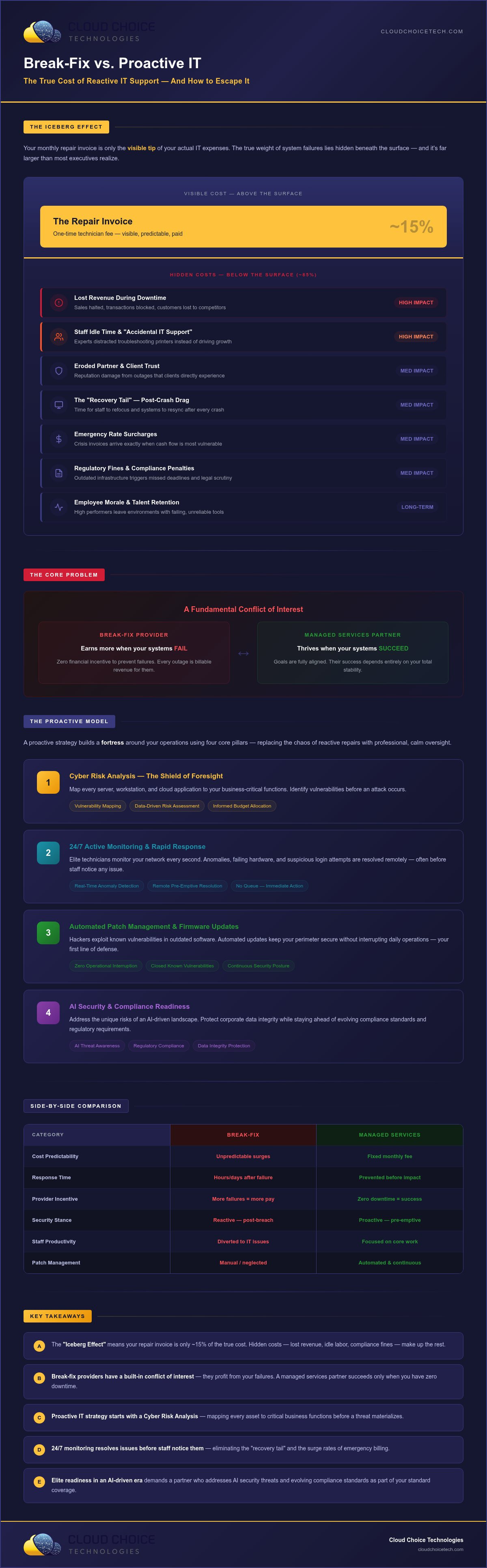
Relying on a break-fix model is like driving a corporate vehicle until the engine explodes. It feels cost-effective because you only pay when something breaks, but this logic ignores the "Iceberg Effect." Your monthly repair invoice represents only the visible tip of your actual expenses. Beneath the surface lies the true weight of system failures: lost revenue, eroded partner trust, and a fundamental conflict of interest. In a reactive model, your IT provider profits from your misfortune. They have no financial incentive to ensure your systems never fail. A proactive IT strategy for business continuity aligns your goals with your provider's goals, focusing on total stability rather than billable hours.
There is also a hidden drain on internal productivity when your staff acts as "accidental IT support." This happens every time a marketing manager spends an hour troubleshooting a printer or a sales lead attempts to reset a frozen server. These aren't just minor annoyances. They're direct diversions from your core business objectives. When your experts are busy doing someone else's job, your growth stalls. This chaos creates a sense of digital uncertainty that ripples through the entire organization.
The True Price of Operational Downtime
Downtime isn't just the minutes your screen is black. It includes the "recovery tail," which is the time it takes for staff to regain their focus and for systems to resync after a crash. Calculate the cost of idle labor during these windows. If your team's collective wages equal several thousand dollars per hour, a single afternoon of system instability can cost more than a year of managed oversight. The Break-Fix Trap is a cycle of recurring failure that prioritizes quick patches over permanent, strategic resolutions.
The 'Shadow Cost' of Unreliable Systems
Technical friction destroys employee morale and retention. High-performers want to work with tools that empower them, not systems that fail them daily. Beyond internal culture, outdated infrastructure often leads to missed regulatory deadlines, which invites heavy fines and legal scrutiny. When you call for help during a crisis, you also face "emergency rates" that inflate repair costs exactly when your cash flow is most vulnerable. A proactive IT strategy for business continuity eliminates these surge prices by identifying vulnerabilities before they become emergencies.
Core Pillars of a Proactive IT Management Strategy
A proactive model doesn't wait for a system to fail. It builds a fortress around your operations. While break-fix providers profit from your downtime, an elite managed partner thrives on your total system stability. This shift requires a rigorous framework designed to neutralize threats before they impact your workflow. A proactive IT strategy for business continuity isn't a luxury; it's a foundational requirement for any organization operating in a high-stakes digital environment. It replaces the chaos of reactive repairs with the calm of professional oversight.
Cyber Risk Analysis as a Strategic Foundation
Identifying vulnerabilities before an attack occurs creates a "Shield of Foresight" for your business. This process involves mapping every server, workstation, and cloud application to your business-critical functions. You can't protect what you haven't identified. Data-driven risk assessments allow executives to make informed financial decisions rather than reacting to sudden hardware failures. Performing a detailed cyber risk analysis allows you to allocate resources where they matter most, ensuring your budget supports long-term stability.
24/7 Vigilance and Rapid Response
Passive alerting is a relic of the past. It simply tells you when something has already broken. Active intervention means an elite technical team monitors your network every second to catch anomalies. They identify failing hardware or suspicious login attempts and resolve them pre-emptively. Often, these issues are fixed via remote support before your staff even realizes there was a potential problem. This level of vigilant oversight provides the peace of mind that comes from knowing experts are handling the technical heavy lifting for you.
Beyond monitoring, rigorous patch management and firmware updates form your first line of defense. Hackers frequently exploit known vulnerabilities in outdated software. Automating these updates ensures your perimeter remains secure without interrupting your daily operations. Finally, a rapid technical assistance protocol ensures that if a complex issue does arise, resolution begins immediately. There's no waiting in a queue or hoping for a callback. It's about elite readiness and unwavering reliability in a world that never stops moving.
Strengthening Continuity with AI Security and Compliance
AI isn't just a productivity tool; it's a high-stakes attack surface. While your team leverages machine learning to drive efficiency, malicious actors are using the same technology to automate social engineering and bypass legacy firewalls. Deploying AI without a proactive IT strategy for business continuity is a significant risk to your corporate data integrity. You need a defense model that evolves as quickly as the threats do. This requires a shift toward intelligent, automated oversight that identifies anomalies at machine speed.
In 2026, organizational protection will be a primary competitive advantage. Partners and clients will demand proof that your digital resilience is absolute. By integrating advanced security protocols, you transform your IT infrastructure from a simple utility into a foundational element of your success. This proactive stance ensures that your business remains the calm in the storm, even as the digital landscape grows more complex and unpredictable.
AI-Driven Organizational Protection
The battle for network security is now fought between competing algorithms. AI-powered threat detection is your fastest defense against AI-generated malware. While hackers use machine learning to probe for vulnerabilities, your systems must use predictive analysis to block them in real-time. You must also implement specialized safety protocols for any internal AI models to prevent sensitive data from leaking into the public domain. Rigorous AI compliance and security measures act as a vigilant guardian, preventing catastrophic data leaks before they can occur.
Evolving Regulatory Frameworks
Global AI regulations are shifting with unprecedented speed. A proactive IT model ensures you aren't scrambling to meet new legal requirements after they've already gone into effect. Continuous auditing keeps your infrastructure in a "compliance-ready" state, removing the stress of sudden regulatory inspections. This level of regulatory compliance IT support protects your reputation and your bottom line. It turns complex legal obligations into a streamlined process of effortless resolution that respects your time and resources.
Don't let emerging AI threats compromise your operational stability. Contact Cloud Choice Technologies today to secure your AI-driven future with elite technical oversight and unwavering reliability.
Implementing Your Resilience Roadmap: Managed Services vs. Break-Fix
A proactive IT strategy for business continuity is the bridge between operational chaos and strategic growth. Transitioning away from the break-fix model requires a fundamental shift in how you view technology. It's no longer a utility to be repaired; it's a foundational asset to be guarded. When you move to managed IT services, you replace unpredictable repair invoices with a stabilized, predictable budget. This financial clarity allows you to reinvest in your core business while an elite partner maintains total control over your digital environment.
The long-term ROI of this approach is found in the disasters that never happen. True business continuity is achieved when your systems are so resilient that your crisis protocols are never invoked. This state of elite readiness ensures that while competitors struggle with sudden outages or security breaches, your operations remain steady and uninterrupted. You gain a partner who acts as the calm in the storm, handling technical complexities so you don't have to.
Selecting a Proactive Managed IT Partner
Not all providers are built for high-stakes security. When evaluating a potential partner, look for these critical indicators of capability:
- Response Speed: Do they offer rapid technical assistance with guaranteed intervention times?
- Strategic Depth: Can they perform in-depth cyber risk analysis and AI compliance auditing?
- Human Accessibility: Are you able to reach a human expert immediately when uncertainty arises?
- Alignment: Is your business continuity their primary metric of success?
Technical superiority is only half the battle. You need a partner who prioritizes professional pride and accountability, ensuring your infrastructure meets rigorous standards every day.
From Reactive Chaos to Strategic Stability
The first 90 days of a proactive partnership are transformative. During this phase, your provider maps your entire infrastructure to identify every potential vulnerability. They stabilize your existing systems, automate critical updates, and implement 24/7 vigilant monitoring. The executive team feels an immediate sense of peace of mind as the "emergency of the week" disappears. You stop being a hostage to your own hardware and start leading with confidence. This transition moves your organization from a state of constant digital anxiety to one of unwavering reliability.
Ready to move beyond the break-fix trap? Secure your business continuity with Cloud Choice Technologies and experience the power of elite, proactive oversight.
Securing Your Operational Future
The era of reactive IT is over. Relying on break-fix support leaves your business vulnerable to hidden costs and sudden downtime. By implementing a proactive IT strategy for business continuity, you shift from a state of constant digital anxiety to one of absolute readiness. You've seen how strategic risk analysis and AI compliance protect your data integrity while stabilizing your budget.
Now is the time to choose a partner that offers 24/7 proactive monitoring and specialized AI security expertise. We provide the elite readiness and rapid response protocols required to keep your organization running smoothly in a high-stakes landscape. Don't wait for the next system failure to rethink your approach. Technology should be the engine of your growth, not the anchor holding you back.
Partner with Cloud Choice Technologies for elite business continuity and reclaim your peace of mind. We are ready to stand as your vigilant guardian in an unpredictable world.
Frequently Asked Questions
What is the main difference between proactive IT and break-fix support?
Proactive IT focuses on prevention while break-fix waits for a disaster to occur. In the break-fix model, your provider only makes money when your business is suffering from a technical failure. A proactive IT strategy for business continuity aligns the provider’s goals with your own. It ensures your systems are always operational through constant oversight and preventative maintenance rather than waiting for things to break.
How much does IT downtime actually cost a mid-sized business in 2026?
The cost of IT downtime in 2026 includes idle labor, lost sales, and severe reputational damage. While exact figures vary by industry, some market analysts report that mid-sized businesses can lose over $200,000 for every hour of total system failure. These figures don't even account for the long-term erosion of partner trust. Investing in stability is always more cost-effective than paying for an emergency recovery after a crash.
Can a proactive IT strategy help with AI compliance and data security?
Yes, a proactive strategy is essential for managing the unique risks of organizational AI. It involves deploying specialized AI compliance and security measures to protect sensitive data from leaking into public models. Your partner should provide continuous auditing to ensure your AI usage remains within shifting regulatory boundaries. This level of oversight turns a potential vulnerability into a secure competitive advantage that protects your corporate data integrity.
Is managed IT support more expensive than break-fix in the long run?
Managed IT support is significantly more affordable than break-fix when you account for hidden "iceberg" costs. Break-fix invoices are unpredictable and often include emergency surcharges. When you factor in the revenue lost during downtime and the cost of staff troubleshooting their own equipment, the reactive model is a financial drain. Managed services provide a predictable monthly budget and much higher operational ROI through zero-downtime operations.
What are the first steps to implementing a business continuity plan?
The first step is conducting a comprehensive Cyber Risk Analysis to identify your organization's specific vulnerabilities. You must map your technical infrastructure to your business-critical functions to understand what needs the most protection. From there, you can establish 24/7 monitoring and rapid response protocols. This diagnostic foundation ensures that your proactive IT strategy for business continuity is based on real-world data rather than guesswork.
How does proactive remote support prevent security breaches before they happen?
Proactive remote support uses automated anomaly detection to identify suspicious activity before a breach occurs. It allows technical teams to apply critical security patches and firmware updates across your entire network instantly. Most vulnerabilities are closed before a human user even notices a potential threat. This vigilant oversight provides a "Shield of Foresight" that keeps your perimeter secure and your sensitive business data protected from emerging threats.