Network segmentation for security: understand its benefits and document policies
A breach is easier to contain when a compromised device cannot freely reach every other system. Network segmentation divides a larger network into smaller, controlled zones. Network segmentation for security best practices starts by limiting each zone to the connections it needs, helping protect sensitive systems and restrict the spread of malicious activity.
Treat segmentation as one layer of protection, not a standalone fix. Its value depends on clear boundaries, well-defined access rules, and ongoing oversight. Without documented policies, teams may struggle to determine which users, devices, and services should communicate, or to spot access that is no longer appropriate.
This article explains how network segmentation works, the security benefits it can provide, and its role in defense in depth. It also covers practical ways to plan network zones, apply least-privilege access, and document policies to support consistent security decisions, troubleshooting, and audits.
Key Takeaways
- Map network zones and access paths so teams can see which systems and users need to communicate.
- Use role-based access and least privilege to limit each user group to the resources its work requires.
- Understand how VLANs, subnets, firewalls, and access-control rules work together to separate network traffic.
- See how segmentation can support threat containment, network performance, and compliance efforts.
- Explore how documented policies and layered controls contribute to a more manageable security approach.
Documenting segmentation and access-control policies
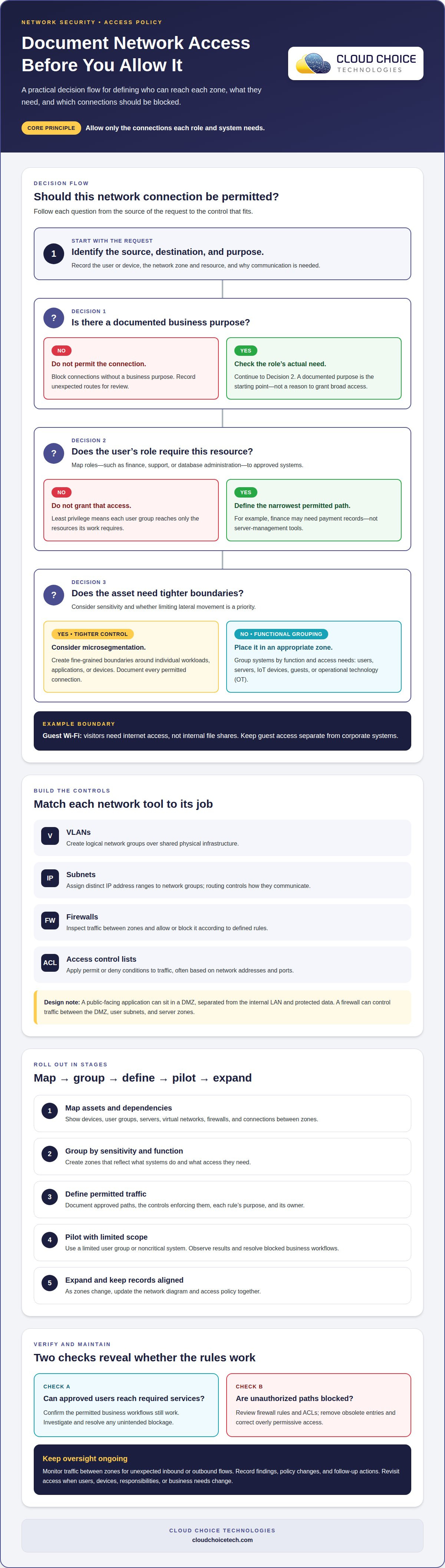
A useful policy records who can reach each network zone, which resources they need, and why. For role-based access control, map roles such as finance, support, and database administration to approved systems. Apply least privilege: a finance user may need payment records, but not server-management tools. Document each role’s owner, permitted access, approval process, and any changes when responsibilities shift.
Pair the policy with an up-to-date network diagram. Show devices, user groups, servers, virtual networks, firewalls, and connections between zones. Mark permitted access paths and the controls that enforce them. For example, a diagram might show a public-facing application connecting to a designated server while its database remains isolated from direct internet access. Record the purpose of each connection so teams can distinguish authorized traffic from unexpected routes.
Create separate zones for users, servers, IoT devices, guests, and operational technology (OT), based on their access needs. Guest Wi-Fi should stay separate from corporate systems: visitors need internet access, not internal file shares. Document third-party access points, the partner’s work function, approved systems, and access limits. Restrict vendors to the devices and services required for their work instead of granting broad network access.
Microsegmentation creates fine-grained boundaries around individual workloads, applications, or devices, rather than grouping them only into broad network zones. Organizations can use it when sensitive assets need tighter controls or limiting lateral movement is a priority. Document every permitted connection to keep these additional controls understandable and manageable.
Implement segmentation in stages to reduce operational disruption. First, map assets and dependencies. Then group systems by sensitivity and function, and define permitted traffic. Pilot the rules with a limited user group or noncritical system, observe the results, and resolve any blocked business workflows before expanding. Keep the network diagram and access policy aligned as each zone changes.
Test effectiveness by confirming that approved users can reach required services and unauthorized paths are blocked. Review firewall rules and access-control lists for obsolete or overly permissive entries. Monitor traffic between zones for unexpected inbound or outbound flows, and record findings, policy changes, and follow-up actions. These records support troubleshooting and show whether controls still match current users, devices, and business needs.
What is network segmentation?
Network segmentation divides a larger network into smaller segments, each with defined communication paths. This architecture separates internal systems by function or sensitivity. For example, a company can isolate a database from employee devices and limit which network traffic reaches it. If an attack compromises one segment, these boundaries can make lateral movement to other systems harder.
Virtual local area networks (VLANs) create logical network groups over shared physical infrastructure. Subnets assign distinct IP address ranges to those groups, while routing controls how they communicate. A switch can carry separate VLAN traffic, and a router or other Layer 3 device can manage permitted connections between subnets. This lets organizations implement logical separation without requiring a different physical network for every group.
Firewalls inspect traffic between network zones and allow or block it according to defined rules. Access control lists (ACLs) apply permit or deny conditions to traffic, often based on network addresses and ports. For example, a firewall can allow an application server to reach a database over a required service while blocking unrelated devices. Internal firewalls add inspection between critical segments, not just at the network perimeter.
Firewall and VLAN architecture should reflect which systems need to communicate. A public-facing website can sit in a demilitarized zone (DMZ), separated from the internal LAN and protected data. A firewall can control traffic between the DMZ, user subnets, and server zones. Document every permitted path and block connections without a business purpose.
Rule management keeps access controls aligned with that design. Administrators should review firewall rules and ACLs regularly, remove obsolete entries, and correct rules that grant broader access than required. Record each rule’s purpose, owner, approved source and destination, and related change. NIST SP 800-41 Rev. 1 is cited as guidance on firewalls and firewall policy, according to the National Institute of Standards and Technology (NIST).
Clear documentation makes network changes easier to assess and troubleshoot. Teams responsible for managed IT services can help maintain network infrastructure and its access controls as business systems change.
Network segmentation benefits
Separate network zones can limit the systems an attacker can reach after compromising a device. Effective network segmentation for security best practices treats each boundary as a way to constrain access, not as a barrier without purpose. For example, isolating payment applications from employee devices can reduce unauthorized paths to sensitive resources. Smaller zones can also help security teams monitor traffic and investigate unusual connections.
Segmentation can improve performance by keeping unnecessary traffic away from applications that do not need it. A guest Wi-Fi network, for instance, can carry visitor internet traffic without using the same route as internal business applications. Teams can prioritize communication between authorized systems while limiting unrelated traffic across the network. The results depend on how well the design reflects actual workflows.
Security benefits depend on suitable rules, not simply on creating VLANs. A firewall between a user network and a server network can allow required application traffic while denying other connections. Reviewing those rules helps prevent attackers from using overly broad pathways to move laterally from a compromised workstation toward critical systems.
Network zones can also help organize compliance work by separating systems that handle regulated information. For example, an organization can isolate payment-processing systems from general office devices, then focus access reviews on that zone. HIPAA is an example of a compliance regulation relevant to zones handling healthcare information, according to the U.S. Department of Health and Human Services. Controls should reflect the data and systems in scope.
Common mistakes include creating segments without enforcing traffic controls, leaving outdated firewall rules active, and allowing broad access between zones. These gaps can expose sensitive applications, weaken monitoring, and give an attacker more routes after a compromise. Over-segmentation can also make legitimate workflows harder to manage when boundaries lack a clear business purpose.
Apply network segmentation for security best practices by giving every segment a defined purpose and reviewing it as systems change. For example, a new server should receive access only to the user groups and applications that need it. Regular reviews of firewall rules, access-control lists, and inter-zone traffic can reveal improper pathways and keep the design aligned with business needs.
Defense-in-depth through network segmentation
Defense in depth combines multiple controls so one failed barrier does not expose every system. Network segmentation adds boundaries inside an organization’s infrastructure, beyond external defenses such as perimeter firewalls. If malware reaches an employee device, strict rules between that device’s zone and critical servers can limit its movement. Endpoint protection, identity controls, and traffic monitoring add further layers, each addressing different threats.
Segmentation works best when access follows least privilege and every connection has a defined purpose. For example, a workstation may reach a business application while direct access to the application’s database remains blocked. If an attacker compromises the workstation, those boundaries make lateral movement harder and can limit the affected systems. Monitoring traffic between zones can also help teams identify unusual connections and respond with clearer context.
Network boundaries must be enforced and reviewed, not treated as a one-time design task. NIST Special Publication 800-215 provides guidance on securing enterprise networks, including network segmentation, according to the National Institute of Standards and Technology (NIST). Organizations can use its enterprise-network focus to inform how they plan connected systems, traffic controls, and security boundaries.
Virtual infrastructure needs its own segmentation decisions. NIST Special Publication 800-125B focuses on securing virtualized environments through network segmentation for virtual machines, according to the National Institute of Standards and Technology (NIST). For example, virtual machines supporting different applications can use separate network controls, limiting unnecessary communication even when they share physical infrastructure.
A practical defense-in-depth design starts with critical assets and the paths they require. Map those dependencies, define permitted traffic, and apply controls at segment boundaries. Then test that business workflows still function while unauthorized paths remain blocked. Review access when applications, users, or infrastructure change. This keeps monitoring useful and avoids creating isolated zones that disrupt legitimate work.
Segmentation complements other cybersecurity controls; it doesn’t replace endpoint protection, secure authentication, or response planning. Organizations reviewing how network boundaries fit into a broader security program can explore cybersecurity services.
Cloud Choice Technologies: AI Compliance and Security
Cloud Choice Technologies can help organizations connect network segmentation decisions with a broader security approach. Its AI Compliance and Security offering addresses AI governance and security alongside the organization’s other controls. This is relevant when teams introduce AI tools and need to understand how those systems fit within existing access boundaries, data-handling practices, and risk oversight.
Segmentation decisions also involve everyday technology operations. Which systems need to communicate? Do user groups have appropriate access? Are network rules still aligned with how employees use applications? Cloud Choice Technologies’ Managed IT Services can support organizations managing network environments and changing technology needs. This may be useful when infrastructure changes make existing access paths or documentation harder to maintain.
For organizations reviewing protective controls, Cloud Choice Technologies’ Cybersecurity services can address broader security concerns alongside network boundaries. Segmentation is one part of a wider approach: access controls, monitoring, and other safeguards each play a role. A review can clarify where network zones fit, which risks deserve attention, and which controls should be considered together. This perspective is useful when a network design has grown over time or business systems have changed.
Cloud Choice Technologies’ Remote Support can help resolve technical issues without requiring every troubleshooting task to happen onsite. This can matter when access problems affect users, devices, or connections between systems. Clear documentation of the network and its permitted paths gives support teams useful context. It can also help distinguish an expected connection failure from a rule that blocks a legitimate business workflow.
Consider Cloud Choice Technologies when your organization is planning changes to network access, reviewing cybersecurity controls, or introducing AI systems that raise compliance and security questions. The right focus depends on your environment, business workflows, and the systems that need protection. A clear discussion of those needs can help identify whether AI Compliance and Security, Managed IT Services, Cybersecurity, or Remote Support best fits the situation. Contact Cloud Choice Technologies to discuss your organization’s needs.
Make segmentation an ongoing security practice
Network boundaries need to keep pace with changing users, applications, and business priorities. Treat network segmentation for security best practices as an ongoing discipline: revisit access decisions when systems change, and keep accountability clear as responsibilities shift. This provides a practical path from design decisions to consistent day-to-day oversight.
Cloud Choice Technologies provides managed IT services and cybersecurity services to help businesses address technology operations and security needs. These services can help when your team needs support maintaining its environment, strengthening cybersecurity, or resolving technical issues that affect access and connectivity. The right focus depends on your organization’s needs and current priorities.
Start by identifying the network decisions that need attention and their business impact. A focused conversation with Cloud Choice Technologies can clarify which support is relevant, without turning the process into a complicated project before you know what is needed.
Contact Cloud Choice Technologies to discuss your organization’s needs and possible next steps. A clear, deliberate approach can help keep security decisions aligned with the way your business works.
Frequently Asked Questions
What is network segmentation and how does it improve security?
Segmentation can reduce unnecessary reachability between systems, narrowing the paths available to an attacker. It can also help teams investigate an incident by showing which systems could communicate with the affected resource. For example, if a software build service is compromised, carefully scoped connections can help distinguish approved deployment routes from unrelated access. Segmentation complements, but does not replace, controls that verify users and devices.
What are network segmentation best practices for enterprise environments?
Enterprise environments benefit from consistent policies across offices, data centers, and cloud platforms. Assign an owner to each zone and define how policy exceptions are approved, reviewed, and retired. Include a rollback plan for changes that affect essential services, such as authentication or software deployment. These practices make network segmentation for security best practices easier to govern as teams, applications, and infrastructure evolve.
How should organizations identify assets and define segmentation zones?
Begin by reconciling asset records with information from endpoint tools, cloud inventories, and network management systems. Pay special attention to temporary resources, such as short-lived test machines, which can fall outside routine oversight. For each asset, record a business owner and lifecycle status. These details help determine whether it belongs in an existing zone, needs a distinct policy, or should be removed from the environment.
How do VLANs, firewalls, and software-defined networking compare for segmentation?
Choose an approach that fits the environment and the team’s ability to operate the controls consistently. VLAN-based designs can suit established switching environments; firewall-centered policies can provide a familiar enforcement point; and software-defined networking can help manage policies across virtual workloads. These approaches are not mutually exclusive. Before selecting an architecture, consider where systems run, how policies will change, and whether administrators can troubleshoot the resulting design.
What firewall rules and access controls should be used between network segments?
Define rules in enough detail to identify the initiating system, destination, required service, business owner, and reason for access. Specify whether connections can be initiated in one direction or both, and log activity where it supports investigation. Give exceptions a review date so temporary access does not quietly become permanent. For example, remove a deployment exception after its approved release task ends.