
Managed Detection and Response for Business Security Teams
Threat alerts alone don’t protect a business; investigation and response do. Managed detection and response (MDR) for business helps organizations spot suspicious activity across endpoints, networks, and cloud environments, then investigate and contain threats. MDR services provide security monitoring 24 hours a day, 7 days a week.
It’s reasonable to expect an in-house team to know its systems best. But monitoring multiple security layers takes time, expertise, and the right tools. MDR adds specialist monitoring and threat investigation while keeping your internal team involved in decisions about operations and risk.
This guide explains what MDR does, how it connects activity across security layers, and how it can support an existing security team. It also covers what service-level agreement (SLA) response commitments mean, which capabilities to assess, and how managed detection and response fits into wider business cybersecurity.
Key Takeaways
- Use MDR to extend security monitoring across endpoints, networks, cloud environments, and other connected layers, rather than relying on isolated alerts.
- Look for human-led threat hunting and investigation that can connect signals across systems, prioritize incidents, and support containment.
- Define how an MDR provider works with your in-house security and IT teams, including who investigates alerts and who makes response decisions.
- Read the service-level agreement closely: distinguish alert acknowledgment, investigation, escalation, and response commitments.
- Assess how security monitoring, cyber risk analysis, and broader IT support fit together to address your organization’s needs.
What is managed detection and response (MDR) used for?
Managed detection and response (MDR) combines security monitoring, investigation, and support responding to threats. Depending on the service’s scope, monitoring may cover email, endpoints, servers, cloud workloads, and networks.
Continuous Threat Monitoring
Round-the-clock monitoring looks for suspicious activity across connected business systems. For example, an unusual endpoint login may matter more when paired with unexpected network traffic or cloud account changes. A 24/7 security operations center can review alerts outside normal business hours, while automated tools help surface activity for expert analysis.
Coverage matters. Businesses should map monitored email, endpoints, servers, cloud workloads, and network infrastructure against their own environment. A system that generates data but isn’t connected to monitoring may leave investigators without useful context. The National Institute of Standards and Technology (NIST) notes that organizations lacking resources to monitor computers and networks internally can engage a service provider to watch for suspicious activity.
Alert Triage and Incident Response
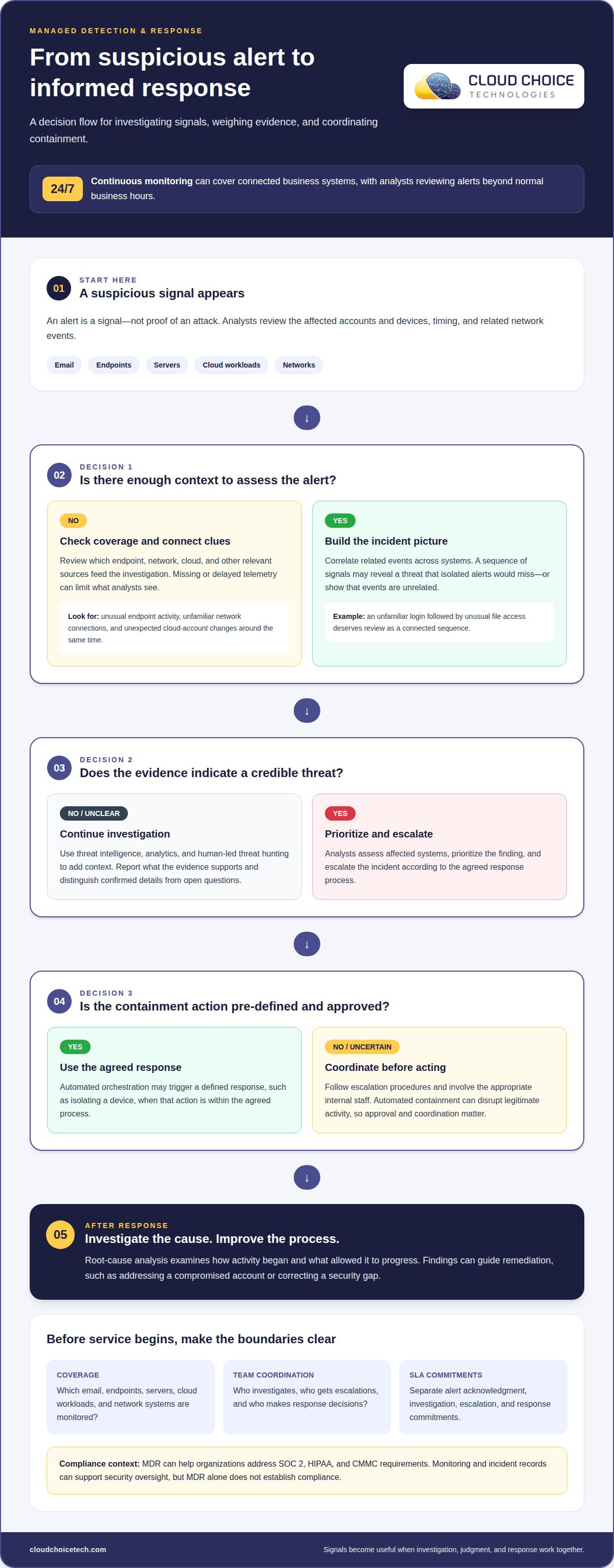
An alert is a signal, not proof of an attack. MDR analysts investigate details such as affected accounts and devices, timing, and related network events to assess whether an alert indicates a credible threat. They prioritize findings, escalate incidents, and support containment to help limit an attack’s spread.
Businesses choosing an MDR provider should look for always-on coverage, enhanced threat intelligence, human-led threat hunting, and proven enterprise experience. Ask how analysts investigate alerts and coordinate response actions with internal staff. The MDR process can include investigation, containment, and root cause analysis, which helps teams understand how an incident began and reduce the chance of recurrence.
What compliance requirements can MDR help U.S. businesses meet? MDR can help organizations address SOC 2, HIPAA, and CMMC requirements. Monitoring and incident records can support security oversight, but MDR doesn’t by itself establish compliance.
What are the risks and limitations of MDR? MDR depends on the systems and telemetry within its scope, so coverage gaps can limit what analysts see. Automated containment can also disrupt legitimate activity, making clear escalation procedures and coordination with internal teams important.
MDR works best as part of a defined security process. Before service begins, agree on coverage boundaries, alert escalation paths, and response responsibilities. Confirm that monitoring includes each critical environment, from user email and endpoints to cloud workloads and the business network. Clear procedures help teams respond to credible threats without treating every alert as an incident.
Cross-layer threat detection and telemetry correlation
Correlating telemetry helps analysts connect separate events into a clearer incident picture. Network, endpoint, and cloud signals together may reveal activity that isolated alerts miss.
Cross-Layer Telemetry Correlation
Each security layer provides different clues. An endpoint may show an unusual process, while network logs reveal connections to unfamiliar destinations. Cloud records might show unexpected account changes around the same time. Correlating these events helps analysts assess whether they point to one threat or unrelated activity.
Coverage shapes what analysts can see. Review which endpoint, network, cloud, and IoT sources feed the analysis. Managed extended detection and response (MXDR) can extend coverage across endpoints, networks, clouds, and the Internet of Things. Ask how missing or delayed telemetry affects investigations and reporting.
Threat Intelligence and Hunting
Threat intelligence can provide context for suspicious indicators, such as unusual connections or behavior. Analytics may help prioritize incidents by combining these clues with activity across the organization. Human-led threat hunting looks for patterns automated alerts may miss, such as a sequence of low-profile actions across connected systems.
Ask how hunting findings are shared with your team. Useful reporting connects the evidence, explains the likely risk, and identifies relevant systems. This context helps teams make informed cybersecurity decisions and understand changes in their security posture.
Investigation and Root-Cause Analysis
When a potential incident emerges, investigators examine related alerts, devices, accounts, and network events. They build a timeline and identify systems with evidence of impact. For example, an unfamiliar login followed by unusual file access deserves review as a connected sequence, not merely as two separate notifications.
Root-cause analysis examines how activity began and what allowed it to progress. Findings can guide remediation, such as addressing a compromised account or correcting a security gap. Check whether incident reports distinguish confirmed evidence from open questions and explain recommended next steps.
AI-Assisted Detection and Response
AI-assisted analytics can sort large volumes of telemetry and flag patterns for expert review. Automated security orchestration can also trigger defined responses, such as containing a threat, to support timely intervention. Automation assists analysts; it doesn’t replace investigation or business judgment.
Before relying on automated containment, understand which actions run automatically and which require human approval. A response might isolate a device, while remediation guidance could direct staff to review affected accounts. Clear escalation paths help limit disruption to legitimate work. For broader cybersecurity planning, cybersecurity services can help align security controls with business needs.
Support for in-house SOC and IT security teams
MDR can extend an organization’s security capacity without replacing internal analysts. Its value depends on how monitoring, investigation, and response fit existing controls and team responsibilities.
Extend Team Capacity and Visibility
An in-house security team understands its business systems, users, and operational priorities. MDR analysts can add monitoring and investigation capacity, leaving internal staff to focus on decisions that require organizational context. For example, an analyst can help assess whether a suspicious endpoint event affects a critical business function before containment is approved.
Define responsibilities before an incident. Decide who reviews escalated alerts, who authorizes disruptive actions, and who informs business leaders. Clear roles prevent duplicated investigations and connect incident response to operational needs. Reporting should give internal teams the findings, affected assets, and recommended actions.
Integrate Existing Security Controls
Existing endpoint detection and response tools can provide alerts, investigation details, and containment capabilities. Managed endpoint detection and response (MEDR) can cover endpoint protection within a broader MDR service. Managed network detection and response (MNDR) can add monitoring for network infrastructure.
Map each control to its role: which system detects activity, where alerts go, and who acts on them. For example, document how an endpoint alert reaches an analyst and how the analyst coordinates with IT staff. This review can reveal gaps, duplicate notifications, and unclear handoffs.
Connect Tools and Workflows
Before onboarding, list the tools already used for endpoints, networks, identity, email, and cloud workloads. Identify which tools provide telemetry, which teams receive alerts, and what information investigators need. This inventory gives analysts a practical view of available evidence rather than a set of fragmented notifications.
Establish access and escalation workflows, too. Specify how analysts share findings, who can isolate an endpoint, and how internal staff receive remediation guidance. Clear permissions help teams act promptly while preserving business oversight of sensitive systems.
Plan for Hybrid and Multi-Cloud Coverage
Hybrid environments combine local infrastructure with cloud workloads, while multi-cloud environments use more than one cloud platform. MDR coverage should account for each environment that supports business operations. Managed extended detection and response (MXDR) can extend coverage across endpoints, networks, clouds, and the Internet of Things.
Ask how monitoring handles telemetry from each environment and how analysts investigate activity that crosses between them. An endpoint event, for example, may be linked to a cloud account change and network activity. Shared visibility helps internal teams understand an incident’s path, coordinate response, and use reporting to improve security operations.
MDR service-level agreements and response times
A service-level agreement (SLA) sets measurable expectations for monitoring, alert handling, escalation, and response. Read it alongside the service description: acknowledging an alert quickly is not the same as investigating, containing, or fully remediating an incident.
What is managed detection and response (MDR) for businesses? MDR combines security monitoring with expert investigation and support responding to threats. Capabilities may include threat intelligence, alert triage, threat hunting, containment, and incident reporting. The SLA should clarify which activities the provider performs and which remain your team’s responsibility.
Check how the agreement defines response time. It should distinguish when the provider receives an alert, when an analyst starts reviewing it, and when the provider contacts your organization. It should also explain severity levels, escalation channels, and whether commitments apply to every monitored environment. A platform may detect an attack quickly, but the SLA sets out the service’s documented commitments.
A reported response time illustrates why these distinctions matter. A Fischer Homes infrastructure manager said they determined whether an alert was legitimate in three minutes using an MDR service. That is one individual’s experience, not a universal SLA. Your agreement should specify its own triggers, timing measures, and actions for each incident category.
What types of businesses need MDR services? MDR may suit organizations that need added security monitoring or investigation capacity, including businesses with limited in-house coverage. Consider the sensitivity of your systems, available analyst capacity, cloud and network complexity, and the response responsibilities your internal team can sustain.
Service names often describe different coverage areas. Managed endpoint detection and response (MEDR) focuses on endpoints. Managed network detection and response (MNDR) covers network infrastructure. Managed extended detection and response (MXDR) can extend coverage across endpoints, networks, clouds, and the Internet of Things. Compare these scopes with your actual environment, not just a provider’s platform label.
What should businesses expect during MDR onboarding and incident response? Onboarding typically establishes which systems send telemetry, who receives escalations, and who authorizes containment. During an incident, the provider investigates, shares findings, and follows agreed response steps. The SLA should identify handoffs, reporting procedures, and remediation responsibilities.
How much does MDR cost for a business in the United States? MDR pricing varies with the monitored assets, coverage scope, service capabilities, and response requirements. Ask for a quote based on your needs.
Review promotional terms as carefully as ongoing terms. Check the included coverage, duration, exclusions, renewal conditions, and any changes to support or response commitments afterward. Confirm that requirements such as hybrid cloud visibility or network monitoring remain covered when promotional terms end.
Cloud Choice Technologies: Managed IT Services
Cloud Choice Technologies can help businesses connect security priorities with day-to-day technology support. Its managed IT services support ongoing IT needs, while Cybersecurity and Cyber Risk Analysis help organizations assess threats and strengthen their security approach.
Consider managed support when your internal team needs help managing technology alongside security concerns, or wants a clearer view of cyber risks. The right next step depends on your environment, existing monitoring coverage, and how security responsibilities are shared across your team.
To discuss your business’s IT and security needs, visit Cloud Choice Technologies.
Make Your Next Security Decision With Clarity
A managed detection and response (MDR) for business strategy should reflect your operational priorities, not just your security tools. Start by identifying critical systems, who owns security decisions, and how outside support should fit your workflow. These answers provide a practical basis for evaluating coverage and response commitments.
Cloud Choice Technologies provides Managed IT Services, Cybersecurity, and Remote Support for business technology and security needs. Its Cyber Risk Analysis can help inform decisions about risks and priorities. Start with a clear view of your current environment and where your team needs support. Cloud Choice Technologies also offers a free Network Security Analysis.
Take the next step at your pace. Contact Cloud Choice Technologies to discuss your business’s IT and security priorities, and move forward with greater clarity.
Frequently Asked Questions
What is the difference between MDR and SOC?
A SOC is a security operations function; MDR is a managed service focused on detecting and responding to threats. A business may run its own SOC, outsource SOC activities, or use MDR to add external security expertise. The terms can overlap: an MDR provider may use a security operations center for monitoring. Compare responsibilities, not labels, to see who investigates alerts and coordinates action.
How do you enable MDR?
Document business-critical systems, current security tools, and who approves disruptive actions. Define the environments to monitor and connect relevant telemetry sources, such as endpoint and cloud security tools. Before monitoring begins, agree on escalation procedures, incident contacts, and reporting expectations. For example, clarify whether the IT lead or an executive authorizes isolating a device that supports an essential business process.
How does MDR work?
MDR combines security technology with analyst-led work to identify and assess suspicious activity. The service gathers signals from agreed coverage, prioritizes findings, and investigates whether they point to a real threat. An analyst’s incident report, for example, can help a security team decide whether to disable an account, investigate a user’s device, or monitor the situation further. The provider and business coordinate actions under agreed procedures.
What are the benefits of MDR?
MDR can give a business access to security expertise and investigation capacity beyond its internal staff. It can help teams distinguish urgent incidents from routine notifications, making security work easier to prioritize. Clear incident documentation is another practical benefit: leaders can understand what happened, which systems were affected, and what follow-up remains. The value depends on suitable coverage and coordination with internal decision-makers.
What are the components of MDR?
Core components commonly include security monitoring technology, analyst investigation, threat intelligence, escalation procedures, and incident reporting. Some services also include threat hunting, containment support, or root-cause analysis. Together, these elements turn security signals into decisions and follow-up actions. For instance, a report should identify the affected asset and recommend a next step, giving internal staff context to coordinate remediation.
What are the types of MDR?
MDR services often differ in the environments they cover. Managed endpoint detection and response (MEDR) focuses on endpoint devices, while managed network detection and response (MNDR) addresses network infrastructure. Managed extended detection and response (MXDR) can extend coverage across endpoints, networks, cloud environments, and connected devices. Match the service scope to your business systems, including workloads that operate beyond a traditional office network.