
IT Disaster Recovery Planning in 2026: The Executive Resilience Framework
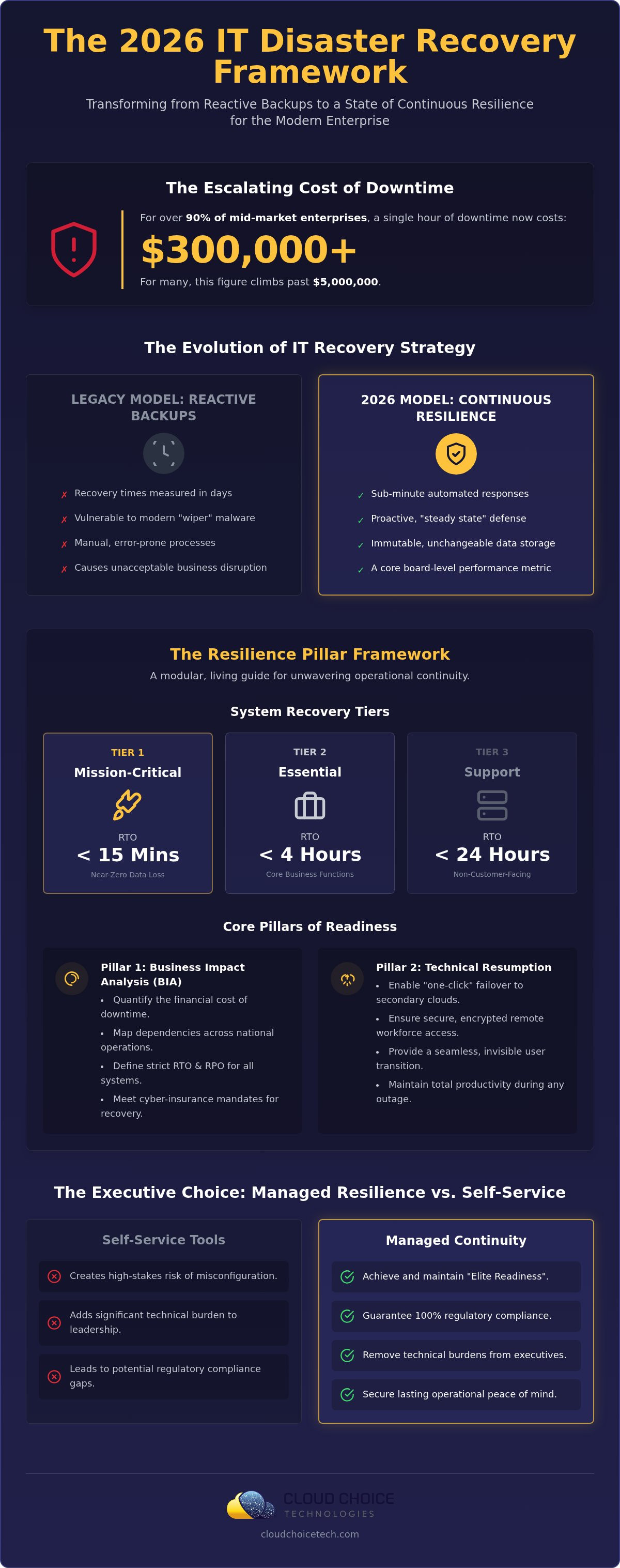
For more than 90% of mid-market enterprises in 2026, a single hour of operational downtime now costs over $300,000; for many, that figure climbs past $5 million. You've likely felt the mounting pressure of securing data across a national remote workforce while facing increasingly strict cyber insurance requirements. It's a high-stakes environment where traditional backups are no longer enough to stop AI-driven threats. You need a strategy that transforms IT disaster recovery planning from a reactive chore into a pillar of elite readiness.
We understand that digital uncertainty creates unnecessary stress for your leadership team. This article promises to show you how to master the modern IT disaster recovery planning process to eliminate downtime and protect your national operations. We'll provide a clear roadmap to achieving near-zero Recovery Time Objectives (RTO) and ensuring 100% regulatory compliance. By the end of this guide, you'll have the Executive Resilience Framework needed to maintain total control over complex disruptions and secure lasting peace of mind. We'll break down the specific steps to move from vulnerability to a state of unwavering reliability.
Key Takeaways
Transition from reactive backup routines to a 2026 continuous resilience model that proactively safeguards your national operations.
Discover how to integrate the Resilience Pillar template into your IT disaster recovery planning to create a living, real-time defense against AI-driven threats.
Compare the long-term cost-effectiveness of managed resilience models against the high-stakes risks of self-service backup tools.
Learn how a managed approach to operational security removes technical burdens from executives while maintaining elite readiness and total regulatory compliance.
Table of Contents
The 2026 IT Disaster Recovery Template: A Strategic Framework
Elite Readiness: Why Managed Continuity is the Executive Choice
The Evolution of IT Disaster Recovery Planning in 2026
In 2026, the definition of IT disaster recovery planning has shifted from a technical insurance policy to a core pillar of operational continuity. Legacy models relied on reactive "backup and restore" cycles that often took days to complete. Today, that delay is unacceptable. Modern resilience frameworks are proactive, designed to maintain a "steady state" even during active cyberattacks. Executive accountability has followed suit. Resilience isn't just an IT task; it's a board-level performance metric used to judge organizational health and stability.
The primary driver of this evolution is the sophistication of 2026 threats. AI-powered ransomware now executes at machine speed, requiring automated, sub-minute response times to isolate infections before they spread across national networks. A robust Disaster Recovery Plan (DRP) must leverage real-time monitoring and automated failovers to ensure that business operations don't just recover, but never truly stop. It's about moving from a state of repair to a state of constant readiness.
Why Traditional Backups Are No Longer Enough
Standard cloud backups are increasingly vulnerable to modern "wiper" malware designed to delete recovery points before encrypting primary data. To counter this, elite organizations have moved toward immutable data storage. This ensures that once data is written, it cannot be altered or deleted by unauthorized actors. By integrating these strategies with comprehensive business cybersecurity solutions, you prevent the very need for a manual "disaster" response. You're not just saving data; you're preserving your brand's integrity through preventative oversight.
Resilience in a Distributed National Economy
Managing a workforce spread across the country introduces unique points of failure. A hardware crash in a remote hub shouldn't paralyze a national workflow. This is where specialized remote IT support for corporations becomes a vital component of your recovery strategy. In 2026, clients expect "zero-latency" recovery. Whether your team is in a central office or working remotely, your IT disaster recovery planning must provide a seamless transition to backup systems that feels invisible to the end user. This level of precision is what defines the modern executive resilience framework.
The 2026 IT Disaster Recovery Template: A Strategic Framework
Modern IT disaster recovery planning requires more than a simple checklist stored in a PDF. To stay ahead of 2026 threats, your strategy must exist as a "Resilience Pillar" template-a modular, living guide that integrates directly with your infrastructure. This framework shouldn't just sit on a shelf; it needs to be powered by real-time data. Integrating business network monitoring services is non-negotiable. These tools act as the digital tripwire, triggering recovery protocols the moment an anomaly is detected.
To ensure efficiency, your template must establish a clear hierarchy of recovery. Not every system requires the same speed of resumption. We categorize systems into three distinct tiers:
Mission-Critical (Tier 1): Systems that require an RTO of less than 15 minutes and near-zero data loss.
Essential (Tier 2): Core business functions that must be restored within 4 hours.
Support (Tier 3): Non-customer-facing systems with a recovery window of up to 24 hours.
Pillar 1: Business Impact Analysis (BIA) and RTO/RPO Mapping
Business Impact Analysis (BIA) is the foundational step in quantifying the financial cost of every minute of downtime. For a national organization, this process involves mapping dependencies across various operational units and time zones. You must define your Recovery Time Objective (RTO)-how quickly you need to be back up-and your Recovery Point Objective (RPO)-how much data loss is tolerable. In 2026, Tier-1 insurance providers often mandate sub-15-minute RTOs for mission-critical workloads to maintain coverage eligibility.
Pillar 2: Technical Resumption and Secure Remote Work
When a primary network fails, your distributed workforce shouldn't lose a second of productivity. You need "one-click" failover capabilities to secondary cloud environments that replicate your entire production stack. Implementing secure remote work solutions ensures that even during an office-level outage, your team maintains encrypted, high-performance access to vital tools. This creates a seamless transition that is virtually invisible to your clients.
Pillar 3: AI Compliance and Crisis Governance
Recovery isn't just about technical uptime; it's about governance. Your national "Resilience Command" must have clear communication protocols to manage the crisis without violating privacy laws. Maintaining regulatory compliance IT support throughout the resumption process ensures that AI-driven security tools don't bypass essential guardrails during a failover. Professional managed IT services can help you automate these compliance checks so you remain protected on all fronts.
Evaluating Business Continuity Planning Services
Choosing between a self-service backup tool and a managed resilience model is the difference between owning a fire extinguisher and having a full-time fire department. Self-service tools often fail during a crisis because they lack the human oversight required to navigate complex 2026 AI threats. A "Vigilant Guardian" partner doesn't just store your data; they detect anomalies before they trigger a disaster. This proactive stance ensures your IT disaster recovery planning remains a living defense rather than an outdated document gathering digital dust.
Many executives hesitate at the monthly investment required for comprehensive continuity. However, when you consider that a single hour of downtime in 2026 can exceed $300,000 for mid-market firms, the financial logic is undeniable. You're turning a catastrophic variable risk into a fixed, predictable performance standard. It's about purchasing certainty in an era of digital uncertainty. By the time you need your recovery plan, it's already too late to wonder if it works.
Proactive Resilience vs. Reactive Recovery
Emergency technical resumption is notoriously expensive. Beyond the immediate repair costs, you face the long-term erosion of client trust and brand reputation. 2026 cyber insurance carriers now mandate proven, tested continuity plans for policy eligibility. Utilizing managed IT services provides the necessary infrastructure for continuous, automated testing. This ensures your systems meet the rigorous standards required for both insurance compliance and operational stability.
Vendor Selection: The 2026 Checklist
Vetting a service provider requires looking beyond basic storage capacities. Your partner must function as an extension of your executive team, providing elite readiness across your entire national footprint. Evaluate potential partners against these critical 2026 standards:
Does the provider offer 24/7 national remote support with guaranteed sub-hour response times?
Are they demonstrated experts in AI safety and national regulatory adherence?
Do they integrate managed cloud security services directly into the continuity package?
Can they provide documented proof of successful recovery drills conducted within the last 90 days?
To ensure your organization is prepared for the next evolution of digital threats, you should consult with experts who prioritize constant uptime. Secure your national operations with a proactive resilience audit today.
Elite Readiness: Why Managed Continuity is the Executive Choice
Cloud Choice Technologies stands as the authoritative partner for national operational security. We recognize that as an executive, your focus belongs on growth and strategy, not on the technical minutiae of server failovers. Our managed approach removes the technical burden from your internal teams, replacing digital uncertainty with a sense of total control. You aren't just buying a backup solution. You're securing a vigilant, fast-acting guardian that maintains your operational integrity 24/7.
Effective IT disaster recovery planning in 2026 is about more than avoiding a crisis. It's about establishing a foundation of unwavering reliability that your clients can trust. When you shift from reactive emergency planning to a model of guaranteed performance, you eliminate the stress of potential downtime. We provide the calm in the storm. This ensures that even the most sophisticated AI-driven threats are met with a composed, professional defense that keeps your brand's reputation intact.
The Cloud Choice Advantage: Vigilance and Velocity
Our framework integrates specialized AI risk analysis into every recovery layer. This allows us to identify and neutralize vulnerabilities before they can be exploited by malicious actors. For corporations with a distributed national footprint, our service model provides a unified standard of protection regardless of where your team is located. We combine technical superiority with high accessibility. This ensures you always have a human expert ready to respond. This velocity is what separates a standard recovery plan from elite readiness. We pride ourselves on being a partner that is technically superior and highly accessible at all times.
Next Steps: Securing Your 2026 Growth
Your path to total resilience begins with a few decisive actions. We move quickly from identifying vulnerabilities to implementing long-term solutions. Our process includes:
A proactive cyber risk analysis to uncover hidden infrastructure weaknesses.
Customized RTO and RPO mapping aligned with your specific business tiers.
The deployment of a dynamic, managed resilience program that evolves with 2026 threats.
This isn't a static document. It's an active, managed service that evolves alongside your business needs. Don't wait for a disruption to test your defenses. Ensure your business never stops; consult with our resilience experts today.
Mastering National Resilience for 2026
Resilience is no longer a choice; it's an operational standard. By adopting a proactive IT disaster recovery planning framework, you move beyond basic backups and into a state of constant readiness. We've explored how a modular template and real-time monitoring turn recovery into a predictable performance metric. This shift allows your leadership team to focus on national growth rather than digital uncertainty. You're now equipped to handle complex disruptions with professional confidence and total control.
Cloud Choice Technologies provides the elite readiness your organization requires to thrive. We combine AI-Driven Threat Detection with a National Rapid Response Infrastructure to ensure your operations remain uninterrupted. Our commitment includes a 100% Compliance Guarantee, providing you with immediate peace of mind in a high-stakes environment. It's time to stop reacting to emergencies and start guaranteeing performance. Get Your 2026 Business Continuity Assessment today to secure your digital future. Your organization deserves the stability that only a vigilant, fast-acting partner can provide. Let's build a resilient future together.
Frequently Asked Questions
What is the difference between IT disaster recovery and business continuity planning?
IT disaster recovery planning focuses specifically on the technical restoration of data and infrastructure after a disruption. Business continuity planning is a broader strategy that ensures every aspect of the organization, including personnel and physical operations, remains functional. While recovery gets your servers back online, continuity ensures your team has a way to communicate and serve clients during the process. Both are essential components of a modern resilience framework.
How often should an IT disaster recovery plan be tested in 2026?
You should conduct full-scale recovery tests at least quarterly to account for the rapid evolution of 2026 cyber threats. Static annual testing is no longer sufficient because software updates and infrastructure changes happen weekly. Modern frameworks utilize automated, non-disruptive testing environments that verify your RTOs and RPOs in real-time. This ensures that when a genuine crisis occurs, your failover protocols execute exactly as documented without manual intervention or surprise failures.
Does business continuity planning reduce cyber insurance premiums?
Yes, a documented and tested continuity plan is now a primary requirement for Tier-1 cyber insurance eligibility. Carriers in 2026 prioritize organizations that demonstrate a proactive approach to risk, often offering lower premiums or better coverage terms to those with verified recovery capabilities. By proving that you can resume operations within minutes, you reduce the insurer's potential payout for business interruption, making your enterprise a significantly lower risk to underwrite.
Can IT disaster recovery services protect against AI-powered ransomware?
Advanced IT disaster recovery planning now incorporates AI-driven threat detection to identify ransomware behavior before encryption begins. If an infection occurs, services utilizing immutable, air-gapped storage ensure that your backups remain untouched by the malware. This allows for a clean restoration of your environment in sub-minute timeframes. It's a shift from merely hoping to recover to guaranteeing that your data remains safe and accessible despite sophisticated machine-speed attacks.
What are the most critical components of a Business Impact Analysis (BIA)?
The most critical components of a BIA include identifying mission-critical business functions, mapping technical dependencies, and quantifying the financial cost of downtime per minute. You must also determine the maximum tolerable downtime for each department to set accurate RTOs. This analysis provides the data needed to prioritize recovery efforts, ensuring that your most profitable and essential services are restored first during a national outage or system failure.
How does disaster recovery planning support a remote national workforce?
A robust plan ensures that your distributed team maintains secure access to essential applications from any location during a primary site failure. By utilizing secondary cloud environments and secure remote work protocols, you eliminate the single point of failure inherent in traditional office-centric models. This support allows your national workforce to remain productive and responsive to clients, regardless of localized hardware issues or regional connectivity disruptions that might otherwise paralyze operations.