
How to Pass a Cybersecurity Audit: The Strategic Role of Managed Services in 2026
What if your next cybersecurity audit wasn't a frantic scramble to gather evidence, but a quiet validation of the security you've already built? With the NIS2 Directive enforcement deadline of October 1, 2026, fast approaching and the recent suspension of CMMC 2.0 Phase 2 assessments creating fresh uncertainty, the regulatory landscape feels like a moving target. You likely feel the pressure of manual evidence collection pulling your staff away from their core duties. It's a common frustration. However, it's entirely avoidable when you implement continuous compliance monitoring for cybersecurity. This proactive approach ensures your systems remain in a state of elite readiness, regardless of when an auditor arrives.
This article provides a clear roadmap to help you navigate these complex requirements with total confidence. You'll discover how to leverage managed services to automate your compliance reporting and eliminate the fear of audit creep. We'll explore how a vigilant partner acts as your calm in the storm, handling technical inquiries so you can focus on scaling your business. You'll learn how to turn your security framework into a foundational element of your long-term success.
Key Takeaways
- Shift your perspective from reactive preparation to a 24/7 state of elite readiness that eliminates the stress of seasonal audits.
- Implement continuous compliance monitoring for cybersecurity to automate evidence collection and maintain a permanent, secure repository of audit-ready artifacts.
- Leverage a proactive managed partner to act as your technical liaison, translating complex security data into clear compliance proof for auditors.
- Prepare for the 2026 regulatory landscape by ensuring your AI-powered defenses and automated models are themselves fully compliant with emerging standards.
- Streamline your operational workflows by removing the burden of manual audit preparation from your internal staff, allowing them to focus on core business growth.
Breaking the Audit Cycle: Why Continuous Compliance Monitoring is Essential
Traditional cybersecurity audits often feel like a seasonal storm. You spend weeks in a reactive scramble, pulling staff away from critical projects to hunt for logs and documentation. This point-in-time approach is failing in 2026. Regulators now demand proof of ongoing vigilance, not just a single day of perfection. Transitioning to continuous compliance monitoring for cybersecurity shifts your organization into a state of elite readiness. It replaces the frantic audit cycle with a calm, automated verification process that runs 24/7. By utilizing continuous monitoring, you identify and remediate vulnerabilities the moment they appear, long before an auditor ever sets foot in your office. This persistent oversight is a core component of modern managed IT services, providing the technical foundation needed to maintain a stable, defensible security posture.
The Cost of Reactive Compliance
Reactive compliance is expensive. When your team spends hundreds of hours on manual evidence collection, you're losing valuable operational momentum. These "quick fixes" implemented just to pass an inspection often create long-term security debt because they don't address the root cause of the vulnerability. Beyond internal costs, an audit failure carries severe reputational weight. In 2026, corporate partners view a failed audit as a sign of digital instability. They won't hesitate to terminate contracts to protect their own supply chain integrity. You can't afford to treat compliance as a temporary project; it must be a permanent operational standard.
Mapping Your Compliance Framework
Success begins with a clear baseline. Whether you're navigating the 1,196 controls of NIST SP 800-53 or the specific privacy requirements of HIPAA, you need a precise map. A comprehensive cyber risk analysis serves as your primary diagnostic tool. It identifies where your current technical controls fall short of regulatory goals. This strategic alignment ensures that every security measure you implement serves a dual purpose: protecting your assets and satisfying specific audit requirements for frameworks like SOC2 or CMMC. We help you bridge the gap between abstract regulations and concrete technical configurations, ensuring you're always prepared for scrutiny.
The Architecture of an Audit-Ready Environment
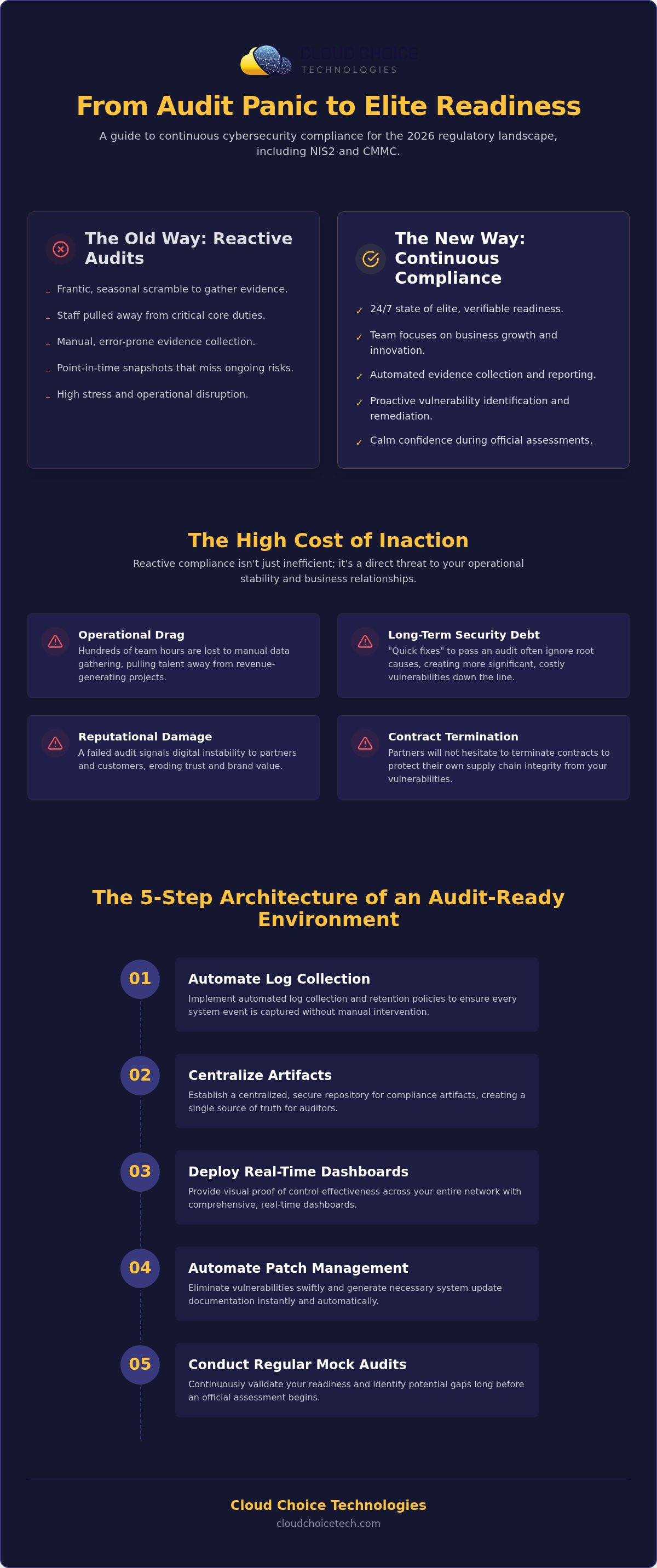
How do you build a system that never fails an inspection? It requires more than just good intentions; it demands a structured architecture designed for constant scrutiny. Building an audit-ready environment means embedding compliance into your daily technical operations. This is where continuous compliance monitoring for cybersecurity becomes your most valuable asset. Does your current infrastructure tell a story of neglect or one of elite readiness? By following a disciplined, five-step architecture, you can ensure your business remains defensible at all times.
- Step 1: Implement automated log collection and retention policies to ensure every system event is captured without manual intervention.
- Step 2: Establish a centralized, secure repository for compliance artifacts, creating a single source of truth for auditors.
- Step 3: Deploy real-time dashboards that provide visual proof of control effectiveness across your entire network.
- Step 4: Automate patch management to eliminate vulnerabilities and generate the necessary system update documentation instantly.
- Step 5: Conduct regular mock audits to validate your readiness and identify gaps before an official assessment begins.
Automating the Evidence Paper Trail
Manual spreadsheets are the enemies of efficiency. They're prone to error and quickly become outdated. We replace these fragile systems with automated reporting tools that provide timestamped security records. This creates a chronological narrative of your security efforts. These tools don't just record what happened; they capture evidence of absence. This proves to auditors that specific threats were blocked and unauthorized access attempts were mitigated. This high-definition visibility provides immediate peace of mind for executives facing strict regulatory deadlines. If you're ready to move beyond manual tracking, our compliance services provide the automated framework you need to stay ahead.
Technical Controls and Policy Alignment
A common audit failure occurs when written policies don't match actual technical configurations. Your firewall rules must mirror your stated security goals. We bridge this gap by aligning your technical controls with your organizational mandates. This includes documenting employee security training and phishing simulation results directly within your compliance portal. When an incident occurs, your response actions must link back to specific compliance requirements. This creates a closed-loop system where every technical action is justified by a policy and every policy is enforced by a control. This level of precision is exactly what modern frameworks like NIST SP 800-53 Revision 5 demand from resilient organizations.
Navigating the Audit Window with Proactive Support
The arrival of an auditor shouldn't feel like an interrogation. It's a professional verification of your business resilience. However, facing an auditor alone often leads to unnecessary stress and technical misunderstandings. We act as your dedicated technical liaison, bridging the gap between complex network configurations and strict regulatory requirements. By maintaining continuous compliance monitoring for cybersecurity, we ensure that every inquiry is met with immediate, data-backed evidence. This proactive stance transforms the audit window from a period of uncertainty into a demonstration of your organization's elite readiness.
Auditors frequently perform "spot checks" to verify that controls are active in real-time. Our remote IT support capabilities allow us to respond instantly to these requests. We can pull live configurations or demonstrate security protocols on the fly. If a minor discrepancy is identified during the process, our rapid response team can implement real-time remediation. Fixing findings before the final report is issued prevents small issues from becoming formal non-compliance marks. This level of agility is essential for maintaining a clean regulatory record in 2026.
Managing the Auditor Relationship
Expert presence during auditor interviews is critical. It prevents accidental admissions of non-compliance that often stem from misinterpreting a technical question. We speak the auditor's language, translating technical jargon into clear compliance proof. This builds a foundation of trust. When an auditor sees a team that is disciplined and meticulous about details, they're less likely to engage in "audit creep." We provide the calm, professional confidence needed to keep the assessment focused and efficient. If you want to secure this level of professional oversight, our compliance services provide the expert support you need.
The Value of Compensating Controls
Sometimes, a primary security control cannot be met due to legacy systems or specific business constraints. In these cases, we leverage expert consulting to design and document compensating controls. These alternative measures satisfy the auditor's intent while respecting your operational realities. We provide the technical justification needed to prove these deviations don't increase your risk profile. This ensures your continuous compliance monitoring for cybersecurity remains robust, even when standard solutions don't fit your unique architecture. Our goal is to ensure your business continuity remains uninterrupted throughout the entire regulatory process.
Sustaining Governance: AI Security and the Future of Audits
The regulatory landscape in 2026 has undergone a fundamental shift. It's no longer enough to secure your data; you must now secure the algorithms that process it. As AI becomes deeply embedded in your operational fabric, it introduces a new frontier for auditors. They're looking for proof that your automated defenses are governed by strict ethical and privacy standards. Integrating continuous compliance monitoring for cybersecurity allows you to track these AI models in real-time. This ensures your innovation doesn't outpace your integrity. By maintaining this level of oversight, you transform compliance from a legal hurdle into a powerful engine for brand reputation.
Auditing AI-Driven Organizational Protection
Your defenses against an AI-powered cyber threat must be as sophisticated as the attacks they prevent. However, these defenses are themselves subject to audit. Regulators now require verification of your AI governance frameworks to prevent data bias and privacy leaks. We help you bridge the gap between rapid technical innovation and stringent 2026 standards. Our specialized AI security measures ensure your models are transparent and defensible. This proactive approach prevents your automated tools from becoming a liability during your next regulatory assessment.
Continuous Monitoring as a Business Strategy
An audit shouldn't be the end of your security efforts. It's simply a milestone in a larger journey of governance. We help you transition your audit results into a long-term regulatory compliance IT support strategy. This involves setting up automated alerts to detect "compliance drift" the moment it occurs. When a system configuration changes or a new user is added, your monitoring tools should flag any potential violations immediately. Quarterly executive reviews keep your leadership team informed and ensure that security remains a core part of your corporate culture.
Businesses that embrace this model gain a significant competitive advantage. They don't just "pass" audits; they demonstrate a commitment to digital excellence that attracts high-value partnerships. When your clients see that you've implemented continuous compliance monitoring for cybersecurity, they know their data is protected by a vigilant, always-on guardian. This builds a level of trust that traditional, point-in-time security can't match. You aren't just checking boxes; you're building a foundation for sustainable growth in an increasingly regulated world.
Mastering the Future of Regulatory Readiness
The 2026 regulatory landscape doesn't have to be a source of operational dread. By shifting from reactive scrambles to a state of elite readiness, you protect both your business continuity and your professional reputation. We've explored how a robust architecture and expert guidance transform the audit window into a simple validation of your existing strength. Implementing continuous compliance monitoring for cybersecurity ensures you're never caught off guard by shifting standards or unexpected inquiries. It's about moving from a defensive posture to one of undisputed authority and persistent stability.
Cloud Choice Technologies acts as your vigilant guardian, providing the specialized AI security expertise and proactive risk management required for nationwide adherence. Our 24/7 monitoring and rapid response capabilities handle the technical complexities so your team can stay focused on core growth. Secure your audit success with Cloud Choice Technologies’ expert compliance consulting. You have the power to turn compliance into a strategic advantage that builds lasting trust with your partners. Take control of your digital future today and move forward with total confidence.
Frequently Asked Questions
What is the difference between a cybersecurity assessment and a cybersecurity audit?
A cybersecurity assessment is a proactive, internal review designed to identify gaps and improve your security posture before a formal inspection. In contrast, an audit is a formal, third-party examination that verifies your adherence to specific regulatory standards. While an assessment helps you prepare, the audit provides the official certification needed for compliance. Assessments are flexible and collaborative; audits are structured and evidence-based, requiring definitive proof of your technical controls.
How long does it typically take for an MSP to prepare a company for a major audit?
Preparing for a major audit typically takes between three to six months, depending on your organization's current security maturity. This timeframe allows us to perform a thorough cyber risk analysis, remediate existing vulnerabilities, and implement continuous compliance monitoring for cybersecurity. Rushing the process often leads to missed documentation or technical oversights. Starting early ensures your team has enough time to integrate new protocols without disrupting your core business operations.
Can managed services help us meet specific cyber insurance compliance requirements?
Yes, managed services are essential for meeting the increasingly strict requirements of modern cyber insurance policies. Insurers now demand specific technical controls, such as multi-factor authentication and regular vulnerability scanning, before they'll issue or renew a policy. We align your infrastructure with these mandates to ensure you remain insurable and protected. This proactive management reduces your risk profile, which can lead to more favorable coverage terms and lower annual premiums.
What happens if the auditor finds a critical vulnerability during the process?
If a critical vulnerability is discovered, our rapid response team immediately begins remediation to fix the issue before the auditor issues their final report. We provide the technical liaison needed to explain the situation and demonstrate that the flaw has been neutralized. This quick intervention often prevents a minor finding from escalating into a formal non-compliance mark. Our goal is to maintain your elite readiness by resolving technical conflicts in real-time.
How does AI compliance change the way we approach cybersecurity audits in 2026?
AI compliance in 2026 requires you to audit not just your data, but the algorithms and models that process it. Regulators now focus on data privacy, algorithmic bias, and the security of automated decision-making systems. This shift means your audit strategy must include specialized AI governance frameworks. We help you bridge this gap by ensuring your AI-powered defenses meet emerging standards while maintaining the transparency required by modern national regulatory bodies.
Is it possible to automate 100% of the evidence collection for a SOC2 or HIPAA audit?
While you can't automate 100% of evidence collection, you can automate roughly 80% to 90% of the technical requirements for SOC2 or HIPAA. Elements like employee security training, physical site security, and certain policy approvals still require human validation. However, continuous compliance monitoring for cybersecurity handles the heavy lifting by automatically gathering logs, system configurations, and access records. This significantly reduces the manual burden on your staff and ensures data accuracy.