
Financial Services IT Compliance: A 2026 Roadmap for Audit-Ready Infrastructure
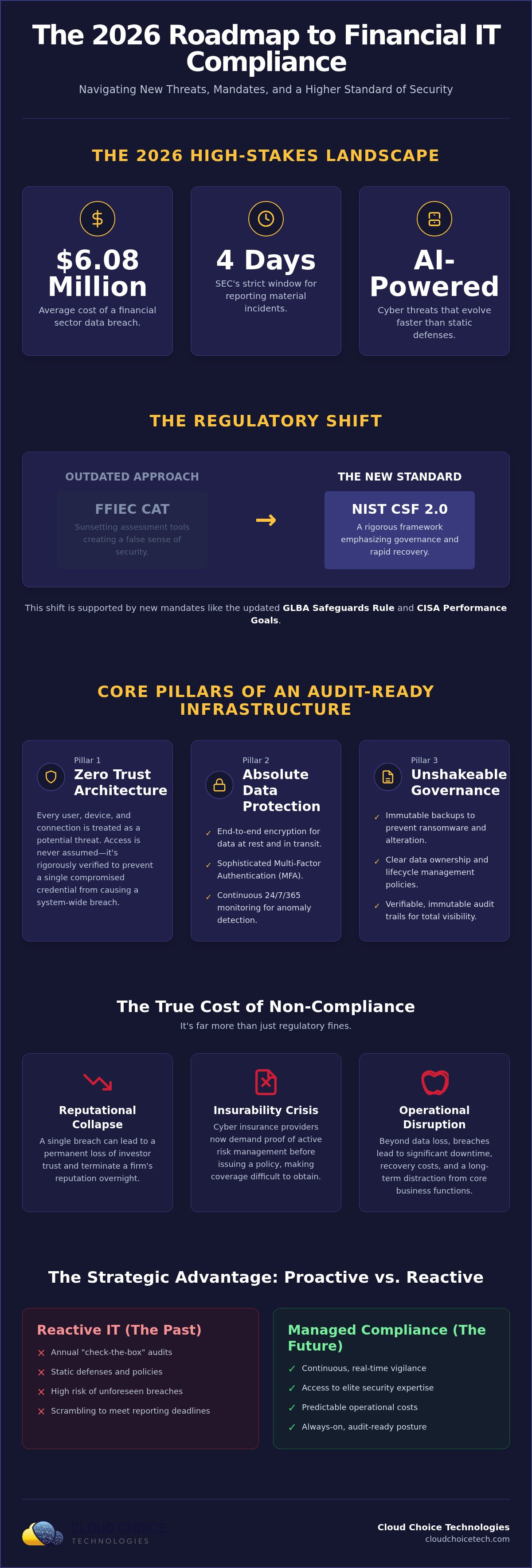
With the average cost of a financial sector data breach hitting $6.08 million in 2026, the price of a "wait and see" approach to security has never been higher. You're likely feeling the weight of the SEC's four business day reporting window and the anxiety of managing AI-powered cyber threats that evolve faster than your internal policies. Managing financial services IT compliance shouldn't feel like a constant race against a clock you can't see. It's exhausting to maintain a stable environment while the FFIEC sunsets old tools and NIST CSF 2.0 demands rigorous new levels of governance.
This article provides a definitive 2026 roadmap to master these complexities. You'll learn how to transform your infrastructure into a fortress of operational excellence that simplifies the audit process rather than complicating it. We'll break down the shift from the FFIEC CAT to CISA's Performance Goals, the new reporting mandates under the GLBA Safeguards Rule, and the specific steps required to achieve an unshakeable security posture. By the end, you'll have the tools to move beyond fear and into a state of elite readiness.
Key Takeaways
- Adapt to the 2026 regulatory shift by moving beyond the sunsetted FFIEC CAT and adopting the NIST CSF 2.0 framework for superior governance.
- Implement Zero Trust Architecture and end-to-end encryption to secure sensitive data against increasingly sophisticated AI-powered threats.
- Streamline your internal reporting processes to meet the SEC's strict four-day incident disclosure window and the updated GLBA Safeguards Rule requirements.
- Conduct a proactive cyber risk analysis to identify infrastructure gaps before they become costly liabilities during a regulatory audit.
- Strengthen your financial services IT compliance by shifting from reactive IT to a managed model that provides elite security expertise and predictable operational costs.
The 2026 Landscape of Financial Services IT Compliance
The 2026 standard for financial data integrity is no longer a static goal. It's a continuous, real-time requirement. Traditional "check-the-box" compliance fails because AI-powered cyber threats don't wait for your quarterly review. These automated attacks exploit vulnerabilities in seconds, rendering static defenses obsolete. Relying on annual audits creates a false sense of security that sophisticated regulators now actively penalize. Organizations must transition to a proactive regulatory compliance IT support model to maintain operational continuity. Maintaining financial services IT compliance requires a vigilant, always-on approach that treats security as a core business function.
The SEC and FINRA have tightened the leash on infrastructure requirements. The SEC now mandates disclosure of material incidents within four business days, leaving no room for delayed responses. Meanwhile, the Federal Financial Institutions Examination Council (FFIEC) has sunsetted older assessment tools in favor of more rigorous frameworks like NIST CSF 2.0. This shift ensures that financial services IT compliance is woven into the very fabric of your network architecture, emphasizing governance and rapid recovery over passive observation.
New Regulatory Mandates for 2026
Modern mandates prioritize data transparency and immediate accountability. In 2026, cloud storage is no longer just about off-site backup; it requires verifiable encryption at rest and in transit with strict access controls. Regulators now look for immutable audit trails across distributed networks. If you can't prove who accessed a record within minutes of a request, you aren't compliant. This move toward real-time reporting reflects a broader industry push for total visibility. It's about having the ability to demonstrate your security posture at any given moment, not just during a scheduled audit.
The High Cost of Non-Compliance
Fines are only the beginning of the fallout. While the average cost of a financial sector breach has reached $6.08 million, the loss of investor trust is often permanent. A single breach can terminate a firm's reputation overnight. Additionally, cyber insurance compliance requirements have become significantly more stringent. Insurers now demand proof of active risk management and AI-driven threat detection before they'll even issue a policy. Proactive management is no longer a luxury; it's the only way to protect your bottom line and ensure the long-term survival of your firm.
Core Pillars of a Compliant Financial IT Infrastructure
Building an audit-ready environment requires more than software. It demands a structural shift toward Zero Trust Architecture. In this model, every user and device is treated as a potential threat regardless of their location. Access is never assumed; it's earned through rigorous verification. This approach forms the backbone of modern financial services IT compliance, ensuring that a single compromised credential doesn't lead to a total system collapse.
Data protection must be absolute. The Gramm-Leach-Bliley Act (GLBA) mandates strict safeguards for non-public personal information. To meet these standards, your infrastructure must utilize end-to-end encryption for data both at rest and in transit. Pair this with sophisticated multi-factor authentication (MFA) to lock down entry points. However, static defenses aren't enough. You need continuous, 24/7/365 monitoring to detect anomalies before they escalate into breaches. If your team lacks the capacity for this constant vigilance, consider strengthening your posture with expert compliance services.
Data Governance and Integrity
Securing data is only half the battle; you must also ensure its integrity. Implementing immutable backups is a non-negotiable step to prevent unauthorized alteration or ransomware encryption. Clear data ownership and lifecycle management policies ensure that sensitive information is only retained as long as necessary. Many firms are now finding that the rigorous standards of HIPAA compliance IT services offer an excellent blueprint for protecting Personally Identifiable Information (PII) within the financial sector. Applying these high-level privacy logics ensures your data remains both secure and verifiable during an audit.
AI Compliance and Security Integration
AI is transforming the industry, but it brings new risks. Algorithmic trading models and automated customer service bots must be secured against manipulation. Monitoring for "AI drift" is essential. If a model's outputs begin to deviate from regulatory standards, it could lead to unintentional violations. Conversely, AI-driven threat detection is your greatest ally. These systems identify patterns of malicious behavior that human analysts might miss, allowing you to stay ahead of sophisticated hackers. Integrating AI into your financial services IT compliance strategy ensures your firm remains agile and protected in an increasingly automated world.
Bridging the Gap: From Vulnerability to Audit-Readiness
Transforming your infrastructure from a target into a fortress requires a methodical, four-step approach. You can't fix what you haven't measured. Achieving financial services IT compliance starts with identifying the specific cracks in your armor before a regulator does. This isn't about vague security improvements; it's about surgical precision in your technical strategy.
- Step 1: Conduct a comprehensive cyber risk analysis. This deep dive uncovers hidden vulnerabilities that standard IT scans often miss.
- Step 2: Map existing IT workflows against current regulatory frameworks. You must ensure that every data movement aligns with the latest SEC and FINRA expectations.
- Step 3: Implement prioritized remediation. Address high-risk vulnerabilities immediately to shrink your attack surface.
- Step 4: Establish a culture of compliance. Regular staff training and phishing simulations turn your employees into a defensive layer rather than a liability.
The Role of Cyber Risk Analysis
Standard IT audits look at the past, but a deep cyber risk analysis prepares you for the future. Many firms struggle with "shadow IT"-unauthorized apps or personal devices that bypass security protocols and jeopardize your compliance status. This analysis brings these hidden risks into the light. A comprehensive risk analysis serves as a predictive roadmap that identifies and neutralizes potential audit failures before they manifest as regulatory penalties. Insights from ISACA on cloud regulation highlight how critical it is to maintain visibility across both on-premise and hybrid cloud systems in this high-stakes environment.
Streamlining the Audit Process
Audits are stressful because of the scramble for data. You can eliminate this friction by organizing documentation for instant retrieval. Centralizing your logs and reports ensures you're never hunting for proof of compliance during a live review. Automating your compliance reports can save your executive team hundreds of hours annually, allowing them to focus on growth rather than paperwork. Managed services provide the "calm in the storm" by maintaining an audit-ready state every day of the year. If you're ready to secure your infrastructure, schedule a cyber risk analysis today to close your security gaps.
The Managed Services Advantage for Financial Firms
Financial leadership often views technology as a burden. It's time to change that perspective. Transitioning from heavy capital expenditure (CapEx) to a predictable operational expenditure (OpEx) model provides your firm with immediate financial stability. Instead of facing massive, unexpected bills for hardware refreshes or emergency security patches, you gain a fixed monthly cost. This predictability allows for better resource allocation elsewhere in your business.
Elite security talent is expensive and scarce. Building a full in-house Security Operations Center (SOC) requires a budget that most mid-sized firms can't justify. By leveraging financial services IT compliance through a managed partner, you access high-level expertise without the massive payroll. You aren't just hiring a technician; you're gaining an entire team of regulatory alignment experts and AI security consultants who understand the 2026 landscape. This partnership transforms managed IT services into a powerful growth engine that supports your firm's expansion rather than hindering it.
- Predictable Budgeting: Eliminate the "spike and crash" of IT spending through a fixed OpEx model.
- Elite Expert Access: Gain specialized AI and compliance knowledge without the cost of full-time hires.
- Continuous Alignment: Stay ahead of SEC and FINRA updates in real-time rather than during a frantic audit season.
24/7 Vigilance and Rapid Response
Threats don't clock out at 5:00 PM. Immediate intervention is non-negotiable when a security alert triggers. Proactive maintenance prevents the operational downtime that often leads to compliance lapses. Cloud Choice Technologies provides rapid technical assistance to ensure your systems remain online and secure. We function as a vigilant guardian, neutralizing vulnerabilities before they can be exploited. This fast-acting approach provides the peace of mind necessary to focus on your clients, knowing your infrastructure is under constant, professional oversight.
Strategic Partnership for Long-Term Security
A project-based consultant provides a temporary fix, but a partner provides a long-term strategy. We align your IT roadmap with your firm's specific business goals. We track the shifting 2026 regulatory landscape so you don't have to spend your time reading policy amendments. This allows your leadership team to remain focused on high-level decision-making. Financial services IT compliance is a continuous journey, not a one-time destination. It requires a dedicated partner committed to the long-term integrity and success of your operations.
Securing Your Competitive Edge in a Regulated Future
The 2026 regulatory landscape doesn't have to be a source of constant anxiety. By shifting from reactive troubleshooting to a proactive governance model, you transform your infrastructure into a strategic asset. Mastering financial services IT compliance is more than a legal necessity; it's a commitment to your firm's long-term stability and client trust. You've seen how Zero Trust architecture and deep cyber risk analysis create a foundation that simplifies even the most rigorous audits. Now is the time to act before the next reporting deadline arrives.
Cloud Choice Technologies provides national US coverage with elite readiness to help you navigate these complexities. Our specialized financial sector IT expertise and proactive AI compliance monitoring ensure your systems remain a "calm in the storm." Secure your firm’s future with a professional cybersecurity consulting session from Cloud Choice Technologies. You deserve a partner that handles the technical details so you can focus on driving growth. Let's build an audit-ready future together.
Frequently Asked Questions
What are the primary IT compliance regulations for financial services in 2026?
The primary regulations include the NIST Cybersecurity Framework 2.0, the SEC's four-day incident disclosure rule, and the amended GLBA Safeguards Rule. NIST 2.0 is now the industry gold standard following the sunset of the FFIEC CAT in August 2025. These frameworks emphasize governance and real-time transparency. Staying aligned requires moving beyond static checklists to a model of continuous oversight that protects both consumer data and firm integrity.
How often should a financial firm conduct a cyber risk analysis?
You should conduct a comprehensive cyber risk analysis at least once a year or whenever you implement major system changes. The rapid evolution of AI-powered threats in 2026 makes semi-annual reviews a safer choice for high-volume firms. Regular analysis identifies "shadow IT" and hidden vulnerabilities before they trigger an audit failure. It's a preventative strategy that replaces digital uncertainty with a clear, actionable roadmap for security.
Can managed IT services help us pass a FINRA or SEC audit?
Managed IT services streamline audits by providing immutable logs and automated compliance reports. Instead of scrambling for documentation, you have a centralized repository of technical proof ready for SEC or FINRA examiners. A managed partner maintains your infrastructure in a state of constant readiness. This proactive posture removes the stress of the audit process, ensuring your firm meets all financial services IT compliance standards without disrupting daily operations.
What is the role of AI in financial services IT compliance?
AI is essential for both detecting sophisticated threats and managing algorithmic governance. It identifies anomalous behavior in real-time, which is critical for meeting the SEC’s tight reporting windows. Additionally, AI compliance tools monitor for "AI drift" in your trading or customer service models to prevent unintentional regulatory violations. Using AI-driven security allows you to neutralize automated attacks that move too fast for human intervention alone.
How does a Zero Trust architecture improve regulatory adherence?
Zero Trust architecture improves adherence by ensuring that no user or device is trusted by default. This model aligns perfectly with the GLBA's requirement for strict access controls and data encryption. By verifying every request, you prevent unauthorized lateral movement within your network. This granular visibility provides the verifiable audit trails that regulators demand, making it significantly easier to demonstrate the integrity of your financial services IT compliance strategy.
What happens if our IT infrastructure fails a compliance audit?
Failure leads to significant SEC or FINRA fines and can lead to the loss of your operating license. Beyond the legal penalties, the reputational damage often causes an immediate loss of investor trust. In 2026, the average cost of a data breach in the financial sector is $6.08 million. Failure also risks your cyber insurance eligibility, leaving your firm financially exposed during a major security event.