
Developing an AI Acceptable Use Policy for Business: The 2026 Executive Framework
What if your company’s most sensitive intellectual property is currently being used to train a public AI model without your consent? For most executives, the threat of "Shadow AI" isn't a distant possibility; it's an active vulnerability that compromises your data every day. Developing an AI acceptable use policy for business has shifted from a secondary HR task to a foundational requirement of your 2026 cybersecurity strategy. You've likely seen the productivity benefits of these tools, but the lack of oversight and the risk of intellectual property leakage creates a significant operational burden.
We believe that total control over your digital environment is the only way to ensure continuity. This executive framework provides a precise, risk-first roadmap to master AI governance without stifling innovation. You'll learn how to draft and deploy a policy that protects your corporate assets and aligns perfectly with 2026 compliance standards. We'll cover the essential steps to mitigate AI-related cyber risks, establish clear usage boundaries, and provide the technical oversight needed to keep your organization secure and resilient.
Key Takeaways
- Understand why AI governance serves as the foundational contract for organizations operating in the 2026 digital environment.
- Implement a methodical framework for developing an AI acceptable use policy for business to protect your most sensitive intellectual property.
- Pinpoint the core pillars every robust policy requires to eliminate employee confusion and prevent accidental security breaches.
- Integrate your AI usage rules into a broader cybersecurity strategy to maintain elite readiness against emerging threats.
- Transition to a proactive service model where professional oversight ensures continuous compliance and operational stability.
Understanding the Necessity of AI Governance in 2026
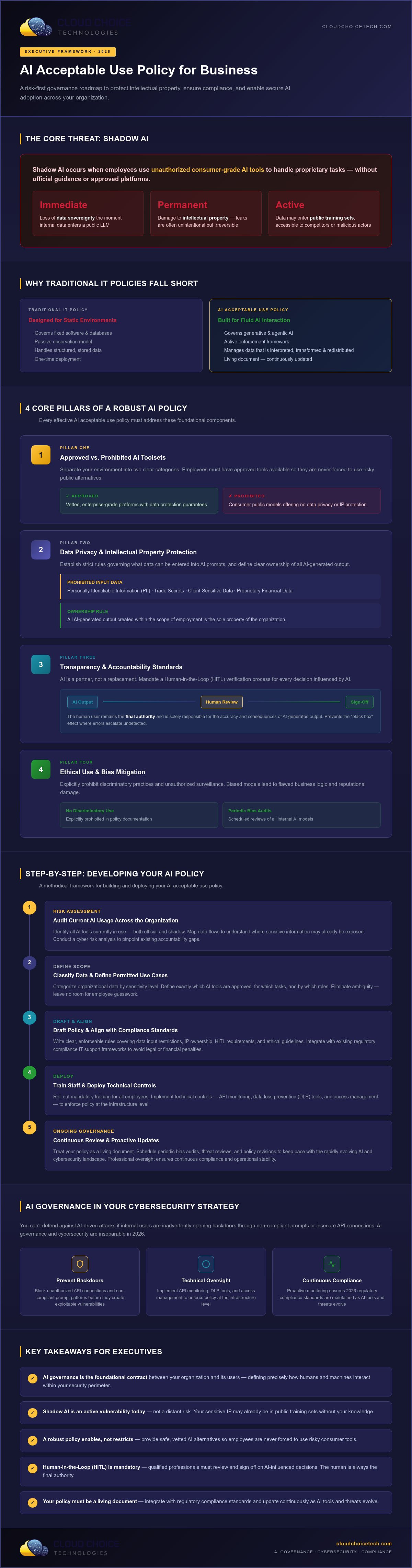
AI governance is no longer a luxury for the forward-thinking few. It's the foundational contract between your organization and its users, defining exactly how humans and machines interact within your perimeter. By 2026, generative and agentic AI have become ubiquitous, embedded in every workflow from basic email drafting to complex financial modeling. Traditional IT policies, designed for static software and fixed databases, can't manage the fluid, generative nature of AI interaction. Developing an AI acceptable use policy for business is the only way to establish clear data handling standards for an era where machines don't just store data but interpret, transform, and redistribute it.
The Risks of Shadow AI and Unregulated Usage
Shadow AI is the greatest invisible threat to your corporate assets. This phenomenon occurs when employees use unauthorized, consumer-grade AI tools to handle proprietary tasks because they lack official guidance or tools. When a team member feeds internal spreadsheets or strategic plans into a public Large Language Model (LLM), you lose data sovereignty immediately. That information may become part of a public training set, potentially accessible to competitors or malicious actors. These leaks are often unintentional, but the damage to your intellectual property is permanent. Unregulated usage has become a primary target for modern business cybersecurity solutions because software alone can't fix a culture of unmanaged access.
Bridging the Gap Between Innovation and Security
A robust policy isn't about saying "no" to progress. It's a tool for secure enablement. Your executive responsibility is to provide safe, vetted AI alternatives so employees don't feel forced to use risky public tools. This framework transforms AI from a liability into a controlled competitive advantage. The rise of AI-powered cyber threats makes this governance mandatory. You can't defend against AI-driven attacks if your internal users are inadvertently opening backdoors through non-compliant prompts or insecure API connections. We provide the calm in this digital storm by helping you build a policy that balances operational speed with absolute protection.
Core Components of a Robust AI Acceptable Use Policy
A policy is only as effective as its clarity. Developing an AI acceptable use policy for business requires a shift from passive observation to active enforcement. Your framework must be a living document that provides absolute clarity, leaving no room for employee guesswork. We recommend a vigilant guardian approach that separates your environment into Approved AI Toolsets, which are vetted, enterprise-grade platforms, and prohibited public models that offer no data protection. This distinction ensures your team has the tools they need without exposing the business to unnecessary risk.
Data Privacy and Intellectual Property Protection
The core of your policy must protect the information that makes your business unique. Establish strict rules on what data can be entered into AI prompts. Prohibit the input of personally identifiable information (PII), trade secrets, or client-sensitive data into any platform that has not been specifically approved. It's equally vital to define ownership clearly. Your policy should state that all AI-generated output created within the scope of employment remains the sole property of the organization. Integrating these rules with regulatory compliance IT support standards ensures that your AI usage doesn't trigger legal or financial penalties.
Transparency and Accountability Standards
AI is a partner, not a replacement. You must mandate a Human-in-the-loop (HITL) verification process for every decision influenced by an AI tool. Whether it's a financial forecast or a code deployment, a qualified professional must review and sign off on the output. Accountability is non-negotiable. The human user remains the final authority and is solely responsible for the accuracy and consequences of AI-generated output. This standard prevents the "black box" effect where errors go unnoticed until they cause operational downtime. A quick cyber risk analysis often reveals where these gaps in accountability currently exist.
Ethical Use and Bias Mitigation
Your policy should explicitly prohibit using AI for discriminatory practices or unauthorized surveillance. This isn't just about ethics; it's about stability. Biased models can lead to flawed business logic and reputational damage. Schedule periodic bias audits for any internal models to ensure they remain aligned with your executive IT risk management goals. This proactive stance keeps your organization resilient against both technical and social vulnerabilities.
Step-by-Step Guide to Developing Your AI Policy
Execution is where most organizations stumble. Developing an AI acceptable use policy for business is a methodical process that requires total visibility into your current operations. You can't protect what you don't see. This five-step approach ensures your framework is both practical and enforceable, moving your organization from a state of vulnerability to elite readiness. We treat this as a strategic deployment rather than a simple HR update.
Conducting a Cross-Departmental Risk Assessment
Start by auditing every department. Shadow AI often hides in marketing or customer service workflows where speed is prioritized over security. Interview department heads to identify which tools are already in use and what specific needs drive their adoption. The goal of this assessment is to map your "AI attack surface" before you draft a single rule. This data-driven foundation ensures your policy addresses real-world risks rather than theoretical ones. Without this visibility, your security posture remains reactive and incomplete.
Drafting and Iterating the Policy Framework
Begin with a high-level Statement of Purpose. This defines the "why" behind the policy: to enable innovation safely while protecting corporate assets. Use clear, non-academic language to ensure all employees understand their obligations. Avoid complex jargon that leads to accidental breaches. Once the initial draft is complete, incorporate feedback from legal, HR, and operations teams to ensure alignment with 2026 regulations. This collaborative approach creates a policy that is legally sound and operationally viable. It's a cross-departmental shield that protects everyone.
Implementation, Training, and Continuous Monitoring
Rollout must be paired with mandatory AI literacy and security training. Employees need to understand the risks of data leakage and the importance of using approved toolsets. Simultaneously, establish technical guardrails, such as Data Loss Prevention (DLP) software, to enforce policy rules automatically. Your policy is a living document. AI technology moves at a relentless pace, so you must schedule quarterly reviews to address new capabilities or emerging threats. Staying ahead of the curve is the only way to maintain long-term resilience. Our experts provide the AI compliance and security oversight needed to turn these steps into a functional reality for your business.
Leveraging Specialized AI Compliance for Long-Term Protection
AI governance shouldn't exist in a silo. It's a critical component of a comprehensive managed IT services strategy. By integrating policy enforcement into your broader infrastructure, you remove the heavy lifting from your internal executive team. Developing an AI acceptable use policy for business is the first step, but continuous oversight is what ensures long-term stability. Complex security becomes manageable when you have a vigilant partner handling the technical details. This proactive approach replaces reactive crisis management with elite readiness.
Integrating AI Policy with Existing Cybersecurity Infrastructure
Your AI policy must sync perfectly with endpoint protection and network monitoring. It isn't enough to have rules on paper; you need the technical infrastructure to detect violations in real time. We use sophisticated security algorithms to monitor AI usage patterns, effectively using AI to protect against AI-related risks. This layer of defense is especially vital for remote workforces. Our managed cloud security services ensure that your policy guardrails extend beyond the office walls, protecting your data wherever your team operates.
The Role of Managed IT in AI Governance
A specialized partner provides the always-on vigilance that internal teams often lack. Regulatory shifts in 2026 happen quickly, and staying compliant requires constant foresight. Our AI compliance consultants act as your responsive guardians, adjusting your technical controls as new threats emerge. We provide the rapid response needed to neutralize vulnerabilities before they become breaches. You don't have to navigate these complexities alone. Secure your organization’s future with Cloud Choice Technologies’ AI compliance and security services. We handle the digital uncertainty so you can focus on driving your business forward with confidence.
Securing Your Competitive Advantage in the AI Era
The landscape of 2026 demands more than just awareness; it requires a disciplined, proactive approach to digital oversight. Developing an AI acceptable use policy for business is the critical first step toward transforming potential vulnerabilities into a secure, scalable asset. By establishing clear pillars of accountability and integrating them with robust technical guardrails, you protect your intellectual property from the risks of Shadow AI. This framework ensures your team can innovate with confidence while your corporate assets remain under total control. Success depends on moving from a reactive posture to one of elite readiness.
You don't have to manage these high-stakes complexities alone. We provide the stability your organization requires through specialized AI risk analysis and 24/7 managed cybersecurity monitoring. Our team delivers the executive-level compliance oversight needed to keep your operations resilient against evolving threats. Partner with Cloud Choice Technologies for expert AI compliance and security consulting today. We're here to serve as your vigilant guardian in an ever-changing digital world. Take control of your organizational security and lead your industry with unwavering confidence.
Frequently Asked Questions
What is an AI acceptable use policy and why does my business need one in 2026?
An AI acceptable use policy is a formal framework that defines the boundaries of how employees interact with generative and agentic AI tools. In 2026, these tools are ubiquitous in every corporate workflow. Without a policy, you risk proprietary data being absorbed into public models. Developing an AI acceptable use policy for business ensures that your team uses technology to drive productivity without compromising your corporate assets or operational continuity. It provides the elite readiness required to navigate modern digital threats.
How does an AI policy differ from a standard IT or data privacy policy?
Standard IT policies typically focus on data storage and network access. AI policies must address the generative nature of Large Language Models and the specific risks of prompt engineering. They define data sovereignty in an environment where information is constantly transformed and redistributed. While a privacy policy protects static records, an AI policy governs the active creation and interpretation of data. This specialized oversight is a critical component of modern cybersecurity and compliance services that prioritize data integrity.
What are the biggest risks of not having a formal AI policy for employees?
The primary risk is the loss of intellectual property through unauthorized usage of public AI tools. When employees feed sensitive information into unvetted platforms, that data often becomes part of a public training set. This creates a permanent vulnerability. Additionally, you face regulatory penalties if your AI interactions violate 2026 compliance standards. Without formal guardrails, your organization remains in a reactive state. You are vulnerable to both internal errors and external AI-powered cyber threats that target unmanaged access points.
Can an AI policy help protect my company from intellectual property theft?
Yes. A robust policy establishes clear "Approved AI Toolsets" that utilize enterprise-grade security and data isolation. By explicitly prohibiting the use of public models for corporate tasks, you prevent the accidental export of trade secrets. The policy also clarifies that all AI-generated output remains the sole property of the organization. This legal and technical framework, supported by specialized AI compliance and security measures, ensures that your most valuable assets stay within your controlled perimeter and remain your exclusive property.
How often should a business update its AI acceptable use policy?
We recommend a quarterly review cycle. AI technology evolves at a relentless pace; therefore, a policy written six months ago may not address the capabilities of today's agentic systems. Developing an AI acceptable use policy for business is not a one-time task; it is a continuous process of refinement. Regular updates allow you to incorporate new technical guardrails and align with the latest regulatory shifts. This proactive approach maintains your organization’s resilience and keeps your security infrastructure current and effective.
Who should be involved in the development of a corporate AI policy?
Effective governance requires cross-departmental collaboration. Your IT and cybersecurity teams provide the technical guardrails, while legal counsel ensures alignment with 2026 regulations. HR plays a vital role in defining employee accountability and training requirements. Finally, department heads from operations and marketing must provide insights into specific workflows. This unified approach ensures the policy is operationally viable and provides comprehensive protection. A managed IT partner can facilitate this process by providing the necessary technical oversight and specialized cyber risk analysis.