
Dark Web Monitoring for Business: 2026 Strategic Guide
If your corporate network access is currently being auctioned for a six-figure sum on a hidden forum, would you even know before the ransom note appears? For most executives, the dark web feels like a digital black hole where sensitive data vanishes and reappears as a liability. Implementing effective dark web monitoring for business is no longer a luxury reserved for global giants. It's a foundational requirement for any organization that values its operational continuity in 2026. You're likely tired of generic security alerts that provide plenty of noise but very little direction on how to actually protect your assets.
We understand the stress of digital uncertainty and the difficulty of justifying security spend when the threats feel invisible. This guide promises to transform that fear into a proactive defense strategy. You'll discover how to safeguard your corporate credentials and sensitive data by leveraging professional intelligence. We'll outline a clear protocol for responding to data leaks, reducing the risk of credential stuffing attacks, and providing the peace of mind that comes from continuous, professional oversight. It's time to move past reactive panic and step into a position of elite readiness.
Key Takeaways
- Traditional firewalls can't stop data that's already been leaked. You need a proactive security layer that identifies external threats before they turn into internal breaches.
- Professional dark web monitoring for business converts raw data into actionable intelligence. This allows you to neutralize compromised credentials before they're exploited by bad actors.
- Enterprise-grade monitoring requires more than just automated scans. High-level protection must be backed by a professional Security Operations Center (SOC) to ensure rapid, human-led intervention.
- Data leak intelligence should trigger your broader compliance review. You'll learn how to integrate these findings into a comprehensive cyber risk analysis to meet modern regulatory standards.
- Continuous oversight replaces digital uncertainty with elite readiness. You'll gain the ability to justify security investments through clear, documented protocols and actionable threat reporting.
Understanding the Dark Web Threat Landscape for Modern Enterprises
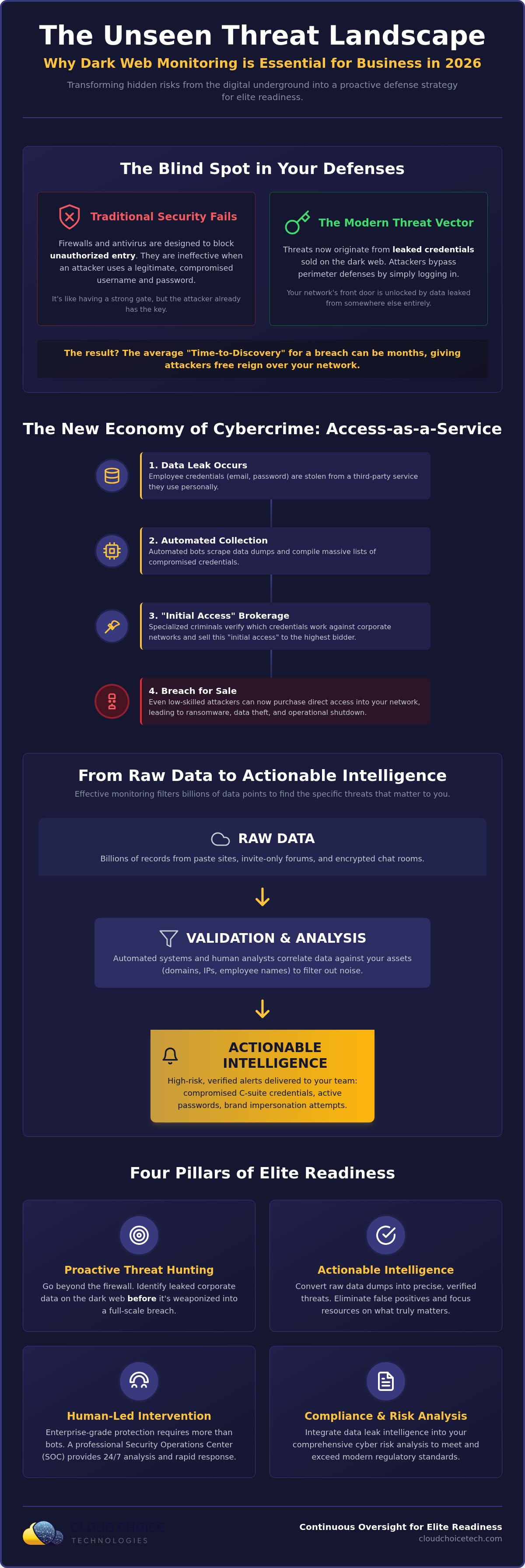
A firewall is a perimeter, not a vault. If your data is already outside those walls, the strongest encryption in the world won't bring it back. In 2026, dark web monitoring for business serves as a proactive intelligence layer that looks beyond your network boundaries. It identifies leaked assets before they're used to launch a full-scale attack. This approach shifts your posture from reactive recovery to elite readiness, ensuring you stay ahead of adversaries who thrive in the shadows.
Cybercriminals prioritize high-value targets like corporate credentials, intellectual property, and sensitive financial records. The most dangerous aspect of a leak isn't just the theft; it's the silence. Many businesses take months to realize a breach has occurred, giving attackers ample time to map the network and escalate privileges. Understanding the Dark Web is the first step in closing this "time-to-discovery" gap and regaining control over your digital footprint.
The Evolution of Data Markets in 2026
The underground economy has matured into a professionalized ecosystem. Automated bots now scrape and list corporate data with industrial efficiency, removing the need for manual hacking in the early stages of an attack. We've seen a definitive shift from small-scale identity theft to the high-stakes world of "initial access" brokerage. In this market, specialized criminals sell the keys to your entire network to the highest bidder. Access-as-a-Service has become the dominant business model for modern threat actors, allowing even low-skilled attackers to purchase entry into sophisticated corporate environments with a single click.
Why Traditional Security Isn’t Enough
Standard antivirus software and firewalls are designed to block unauthorized entry. They're remarkably ineffective when an attacker uses a legitimate, compromised username and password. This is why cyber risk analysis services are now the baseline for any serious defense strategy. You cannot defend what you cannot see, and traditional tools simply don't have visibility into external data dumps.
Employee behavior remains a significant vulnerability that technology alone cannot fix. Password reuse across personal and professional accounts creates a massive blind spot for IT departments. If a staff member's personal social media account is leaked in a third-party breach, that same credential often grants an attacker access to your corporate cloud. Professional dark web monitoring for business illuminates these hidden connections, providing the foresight needed to reset credentials before a breach begins. It replaces digital uncertainty with a sense of being protected by a vigilant, fast-acting partner.
How Modern Monitoring Transforms Hidden Risks into Actionable Intelligence
Effective monitoring isn't just about looking; it's about seeing. It involves automated scraping of paste sites, infiltrating invite-only forums, and monitoring encrypted chat rooms where stolen data is brokered. This depth is necessary because, as highlighted in the FTC explanation of dark web risks, criminals operate in layers of anonymity. We penetrate these layers to find the specific data points that put your business at risk.
There's a vital distinction between raw data and validated intelligence. A list of leaked emails is raw data. Knowing which of those emails belong to your C-suite and have active, unexpired passwords is validated intelligence. Professional dark web monitoring for business filters out the noise, so you only act on what truly threatens your operations. This precision saves your team from chasing ghosts and focuses resources on genuine vulnerabilities.
We also look for typosquatting and brand impersonation. Attackers often register domains that look almost identical to yours to trick employees or clients into entering credentials. By identifying these fake sites the moment they're registered, we can shut down phishing campaigns before they land in an inbox. This level of oversight is a core component of comprehensive managed IT services, where security and operational continuity are intertwined. If you're unsure where your data currently resides, a professional cybersecurity assessment can provide the clarity you need.
The Role of AI in 2026 Threat Detection
AI has revolutionized how we process the chaotic data of the underground. It filters through billions of data points to pinpoint genuine threats specific to your organization. Using Natural Language Processing (NLP), these systems monitor non-English hacker forums in real-time, translating intent and urgency from Russian or Chinese marketplaces. AI-powered monitoring virtually eliminates the false-positive fatigue that plagued previous security generations. This ensures your team only responds to high-fidelity alerts that require immediate action.
Continuous Scanning vs. Manual Audits
A manual audit is a snapshot of the past. In a globalized threat environment where data is sold in seconds, a "point-in-time" check is fundamentally flawed. You need 24/7/365 vigilance to catch leaks as they happen. This always-on model reflects our philosophy of being a vigilant partner. It provides total control over complex situations, ensuring that if a breach occurs at 3:00 AM, our systems are already working to neutralize the risk. We handle the complexities so you don't have to.
Key Criteria for Evaluating Enterprise-Grade Monitoring Solutions
Not all monitoring is equal. Consumer-grade tools focus on individual credit scores; dark web monitoring for business focuses on corporate survival. An enterprise solution must integrate directly with your Identity and Access Management (IAM) systems. This connection allows for automated responses, such as forcing a password reset or disabling an account the moment a leak is confirmed. Speed is the only metric that truly matters. When a credential is exposed, the window between discovery and exploitation is often measured in minutes. If an alert takes hours to reach a human expert, the defense has already failed.
A robust solution must be backed by a professional Security Operations Center (SOC). While technology identifies the data, human experts interpret the threat. As detailed by CISA on Cyber Crime and the Dark Web, these hidden forums serve as the primary engine for modern ransomware operations. Having a guardian who understands this context transforms a simple notification into a strategic defensive maneuver. It provides the calm confidence you need to handle complex digital situations without operational downtime.
Accuracy and False Positive Reduction
High-volume, low-accuracy alerts are a silent killer of productivity. They cause security fatigue, leading IT teams to ignore critical warnings because of the sheer noise. Professional monitoring utilizes human-in-the-loop verification to ensure every alert is actionable. It distinguishes between recycled "combo lists" from years ago and fresh, high-risk data leaked this morning. You don't have time to chase ghosts. You need precision that identifies exactly which assets are at risk and how to secure them immediately.
Comprehensive Coverage Beyond Credentials
Modern threats extend far beyond simple passwords. Attackers hunt for leaked API keys, GitHub repositories, and misconfigured cloud files that provide a roadmap to your internal infrastructure. Shadow IT, where employees use unauthorized cloud services, often creates the biggest vulnerabilities. Your monitoring must cast a wide net to capture these outliers before they're exploited. Use this checklist to evaluate your current posture:
- Does the service include human verification for all high-priority alerts?
- What is the documented time between a leak discovery and your team being notified?
- Does the platform actively monitor source code repositories and cloud configuration files?
- Can the solution integrate with your current IAM and SIEM systems for automated response?
- Are you alerted to brand impersonation and typosquatted domains in real-time?
If your current provider cannot answer these questions with certainty, it's time to upgrade your oversight. You can secure your corporate perimeter today by partnering with experts who prioritize elite readiness and rapid intervention.
Integrating Dark Web Intelligence into Your Managed Cybersecurity Strategy
Discovery is merely the first step. The true test of your resilience lies in the minutes following an alert. Integrating dark web monitoring for business into your broader strategy ensures that a discovered leak doesn't escalate into a catastrophic breach. It acts as a trigger for immediate, decisive action. When a credential appears on a forum, your response must be surgical and swift.
Finding a leak often signals deeper systemic issues. These discoveries should immediately trigger a regulatory compliance IT support review to ensure your data handling meets 2026 standards. We utilize these alerts to enforce mandatory password resets and strengthen Multi-Factor Authentication (MFA) protocols across the board. By treating dark web intelligence as a primary input for your cybersecurity posture, you eliminate the digital blind spot and maintain total control over your assets.
Building a Response Protocol
A structured response prevents panic and ensures thorough remediation. We follow a precise three-step protocol to neutralize threats as they emerge:
- Step 1: Verification. We confirm the data’s authenticity and determine its age to assess the current risk level.
- Step 2: Isolation. Affected accounts and systems are immediately isolated to prevent lateral movement within your network.
- Step 3: Forensic Analysis. We conduct a deep dive to determine if the leak originated from an internal lapse or a third-party vendor breach.
The Cloud Choice Advantage
At Cloud Choice Technologies, we don't just hand you a list of problems. We provide a narrative of effortless resolution. Our systems integrate dark web alerts into a unified security dashboard, giving you a single source of truth for your digital risk. This visibility allows our team to function as the calm in the storm, handling the technical complexities of remediation so your internal staff remains focused on business growth.
Our rapid response model moves from alert to resolution with mechanical precision. We pride ourselves on being a vigilant, always-on partner that protects your operational continuity. Don't wait for a ransom note to discover your vulnerabilities. Secure your business with comprehensive cybersecurity and monitoring today.
Achieving Elite Readiness in a Volatile Threat Landscape
The digital environment of 2026 demands more than just passive defense. It requires a fundamental shift toward elite readiness where hidden vulnerabilities are neutralized before they impact your operations. By moving beyond traditional firewalls and embracing a proactive intelligence model, you eliminate the uncertainty that fuels cybercrime. Effective dark web monitoring for business is the foundation of this stance, providing the visibility needed to protect your most sensitive assets from professionalized threat actors.
You've seen that true security involves more than just automated scans. It requires the integration of validated intelligence into a robust response protocol that protects your reputation and your bottom line. We provide the peace of mind you need through proactive AI-powered threat detection and dedicated compliance oversight. Our team ensures your organization remains resilient with rapid technical assistance and 24/7 monitoring. We function as your vigilant partner, handling the complexities of the digital underground so you don't have to.
Are you ready to take total control of your digital security? Get a Comprehensive Cyber Risk Analysis for Your Business and secure your corporate future with unwavering reliability.
Frequently Asked Questions
What is the difference between deep web and dark web monitoring?
Deep web monitoring covers unindexed content like private databases, legal portals, and paywalled sites, while dark web monitoring targets encrypted networks designed for total anonymity. Most corporate data leaks occur on the dark web where stolen credentials are traded in criminal marketplaces. Professional oversight ensures you have visibility into these hidden layers to protect your digital footprint effectively.
Is it too late to act if my business information is already on the dark web?
It's never too late to intervene because the presence of data on the dark web is often a precursor to an attack rather than the final stage. Rapid detection allows you to reset compromised credentials and isolate systems before a criminal can exploit the information. Acting quickly converts a potential disaster into a manageable security incident, preserving your operational continuity.
How often should a business perform dark web scans?
Continuous, real-time scanning is the only effective way to implement dark web monitoring for business in 2026. Point-in-time audits are insufficient because they leave wide windows of vulnerability where attackers can move undetected. You need an always-on solution that alerts your security team the moment a leak is detected. This ensures that you can act before a threat actor has the chance to exploit the data.
Can dark web monitoring prevent a ransomware attack?
Dark web monitoring prevents ransomware by identifying the stolen "initial access" credentials that attackers use to enter your network. Ransomware is typically the final stage of a breach; stopping it begins with neutralizing the leaked data used to gain entry. By closing these digital doors early, you disrupt the entire attack chain and avoid the stress of operational downtime.
Do I need dark web monitoring if I already use Multi-Factor Authentication (MFA)?
MFA is a critical defense, but it isn't a silver bullet against modern session hijacking or MFA fatigue attacks. dark web monitoring for business provides an essential layer of visibility that MFA cannot offer. It alerts you to exactly which credentials have been compromised. This allows you to reset those specific accounts and investigate the source of the exposure before your secondary defenses are bypassed.
What happens if a third-party vendor is breached and our data is leaked?
Monitoring detects your corporate data regardless of whether the leak originated from your network or a third-party partner. Once a vendor breach is identified, we help you isolate affected accounts and conduct a forensic review to minimize the impact. This oversight ensures your security isn't dependent on the potentially weaker standards of your supply chain partners, maintaining your elite readiness stance.