
Cybersecurity Supply Chain Risk Management: The 2026 Executive Checklist
Did you know that 30% of all data breaches now originate within the supply chain? This twofold increase proves your perimeter is only as strong as your least secure vendor. By 2026, cybersecurity supply chain risk management has matured into a high-stakes procurement discipline. You likely feel the pressure of this shift through endless vendor questionnaires and the constant fear of a "SolarWinds" style attack. It's difficult to quantify these risks for insurance or board meetings when the regulatory requirements keep shifting.
We understand the need for clarity in a world of digital uncertainty. This guide provides a structured, executive-level framework to secure your digital supply chain with precision. You'll master a streamlined checklist for vetting vendors and aligning with 2026 standards like CMMC and NIST SP 1326. We'll walk through a tiered approach to risk that protects your critical data at every touchpoint, giving you the peace of mind that comes from total oversight and elite readiness. By the end of this article, you'll have a repeatable process to ensure your vendors don't compromise your network.
Key Takeaways
Recognize the shift from static perimeter defense to a dynamic lifecycle process that prioritizes identity-first security across all vendor touchpoints.
Learn to implement the essential 5-pillar framework for cybersecurity supply chain risk management, starting with rigorous identity and access protocols.
Discover how to categorize vendors by impact level to prevent administrative burnout and apply the right level of scrutiny where it matters most.
Explore how partnering with a responsive guardian for vendor oversight replaces digital uncertainty with elite readiness and operational continuity.
Table of Contents
Why Supply Chain Security is the New Perimeter in 2026
The old concept of a "secure perimeter" died when your data moved to the cloud and your vendors gained administrative access. In 2026, robust cybersecurity supply chain risk management isn't a one-time audit. It's a continuous lifecycle process. To understand the foundational concepts, executives often ask: What is Supply Chain Risk Management? It involves identifying, assessing, and mitigating risks throughout the entire life of a vendor relationship. This vigilant approach ensures that a single vulnerability in a partner's network doesn't become a catastrophic failure in yours.
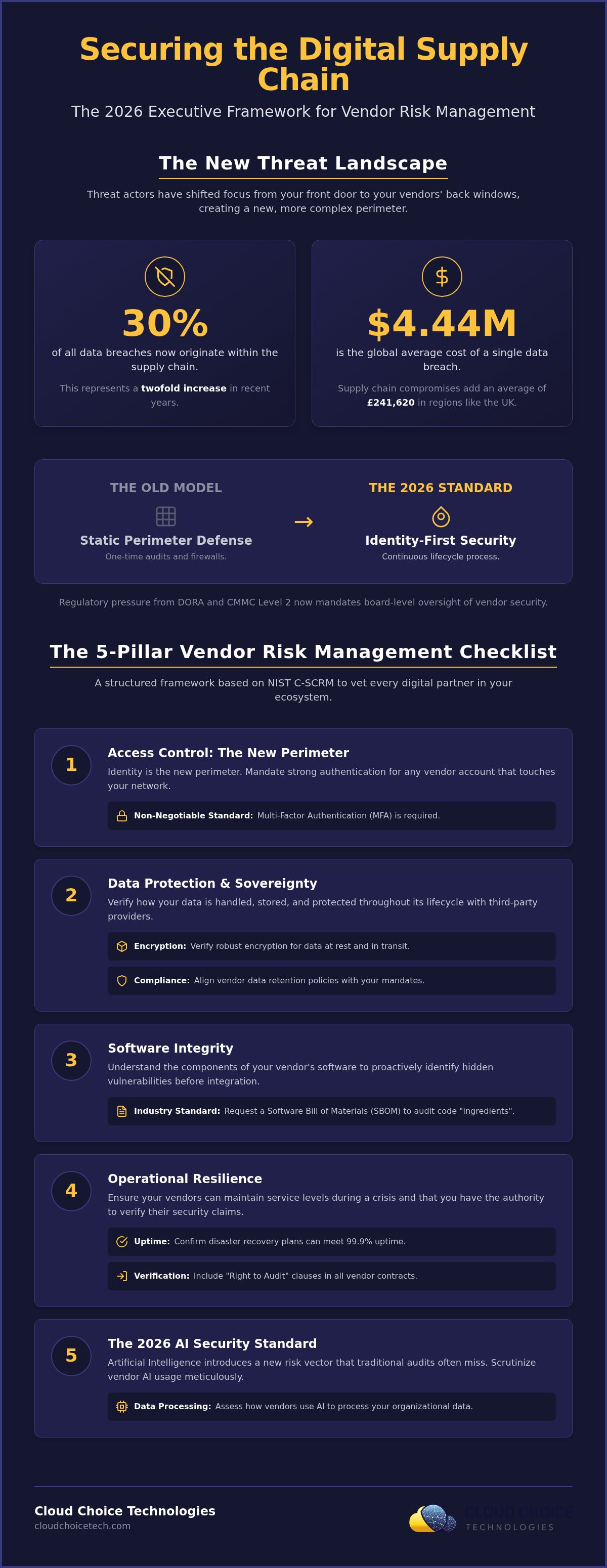
Threat actors have shifted their focus. They no longer waste time knocking on your front door when they can walk through a vendor's back window. Currently, 30% of all data breaches originate within the supply chain, representing a twofold increase in recent years. By targeting upstream service providers, attackers can compromise thousands of downstream clients in a single strike. This "island hopping" strategy turns a small software provider into a high-speed highway to your core assets. The cost of inaction is staggering.
The Evolution of Third-Party Threats
Vulnerabilities have moved beyond simple unpatched software. Today's risks are buried in complex API integrations and cloud-native exploits that bypass traditional firewalls. Attackers exploit the trust you've already granted to your partners. Effective cybersecurity supply chain risk management is the systematic identification of risk across the distributed technology ecosystem. It requires moving to an "identity-first" model where every connection is verified, regardless of where it originates. This proactive stance replaces digital uncertainty with elite readiness.
Executive Accountability and Regulatory Pressure
Ignorance of vendor practices is no longer a valid legal defense. New 2026 standards, including the full implementation of the Digital Operational Resilience Act (DORA) and CMMC Level 2 assessments, mandate board-level oversight. You're now personally responsible for the security posture of your partners. Utilizing regulatory compliance IT support is essential for maintaining audit readiness and avoiding the heavy fines associated with non-compliance. This isn't just about checking boxes. It's about protecting your brand's reputation and ensuring the total continuity of your operations.
The Essential 5-Pillar Vendor Risk Management Checklist
Managing third-party vulnerabilities requires more than a simple spreadsheet. It demands a structured approach that integrates directly into your business cybersecurity solutions. By utilizing the NIST C-SCRM Framework, organizations move from reactive firefighting to a state of elite readiness. This checklist serves as your foundational guide for vetting every digital partner in your ecosystem and ensuring total oversight.
Pillars 1 & 2: Access and Data Protection
Identity is the new perimeter. You must mandate Multi-Factor Authentication (MFA) for all vendor-side accounts that touch your network. It's a non-negotiable standard in 2026. Beyond access, data sovereignty is critical for operational continuity. Verify that every third-party SaaS provider uses robust encryption for data at rest and in transit. Don't assume their retention policies match yours. Require vendors to align their data lifecycle management with your specific compliance mandates to prevent legal exposure and digital uncertainty.
Pillars 3 & 4: Integrity and Resilience
Do you know what's actually inside your software? Requesting a Software Bill of Materials (SBOM) is now an industry standard. It allows you to audit the "ingredients" of your vendor's code for hidden vulnerabilities before they reach your environment. Resilience is equally vital. Review your vendor's business disaster recovery services to ensure they can maintain 99.9% uptime during a crisis. Ensure your contracts include "Right to Audit" clauses. These give you the legal authority to verify their security claims through independent, professional assessments.
Pillar 5: The 2026 AI Security Standard
AI introduces new layers of risk that traditional audits often miss. You must assess how vendors use AI to process your organizational data. Implementing strict AI compliance and security measures prevents proprietary data leakage into public models. We require all vendors to disclose any Large Language Model (LLM) training that involves your proprietary information. This transparency is a cornerstone of modern cybersecurity supply chain risk management. If you feel overwhelmed by these technical requirements, our team can perform a comprehensive cyber risk analysis to identify your weakest links and provide immediate peace of mind.
Moving from Checklist to Action: A Graded Risk Strategy
Applying the same level of scrutiny to a janitorial service as you do to your cloud hosting provider is a recipe for administrative burnout. It wastes valuable resources and slows down critical business operations. To achieve elite readiness, you must adopt a graded risk strategy. This method ensures that your cybersecurity supply chain risk management efforts are focused precisely where the danger is greatest. By following the NIST C-SCRM Framework, you can build a scalable model that protects your assets without suffocating your procurement team.
Defining Your Cybersecurity Impact Levels (CIL)
Categorizing your vendors is the first step toward operational clarity. We recommend a three-tier system based on the level of access a partner has to your environment. High-impact vendors include those with direct network access or those handling sensitive PII and PHI; these require the full 5-pillar audit. Medium-impact vendors are essential service providers that support operations but have no direct data access. Finally, low-impact vendors are commodity providers with zero digital footprint. This tiered approach ensures your team spends time where the risk is highest.
Integrating Security into Procurement
Security isn't an afterthought. It's a prerequisite for doing business. You should pre-screen every vendor before they even reach the RFP stage to identify potential red flags early. Utilizing professional cyber risk analysis services allows you to automate these initial evaluations and maintain momentum. This proactive step helps you establish clear "Kill Criteria" for vendors that fail basic security hygiene, such as lacking MFA or failing to disclose LLM training data.
The annual "point-in-time" assessment is no longer sufficient. In 2026, threat landscapes change in hours, not months. Your strategy must shift toward continuous monitoring of high-impact vendors to detect shifts in their security posture in real time. This persistent vigilance replaces digital uncertainty with total control over your ecosystem. If you're ready to move from a static checklist to an active defense, contact us for a professional cyber risk analysis to secure your supply chain today.
Partnering for Vigilance: Managed C-SCRM Solutions
Maintaining a dedicated in-house program for cybersecurity supply chain risk management is a massive undertaking for most mid-sized enterprises. The sheer volume of vendor questionnaires, SOC 2 reports, and technical audits is enough to overwhelm even the most disciplined IT teams. How can you stay ahead of every software update or credential leak across fifty different vendors? You can't, at least not without sacrificing your focus on core business growth. This is where the burden of digital uncertainty often leads to operational paralysis.
Cloud Choice Technologies acts as your responsive guardian. We bridge the gap between raw technical audits and the high-level insights you need for executive decision-making. Our team provides real-time monitoring of vendor vulnerabilities and dark web leaks, identifying threats before they manifest in your network. We replace the stress of "what-if" scenarios with the confidence of elite readiness. By turning complex risk data into actionable intelligence, we ensure you remain the "calm in the storm" during industry-wide disruptions.
The Managed IT Advantage in Supply Chain Security
Leveraging managed cloud security services allows you to secure third-party integrations with professional precision. We provide proactive network maintenance that specifically monitors vendor-side entry points, ensuring that a compromise at a partner firm doesn't grant an attacker a key to your kingdom. Outsourcing your risk analysis reduces the cognitive load on your internal staff. It allows them to focus on innovation while we handle the meticulous oversight required for modern compliance.
Establishing a Foundation for Future Growth
A robust approach to cybersecurity supply chain risk management does more than just protect your data. It improves your brand's trust and marketability. In 2026, clients want to know their information is safe across your entire ecosystem. This is especially critical as you face new AI-driven threats. Many vendors now use Large Language Models (LLMs) that may inadvertently ingest your proprietary data for training. We serve as your specialized AI compliance and security partner, ensuring that your intellectual property remains yours alone.
The digital world moves fast, but your security can move faster. Don't wait for a vendor breach to expose your vulnerabilities. Establish a proactive defense that supports your long-term success. Contact Cloud Choice Technologies today for a comprehensive cyber risk analysis and gain the peace of mind that comes from total oversight.
Securing Your Organization’s Future Through Total Oversight
The digital landscape of 2026 demands a shift from passive defense to proactive vigilance. You've seen how cybersecurity supply chain risk management has evolved into a critical executive priority. By implementing a graded risk strategy and focusing on identity-first protocols, you protect your organization from the cascading effects of third-party breaches. The era of the simple annual audit is over. It's time to embrace continuous monitoring and specialized AI compliance to stay ahead of sophisticated threat actors.
You don't have to manage these complexities alone. Cloud Choice Technologies stands as your vigilant, always-on partner, providing national cybersecurity oversight that keeps your operations running without interruption. We specialize in AI compliance and security, ensuring your proprietary data remains protected even as technology evolves. Our team handles the meticulous details so you can focus on leading your business with confidence.
Take the first step toward elite readiness today. Secure your digital supply chain with a professional Cyber Risk Analysis from Cloud Choice Technologies. You've built your reputation on reliability; we're here to ensure your digital foundation is just as strong.
Frequently Asked Questions
What is the most common entry point for a supply chain attack?
Stolen vendor credentials and unpatched software vulnerabilities remain the primary entry points for attackers. These threat actors exploit the existing trust between you and your partners to bypass traditional firewalls. Once a vendor's account is compromised, the attacker can move laterally into your network with administrative ease. This is why identity-first security and multi-factor authentication are critical. You must verify every connection to prevent a partner's mistake from becoming your catastrophic failure.
How often should I review my high-impact vendors' security posture?
High-impact vendors require continuous, real-time monitoring rather than traditional annual audits. The threat landscape in 2026 changes too rapidly for "point-in-time" assessments to remain effective. You should review their security posture whenever they update their services or when new regulatory standards emerge. This persistent vigilance ensures that any shift in their risk status is detected immediately. It replaces digital uncertainty with total oversight, allowing you to maintain elite readiness and operational continuity throughout the year.
What is a Software Bill of Materials (SBOM) and why is it mandatory in 2026?
An SBOM is a comprehensive inventory of every component, library, and dependency within a software product. It functions like an ingredient list for your digital tools. In 2026, it's a mandatory element of cybersecurity supply chain risk management because it allows you to identify hidden vulnerabilities in third-party code. Without an SBOM, you're blind to risks buried deep in your software stack. Having this inventory enables a rapid response when a specific component is compromised globally.
Can managed IT services help with vendor risk management?
Managed IT services provide the specialized expertise and technical tools required to handle complex vendor oversight. We act as your responsive guardian by performing in-depth cyber risk analysis on your behalf. This reduces the burden on your internal staff while ensuring rigorous security standards are met. By outsourcing these evaluations, you gain access to national cybersecurity expertise and real-time monitoring. It bridges the gap between raw technical data and the clear insights you need for executive decision-making.
How do I handle a vendor that refuses to provide security documentation?
A refusal to provide security documentation is a critical red flag that should trigger your "Kill Criteria." In 2026, transparency is a non-negotiable prerequisite for doing business. You must prioritize your organization's safety over vendor convenience. If a partner won't disclose their security posture, they represent an unacceptable risk to your data and reputation. We recommend seeking alternative providers that value accountability. Protecting your digital foundation is more important than maintaining a relationship with a non-compliant vendor.
What are the specific risks of AI in the supply chain?
AI risks primarily involve proprietary data leakage and the use of unverified training models by your vendors. Many third-party tools now integrate Large Language Models that might inadvertently ingest your sensitive information. This creates a new layer of digital uncertainty for your cybersecurity supply chain risk management strategy. You must verify that your partners have strict AI compliance and security measures in place. Without these protections, your intellectual property could be used to train public models without your consent.