
Cybersecurity Compliance Services: The 2026 Executive Strategy for Risk Mitigation
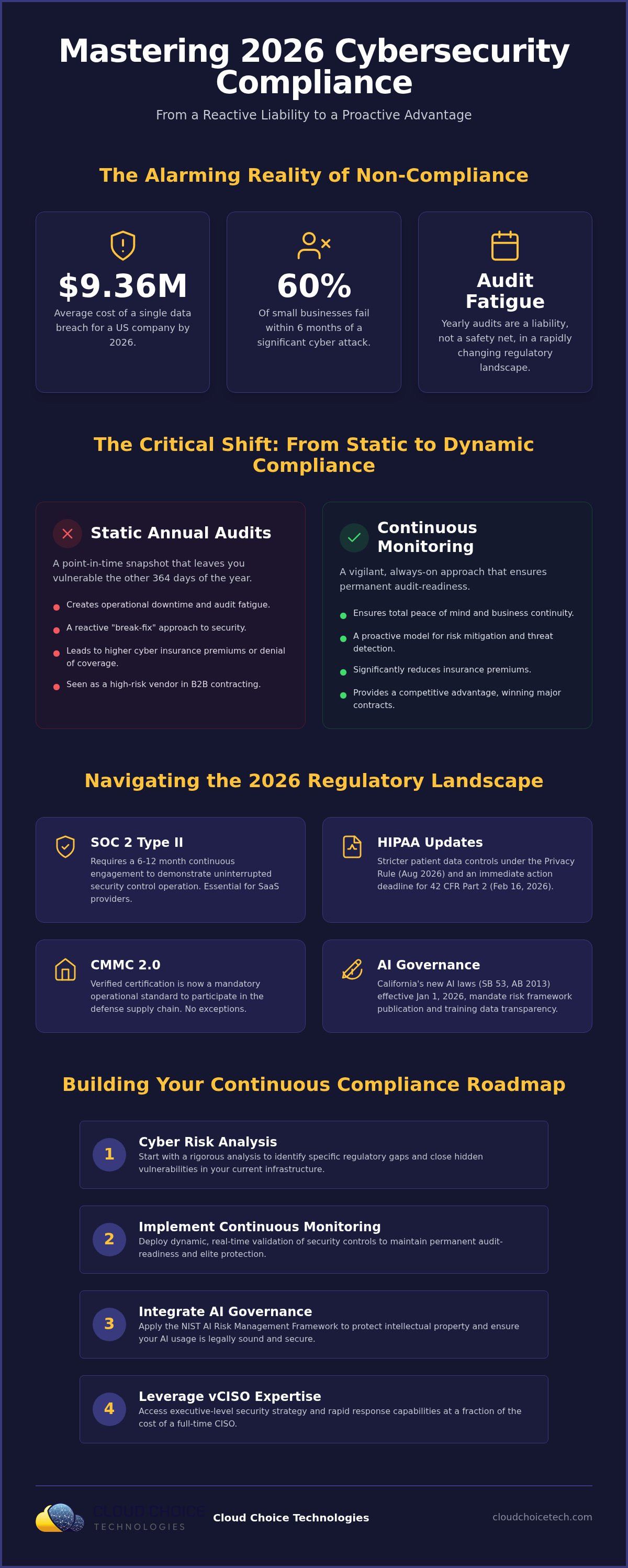
With US companies facing an average data breach cost of $9.36 million per incident in 2026, the traditional yearly audit is no longer a safety net. It's a liability. You've likely felt the mounting pressure of audit fatigue while trying to keep pace with new frontier AI transparency laws and the latest HIPAA updates. It's exhausting to maintain operational continuity when the regulatory landscape shifts every month. Relying on outdated cybersecurity compliance services that only offer point-in-time snapshots leaves your organization vulnerable to the 60% of small businesses that fail after a significant breach. You need a partner that acts as a vigilant guardian.
We believe compliance should be a foundational element of your success, not a hurdle. This executive strategy will show you how to master regulatory complexities through a proactive, managed approach to risk mitigation. By shifting to continuous oversight, you can secure total peace of mind and significantly reduce your insurance premiums. We'll examine how to maintain permanent audit-readiness and implement AI governance that protects your brand. You'll learn to replace digital uncertainty with the composed confidence of an elite, protected enterprise.
Key Takeaways
Transition from static annual audits to dynamic, continuous monitoring to maintain elite readiness and eliminate operational downtime.
Master the 2026 regulatory shifts in SOC 2 Type II and HIPAA to ensure your distributed infrastructure remains fully protected.
Discover how specialized cybersecurity compliance services leverage AI governance to reduce cyber insurance premiums and secure total peace of mind.
Implement a strategic compliance roadmap starting with a rigorous cyber risk analysis to identify and close hidden vulnerabilities.
Leverage the expertise of a vCISO to access executive-level security strategy and rapid response capabilities at a fraction of the cost.
Table of Contents
Navigating the 2026 Regulatory Landscape: SOC 2, HIPAA, and AI
Selecting a Managed Compliance Partner: The Vigilant Guardian
What are Cybersecurity Compliance Services in 2026?
In 2026, cybersecurity compliance services represent the strategic alignment of your entire IT infrastructure with an increasingly complex web of legal and industry standards. It's no longer enough to perform a static, annual check-up. The digital environment moves too fast. Modern compliance requires dynamic, continuous monitoring that provides real-time validation of your security controls. This shift ensures you aren't just meeting a standard on a specific day; you're maintaining elite readiness every hour of the year. We act as the vigilant guardian in this process, ensuring your systems remain resilient against evolving threats.
The C-suite must lead this conversation because compliance is now a foundational element of business continuity. Beyond avoiding fines, your compliance posture directly dictates your cyber insurance eligibility. In 2026, insurance providers often deny coverage or spike premiums for organizations that cannot demonstrate continuous oversight. By integrating cybersecurity regulation into your core business strategy, you transform a technical burden into a robust shield for your brand's reputation. It's about taking total control over complex situations before they escalate into crises.
The Cost of Non-Compliance vs. Managed Oversight
The financial stakes have never been higher. With the average US data breach cost reaching $9.36 million in 2025, a reactive "break-fix" approach is essentially a gamble with your company's future. Regulatory fines are only the beginning of the fallout. The real damage stems from operational downtime and the loss of hard-won client trust. Managed oversight replaces this uncertainty with a proactive service model. This isn't just about protection; it's a competitive advantage. In B2B contracting, being able to prove continuous compliance often makes the difference between winning a major contract and being sidelined as a high-risk vendor.
Bridging the Gap Between Security and Regulation
It's a common misconception that being secure automatically makes you compliant. You might have sophisticated firewalls, but if you lack the documented, repeatable processes required by frameworks like SOC 2 or HIPAA, you're still at risk. Specialized cybersecurity compliance services codify these best practices into a reliable system. Through comprehensive cyber risk analysis, we identify the specific regulatory gaps in your current setup. This process ensures your technical defenses align perfectly with your legal obligations. It creates a seamless narrative of professional excellence that reassures both regulators and stakeholders.
Navigating the 2026 Regulatory Landscape: SOC 2, HIPAA, and AI
The 2026 regulatory environment demands more than just awareness. It requires total control. Effective cybersecurity compliance services have transitioned from annual milestones to a continuous validation baseline. For SaaS providers, SOC 2 Type II audits now typically require a six to twelve month engagement to demonstrate uninterrupted control operation. If your systems fail to meet these standards for even a single day, your compliance status is at risk. This shift ensures you remain a reliable partner in a high-stakes market where transparency is the primary currency.
Healthcare organizations face similar pressures. The release of the HIPAA Privacy Rule final rule in August 2026 mandates stricter controls over patient data access and sharing. While the Security Rule update is delayed until July 2027, the 42 CFR Part 2 alignment deadline of February 16, 2026, requires immediate action for substance use disorder records. We help you secure Protected Health Information (PHI) across distributed networks, maintaining stability while you focus on patient care. We align your infrastructure with NIST cybersecurity and privacy standards to ensure you meet these rigorous requirements without slowing down your operations.
For those in the defense sector, CMMC 2.0 is now a mandatory operational standard. You can't participate in the defense supply chain without verified certification. This isn't just a hurdle; it's a foundational element of your business success.
The Rise of AI Compliance and Governance
AI introduces unique risks like data leakage, algorithmic bias, and sophisticated adversarial attacks. As of January 1, 2026, California's Transparency in Frontier AI Act (SB 53) and the AI Training Data Transparency Act (AB 2013) are in full effect. These laws require developers to publish risk frameworks and summarize training datasets. We implement the NIST AI Risk Management Framework (RMF) to protect your intellectual property and ensure your AI usage remains legally sound. Proactive governance prevents AI from becoming a liability to your reputation.
Industry-Specific Standards: PCI DSS and Beyond
Financial transactions now fall under the strict requirements of PCI DSS 4.x. This version emphasizes continuous security testing and robust multi-factor authentication for all data access points. In a global market, data sovereignty is also a critical factor. You must ensure data stays within specific geographic borders to meet localized laws. Our executive guide to regulatory compliance IT support provides a deeper look at managing these multi-layered requirements. If you're feeling overwhelmed by these shifts, our specialists are ready to help you analyze your current cyber risk to identify your next steps.
Building a Continuous Compliance Roadmap
Establishing a roadmap for continuous compliance requires a methodical, step-by-step approach that prioritizes stability and foresight. It's not a one-time project; it's a recurring cycle of improvement that keeps your organization in a state of elite readiness. We begin by conducting a comprehensive cyber risk analysis to establish your baseline. This initial assessment illuminates hidden vulnerabilities and provides the clarity needed to make informed strategic decisions. To ensure your strategy aligns with national standards, we integrate resources from the Cybersecurity & Infrastructure Security Agency (CISA) to mirror the highest levels of federal oversight.
Once your baseline is secure, the next phase involves mapping your existing controls to multiple frameworks. This process eliminates redundant work by identifying where a single security measure satisfies multiple regulatory requirements. In 2026, manual oversight is no longer enough to manage this complexity. You must implement automated monitoring and AI-driven guardrails that provide real-time alerts the moment a control drifts from its required state. Finally, establish a rigid cadence for internal audits and executive reporting. This ensures the C-suite remains in total control, transforming cybersecurity compliance services from a technical checklist into a transparent business advantage.
The Role of Cyber Risk Analysis
A rigorous risk assessment serves as the north star for your entire compliance journey. Without it, you're merely guessing where your greatest threats lie. We help you prioritize remediation efforts based on actual business impact, ensuring your budget is spent where it provides the most protection. This focused approach is essential for protecting your assets with business cybersecurity solutions that support long-term operational continuity. It's about being the "calm in the storm" by knowing exactly where your defenses stand.
Implementing Secure AI Deployment
Vetting third-party AI tools is a critical requirement for maintaining a modern compliance posture. You must verify how these platforms handle your data and ensure they don't expose your intellectual property to public models. We recommend a "human-in-the-loop" governance model to oversee AI-driven decisions, preventing automated bias from creating legal liabilities. Staying informed about AI-powered cyber threats and protection allows your team to innovate safely while maintaining rigorous standards. If you're ready to secure your infrastructure against these emerging risks, contact our managed compliance experts today to start your roadmap.
Selecting a Managed Compliance Partner: The Vigilant Guardian
Choosing the right provider for cybersecurity compliance services is a strategic decision that defines your organization's resilience. It's the difference between a reactive vendor and a vigilant guardian. In 2026, your selection criteria must go beyond basic certifications. Look for a partner with proven depth in AI security and rapid response capabilities. You need a team that doesn't just identify a threat; they must be capable of neutralizing it before it impacts your operational continuity. This level of elite readiness is what separates industry leaders from those vulnerable to digital uncertainty.
Accessing a virtual CISO (vCISO) through your partner provides executive-level security strategy without the overhead of a full-time hire. This oversight ensures your compliance roadmap remains aligned with your broader business objectives. When an actual audit begins, this partnership serves as the "calm in the storm." Instead of a frantic search for evidence, you present a transparent history of continuous validation. Your partner transitions from a simple utility provider to a foundational element of your long-term success, handling technical complexities so you can focus on growth.
Why Managed IT and Cybersecurity Contracts Win
Managed IT performance and security compliance are fundamentally linked. When your infrastructure is optimized for efficiency, it's often more secure by design. Recurring oversight through managed contracts eliminates the stressful "fire drills" that typically precede an audit. Cloud Choice Technologies provides proactive remote support that monitors your systems around the clock. This "always-on" model ensures that vulnerabilities are patched and controls are verified in real time. It maintains your stability and protects your reputation without interrupting your daily workflow.
Next Steps: Securing Your 2026 Strategy
The first step toward total control is an immediate review of your current compliance gaps. Waiting for a breach or an audit notice to act is a high-stakes gamble you don't need to take. True peace of mind occurs when your security posture meets your operational excellence. You deserve to operate with the confidence that your assets are protected by a fast-acting, sophisticated partner. It's time to stop managing uncertainty and start leading with professional excellence. You can secure your organization’s future with Cloud Choice Technologies and transform your compliance burden into a competitive shield.
Mastering the Future of Digital Resilience
The regulatory landscape of 2026 demands more than just checking boxes; it requires a culture of continuous validation and elite readiness. You've seen how the shift from annual audits to dynamic monitoring protects your brand and reduces insurance premiums. By choosing the right cybersecurity compliance services, you transform compliance from a technical hurdle into a foundational element of your business success. It's about maintaining total control over complex environments so you can focus on growth without the fear of devastating fines or operational downtime.
Securing this level of oversight requires a partner that acts as a vigilant guardian. Our national cyber risk advisory experts provide the foresight and rapid response capabilities needed to handle the digital world's complexities. With specialized AI compliance frameworks and vigilant 24/7 managed security, we ensure your operations remain stable and secure. Don't let audit fatigue or emerging threats slow your momentum. Take the next step toward operational excellence and peace of mind today. Partner with Cloud Choice for Elite Compliance Oversight and lead your organization with undisputed expertise.
Frequently Asked Questions
What is the difference between cybersecurity and cybersecurity compliance?
Cybersecurity refers to the technical tools and practices used to protect systems from attacks. In contrast, cybersecurity compliance services focus on aligning those defenses with specific legal and industry standards. While security keeps the hackers out, compliance provides the documented proof that your organization meets its regulatory obligations. It's the difference between having a lock on the door and proving to an auditor that the lock meets building codes.
How much do cybersecurity compliance services typically cost for a mid-sized business?
Costs for compliance oversight depend on your organization's complexity and the specific frameworks required. Mid-sized companies often face higher expenses because they manage larger data sets across multiple regulatory standards. While initial assessments and ongoing management require a financial commitment, these costs are a fraction of the $9.36 million average data breach cost. We focus on providing scalable solutions that replace unpredictable expenses with stable, recurring service agreements.
Is SOC 2 compliance mandatory for all businesses in 2026?
SOC 2 compliance isn't a federal requirement for every business, but it's the undisputed baseline for SaaS providers and data processors in 2026. Most enterprise clients won't sign a contract without seeing a current SOC 2 Type II report. This validation proves you've maintained continuous control operation for at least six months. It's a critical tool for building trust and securing major B2B contracts in a high-stakes market.
How does AI impact my organization’s regulatory compliance requirements?
AI introduces new transparency and risk management obligations under laws like California's Transparency in Frontier AI Act. You're now required to publish risk frameworks and disclose when content is AI-generated. Beyond legal mandates, AI governance protects your intellectual property from data leakage and adversarial attacks. Implementing the NIST AI Risk Management Framework ensures your use of emerging technology remains a foundational element of your success rather than a legal liability.
Can managed IT services help with HIPAA or CMMC audits?
Managed IT services are essential for navigating the rigorous documentation requirements of HIPAA and CMMC audits. We provide the proactive oversight and remote support needed to maintain continuous compliance. By automating evidence collection and maintaining a secure infrastructure baseline, we remove the stress of audit preparation. Our team functions as your vigilant guardian, ensuring your technical controls always align with the latest 2026 regulatory updates and implementation timelines.
How often should a business conduct a cyber risk analysis?
A business should conduct a comprehensive cyber risk analysis at least annually, but the modern standard has shifted toward continuous assessment. In 2026, waiting twelve months to identify a vulnerability is too risky. You should also trigger a new analysis whenever you implement major infrastructure changes or adopt new AI tools. This proactive approach ensures your security strategy evolves as fast as the threats, providing total peace of mind for your executive team.