
Creating a Robust Business Continuity and Disaster Recovery Plan for 2026
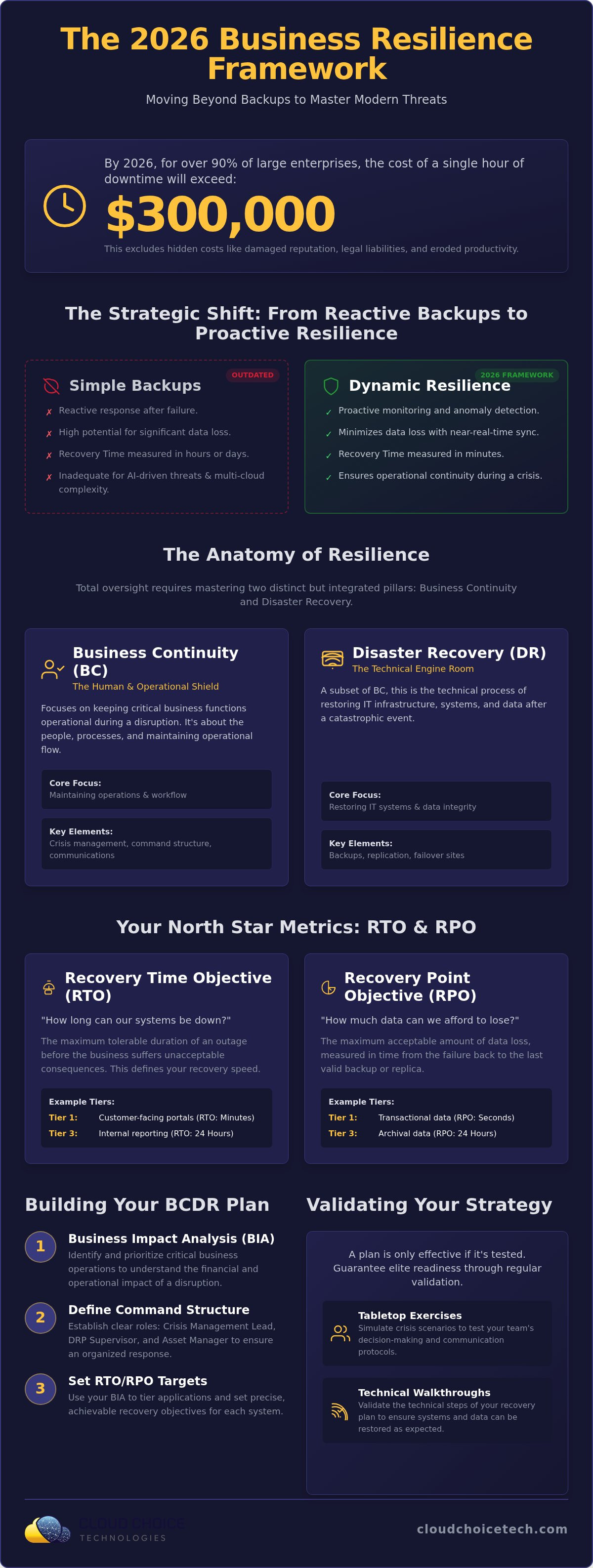
For over 90% of mid-size and large enterprises in 2026, a single hour of operational downtime now costs more than $300,000. When a digital crisis hits, the financial and reputational fallout happens in real time, leaving no room for hesitation. You understand that the stakes have never been higher. AI-driven threats and multi-cloud complexities have redefined the risk landscape, making a robust business continuity and disaster recovery plan the foundational element of your organization's survival.
It's natural to feel the weight of this responsibility while managing remote environments and shifting compliance standards. You need a strategy that offers total control over complex situations. This article will help you master the step-by-step process of building a dynamic resilience framework designed for modern threats. We'll provide a clear, actionable roadmap to minimize your recovery time objectives and ensure regulatory alignment. By the end, you'll have the tools to replace digital uncertainty with the confidence of elite readiness. We will move quickly from identifying vulnerabilities to presenting comprehensive, professional solutions that protect your operations.
Key Takeaways
- Identify why the 2026 threat landscape requires a shift from simple backups to a dynamic, AI-integrated resilience framework.
- Distinguish between business continuity for operational stability and disaster recovery for IT systems to ensure total oversight during a crisis.
- Master the step-by-step process of building a business continuity and disaster recovery plan that leverages proactive monitoring for rapid response.
- Validate your emergency protocols through tabletop exercises and technical walkthroughs to guarantee elite readiness when seconds matter.
- Minimize recovery time objectives and maintain regulatory compliance by positioning proactive risk management at the core of your strategy.
Beyond Backups: Why Your Business Needs a 2026 BCDR Framework
A modern business continuity and disaster recovery plan isn't a static document sitting on a server. It's the synergy between proactive continuity and reactive recovery. In 2026, the digital landscape is defined by AI-powered cyber threats and complex outages in multi-cloud environments. Relying on daily backups is a strategy that belongs in the past. If your recovery time objective (RTO) is measured in minutes, waiting for a 24-hour-old tape or cloud snapshot to restore is a recipe for failure. Modern threats require real-time resilience.
Elite readiness requires a shift toward managed IT services that provide the calm in the storm. Effective Business continuity planning ensures that your critical functions remain operational during a crisis, rather than just hoping for a successful reboot afterward. This proactive oversight allows you to identify anomalies before they escalate into full-scale disasters, maintaining a state of constant vigilance.
The True Cost of Operational Downtime
The financial impact of a system failure extends far beyond lost sales. You must account for damaged reputation, legal liabilities, and the total erosion of employee productivity. While data loss is catastrophic, data corruption is often more insidious. It forces your team to verify every record, ballooning the time required for restoration and creating massive operational friction. Downtime is the interval between the initial failure and the full restoration of all business operations.
Regulatory and Compliance Drivers for BCDR
Modern oversight bodies no longer view recovery plans as optional. Utilizing regulatory compliance IT support is essential for meeting mandates that require documented, tested recovery protocols. Beyond avoiding fines, a robust business continuity and disaster recovery plan is often a prerequisite for cyber insurance eligibility. Carriers now demand audit-ready documentation to prove you can withstand AI-driven disruptions. Maintaining this level of oversight isn't just about ticking a box; it's about securing the long-term success of your enterprise through disciplined, meticulous preparation. This authoritative approach ensures you remain compliant while protecting your stakeholders' interests.
The Anatomy of Resilience: Differentiating Business Continuity and Disaster Recovery
Understanding the distinction between these two pillars is vital for total oversight. Business continuity focuses on the human element and operational flow. It's about keeping the lights on and the people working. Disaster recovery is the technical engine room. It ensures your data remains intact and your systems return to a functional state. A high-performance business continuity and disaster recovery plan integrates both to create a seamless shield against disruption. To effectively create a business continuity plan, you must first identify your command structure. This includes a Crisis Management Lead to orchestrate the response, a DRP Supervisor to handle technical restoration, and an Asset Manager to track critical resources.
Your strategy begins with a Business Impact Analysis (BIA). This process identifies which operations are the lifeblood of your company and which can wait. By layering in business cybersecurity solutions, you move from a reactive posture to a preventative one. It's easier to maintain continuity when you've already neutralized the threat. If you're unsure where your vulnerabilities lie, a professional cyber risk analysis can provide the clarity you need to move forward with confidence.
Defining RTO and RPO: Your North Star Metrics
Precision is mandatory when setting recovery targets. Your Recovery Time Objective (RTO) defines exactly how long your business can survive a system outage before the damage becomes irreversible. Conversely, the Recovery Point Objective (RPO) determines the maximum amount of data loss you can tolerate. Use these metrics to tier your applications. Tier 1 systems, like your customer-facing portal, require near-zero RTO. Tier 3 systems might wait 24 hours. This prioritization ensures your resources go where they matter most.
Distributed Workforce and Remote Continuity
The rise of the hybrid model has complicated the traditional failover strategy. Relying on remote IT support for corporations is now a foundational requirement for resilience. You must protect endpoints that exist outside your physical office. This involves deploying robust endpoint protection and ensuring secure cloud access as a primary failover mechanism. When the main office goes dark, your team should be able to transition to a remote environment without missing a single beat. This approach ensures your workforce remains productive regardless of the physical location of your servers.
Step-by-Step: Creating Your IT Incident Response and Recovery Plan
A high-performance business continuity and disaster recovery plan requires a phased, disciplined approach to technical restoration. As defined by the University of Texas at Austin's emergency management office, continuity is the process of maintaining essential functions during and after a disaster. In 2026, this process must be digital-first and highly automated to counter the speed of AI-driven disruptions.
Phase 1 begins with preparation. You must establish a clear communication tree and emergency protocols before a crisis strikes. Phase 2 moves into detection and analysis. You utilize AI-driven monitoring to identify anomalies that traditional systems might miss. Once a threat is confirmed, Phase 3 focuses on containment and eradication. You isolate the threat immediately to prevent lateral movement through your environment. Phase 4 involves the actual recovery, executing a failover to managed cloud security services to restore operations. Finally, Phase 5 requires post-incident activity. You conduct a meticulous root cause analysis to refine your strategy for the next challenge.
Automating the Response with AI
Seconds matter during a breach. AI security measures can execute pre-approved isolation scripts the instant a vulnerability is detected. This automation removes the risk of human error during high-stress recovery windows. AI compliance ensures these automated responses follow legal protocols and industry standards automatically.
The Emergency Communication Plan
You can't lead in a vacuum. Your internal communication strategy must reach every staff member, while your external strategy keeps clients and vendors informed. When primary networks fail, you need out-of-band communication methods like encrypted messaging apps or secondary satellite links. Role-based notification checklists ensure everyone knows their duty without hesitation. If you're ready to secure your operations, our experts provide the managed IT services you need to maintain total control.
Validating Your Strategy: Testing and Maintaining Operational Continuity
A business continuity and disaster recovery plan is only as reliable as its last successful test. Relying on a theoretical framework without validation is a high-stakes gamble your organization cannot afford. Research indicates that 58% of data backups fail during the actual recovery process. This statistic serves as a stark reminder that elite readiness requires more than just documentation. It demands a disciplined, methodical approach to testing that evolves alongside your digital infrastructure. You must move beyond assumptions to reach a state of total control.
Your validation journey begins with tabletop exercises. These sessions involve walking through various crisis scenarios with key stakeholders to identify gaps in decision-making and communication. Once your team is aligned, transition to structured walkthroughs. This phase focuses on checking the precision of your technical recovery scripts against your current IT environment. The final, most rigorous stage is simulation testing. By executing a full failover to a secondary environment, you prove your ability to maintain operational continuity under real-world pressure. Regular maintenance ensures that as your systems scale, your resilience keeps pace.
The 2026 BCDR Checklist
Use this concise checklist to ensure your framework remains audit-ready and effective:
- Are all critical assets tiered accurately by RTO and RPO metrics?
- Is your emergency contact list updated and stored in an accessible, offline format?
- Have you verified that third-party vendor SLAs align with your required recovery windows?
- Are your immutable, air-gapped backups verified for zero errors?
Partnering for Resilience
Maintaining a sophisticated resilience framework is a continuous commitment that often exceeds the capacity of internal teams. Transitioning from a DIY plan to a professionally managed model provides the vigilant, always-on protection your enterprise deserves. By integrating proactive cyber risk analysis services, you can identify infrastructure shifts that require immediate plan adjustments. A managed IT partner functions as the calm in the storm, handling the technical complexities so you can lead with confidence. This partnership ensures that your business continuity and disaster recovery plan remains a foundational element of your long-term success rather than a static document.
Securing Your Competitive Advantage Through Resilience
Building a modern resilience framework requires shifting from passive backups to active, AI-integrated oversight. You've learned how to prioritize critical assets through Business Impact Analysis and validate your response through rigorous simulation testing. These steps ensure your operations remain stable regardless of external threats. A high-performance business continuity and disaster recovery plan isn't just about survival; it's about maintaining undisputed expertise and stakeholder confidence in a volatile digital world.
Cloud Choice Technologies provides the vigilant 24/7 security monitoring and expert compliance oversight you need to thrive. Our team delivers rapid technical assistance for distributed workforces, ensuring your data remains protected and accessible. Secure your operations with a professional cyber risk analysis from Cloud Choice Technologies. You've taken the first step toward total control over your digital future. Now, let's build the foundation for your continued success together. Your organization's stability is our priority, and we're ready to act as your fast-acting partner in every scenario.
Frequently Asked Questions
What is the primary difference between business continuity and disaster recovery?
Business continuity focuses on keeping the entire organization's operations running during a crisis. It covers people, processes, and essential services. Disaster recovery is a technical subset that specifically addresses the restoration of IT systems and data after a failure. While continuity ensures you can still serve clients from a remote location, recovery ensures the servers hosting your data are back online and functional. This distinction ensures total oversight of both human and technical assets.
How often should a business continuity plan be tested?
You should conduct tabletop exercises at least twice a year and execute full-scale simulation tests annually. However, any significant change to your IT infrastructure or a shift in regulatory requirements should trigger an immediate review. Testing ensures that your business continuity and disaster recovery plan remains effective against the latest AI-driven threats. Regular validation is the only way to guarantee your team can act with elite readiness when a real crisis occurs.
What are the most critical components of an IT incident response plan?
A high-performance plan must include a clear communication tree, role-based notification checklists, and automated isolation protocols. You need specific phases for detection, containment, and eradication of threats to prevent lateral movement. Modern plans also require a failover mechanism to managed cloud environments. These components work together to minimize your recovery time objective and protect your reputation from the long-term fallout of a digital disruption. This approach provides immediate peace of mind.
Can a small business afford a professional BCDR plan?
Professional resilience is an essential investment for businesses of all sizes. Research shows that 40% of organizations fail to reopen after a major disaster. Managed IT services provide a cost-effective alternative to building an internal security team. By utilizing a consumption-based model for cloud failover and remote support, you gain access to enterprise-grade protection without the overhead of physical infrastructure. This proactive approach prevents the catastrophic costs associated with prolonged operational downtime.
How does AI impact modern disaster recovery planning?
AI serves as both a sophisticated threat and a powerful defensive tool. In 2026, AI-driven monitoring identifies anomalies in real time, allowing for the execution of pre-approved isolation scripts before a human operator could even react. This automation reduces human error during high-stress recovery windows. Integrating these tools into your business continuity and disaster recovery plan ensures your organization can counter the speed and scale of modern, automated cyberattacks effectively and with total control.
What is a Business Impact Analysis (BIA) and why is it important?
A BIA is a systematic process used to determine the potential effects of an interruption to critical business operations. It helps you prioritize recovery efforts by identifying which systems are essential for survival and which can wait. By setting specific Recovery Time Objectives for different tiers of applications, you ensure that your resources are allocated efficiently. This analysis forms the foundation of a disciplined, audit-ready resilience framework that provides the calm in the storm.