
20 Essential Questions to Ask a Potential Managed IT Provider: The 2026 Executive Checklist
Is your current IT strategy a proactive shield or just a reactive help desk waiting for the next disaster? In 2026, the gap between "working" technology and truly secure, compliant operations has never been wider. You likely feel the mounting pressure of tightening AI regulations and the constant threat of catastrophic downtime. Identifying the right questions to ask a potential managed IT provider is no longer a clerical task; it's a vital executive safeguard. You deserve a partner who acts as a vigilant guardian, ensuring your infrastructure meets rigorous standards before a crisis occurs.
We understand that digital uncertainty creates unnecessary friction for your leadership team. This article promises to master your vendor vetting process by providing a high-stakes checklist designed for the modern regulatory environment. You'll learn how to identify elite partners who prioritize operational continuity and cyber insurance eligibility. We will break down twenty essential questions that reveal whether a provider offers true foresight or merely basic repairs. From AI safety protocols to rapid response benchmarks, this guide ensures your next partnership is built on elite readiness and unwavering reliability.
Key Takeaways
- Understand the difference between "best effort" responses and binding Service Level Agreements that guarantee operational continuity.
- Discover the specific questions to ask a potential managed IT provider to verify they prioritize proactive cyber risk analysis over outdated, reactive security measures.
- Master the 2026 AI frontier by vetting your partner's ability to govern data security within Large Language Models and maintain strict AI compliance.
- Evaluate potential partners as strategic assets by examining their roadmap for business continuity and their capacity to serve as an elite Virtual CIO.
Operational Excellence: Vetting Support and Service Level Agreements
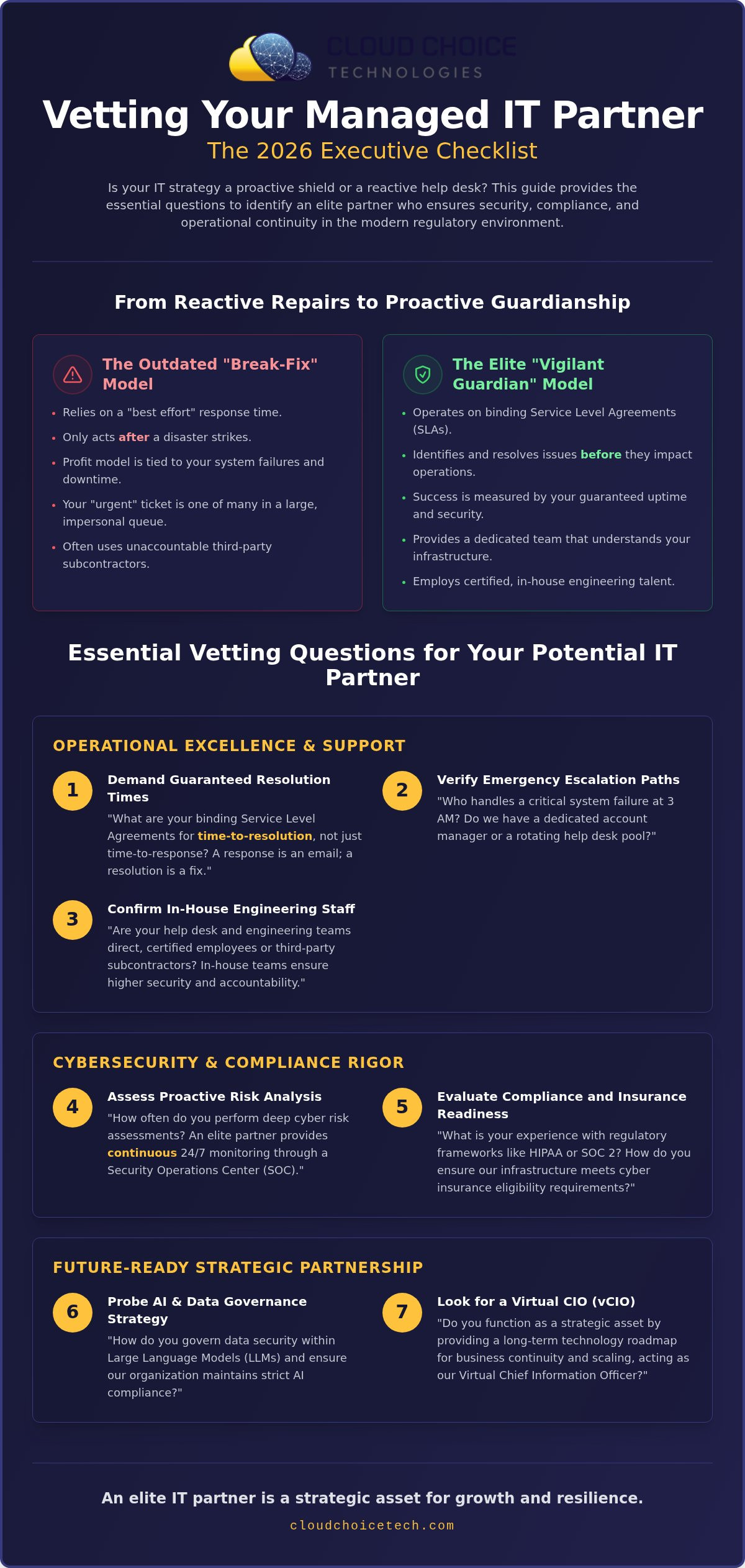
Operational excellence isn't a luxury; it's the baseline for your business continuity. When evaluating your options, the most critical questions to ask a potential managed IT provider focus on how they define "support." Many vendors offer a "best effort" response, which essentially means they'll get to you when they can. This reactive mindset belongs to the outdated break-fix model, where your provider only makes money when your systems fail. You need a partner committed to elite readiness. This means shifting toward a proactive service model that identifies and resolves issues before they impact your staff. Ask about their engineer-to-client ratio. If a provider's staff is stretched too thin, your "urgent" ticket becomes just another number in a massive queue. You deserve personalized care from a team that understands your infrastructure as well as you do.
Guaranteed Response Times and Escalation Procedures
Don't settle for vague promises of "fast" service. Demand specific time-to-resolution metrics rather than just time-to-response numbers. A response is merely an acknowledgment; a resolution is a fix. You should know exactly how long it takes to restore a downed server or a compromised network. Ask for a clear emergency escalation path. Who handles the call at 3 AM when your primary systems go dark? You should have access to a dedicated account manager who knows your history, not a rotating help desk pool where you have to explain your setup every time you call. An elite SLA functions as a financial guarantee of performance, explicitly penalizing the provider for failing to hit agreed-upon uptime and resolution targets.
In-House Engineering vs. Outsourced Subcontractors
The quality of your remote IT support depends entirely on the people behind the screen. Verify if the help desk staff are direct employees or third-party subcontractors. Subcontractors often lack the institutional knowledge and accountability required to maintain high security standards. Ask about their continuous training and certification requirements. In a landscape where threats evolve weekly, your technical team must be disciplined and current. This level of internal expertise is vital for managing a distributed national workforce effectively. This strategic alignment is a core component of The Executive Guide to Managed IT Services in 2026, where operational stability meets long-term growth. Ensure your provider has the reach and the internal talent to support your team wherever they operate.
Vigilant Protection: Cybersecurity and Compliance Rigor
A standard firewall is no longer a sufficient defense in 2026. Threats have evolved beyond simple perimeter breaches, requiring a more sophisticated, multi-layered approach to digital safety. When you evaluate the questions to ask a potential managed IT provider, focus on how they perceive risk. You don't need a vendor who simply installs software and walks away. You need a vigilant guardian that utilizes deep cyber risk analysis to uncover hidden vulnerabilities before a malicious actor finds them first. This proactive stance is what separates an elite partner from a basic utility. It's also vital to ask: who watches the watchers? A provider should be transparent about their own internal security posture, demonstrating that they protect your data with the same rigor they apply to their own infrastructure.
Proactive Risk Analysis and Threat Detection
Ask: "How often do you perform deep cyber risk assessments on our infrastructure?" If the answer is anything less than continuous, your business is at risk. Elite providers maintain robust Security Operations Center (SOC) capabilities, offering true 24/7 monitoring that detects anomalies in real time. This level of oversight is essential for ransomware prevention. By implementing multi-layered data protection, a provider ensures that a single point of failure won't bring your operations to a halt. Proactive risk management reduces total cost of ownership by preventing breach-related fines and the astronomical costs of operational recovery.
Compliance Alignment and Cyber Insurance Readiness
Regulatory compliance is a complex, shifting landscape that requires specialized expertise. Ask about their specific experience with frameworks like HIPAA, SOC 2, or the latest financial regulations. Your provider must have the technical depth to perform a rigorous IT infrastructure security audit to ensure every endpoint meets current standards. This isn't just about avoiding fines; it's about insurance eligibility. Most carriers now require detailed documentation of your security protocols before they'll honor a claim. If you aren't sure where your current defenses stand, scheduling a professional cyber risk analysis can provide the clarity you need to move forward with confidence. Your partner should stay ahead of both federal and international privacy laws, serving as a sophisticated entity that handles these complexities so you don't have to.
The AI Frontier: Security and Governance for Modern Enterprises
Artificial intelligence has fundamentally shifted the risk landscape for modern enterprises. In 2026, an IT provider who doesn't prioritize AI governance is a significant liability. You need to know exactly how they secure your data within Large Language Models (LLMs). One of the most vital questions to ask a potential managed IT provider is how they prevent sensitive corporate data from leaking into public AI training sets. Without strict protocols, your proprietary information could become part of a public dataset, creating an irreversible breach of confidentiality. Elite providers don't just "allow" AI; they govern it with technical precision and clear oversight.
AI Security Measures and Data Privacy
Ask: "What protocols do you have in place to prevent sensitive corporate data from leaking into public AI models?" You should hear about private LLM instances, data masking, and strict anonymization techniques. An elite partner offers dedicated AI compliance and security services to ensure your staff uses these tools without compromising your intellectual property. They must also implement AI-driven threat detection. These systems use machine learning to identify and stop zero-day attacks before they can penetrate your network, providing a level of protection that human monitoring alone cannot match.
Governance Frameworks for Emerging Technologies
Shadow AI is a growing threat to your operational integrity. This occurs when employees use unauthorized AI tools to process company data, often without realizing the security implications. Your provider should govern AI use through automated policies and technical blocks that prevent the use of unvetted platforms. Ask about their roadmap for managing AI-specific regulatory adherence. They should perform specialized security audits for any third-party software integrations that feature AI capabilities. Request specific examples of how they've helped other organizations implement AI governance policies that balance innovation with rigorous safety standards.
If you're concerned about how rapid AI adoption impacts your regulatory standing, it's time to secure your infrastructure with professional AI compliance and security services. We provide the elite readiness required to manage these emerging technologies with total confidence.
Strategic Partnership: Long-Term Value and Scaling
A true IT partner does more than fix broken hardware. They function as a strategic extension of your leadership team. As you grow, you need a provider capable of evolving from a support desk into a Virtual CIO (vCIO). This shift ensures your technology investments align directly with your long-term business goals. When considering your options, the questions to ask a potential managed IT provider should focus on their ability to handle business continuity and disaster recovery. Can they guarantee operational stability during a regional outage or a targeted cyberattack? You need a partner that scales with your national expansion without allowing service quality to degrade. Elite readiness means having a plan for growth before the first new office even opens.
Reporting, Transparency, and Strategic Oversight
Transparency builds trust. Demand to see samples of their monthly executive reports and security posture summaries. These documents should provide clear, quantifiable metrics regarding your system health and risk levels. Inquire about the frequency of Strategic Business Reviews (SBRs). These meetings are vital for ensuring your IT infrastructure supports your upcoming initiatives. A sophisticated provider will deliver a clear technology roadmap for the next 18 to 36 months, identifying necessary upgrades and security enhancements well in advance. This foresight prevents budget surprises and keeps your operations streamlined.
The Onboarding and Transition Process
The switch to a new provider shouldn't cause the very downtime you're trying to avoid. Ask: "What is your specific process for transitioning from our current provider to your services?" A disciplined partner will have a rigorous documentation phase, mapping every inch of your network to ensure a seamless handover. They must commit to zero downtime during the switch. Evaluate their readiness to provide rapid technical assistance during the first 90 days of the contract. This initial period is critical for establishing baseline security and stabilizing your environment. You deserve a transition that feels like a relief, not a secondary crisis.
Secure Your Digital Legacy in a 2026 Landscape
You now have a high-stakes roadmap to navigate the complexities of modern vendor vetting. By prioritizing AI compliance and proactive risk analysis, you move beyond simple troubleshooting toward true operational resilience. These specific questions to ask a potential managed IT provider reveal whether a vendor is a mere utility or a sophisticated guardian of your assets. You deserve a partner who eliminates the anxiety of digital uncertainty through disciplined, meticulous oversight. This checklist ensures your next technical alliance is built on a foundation of elite readiness rather than reactive repair.
Don't let your business settle for support that leaves you vulnerable to evolving threats. Our team provides the security you need with AI-ready security frameworks and specialized regulatory compliance experts. We maintain vigilant 24/7 remote monitoring to ensure your infrastructure remains stable and secure around the clock. Secure Your Corporate Future with Cloud Choice Technologies and transform your technical infrastructure into a cornerstone of your success. Your path to digital peace of mind starts with a single decisive step toward a more secure tomorrow.
Frequently Asked Questions
What are the most important security certifications a managed IT provider should have in 2026?
In 2026, look for SOC 2 Type II and ISO/IEC 27001 certifications as the baseline for security excellence. These standards prove a provider maintains rigorous, audited controls over your data. If you're in a regulated field, ensure they hold CMMC or HIPAA-specific credentials to guarantee they understand your unique legal obligations. These certifications demonstrate a commitment to the highest professional standards and elite readiness.
How do I know if an MSP is actually proactive or just using that as a marketing term?
A truly proactive provider presents a detailed technology roadmap and evidence of regular cyber risk analysis. They don't just wait for your call; they identify and neutralize vulnerabilities before they cause downtime. Ask for a sample of their automated patching schedule and recent security audit reports to see their preventative measures in action. These are key questions to ask a potential managed IT provider to separate real guardians from reactive help desks.
Is it better to have a local IT provider or a national provider for a distributed workforce?
A national provider is often superior for a distributed workforce because they offer consistent remote support and a deeper pool of specialized engineers. While local vendors provide physical proximity, elite national partners use advanced remote monitoring tools to resolve issues across multiple time zones simultaneously. This ensures your entire team receives the same high standard of care regardless of their physical location.
What should be included in a standard managed IT service contract?
Your contract must include clearly defined Service Level Agreements (SLAs), a detailed scope of work, and specific data protection protocols. It should also outline the onboarding and offboarding processes to ensure you aren't locked into a failing relationship. Demand transparency regarding what is included in your monthly fee and what constitutes an additional billable project to avoid budget surprises. A comprehensive contract protects both your budget and your operational continuity.
How does a managed IT provider help with cyber insurance compliance?
Managed IT providers help you meet insurance requirements by implementing and documenting critical controls like Multi-Factor Authentication (MFA) and endpoint encryption. They provide the audit logs and security posture summaries that carriers demand during the application process. This vigilant oversight ensures you remain eligible for coverage and helps lower your premiums through demonstrated risk mitigation. Without this documentation, your claim could be denied during a crisis.
Can a managed IT provider help my company implement AI safely?
Elite providers offer AI compliance and security services to help you deploy Large Language Models without exposing sensitive data. They establish governance frameworks that prevent staff from using unvetted tools and ensure all platforms meet corporate privacy standards. By creating secure, private instances for your team, they allow you to innovate while maintaining total control over your intellectual property. This approach balances rapid growth with unwavering security.