
Vendor Risk Management Checklist: A Practical Guide for 2026
Vendor risk doesn’t end when a contract is signed. Information may be scattered across questionnaires, contracts, and email, while ownership and review dates get overlooked after onboarding. A practical vendor risk management checklist gives your team a repeatable way to decide what to check before approval and what to monitor throughout the relationship.
Not every vendor needs the same level of scrutiny. A provider with access to sensitive data or a role in critical operations warrants a closer review than a low-impact supplier. The key is to assess that difference consistently, then make sure someone owns each decision and follow-up action.
This guide walks you through a risk-based checklist for planning, due diligence, contracts, ongoing monitoring, and exit planning. You’ll learn how to match review depth to vendor access and business impact, document risk decisions, assign remediation follow-up, and set review dates. For a separate look at your own technology environment, Cloud Choice Technologies offers a free Network Security Analysis. It assesses your environment, not your vendors.
Key Takeaways
- Use a vendor risk management checklist to tailor due diligence to each vendor’s access, data handling, and importance to your operations.
- Request evidence that fits the service and risk. Treat vendor self-attestation as one input, not conclusive proof.
- Keep risks visible after onboarding by recording changes, assigning owners, and setting review timing based on risk and organizational policy.
- Choose tracking tools that make ownership, evidence retrieval, and reporting practical for your team, whether you use a spreadsheet or a dedicated system.
- Cloud Choice Technologies’ free Network Security Analysis assesses your technology environment, not a vendor’s security.
What Vendor Risk Management Means and Why a Checklist Matters
Vendor risk management is the ongoing process of identifying, assessing, treating, and monitoring risks created by third-party relationships. It extends beyond procurement because a vendor can affect your data, systems, operations, compliance obligations, and ability to keep services running.
Vendor risk management is the business process of overseeing third-party risks throughout a relationship, not simply selecting a supplier and signing a contract. The broader discipline of Third-party risk management covers these connected concerns; vendor risk management applies that oversight to risks a supplier may introduce. A checklist helps teams ask consistent questions and record evidence, but it can’t determine on its own whether a risk is acceptable. People with the right authority must weigh the findings, decide what to do, and assign accountability.
Which vendors need a closer review?
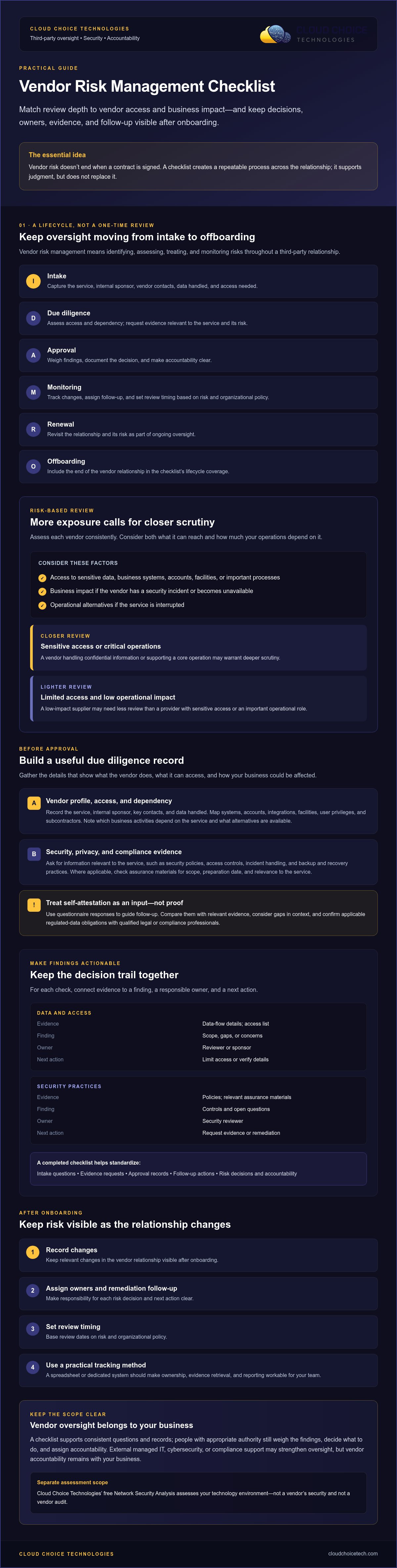
Start by considering access and business impact. Could the vendor access sensitive data, business systems, accounts, facilities, or important processes? What would happen if it experienced a security incident or became unavailable? A supplier that handles confidential information or supports a core operation may warrant deeper scrutiny than one with limited access and little operational impact.
Use those answers to set the review depth. For example, document the systems and data a vendor can reach, the business activities that depend on its service, and what alternatives are available if the service is interrupted. This keeps attention focused where disruption or a security issue could cause the greatest harm, rather than applying identical checks to every supplier.
What a vendor risk checklist can and cannot do
A vendor risk management checklist can standardize intake questions, evidence requests, approval records, and follow-up actions. It also helps teams track the relationship through its full lifecycle: intake, due diligence, approval, monitoring, renewal, and offboarding. The checklist creates consistency; it doesn’t replace sound judgment or make a vendor risk-free.
A completed questionnaire is a starting point, not proof that every risk is controlled. Compare responses with relevant evidence, consider gaps in context, and record who accepted the risk or owns remediation. Keep responsibility clear: managed IT, cybersecurity, or compliance support may strengthen your organization’s oversight, but vendor accountability remains with your business. Cloud Choice Technologies’ free Network Security Analysis assesses your technology environment; it isn’t a vendor audit.
Vendor Risk Management Checklist for Due Diligence and Approval
Before approving a vendor, establish what it does, what it can access, and how your business would be affected by a disruption. A practical vendor risk management checklist makes the review consistent and keeps evidence, decisions, and follow-up together. The AICPA vendor management white paper offers additional guidance on structuring vendor oversight and due diligence.
Vendor profile, data access, and business dependency
Record the service, internal sponsor, key vendor contacts, and types of data handled. Map access to systems, accounts, integrations, and facilities, noting the level of user privileges and any subcontractors involved. Then assess operational dependency: if the service stopped, which business activities would slow or halt, and what alternatives would be available? These details help reviewers focus on actual exposure, not just the vendor’s name or category.
Security, privacy, and compliance evidence
Ask for information relevant to the service, such as security policies, access controls, incident handling, and backup and recovery practices. Request suitable assurance materials where applicable, then check their scope, preparation date, and relevance to the service your organization will use. A vendor’s questionnaire or self-attestation can guide follow-up, but shouldn’t be treated as independent proof. For regulated data, identify the obligations that apply and confirm requirements with qualified legal or compliance professionals.
Use a compact record to make findings actionable:
| Check | Evidence | Finding | Owner | Next action |
|---|---|---|---|---|
| Data and access | Data-flow details; access list | Scope, gaps, or concerns | Reviewer or sponsor | Limit access or verify details |
| Security practices | Policies; relevant assurance materials | Controls and open questions | Security reviewer | Request evidence or remediation |
| Business dependency | Service description; recovery information | Impact of interruption | Business owner | Document decision and contingency |
Close the review by recording the reviewer, approval date, decision rationale, unresolved issues, and accountable owner for each follow-up. If you need help assessing your own technology environment, explore Cloud Choice Technologies’ free Network Security Analysis. It assesses your environment, not a vendor’s.
How to Monitor Vendor Risk After Onboarding
Approval is a checkpoint, not the finish line. A vendor’s services, access, ownership, or security posture can change, so monitoring needs clear responsibilities and a process for acting on new information.
Vendor reviews should respond to meaningful changes, not calendar reminders alone. Use review dates as planned checkpoints, then bring reviews forward when a change could alter the relationship’s risk. Set timing according to the vendor’s risk level and your organization’s policy rather than relying on a universal schedule.
Set review owners, triggers, and records
Assign a business owner who understands the service and a technical owner who can assess access and security changes. Keep review dates, evidence, decisions, exceptions, and remediation status in a record the relevant teams can find. For related compliance oversight, see this regulatory compliance IT support guide.
Use a consistent sequence to keep oversight active:
- Maintain the record. Confirm the service, contacts, data handled, access, owners, and next scheduled review.
- Watch for triggers. Reassess after a contract renewal, new data access, security incident, significant service change, or change in ownership.
- Review the impact. Gather relevant updated evidence and assess changes using your organization’s approved risk method.
- Assign follow-up. Document the finding, action, accountable owner, due date, escalation path, and any formally accepted residual risk.
- Close or transition. Confirm remediation, or prepare for contract end by planning data return, access removal, and a secure transition.
Respond to findings and plan for vendor changes
Not every finding requires the same response. Classify it by business impact and urgency under your approved method, then decide whether to request evidence, require remediation, restrict access, escalate the issue, or formally accept the remaining risk. Record the decision and rationale so the people accountable for the relationship can act on them.
Plan for disruption before it happens. Know who coordinates the response if the vendor reports an incident or can’t deliver its service. Include contract end, data return, account removal, and transition tasks in the exit plan. A vendor risk management checklist can help keep these actions visible between review cycles.
For support assessing your own technology environment, request Cloud Choice Technologies’ free Network Security Analysis. It assesses your environment, not a vendor.
Turn Vendor Risk Findings into a Sustainable Security Process
A checklist only helps if your team can keep it current and act on what it reveals. Start with a consistent vendor inventory and a small set of minimum review steps. Add detail when your workload, evidence needs, or reporting requirements call for it. Define who can resolve findings, who handles exceptions, and who escalates concerns involving business-critical vendors.
Choose a process your team can maintain
A spreadsheet may work when the inventory is manageable and owners can reliably update records. Make key details easy to find, including review status, evidence, decisions, open issues, and next actions. A dedicated system may be useful if teams struggle to retrieve documents, track responsibilities, or produce consistent reports. Choose based on actual workflow needs, not features your process won’t use. For broader security context, explore business cybersecurity solutions.
Keep escalation practical. Specify who reviews overdue remediation, who can approve an exception, and which business leader must be involved if a vendor issue could disrupt an essential service. The vendor risk management checklist should support these decisions, not become another form that teams complete and forget.
Where managed IT and cybersecurity support fits
Internal owners may be able to manage the process when responsibilities are clear and they have the time and expertise to assess evidence, coordinate reviews, and follow through on findings. Specialist support may help when the organization needs additional capacity or technical and compliance perspective. Managed IT, cybersecurity, cyber risk analysis, and compliance services can support a broader risk program. They don’t transfer vendor approval or risk acceptance; those decisions remain with your organization.
For an overview of how security support can complement internal oversight, review the linked business cybersecurity guidance. Keep the boundary clear: an assessment of your own technology environment can inform your internal security work, but it isn’t a vendor audit.
To assess your organization’s technology environment, request a free Network Security Analysis from Cloud Choice Technologies. It includes white-hat testing and focuses on your environment, not the security of your vendors.
Make Vendor Oversight a Repeatable Business Practice
A strong vendor risk management checklist does more than organize questions. It helps your team match review depth to vendor access and business impact, document decisions and owners, and keep risks visible as services or circumstances change.
Build a process people can maintain. Keep evidence and follow-up actions accessible, set review timing according to risk and policy, and define how the team will respond to incidents, unresolved findings, and vendor transitions. A checklist supports sound judgment; your organization remains responsible for vendor approval and risk acceptance.
Cloud Choice Technologies offers Managed Services, Cyber Security & Protection, cyber risk analysis, and compliance services that may support your broader technology oversight. For a separate assessment of your own environment, request your free Network Security Analysis, a technology assessment that includes white-hat testing. It assesses your environment, not your vendors.
Clear ownership and consistent follow-through can turn scattered information into better-informed decisions. Start with the vendors that matter most, then strengthen the process as your needs grow.
Frequently Asked Questions
What should be included in a vendor risk management checklist?
A vendor risk management checklist should capture the vendor’s service, business owner, key contacts, data handled, access to systems or facilities, and importance to business operations. Include relevant security, privacy, compliance, and service continuity questions, along with the evidence reviewed and any gaps found. Record the decision, rationale, reviewer, accountable owners, follow-up actions, and next review date. Tailor the depth of checks to the vendor’s access and potential impact rather than applying identical requirements to every supplier.
How often should vendors be assessed for risk?
Set assessment timing according to each vendor’s risk and your organization’s policy; there’s no universal interval that fits every relationship. Higher-impact vendors may need closer oversight, while lower-exposure suppliers may require less intensive review. Don’t rely on scheduled reviews alone. Reassess when a vendor changes its service, gains access to new data or systems, reports an incident, changes ownership, or approaches contract renewal. Document the reason for each review and when the next one is due.
Who is responsible for vendor risk management?
Responsibility is shared, but it needs named owners. The business sponsor understands why the vendor is needed and how disruption could affect operations. IT or security reviewers assess technical exposure and evidence, while procurement, legal, or compliance teams may contribute within their roles. A designated decision-maker should approve the relationship or formally accept residual risk. External specialists can support assessment work, but the organization retains accountability for vendor approval and risk decisions.
Is a vendor security questionnaire enough to assess risk?
No. A questionnaire helps standardize questions and identify issues, but a vendor’s answers are self-reported and may not establish that controls work as described. Compare responses with relevant evidence, such as applicable assurance materials or process documentation, and check their scope, date, and relevance to the service. Follow up on unclear or incomplete answers. Consider the vendor’s access and business impact before deciding whether the available information supports approval, further review, or remediation.
What is the difference between vendor risk management and vendor management?
Vendor management covers the broader business relationship, including selection, contracting, service delivery, communications, renewals, and offboarding. Vendor risk management focuses on identifying and addressing risks associated with that relationship, such as security exposure, privacy concerns, operational dependency, and compliance issues. The two processes should work together. Procurement may coordinate a vendor relationship, for example, while IT and business owners assess access, service impact, and the response to identified risks.
What should a business do when a vendor fails a risk assessment?
First, clarify the finding and its potential business impact; a failed assessment doesn’t automatically require the same response in every case. Ask for missing evidence or a remediation plan, assign an internal owner, and set a due date and escalation path. Then decide whether to limit access, delay approval, require corrective action, or formally accept residual risk under your organization’s process. If the risk remains unacceptable, consider another vendor or plan a controlled transition.