
Strategic IT Planning for Business: A Practical Guide
What if the biggest risk in your IT plan isn’t the technology you choose, but the business priorities it overlooks? When projects compete for attention, executives can struggle to see which investments will deliver meaningful results. Strategic IT planning for business objectives creates a clear connection between what the business needs and what technology should do next.
A useful plan isn’t a static document or a list of upgrades. It’s a living roadmap that links each initiative to a specific outcome, weighs impact against risk and available resources, and gives someone ownership of progress. As priorities shift, the roadmap should shift with them.
This guide shows you how to translate business goals into actionable IT decisions, prioritize projects, and measure whether your investments are on track. You’ll also learn how regular reviews keep plans relevant as your organization changes. Cloud Choice Technologies offers Business IT Consulting and vCIO & vCISO Services for organizations seeking planning and executive guidance. The result is a disciplined approach that keeps technology aligned with the business, not competing with it.
Key Takeaways
- Start with business outcomes, then identify the technology decisions and resources that can support them.
- Build strategic IT planning for business objectives around priorities, risks, dependencies, ownership, and measurable progress.
- Gather input from business leaders and IT operations before turning priorities into an approved roadmap.
- Review progress regularly, and adjust priorities or project scope when business needs or constraints change.
- Use clear ownership and measures to keep technology decisions connected to the outcomes they’re meant to deliver.
Why Strategic IT Planning for Business Objectives Starts with Business Outcomes
Technology activity can fill a calendar without moving the business forward. A new platform, system upgrade, or automation request may sound useful, but executives still need to know what business need it addresses. Strategic IT planning for business objectives starts with the outcome, then evaluates which technology choices, resources, and review process can help deliver it.
Consider the objective of improving operations. That goal might point to streamlining a manual process, improving how existing systems share information, or addressing recurring technology issues. Buying a new tool is only one possible response, not the objective itself. A sound plan compares options against the business need, available resources, dependencies, and risks before committing.
How do business objectives become IT priorities?
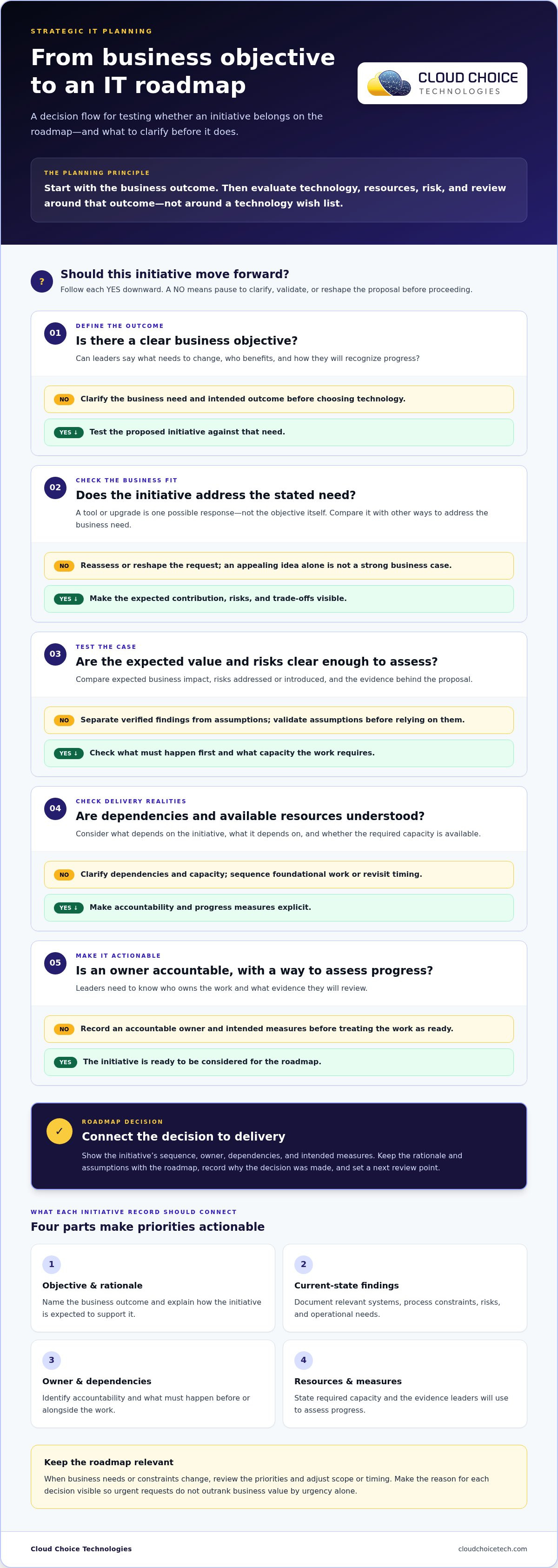
Translate each objective into a practical question: what needs to change, who benefits, and how will leaders recognize progress? Then test potential initiatives: Does this address the stated need? What other work depends on it? Is the expected value clear enough to justify the effort and risk? These questions help distinguish a genuine priority from an appealing idea without a strong business case.
An IT strategy is a decision framework that directs technology, resources, and review toward defined business outcomes, not a technology wish list. This aligns with the broader definition of Technology strategy (IT strategy), which connects technology use to organizational goals. Business IT Consulting can support structured planning and technology decisions.
Strategic direction versus tactical IT requests
Strategy sets direction and establishes what matters most; projects describe the work chosen to move in that direction. If the business wants to reduce delays in serving customers, “buy a new application” is a request, not yet a strategy. Leaders should first identify where delays occur, then compare possible responses and define how they’ll assess whether the chosen project helps.
This distinction gives urgent requests a fair review without letting urgency alone determine priority. A request may support a strategic objective, address a meaningful risk, or need to wait because of dependencies and limited capacity. Record the reason for the decision, its owner, and the next review point. That keeps priorities visible and makes it easier to reconsider them when business needs change.
What a Strategic IT Plan Needs to Connect Objectives with Decisions
A useful plan is a connected decision framework, not a universal template. Its structure should reflect the business’s objectives, operating conditions, risks, and available capacity. The purpose is to make clear why each initiative belongs on the roadmap, what it depends on, who is accountable, and how leaders will judge progress.
For each proposed initiative, trace the rationale from the business need to the expected contribution. If the objective is to improve operational consistency, for example, the plan should explain how a proposed technology change addresses a specific process gap, rather than relying on the tool’s features as justification. That reasoning gives executives a basis for approving, delaying, or reshaping the work.
Which plan components make priorities actionable?
Give each initiative a concise record that leaders can use to make decisions:
- Objective and rationale: Name the business outcome and explain how the initiative is expected to support it.
- Current-state findings: Document relevant systems, process constraints, risks, and operational needs.
- Owner and dependencies: Identify who is accountable and what must happen before or alongside the work.
- Resources and measures: State the capacity required and the evidence leaders will review to assess progress.
Separate verified findings from assumptions. A known limitation in a current process is different from an untested belief about how a new system will improve it. Record assumptions explicitly so leaders can validate them before they become hidden premises in a major decision. Evaluate technology choices in context, including business needs, risks, existing systems, and resource constraints.
How should leaders compare competing IT initiatives?
Compare proposals using the same lenses: expected business impact, risk addressed or introduced, dependencies, and resources required. Make trade-offs visible in plain language. One initiative may support an urgent objective but depend on foundational work; another may be easier to deliver but contribute less to the outcome. Leaders can then discuss timing and capacity without disguising judgment behind an arbitrary score.
Keep the executive view simple: a one-page roadmap can show initiatives, owners, sequence, dependencies, and intended measures. Pair it with supporting notes on rationale, assumptions, risks, and decisions. The roadmap helps leaders see the overall direction; the detail preserves the reasoning behind it. For structured support in shaping those decisions, Business IT Consulting can help connect planning choices to business priorities.
How to Build a Strategic IT Plan in Practical Steps
Turn strategic IT planning for business objectives into a repeatable process. Move from business priorities to an approved roadmap, bringing business leaders and the people responsible for IT operations into the same conversation. Their perspectives help connect desired outcomes with day-to-day realities.
- Set the business priorities. Ask leaders to identify the outcomes that matter and the problems getting in the way. Record each objective in plain language, along with who is affected and why it matters now. This gives proposed IT work a clear reference point.
- Gather operational input. Meet with department leaders and IT staff to understand current workflows, systems, commitments, and pain points. Ask what is working, where delays or workarounds occur, and what existing projects or obligations could affect new work. Capture findings without assuming in advance that a system or process is failing.
- Document constraints, risks, and assumptions. Review relevant systems, available staff capacity, dependencies, and known risks. Separate confirmed facts from assumptions, such as an expected improvement that hasn’t been tested. Identify what decision-makers need to validate before approving an initiative.
- Compare and sequence initiatives. For each proposal, state the business objective it supports and the problem it addresses. Compare likely impact, risks, dependencies, and resource requirements. Then decide whether to advance, defer, combine, or reject it, recording the reason. Sequence foundational work before initiatives that rely on it.
- Assign ownership and define measures. Name a business owner accountable for the intended outcome and an IT owner responsible for coordinating the technology work when those roles differ. Choose measures that reflect the objective, not only project activity. For example, completing a system setup shows delivery; a measure tied to the original operational goal helps assess whether the change made a difference.
- Approve the roadmap and set review points. Present the proposed sequence, owners, dependencies, resource needs, and measures for leadership approval. Set review points to check progress and revisit assumptions. Managed IT services can provide a broader operational context for planning ongoing technology needs.
The roadmap should make trade-offs clear, not hide them. If resources are limited, leaders can see what moves forward, what waits, and how those decisions affect the stated objectives. To bring executive technology guidance into this planning process, explore vCIO and vCISO services.
How to Keep IT Planning Aligned as Business Objectives Change
A roadmap should guide decisions, not lock the business into yesterday’s priorities. Strategic IT planning for business objectives stays relevant when leaders check progress and respond deliberately to new information. That doesn’t mean changing direction every time a request arrives. It means knowing what deserves a status update and what calls for a decision about priorities, scope, or resources.
What should trigger an IT roadmap review?
Revisit the roadmap when a business goal changes, a key dependency shifts, risk exposure grows, or an assumption behind an initiative no longer holds. For example, a project planned to support a particular business process may need reconsideration if that process changes before implementation begins.
Separate routine progress reviews from decision reviews. A progress check asks whether work is on track, whether owners have what they need, and whether measures show movement. A decision review asks whether the initiative still supports a current objective and whether its priority or scope should change. For each decision, record what changed, the evidence considered, who approved the choice, and why the initiative was retained, revised, deferred, or stopped. That record makes trade-offs understandable later.
Let the trigger guide the discussion rather than relying on an arbitrary calendar. A new risk may call for prompt attention; a stable initiative may only need a routine update. Assign responsibility for raising material changes, and make sure the people accountable for business outcomes and IT delivery share relevant information.
When can outside IT guidance support execution?
Business IT Consulting can help leaders assess technology choices against business needs, constraints, and priorities. vCIO & vCISO Services provide executive technology and cybersecurity guidance that can support strategic oversight as plans evolve. This can be useful when decision-makers need to weigh competing initiatives, revisit assumptions, or connect technology planning with security considerations.
Operational context matters too. IT teams or managed IT partners can surface delivery constraints and dependencies that affect the roadmap, while executives retain responsibility for business priorities and trade-offs. Keep ownership clear: advisors can inform decisions, but leaders need to approve changes and communicate what they mean for teams and planned work.
Ready to strengthen your planning and executive oversight? Explore Cloud Choice Technologies’ Business IT Consulting and vCIO & vCISO Services to support informed technology decisions as your business changes.
Make Your Next Technology Decision Count
A roadmap earns its value through the choices it helps leaders make next. Use it to bring business and IT perspectives into the same discussion, clarify which decisions need attention, and keep technology investment tied to outcomes that matter. That discipline makes strategic IT planning for business objectives an ongoing leadership practice, not a document that sits untouched after approval.
When your team needs support shaping priorities or assessing technology decisions, Cloud Choice Technologies’ Business IT Consulting can help inform the planning process. Its vCIO & vCISO Services offer executive technology and cybersecurity guidance as your organization’s needs evolve. The right next step is to identify the decision that would benefit most from a clearer business and technology perspective.
Explore Cloud Choice Technologies’ IT planning and advisory services, and move forward with greater clarity and confidence.
Frequently Asked Questions
How often should a business review its IT strategy?
Choose a review cadence that fits how your business makes plans and investment decisions. Some organizations can align strategy discussions with leadership or budget planning cycles; others may need a different rhythm based on how quickly their priorities shift. Put review dates on the leadership calendar and decide in advance who will prepare updates. That makes strategic IT planning for business objectives part of normal governance rather than an occasional catch-up.
Can a small business create a strategic IT plan without a full-time CIO?
Yes. A business can designate a leader to coordinate planning, gather input, and bring recommendations to the people authorized to decide. The coordinator doesn’t need to replace IT expertise; they need to connect operational needs with business decisions. When additional executive-level perspective would help, vCIO and vCISO Services can provide technology and cybersecurity guidance without requiring the business to create a full-time CIO role.
How can a business measure whether an IT initiative supports its objectives?
Before work starts, identify the data source for each measure and who will review it. A measure is more useful when leaders can compare it with a reliable starting point and interpret it consistently. Consider pairing the intended result with a guardrail, such as checking whether a process improvement creates extra work elsewhere. This helps decision-makers assess whether the initiative is contributing as expected, not just producing activity.
What should leaders do when business priorities change during an IT project?
Use a change-control decision before redirecting work. Ask the project owner to outline the requested change, its effect on commitments and dependencies, and the decisions or approvals needed to proceed. The leadership team can then authorize the adjustment or keep the current scope. Update project documentation and notify affected staff so teams don’t act on conflicting instructions or continue work based on an outdated decision.
Should cybersecurity be part of strategic IT planning?
Yes. Treat security requirements as design considerations for technology decisions, not as an afterthought once a tool or process is already in place. Leaders can consider what information an initiative will handle, who needs access, and what risks the change could introduce. Bringing those questions into planning helps the business account for security alongside usability and operational needs. Cybersecurity services can support organizations addressing these concerns.
How is an IT strategy different from an IT project plan?
An IT strategy helps leaders decide which technology outcomes and constraints should guide the organization’s choices. A project plan turns one approved effort into coordinated work, with tasks, responsibilities, and delivery checkpoints. The distinction matters because a project can meet its delivery targets yet still fail to serve the business if the underlying need has changed. Leaders should assess both whether the project was delivered and whether it remains relevant to the strategy.