
Service level agreement (SLA) for IT support: How to check the terms
To verify an IT support SLA, look for measurable service targets, clear definitions of response and resolution, and explicit responsibilities for both parties. Knowing what to look for in a service level agreement (SLA) for IT support means checking how performance is measured, what happens when targets are missed, and how service hours affect coverage. Review the agreement every 12 months and whenever your business needs change.
It’s easy to focus on an uptime percentage or promised response time. But a target is useful only when the agreement explains what counts, how it’s measured, and who must act when an issue occurs. Vague terms can leave both sides with different expectations, especially during an outage.
This guide explains how to assess service levels and responsibilities, review performance, and manage changes to an IT support SLA. It also shows how ITIL service level management connects SLAs with operational level agreements and underpinning contracts, so you can judge whether the commitments work together in practice.
Key Takeaways
- Review the SLA every 12 months and understand the conditions and notice period for changes, expiration, or termination.
- Check how availability, response, and resolution are measured, including which service hours count toward each target.
- Clarify what the provider and customer each need to do so responsibilities and escalation paths are clear.
- Match the agreement type to the services and customers it covers, then check that supporting operational agreements align with its commitments.
- Use performance reporting and review discussions to spot gaps and keep service expectations relevant as business needs change.
SLA review, adjustment, and termination terms
An SLA needs clear ownership, scheduled reviews, controlled changes, and defined exit terms. These provisions keep service objectives aligned with actual business needs.
SLA Ownership and Change Requests
An SLA owner coordinates reviews, tracks proposed changes, and maintains the current agreement. Naming an owner on both the customer and provider sides helps prevent requests from getting lost between teams. For example, when a business adds a critical application, the customer’s owner can document its impact and submit a change request through the agreed process.
Define how each request is assessed, approved, recorded, and communicated. The agreement should identify who can authorize changes and when revised targets take effect. This process helps prevent informal promises from conflicting with written service commitments.
Reviewing and Revising the SLA
Review the IT service agreement every 12 months, and revisit it sooner when business operations or service dependencies change. Compare service performance with the stated objectives, examine recurring issues, and decide whether targets still reflect operational priorities. Document each decision, including any target adjustments, owners, and effective dates.
How should an organization monitor, review, and renegotiate an IT support SLA? Track performance against agreed measures, review reports with the provider, and submit proposed revisions through the documented change process. Look for patterns, such as repeated delays affecting the same service, rather than treating every incident as isolated.
During deployment, make sure everyone responsible for monitoring knows where results are recorded and how exceptions are escalated. Regular reporting gives both parties a shared record to review. If a third party controls the service-monitoring portal, include it in the SLA process.
Breach Remedies and Service Credits
Remedies explain what happens when service requirements are missed. An SLA may provide service credits deducted from amounts owed under the contract, additional support, or pricing discounts. The agreement should explain how a breach is identified, how a remedy is calculated, and how the customer claims it.
What service credits or remedies apply when an IT support SLA is breached? The agreement’s terms govern. They may specify credits, additional support, or discounts. Check which missed targets qualify, what evidence supports a claim, and whether the remedy applies automatically or requires a customer request.
Termination terms matter as much as performance targets. The SLA should state the circumstances that permit termination or expiration and the required notice period. It should also explain how unresolved issues, ongoing support, and access to service records are handled during the transition. Clear exit provisions help organizations plan a provider change without confusing the end of the agreement with unfinished operational work.
How can I verify service levels?
Verify service levels by checking each metric, how it is calculated, its measurement window, and the evidence in performance reports. For a service level agreement (SLA) for IT support, what to look for first is a clear definition of what counts as an incident and when measurement begins.
Availability and Response-Time Metrics
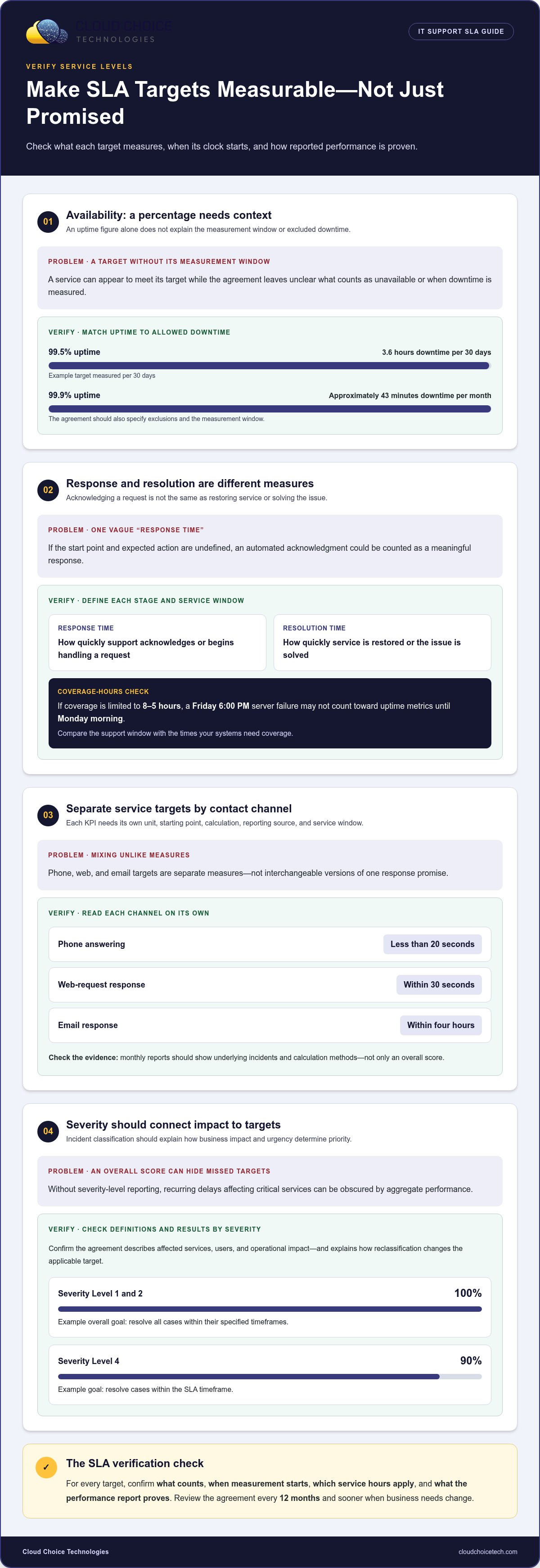
Availability measures how often a service works and remains usable during a defined period. Compare the uptime target with its measurement window and exclusions: an example target of 99.5% uptime per 30 days equates to 3.6 hours of downtime per 30 days. A 99.9% uptime guarantee allows approximately 43 minutes of downtime per month.
Response time and resolution time measure different stages. Response time tracks how quickly support acknowledges or begins handling a request; resolution time tracks how quickly service is restored or the issue is solved. If support coverage is limited to 8-5 hours, a Friday 6:00 PM server failure may not count toward uptime metrics until Monday morning. Compare coverage hours with the times your systems need support.
Clear Metric Definitions
Clear metric definitions state the unit, starting point, calculation, reporting source, and service window for each KPI. This detail prevents an automated acknowledgment from counting as a meaningful response when the intended measure is a technician’s action.
For example, an SLA might set a phone-answering target of less than 20 seconds, a web-request response target within 30 seconds, or an email response target within four hours. Treat these as separate channels, not interchangeable measures. Confirm monthly reports show underlying incidents and calculation methods, not only an overall score.
Keep metrics manageable and connect each one to an objective. A target should measure an outcome the provider controls, while customer responsibilities, such as supplying access, remain visible. For a service level agreement (SLA) for IT support, what to look for also includes a baseline that makes reported performance meaningfully comparable.
Incident Severity Levels
Severity levels classify incidents by business impact and urgency, then connect each category to response and resolution targets. The SLA should describe criteria such as affected services, users, and operational impact, and explain how severity determines handling priorities.
For example, an SLA may set an overall goal of resolving 100% of Severity Level 1 and 2 cases within their specified timeframes, and 90% of Severity Level 4 cases within the SLA timeframe. Check how reclassification affects the applicable target. Reporting results by severity helps show whether strong overall performance conceals missed targets for critical incidents.
Use these definitions to compare commitments with the practical scope of managed IT support, including which services and measurement responsibilities the agreement covers.
How Do SLAs Define Service Provider and Customer Responsibilities?
An SLA identifies the service, the parties, and the commitments that shape their working relationship. Its structure should make accountability visible, so operational expectations don’t depend on assumptions.
Customer-Based, Service-Based, and Multilevel SLAs
A customer-based SLA covers the services and expectations for a particular customer. For example, one organization might receive support for its network, employee devices, and business applications under a single agreement. This format makes customer-specific requirements easier to capture, especially when different systems have distinct operational needs.
A service-based SLA defines the same service commitment for multiple customers. A help desk service, for instance, could have common support terms for its users. This structure is simpler to administer, but the agreement still needs to state which customers and services fall within its scope.
A multilevel SLA combines layers, such as organization-wide terms, customer-group expectations, and service-specific commitments. A company could apply shared security and reporting expectations across departments, then set separate handling arrangements for finance and operations teams. The layers should fit together without conflicting terms.
Provider and Customer Responsibilities
Provider and customer responsibilities define who must act for the agreed service to work. The provider’s role may include delivering the named service, recording requests, and reporting performance. The customer’s role may include assigning contacts, supplying access, and describing business impact. The SLA should connect these duties to the relevant service and process.
Consider an employee who can’t access a business application. The customer’s contact reports the affected user and application, while the support team logs the request and follows the agreed handling process. If the customer must approve access changes, the agreement should make that dependency clear. Otherwise, delays can be difficult to attribute fairly.
Clear ownership also supports escalation. The SLA can identify the provider contact for service issues and the customer representative authorized to make operational decisions. Each party then knows who communicates during a disruption and who can resolve a blocked action.
Customer Feedback and Accountability
Performance reports show whether service commitments are being met, while customer satisfaction surveys capture how users experience the service. For example, quarterly survey results published online can complement reports on requests and service outcomes. These sources answer different questions: whether targets were achieved and whether users found the support effective.
Define who collects survey responses, how results are reviewed, and how feedback becomes an action. If users report recurring confusion about request routing, the parties can clarify the process and assign follow-up responsibility. Pairing feedback with operational records grounds accountability in specific examples, not impressions alone.
ITIL service level management, OLAs, and underpinning contracts
ITIL service level management connects the service a business needs with the operational agreements that support it. The key is alignment: commitments should form a workable chain from customer expectations to the teams and suppliers delivering the service.
ITIL Service Level Management
ITIL service level management provides a framework for defining service quality and keeping it connected to business needs. Its practical value is helping organizations assess whether a service supports its intended use, rather than treating the SLA as a standalone promise.
For example, a customer-facing application may support sales, while an internal reporting tool supports back-office work. Service level management can help an organization identify their different business impacts and reflect those priorities in service objectives. This makes the purpose of each commitment clearer to the people responsible for service delivery and business outcomes.
Connect each objective to the outcome it protects. A commitment should describe the service result that matters, not merely the activity a team performs. That distinction keeps service discussions focused on business value.
OLAs and Underpinning Contracts
An operational level agreement, or OLA, describes how internal teams coordinate to support a service. An underpinning contract sets relevant commitments with an external supplier. Together, these agreements can support the customer-facing SLA without replacing it.
Imagine an application that depends on an internal support team and a software supplier. The OLA can define how the internal team routes a software defect; the supplier contract can describe its support scope. Compare the terms for compatible responsibilities, escalation paths, and service definitions. A mismatch can leave a gap between customer expectations and how supporting teams are organized to deliver.
Use a simple alignment test: trace a service objective through each supporting agreement. If a commitment has no corresponding operational activity or supplier obligation, identify that gap before relying on the objective.
Exclusions and Dependencies
Exclusions describe when an SLA commitment does not apply; dependencies identify conditions that affect delivery. What exclusions and dependencies should an IT support SLA specify? It should identify relevant maintenance periods, customer-controlled systems, required approvals, and any conditions under which terms are waived.
For example, if a scheduled system change requires customer approval, the agreement should clarify how that dependency affects the related service commitment. It should also distinguish planned maintenance from an unplanned interruption, so both parties can interpret service records consistently. Avoid broad exclusions that could weaken an important objective without defining their scope.
For support planning that accounts for connected operational commitments, managed IT services can be part of the discussion.
Cloud Choice Technologies: Managed IT Services
Cloud Choice Technologies provides Managed IT Services for businesses that need structured IT support and clearer alignment between service needs and daily operations. If your agreement leaves support responsibilities unclear or its commitments no longer fit your environment, its managed IT services and Remote Support can help address ongoing technology support needs. Cybersecurity and Cyber Risk Analysis can also help businesses understand and address technology risks that affect their operational priorities. These services are relevant when you’re assessing whether your current IT support arrangement fits your business requirements. Contact Cloud Choice Technologies to discuss your IT support needs.
Turn SLA commitments into a stronger support relationship
Use what to look for in a service level agreement (SLA) for IT support as a working standard, not a document that sits untouched after signing. Bring the agreement into planning conversations, track whether its commitments still support your business priorities, and use changes to your systems or risk profile to guide each review. This discipline keeps expectations connected to how your organization operates.
When you need help aligning IT operations with those expectations, Cloud Choice Technologies provides Managed IT Services and Remote Support. Its Cybersecurity services and Cyber Risk Analysis can also address security needs alongside IT support. Take the next step with a focused discussion about where your current arrangement creates uncertainty and what support could resolve it.
Contact Cloud Choice Technologies to discuss your IT support needs. A clearer path forward starts with a practical conversation.
Frequently Asked Questions
Is there room for negotiation on SLAs with cloud service providers?
Yes, organizations can propose changes before signing, especially when standard terms don’t match operational needs. Include desired service expectations in a request for proposal so suppliers can respond to the same requirements. For example, specify which cloud components support a critical business process and what evidence you need in performance reports. This gives decision-makers a clearer basis for comparing proposals and identifying trade-offs.
What are the different types of SLAs?
The common SLA types are customer-based, service-based, and multilevel. Beyond their labels, compare how each agreement handles service scope, exceptions, and changes. For example, an organization adding a department or application should know whether the agreement requires an amendment or already provides a process for extending coverage. The most useful type is one whose scope remains clear as services and business needs evolve.
What should I consider when selecting metrics for my SLA?
Choose metrics that represent important operational outcomes and can be supported by dependable records. For a business application, you might distinguish user access problems from defects in a specific feature, since they affect workflows differently. Decide how maintenance, customer actions, and connected services affect the calculation. Keep the set focused enough that a manager can explain each measure and what action follows a missed target.
Can I create joint SLAs shared among multiple vendors or service providers?
Yes, providers can coordinate around shared outcomes when a business process relies on several services. For example, an online transaction may depend on a hosted application, payment processing, and network connectivity. A shared framework can describe the end-to-end outcome while each provider retains clear duties in its own agreement. Assign a lead for coordination and define how evidence and incident information move between providers, so handoffs don’t obscure accountability.
Comparing SLA Types: Which Model Fits Your Organization?
Choose the model that best handles how your organization changes. If services are added through frequent acquisitions or reorganizations, consider whether the agreement makes amendments manageable and keeps responsibilities clear during transitions. If business units have distinct approval paths, assess how the structure records exceptions without creating conflicting obligations. A useful test is whether staff can identify the terms for a specific service without interpreting several documents.
How Can Automation Enhance SLA Monitoring and Reporting?
Automation can gather timestamps from service tools, flag records that need review, and prepare recurring performance summaries. For example, a workflow can notify an assigned manager when a ticket lacks a category needed for accurate reporting. Automated results still need human oversight: teams should review unusual events, incomplete records, and changes in service scope before acting on a dashboard. This combination makes reports more useful for operational decisions.