
NIST Cybersecurity Framework Implementation Guide: A Practical 2026 Roadmap
What if adopting the NIST Cybersecurity Framework improved day-to-day security instead of adding another layer of paperwork? A practical NIST cybersecurity framework implementation guide starts with the risks that could disrupt your business, then turns the most important outcomes into work people own and can measure. That’s especially important with NIST CSF 2.0, whose six functions, Govern, Identify, Protect, Detect, Respond, and Recover, connect cybersecurity decisions to business priorities.
It’s understandable to feel unsure where to begin, how much to include, or who should be accountable. This guide provides a risk-led roadmap for defining scope around critical services, establishing a current profile, setting realistic target outcomes, and prioritizing gaps with clear owners and evidence. You’ll also see how to review progress over time so implementation supports ongoing security management, not just documentation. Cloud Choice Technologies’ free Network Security Analysis includes a technology assessment with white-hat testing that can inform initial risk discussions; it isn’t a complete NIST CSF assessment or a guarantee of framework alignment. The aim is steady, measurable improvement grounded in your organization’s real needs.
Key Takeaways
- Use this NIST cybersecurity framework implementation guide to turn business risks into a focused, phased plan.
- Define scope around critical services, then document current practices and target outcomes.
- Assign each improvement an accountable owner, measurable next step, and supporting evidence.
- Prioritize gaps by their potential impact, exposure, and dependencies, not by an unofficial score.
- Keep progress active with recurring reviews of changing risks, completed actions, and unresolved gaps.
What the NIST Cybersecurity Framework Is and What Implementation Should Achieve
The NIST Cybersecurity Framework (CSF) 2.0 is a flexible structure organizations use to understand, assess, prioritize, and communicate cybersecurity risk. It describes outcomes to work toward, not a required set of products, tools, or technical configurations. A useful NIST cybersecurity framework implementation guide therefore connects the framework to the organization’s services and risks, then turns relevant outcomes into practical, owned improvements.
CSF 2.0 is designed for organizations of different sizes, sectors, and levels of cybersecurity maturity. Implementation can help leaders and technical teams build a shared view of risk, but using the framework does not itself grant certification, guarantee compliance, or eliminate risk. For broader background on its history and components, see the NIST Cybersecurity Framework overview.
What are the six functions of NIST CSF 2.0?
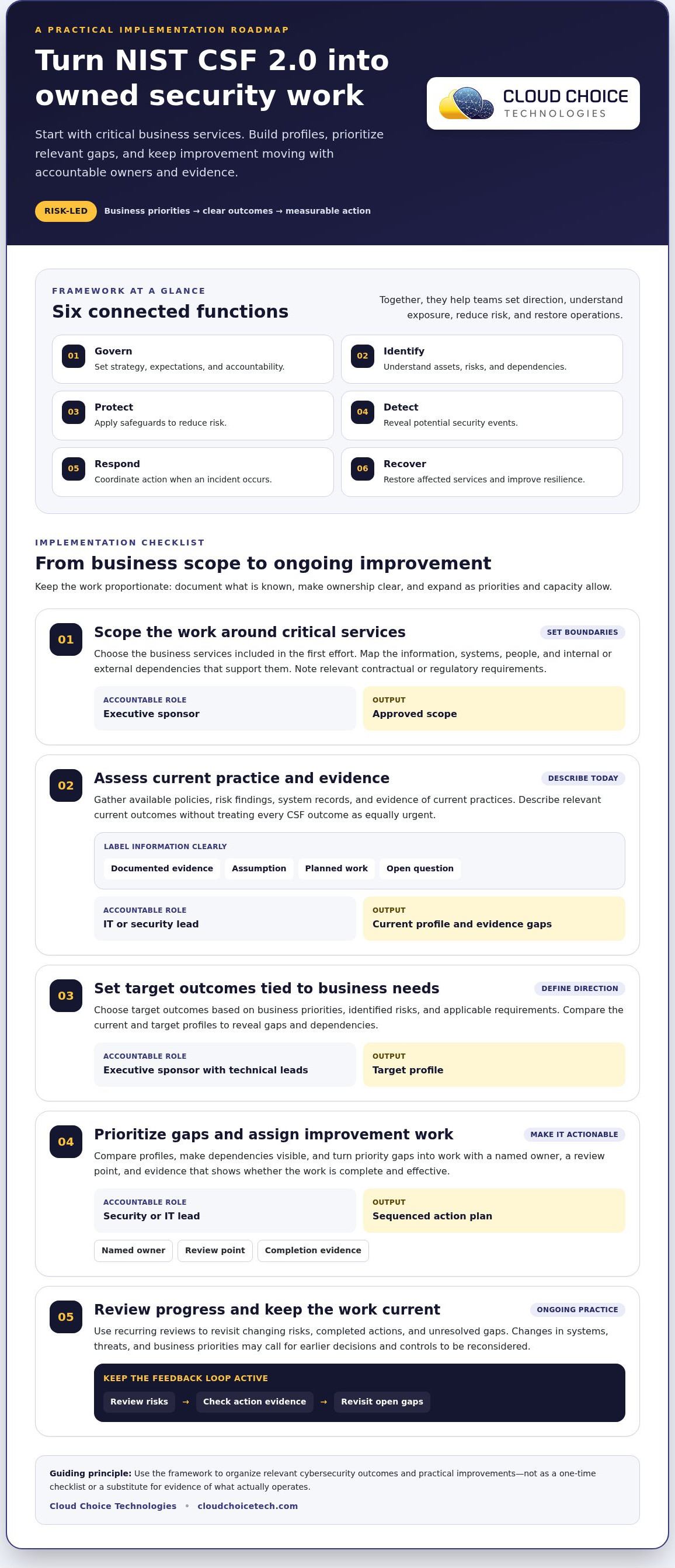
The six functions organize cybersecurity outcomes into connected areas. Govern sets strategy, expectations, and accountability. Identify builds understanding of assets, risks, and dependencies. Protect applies safeguards to reduce risk. Detect helps reveal potential security events. Respond coordinates action when an incident occurs. Recover supports restoring affected services and improving resilience.
Together, the six functions help an organization set direction, understand exposure, reduce risk, recognize incidents, respond effectively, and restore important operations. They are not a one-time checklist: changes in systems, threats, and business priorities can lead teams to revisit earlier decisions and adjust controls.
Who can use the framework, and what should they scope first?
Executives can use CSF 2.0 to connect cybersecurity decisions with business priorities. IT leaders and security practitioners can use it to organize technical work, explain risk, and track improvements. It can also give organizations formalizing risk management a common structure without requiring them to adopt identical tools or processes.
Start with the services the organization needs to deliver, then identify the information, systems, people, and dependencies that support them. For example, a customer-facing service may rely on a business application, staff accounts, stored data, and an external technology provider. Scoping around those connections helps keep implementation relevant and manageable. Business cybersecurity solutions can support organizations as they assess and manage security work.
A technology assessment, such as Cloud Choice Technologies’ free Network Security Analysis with white-hat testing, can inform initial risk discussions. It is one input, not a complete NIST CSF assessment or a guarantee of framework alignment.
How to Implement the NIST Cybersecurity Framework Step by Step
A practical NIST cybersecurity framework implementation guide turns framework outcomes into a sequence of decisions, evidence, and assigned work. Keep the process proportionate: start with a defined business scope, record what is known, and expand as priorities and capacity allow. At every stage, label information clearly as documented evidence, an assumption, planned work, or an open question. That distinction helps decision-makers see the difference between a control that operates and one that is only intended.
Establish scope and document a current profile
Begin with the business services included in the first implementation effort. Map the information, systems, people, and internal or external dependencies that support them. Note relevant obligations that affect those services, such as applicable contractual or regulatory requirements. Then gather available policies, risk findings, system records, and evidence of current practices. Use these materials to describe relevant current outcomes, without treating every CSF outcome as equally urgent.
NIST’s CSF 2.0 Quick-Start Guide for Organizational Profiles offers guidance on creating and using profiles to describe cybersecurity posture. A useful first-stage output is a scoped inventory and current profile. An executive sponsor confirms the scope, while IT or security leads coordinate evidence collection and record gaps in available information.
Set target outcomes and assign improvement work
Set target outcomes based on business priorities, identified risks, and applicable requirements. Compare the current profile with the target profile to identify gaps, dependencies, and outcomes that need action. For example, a response procedure may depend on accurate system records or defined escalation responsibilities. Make those dependencies visible before setting delivery expectations.
Translate priority gaps into actions with a named owner, a review point, and evidence that will show whether the work is complete and effective. The action plan becomes the bridge between framework language and operational improvement.
- Scope: Record included services and dependencies. Accountable role: executive sponsor. Output: approved scope.
- Assess current practice: Gather and label evidence. Accountable role: IT or security lead. Output: current profile and evidence gaps.
- Set targets: Select outcomes tied to business needs. Accountable role: executive sponsor with technical leads. Output: target profile.
- Decide and act: Compare profiles, prioritize gaps, and assign owners. Accountable role: security or IT lead. Output: sequenced action plan.
- Review: Check progress, evidence, and changed risks. Accountable role: designated governance lead. Output: updated profiles and next actions.
Cloud Choice Technologies’ free Network Security Analysis includes a technology assessment with white-hat testing. It can inform initial risk discussions, but it is not a complete NIST CSF assessment. For support managing cybersecurity work, explore business cybersecurity services.
How to Prioritize NIST CSF Gaps Without Mistaking Alignment for Certification
A gap list only becomes useful when it helps the organization decide what to address first. This NIST cybersecurity framework implementation guide uses impact, exposure, and dependencies to organize decisions, not to assign an official NIST score. Treat the categories below as a practical planning aid, then document why each item received its priority.
| Priority | Impact and exposure | Dependencies and typical response |
|---|---|---|
| Higher | A gap could seriously disrupt an important business service, expose sensitive information, or leave a significant risk without an effective safeguard. | Address urgent risk reduction first. Identify prerequisites and assign an owner, decision-maker, and review point. |
| Medium | The gap presents a meaningful risk, but existing safeguards or limited exposure reduce its immediate effect. | Schedule improvements and resolve dependencies, such as clarifying system ownership or improving asset records. |
| Lower | The gap has limited impact on scoped services or exposure is constrained by other controls. | Track for later improvement and reassess if business conditions, systems, or risks change. |
This table is an organizing aid, not an official NIST scoring method. A lower-priority item still needs an owner and review date; its ranking is a decision about sequence, not a declaration that risk has disappeared.
What evidence makes a gap assessment useful?
Support findings with attributable evidence, such as approved policies, system records, or documented review results. Record each source, its owner, the systems or services it covers, and its limitations. A written procedure, for example, shows that guidance exists; it doesn’t by itself show that staff follow it or that the practice works. A framework gap identifies an outcome needing attention; evidence shows whether a related practice operates effectively.
Mark each finding as confirmed, assumed, planned, or unknown. That simple distinction prevents intended improvements from being mistaken for controls already in operation.
How can teams prioritize improvement with limited capacity?
Consider business-service impact, exposure, dependencies, and existing safeguards together. Separate urgent actions that reduce immediate risk from longer-term maturity improvements, then sequence work so prerequisites come first. For example, a response plan may depend on current system and contact records. Cyber risk analysis and leadership guidance can help teams frame risks and improvement priorities.
For help identifying and managing security gaps, explore Cloud Choice Technologies’ cybersecurity services.
How to Sustain NIST CSF Implementation Through Governance and Ongoing Security Work
A framework becomes useful over time only when teams keep its priorities current. This NIST cybersecurity framework implementation guide treats governance as a recurring operating cycle: review what changed, confirm what work is complete, check the quality of supporting evidence, and surface unresolved gaps before they become forgotten risks.
Build a repeatable governance and review cycle
Set a review rhythm that fits your organization’s structure and risk. Revisit scope and priorities when business services, systems, dependencies, risks, or applicable obligations change. At each review, record action status, accountable owners, decisions, evidence, and issues that need escalation.
Executives should provide oversight, resolve competing priorities, and connect security work with business needs and available capacity. Technical owners maintain controls, evidence, and improvement actions. In a smaller organization, one person may hold several responsibilities; define the roles clearly so important risks still reach the right decision-maker. Escalate an issue when its potential impact, resource needs, or unresolved status exceeds the owner’s authority.
Keep the review practical. Ask whether completed actions have evidence, whether that evidence still reflects current operations, and whether risk changes affect the order of planned work. Management review then becomes a decision point, not a documentation exercise.
When can cybersecurity support help implementation work?
Cyber risk analysis can help organize risk discussions and identify issues for consideration. Cybersecurity services can support efforts to address vulnerabilities, while managed services provide monitoring and management of IT systems that can contribute to ongoing visibility. These activities can inform implementation and review, but they don’t guarantee NIST CSF alignment, certification, compliance, or the elimination of risk. For support related to regulatory requirements and security work, explore cybersecurity and compliance services.
Cloud Choice Technologies’ free Network Security Analysis includes a technology assessment with white-hat testing. It can help inform initial risk discussions, but it isn’t a complete NIST CSF assessment. To request the free Network Security Analysis, take this practical first step toward a clearer view of your technology environment.
Turn Framework Priorities Into Ongoing Security Progress
A practical NIST cybersecurity framework implementation guide should lead to more than a completed profile. Start with the business services that matter most, use evidence to understand current practices, and direct limited capacity toward gaps with meaningful impact. Then keep the work moving through clear ownership, regular reviews, and decisions that reflect changing risks and business needs.
Cyber risk analysis, cybersecurity services, and managed IT can support that ongoing effort, but they don’t guarantee NIST CSF alignment, certification, or compliance. A useful first step is to build a clearer picture of your technology environment. Cloud Choice Technologies’ free Network Security Analysis includes a technology assessment with white-hat testing. It can inform initial risk discussions, but it isn’t a complete NIST CSF assessment.
Request your free Network Security Analysis and take a focused step toward stronger, more sustainable security management. Progress starts with a clear view of what needs attention.
Frequently Asked Questions
What is the NIST Cybersecurity Framework?
The NIST Cybersecurity Framework (CSF) is guidance for helping organizations understand, assess, prioritize, and communicate cybersecurity risk. CSF 2.0 organizes outcomes into six connected functions: Govern, Identify, Protect, Detect, Respond, and Recover. It describes what an organization can work toward, not a required set of tools or products. Teams can use it to structure security discussions and improvement plans around business priorities.
How do you implement the NIST Cybersecurity Framework?
Implement the framework by defining scope, assessing current practices, setting target outcomes, identifying gaps, and assigning prioritized improvements to accountable owners. Begin with important business services and the systems, information, and dependencies that support them. Record evidence and distinguish operating practices from assumptions or planned work. This NIST cybersecurity framework implementation guide uses that risk-led sequence to help turn framework outcomes into measurable actions and ongoing reviews.
Is NIST CSF 2.0 a certification?
No. NIST CSF 2.0 is a framework for organizing cybersecurity risk management, not a certification program. An organization can document how its practices relate to framework outcomes, but that alignment does not itself certify the organization, guarantee compliance with specific obligations, or prove that every practice works effectively. Keep evidence of controls and applicable requirements distinct, and avoid describing framework adoption as a guarantee or proof of zero risk.
How long does it take to implement the NIST Cybersecurity Framework?
There is no single implementation timeline that applies to every organization. The effort depends on the scope, the quality of existing records and evidence, the number of gaps, available resources, and how quickly improvement work can be completed. A focused initial profile can help establish direction, while closing prioritized gaps and maintaining reviews is ongoing work. Set practical milestones, track owners and dependencies, and adjust plans as risks or business needs change.
What is the difference between a current profile and a target profile?
A current profile describes the cybersecurity outcomes an organization is achieving now, supported by available evidence and clearly marked uncertainties. A target profile describes the outcomes it wants to achieve based on business priorities, risk, and applicable requirements. Comparing the two reveals potential gaps and dependencies to assess and prioritize. Profiles are planning tools, not certifications: a documented target shows intent, while evidence is needed to assess whether practices operate.
Can a small business use the NIST Cybersecurity Framework?
Yes. NIST CSF 2.0 is designed for organizations of different sizes, sectors, and cybersecurity maturity levels, so a small business can tailor its scope and effort to its needs. Start with a critical service, the information and systems supporting it, and the risks that could disrupt it. Prioritize a manageable set of improvements, assign owners, and review progress regularly rather than treating every framework outcome as equally urgent.