
Mobile Device Management Policy Template: A 2026 Guide to Securing Employee Devices
What if the most significant vulnerability in your 2026 security posture is the AI-integrated device currently sitting in your employee's pocket? With unique mobile users reaching 5.83 billion this year, implementing a robust mobile device management policy template is no longer optional. You likely feel the mounting pressure of new regulations like the Indiana Consumer Data Protection Act or the constant threat of endpoint-originated breaches. It's a complex, high-stakes environment where a single unmanaged OS update can trigger a compliance nightmare. We understand that you need more than just a list of rules. You need a definitive shield for your digital operations.
This guide provides a professional framework tailored for the modern, AI-driven workforce. By following this guide, you'll master the complexities of diverse OS environments and significantly reduce the risk of catastrophic data leaks. We'll walk you through a technically robust strategy that aligns your mobile fleet with current HIPAA and financial audit standards. You're about to transform your mobile security from a point of anxiety into a foundational pillar of corporate excellence. This is your roadmap to total endpoint control.
Key Takeaways
- Secure the AI-data interface on every endpoint by shifting from simple hardware tracking to a modern, data-centric governance model.
- Implement rigorous security mandates including biometrics, MFA, and full-disk encryption to eliminate common entry points for cyber attacks.
- Leverage a professional mobile device management policy template to bridge the gap between complex technical requirements and legally sound corporate compliance.
- Conduct a detailed cyber risk analysis to identify vulnerabilities within your mobile fleet before they result in costly data breaches.
- Build a robust audit trail that satisfies 2026 insurance requirements and regulatory standards like HIPAA, SOC2, and CMMC.
The Architecture of a Professional Mobile Device Management Policy
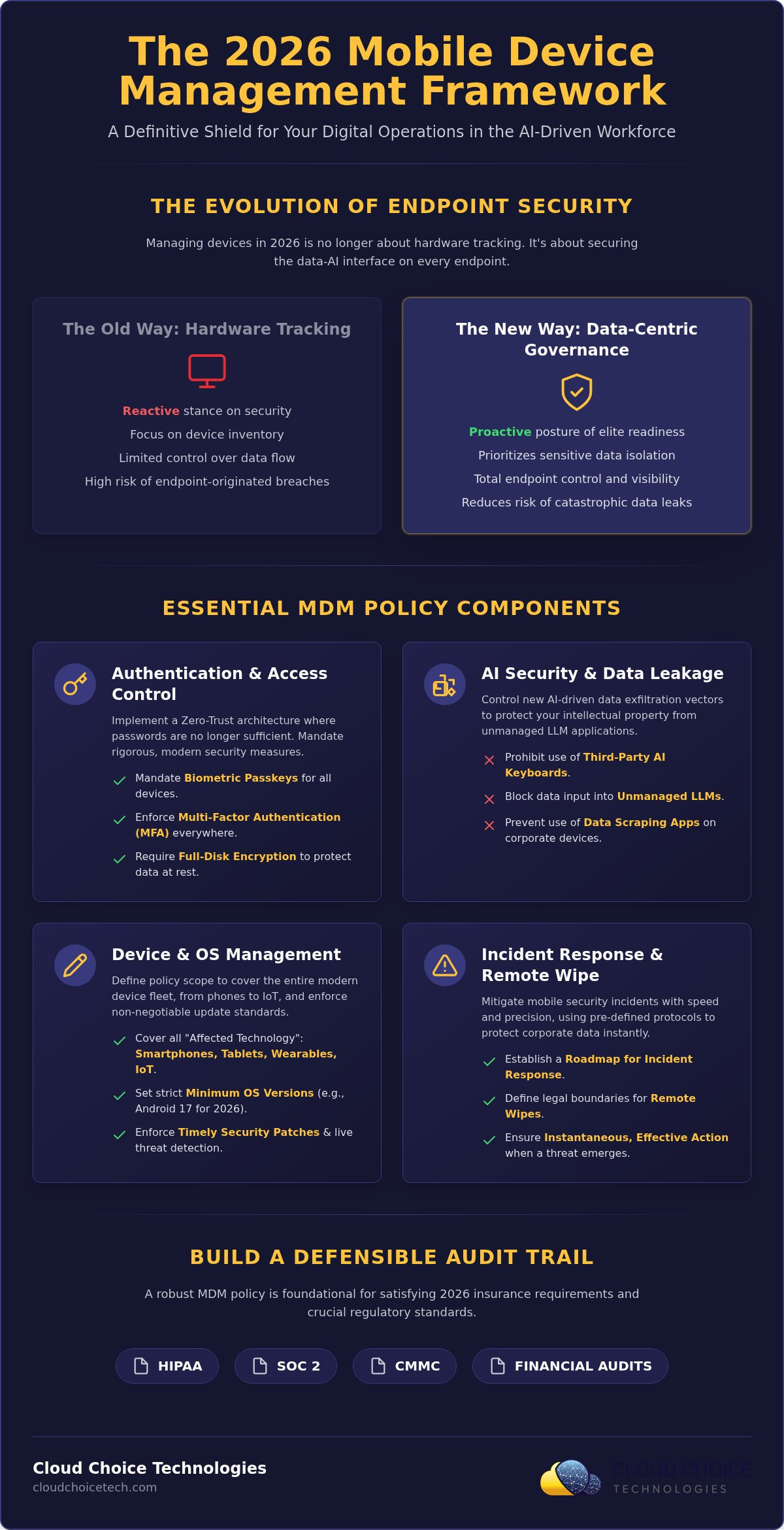
In 2026, managing a fleet of devices is no longer about simply counting laptops and phones. It's about securing the data-AI interface. A modern Mobile Device Management (MDM) strategy prioritizes data-centric governance over basic hardware tracking. This transition ensures that sensitive corporate intelligence remains isolated, even on personal devices. By utilizing a professional mobile device management policy template, your organization moves from a reactive stance to one of elite readiness. It's the difference between digital chaos and total endpoint control.
Executive anxiety often stems from the unknown. Will a lost phone lead to a multi-million dollar breach? A well-crafted policy acts as the calm in the storm, providing a definitive roadmap for incident response. This framework is a vital component of your broader business cybersecurity solutions. It clarifies whether you're operating under a Bring Your Own Device (BYOD) model or a Corporate-Owned, Personally Enabled (COPE) framework. Each has distinct risk profiles. BYOD offers flexibility but requires strict software-level isolation. COPE provides higher control but increases capital expenditure. We help you navigate these choices with precision.
Core Objectives of Mobile Governance
Your governance model must eliminate operational downtime. We achieve this through standardized configurations that prevent unauthorized app installations and risky neural-data processing. A solid mobile device management policy template also establishes the legal boundaries for remote wipes. It protects the company without overstepping into employee privacy. This balance is critical for maintaining trust while ensuring rigorous security standards. Clear protocols ensure that when a threat emerges, your response is instantaneous and effective.
Device Classification and Scope
The scope of mobile governance now extends far beyond the smartphone. It includes tablets, wearables, and edge computing devices that interact with your corporate network. Your policy must define "Affected Technology" broadly enough to cover the Internet of Things (IoT) but specifically enough to be enforceable. We recommend setting strict threshold requirements for OS versions. For instance, in 2026, ensuring devices are updated to Android 17 is a non-negotiable step for live threat detection and anti-theft protection. Keeping your fleet on the cutting edge of security patches is the only way to maintain a preventative security posture.
Essential Components of Your MDM Policy Template
A robust mobile device management policy template serves as the technical blueprint for your organization's security posture. It's not merely a document of "dos and don'ts" but a rigorous framework that defines how data moves across your mobile fleet. In an era where every endpoint is a potential entry point for sophisticated threats, your policy must establish clear boundaries between personal freedom and corporate safety. We focus on creating a frictionless experience for the user while maintaining an ironclad defense for the enterprise.
Authentication and Access Control
Passwords are no longer sufficient for 2026 security standards. Your policy should mandate biometric passkeys and multi-factor authentication (MFA) for every corporate-connected device. Under a zero-trust architecture, mobile devices must re-authenticate frequently based on risk signals like location or network integrity. This proactive approach ensures that even if a device is physically compromised, the data remains inaccessible to unauthorized actors. If you're unsure if your current setup meets these rigorous standards, a cyber risk analysis can identify hidden gaps in your access protocols.
AI Security and Mobile Data Leakage
The integration of AI into mobile operating systems introduces a new vector for data exfiltration. Your policy must strictly prohibit the use of third-party AI keyboards and scraping apps that may harvest keystrokes or clipboard data. We recommend restricting the input of corporate intelligence into unmanaged LLM mobile applications to prevent sensitive data from being used for model training. AI data leakage prevention for mobile endpoints is the systematic identification and blocking of sensitive organizational data before it can be processed by unmanaged generative AI tools or third-party applications. This ensures your intellectual property stays within your controlled environment.
Incident Response and Remote Wipe
Speed is the primary factor in mitigating a mobile security incident. We implement a "2-hour rule" for reporting lost or stolen devices, which triggers an immediate response from our remote support team. To protect your organization from litigation, your policy must include a "Remote Wipe Waiver" signed by every employee. This document clarifies the distinction between a "Full Wipe," typically reserved for corporate-owned hardware, and a "Selective Enterprise Wipe," which removes only business data from a personal BYOD device. This clarity provides immediate peace of mind for both the executive team and the workforce, ensuring that personal photos and data remain untouched during a security intervention.
How to Implement and Enforce Mobile Device Security
Theory alone won't protect your data. Your mobile device management policy template must be backed by a rigorous, four-step implementation process. We start by conducting a comprehensive cyber risk analysis of your mobile fleet. This identifies existing vulnerabilities and sets the baseline for your security posture. Next, select an MDM software platform that aligns perfectly with your specific OS ecosystem. Whether you're managing iOS, Android, or Windows, the software must provide total visibility. We then roll out automated enrollment through Zero-Touch Deployment. This ensures every device is secured the moment it's powered on. Finally, we maintain elite readiness through continuous monitoring and remote IT support for corporations. This proactive oversight keeps your operations running without interruption.
Automated Enforcement vs. Manual Oversight
Manual policy checks are a relic of the past. In a distributed workforce, they're simply impossible to scale. We replace manual oversight with automated compliance triggers that block non-compliant devices in real time. If a device lacks the latest Android 17 security patches or detects a banking scam call, the system revokes access to corporate data instantly. This "calm in the storm" approach removes the burden from your HR team and places it into the hands of a vigilant, fast-acting partner. Proactive remote care identifies mobile threats before they escalate into breaches. If you're ready to secure your fleet, our Cybersecurity services provide the elite oversight your business demands.
Employee Training and Cultural Alignment
Your employees are your first line of digital defense. We focus on turning potential liabilities into proactive guardians of company data. Gamifying mobile security through phishing simulations for mobile users increases engagement and retention. It's about more than just rules; it's about cultural alignment. We communicate the "Guardian" role of IT clearly to reduce privacy concerns. When employees understand that MDM protects their professional integrity as much as the company's assets, compliance becomes effortless. This transparency builds a foundation of trust and accountability across the entire organization.
Aligning MDM with Regulatory Compliance and Insurance
Compliance is no longer a static goal. It's a continuous state of elite readiness. For organizations handling sensitive data, satisfying regulatory compliance IT support standards like HIPAA, SOC2, or CMMC requires absolute control over every mobile endpoint. A professional mobile device management policy template provides the necessary framework to meet these rigorous demands. With the Indiana and Kentucky Consumer Data Protection Acts taking effect in 2026, the legal stakes for mobile data privacy have never been higher. We ensure your mobile fleet isn't just secure, but demonstrably compliant.
Cloud Choice Technologies acts as your vigilant partner in this high-stakes environment. We don't just provide a document; we offer a comprehensive system for mobile governance and AI security. By integrating your MDM policy into a broader compliance strategy, you remove the digital uncertainty that plagues modern executives. Our approach ensures that your security posture is both technically robust and legally sound. This protects your organizational continuity at every level.
Audit Readiness and Documentation
Auditors demand proof, not promises. MDM software generates automated logs that track the compliance status of every device in real time. These logs serve as a critical audit trail, proving "Due Care" if a mobile-originated breach ever occurs. Centralized reporting offers the executive oversight necessary to make informed decisions quickly. You can see at a glance which devices are encrypted and which require immediate intervention. This transparency turns a complex audit process into a streamlined, manageable task. It provides immediate peace of mind during high-pressure financial or regulatory reviews.
Cyber Insurance and Risk Mitigation
Cyber insurance applications in 2026 have become significantly more granular. Carriers now ask specific questions about mobile encryption, remote wipe capabilities, and MFA enforcement. A formal mobile device management policy template is often the primary evidence required to secure favorable premiums. By demonstrating total endpoint control, you lower your organizational risk profile in the eyes of underwriters. Managed IT is the most cost-effective way to maintain this level of compliance. It replaces the high cost of potential fines and insurance denial with the stability of expert, proactive oversight. We handle the technical complexities so you can focus on your core mission.
Securing Your Digital Perimeter for 2026 and Beyond
Securing your mobile fleet is no longer just an IT task; it's a strategic necessity for organizational continuity. You've seen how a professional mobile device management policy template bridges the gap between technical complexity and strict regulatory mandates. By shifting to data-centric governance and embracing automated enrollment, you eliminate the digital uncertainty that leads to operational downtime. This approach ensures your workforce remains productive while your corporate intelligence stays protected under a zero-trust architecture. It's about maintaining total control in an increasingly mobile world.
Don't leave your mobile security to chance in an era of rapid AI integration and evolving privacy laws. We're here to function as your vigilant, fast-acting partner. Secure your mobile workforce today with a professional Cyber Risk Analysis to eliminate 99% of endpoint vulnerabilities and achieve 100% regulatory alignment. With our 24/7 vigilant remote monitoring, you'll operate with the confidence of elite readiness. Take control of your endpoints now and build a foundation of unwavering reliability for your entire team. Your success starts with a secure foundation.
Frequently Asked Questions
Does a mobile device management policy apply to personal phones used for work?
Yes, a mobile device management policy template typically covers any device that accesses corporate networks or sensitive intelligence. If your organization operates a Bring Your Own Device (BYOD) model, the policy establishes the technical and legal boundaries for that access. It ensures that business data remains protected without compromising the user's personal privacy. This creates a secure environment where employees use their preferred hardware while the company maintains its compliance standards.
Can an employer see my personal photos or texts through MDM software?
No, modern MDM solutions are designed to separate personal and professional data through a process called containerization. Your employer can manage and monitor the work profile or corporate applications, but they cannot access your personal photos, private texts, or browsing history. This technical separation provides immediate peace of mind for the workforce. It ensures that corporate oversight is restricted solely to business assets, maintaining a clear line between your private life and your career.
What happens if an employee refuses to sign the MDM policy?
If an employee refuses to sign the policy, they are typically restricted from accessing corporate email or sensitive data on their personal devices. Security is a non-negotiable pillar of modern business continuity. Organizations cannot risk the liability of unmanaged endpoints. In these cases, the employee may be required to use a company-provided device that is fully managed. This ensures the organization remains protected while respecting the individual's choice.
Is remote wipe legal for employee-owned (BYOD) devices?
Yes, remote wipe is legal provided the employee has signed a clear waiver within the mobile device management policy template. Most organizations utilize a selective wipe for BYOD devices. This specifically removes only corporate data and applications without touching personal files. This capability is essential for mitigating risks after a device is lost or stolen. It provides a fast-acting solution to prevent data exfiltration while protecting the employee's personal digital assets.
How does MDM protect against mobile phishing and smishing attacks?
MDM protects against these threats through real-time URL filtering and automated threat detection. It monitors incoming links for known malicious patterns and blocks access to fraudulent websites before a user can reveal credentials. In 2026, these solutions leverage AI to analyze app behavior and detect banking scams or credential harvesting attempts. This proactive remote monitoring acts as a vigilant guardian, neutralizing sophisticated smishing attacks before they can compromise your sensitive data.
What is the difference between MDM, MAM, and UEM in 2026?
MDM focuses on the physical device and its configuration. Mobile Application Management (MAM) controls only specific corporate apps and the data within them. Unified Endpoint Management (UEM) is the comprehensive evolution of these tools. It allows IT teams to manage every endpoint, including smartphones, laptops, and IoT devices, from a single dashboard. This integration provides total visibility and control. It streamlines your security posture and ensures consistent compliance across your entire workforce.