
M&A Cybersecurity Due Diligence: 2026 Executive Guide
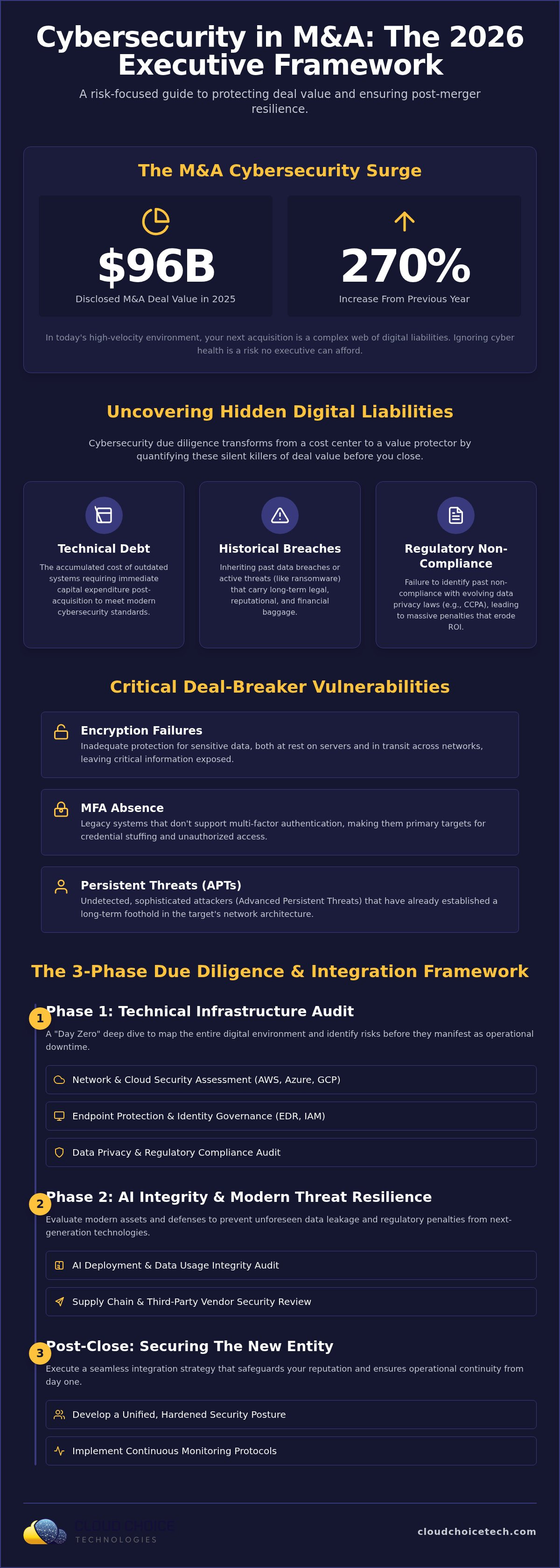
Did you know that disclosed cybersecurity M&A deal value surged to $96 billion in 2025, a staggering 270% increase from the previous year? In this high-velocity environment, your next acquisition is more than a growth opportunity. It's a complex web of digital liabilities. You likely feel the mounting pressure to close deals at record speeds, yet the uncertainty surrounding a target's AI compliance or hidden vulnerabilities remains a constant source of stress. Inheriting a massive data breach or facing substantial penalties under evolving national data protection laws is a risk no executive can afford to ignore.
We understand that you need to move fast without compromising security. This guide provides a definitive, risk-focused framework to quantify technical debt and protect your deal value. We'll show you how to audit for ISO 27001:2022 standards and navigate the latest national data privacy updates concerning sensitive digital assets. By the end of this article, you'll have the tools to execute a seamless post-merger IT integration strategy that safeguards your reputation and ensures operational continuity from the very first day. Let's replace digital uncertainty with the calm confidence of total oversight.
Key Takeaways
- Discover how to quantify technical debt to protect deal valuation and accelerate high-stakes closing timelines.
- Identify critical vulnerabilities in cloud footprints and network architectures using a systematic infrastructure audit checklist.
- Evaluate the integrity of a target’s AI deployments and supply chain security to prevent unforeseen data leakage and regulatory penalties.
- Develop a robust post-merger IT integration strategy that establishes a unified, hardened security posture across the new entity.
- Implement continuous monitoring protocols to detect and neutralize threats that frequently emerge during the chaotic transition phase.
The Strategic Impact of Cybersecurity on M&A Valuation
Cybersecurity is no longer a checklist item for the IT department. In 2026, it's a fundamental driver of deal valuation. We view cybersecurity due diligence as a systematic evaluation of a target's digital assets and liabilities to reveal the true health of the organization. Integrating a thorough due diligence process into your acquisition workflow ensures you identify risks before they become your legal responsibility. A clean audit doesn't just provide peace of mind. It builds immediate deal confidence and accelerates the closing timeline by eliminating technical uncertainty.
Ignoring these factors leads to a high cost of negligence. You risk inheriting historical breaches or, worse, an active ransomware footprint hidden within the target's network. By shifting your perspective and treating cyber health as a key performance indicator (KPI), you transform security from a cost center into a value protector. This proactive stance is essential for any successful post-merger IT integration strategy, allowing you to secure the new entity without operational friction.
Quantifying Hidden Digital Liabilities
Technical debt is a silent killer of deal value. It represents the accumulated cost of outdated systems that require immediate capital expenditure after the deal closes. You must assess what it'll cost to bring the target's infrastructure up to the level of modern business cybersecurity solutions. Additionally, historical data breaches carry long-term legal and reputational baggage. Under the 2026 regulatory landscape, including updated CCPA requirements for neural data, failing to identify past non-compliance can lead to massive financial penalties that erode your expected ROI.
Deal-Breaker Vulnerabilities in 2026
Some technical failures are too significant to ignore. Identifying these vulnerabilities early allows you to negotiate price adjustments or demand remediation before signing. Look for these critical red flags:
- Encryption Failures: Inadequate protection for sensitive data at rest and in transit.
- MFA Absence: Legacy systems that don't support multi-factor authentication are primary targets for credential stuffing.
- Persistent Threats: Undetected APTs that have already established a foothold in the target's network architecture.
Detecting these issues early ensures your post-merger IT integration strategy begins on a stable foundation rather than in a state of emergency.
Phase 1: The Technical Infrastructure Audit Checklist
Visibility is the bedrock of digital security. You can't protect an environment you haven't fully mapped. This phase focuses on a "Day Zero" technical deep dive to ensure your post-merger IT integration strategy rests on a stable foundation. We move beyond simple questionnaires to verify the target's actual network architecture and cloud footprint. Utilizing a Cybersecurity M&A Model Framework allows your team to move left, identifying risks long before they manifest as operational downtime.
Network and Cloud Security Assessment
We start by mapping every cloud instance across AWS, Azure, and Google Cloud. This process often reveals "shadow IT", which are unauthorized applications that create backdoors into the corporate network. We rigorously test firewall configurations and analyze intrusion detection system (IDS) logs for signs of past lateral movement. It's vital to ensure that the target's existing managed cloud security services align with your organization’s rigorous standards for data protection.
Endpoint Protection and Identity Governance
Security starts at the edge. We inventory all corporate-owned devices and remote work endpoints to confirm they're running modern Endpoint Detection and Response (EDR) tools. Auditing identity and access management (IAM) is equally critical. We look for "ghost" users, which are active accounts belonging to former employees, and ensure that zero-trust principles are strictly applied to privileged access accounts. This vigilance prevents unauthorized access during the chaotic integration period.
Data Privacy and Regulatory Compliance Audit
In 2026, regulatory scrutiny is at an all-time high. We review the target's regulatory compliance IT support to verify adherence to HIPAA, GDPR, or specific financial sector rules. Cross-border acquisitions require a careful check for data residency issues and a validation of encryption protocols for data at rest and in transit. For a more granular look at your current posture, our cyber risk analysis can identify these gaps before they impact your final valuation.
Phase 2: Evaluating AI Integrity and Modern Threat Resilience
In the high-stakes mergers of 2026, a target's AI capabilities are often the crown jewel of the deal. They can also be its greatest liability. You must look beyond the surface level of operational efficiency to audit the underlying integrity of these systems. A robust post-merger IT integration strategy requires a deep understanding of how AI models were constructed and how they're defended against automated adversaries. We ensure your acquisition doesn't inherit a "black box" of legal and technical risks.
AI Compliance and Security Auditing
We start by verifying that AI models were trained on legally obtained, compliant data sets. This isn't just about ethics; it's about avoiding massive copyright and privacy litigation under updated 2026 standards. We also identify potential poisoning of AI models, where malicious data is introduced to skew logic or create backdoors. Your AI governance must match evolving national regulatory standards, which have become increasingly rigid regarding algorithmic transparency and the protection of sensitive neural data. Failing to validate these models can lead to a total loss of the asset's projected value.
Third-Party and Supply Chain Risk
Your security is only as strong as the target's weakest vendor. We evaluate the security posture of every key SaaS provider and API integration to ensure they meet your rigorous standards. Contracts must be reviewed for "right to audit" clauses and strict breach notification requirements. We assess the risk of upstream vulnerabilities, ensuring a compromise at a third-party developer doesn't paralyze your core product or expose sensitive data during the integration. This oversight prevents a single vendor failure from derailing your entire post-merger IT integration strategy.
Modern attackers use automated vectors to find gaps in your armor. We analyze the target's resilience against these AI-powered threats and review their incident response plans for modern relevance. If you're uncertain about a target's AI integrity or vendor risk, our experts provide specialized AI compliance and security auditing to safeguard your investment. We provide the clarity you need to move forward with total confidence.
Post-Close Integration: Securing the New Entity
The ink is dry, but the most volatile phase of the acquisition has just begun. The first 90 days represent a high-stakes window where operational friction and security gaps often collide. Establishing a unified security posture across the newly combined organization is your primary objective. This transition requires a meticulous, Day One security cutover for all critical systems and identities to prevent unauthorized access during the shift. By consolidating IT management, you effectively reduce the attack surface and eliminate the operational overhead of maintaining disparate, conflicting systems.
A well-executed post-merger IT integration strategy transforms a collection of digital assets into a single, hardened entity. It removes the stress of uncertainty and replaces it with a state of elite readiness. By focusing on continuous monitoring and rapid intervention, you protect the long-term value of the deal and ensure the continuity of your operations. The storm of integration passes quickly when you have a vigilant partner at the helm.
Standardizing Managed IT and Security Posture
Success depends on rapid standardization. We recommend migrating the target entity to your centralized managed service provider (MSP) immediately. This move ensures that the same rigorous oversight applied to your core business now extends to the new acquisition. You must deploy consistent endpoint protection across the entire distributed workforce to eliminate blind spots. Harmonizing security policies and employee training programs creates a cohesive culture of vigilance; this ensures every team member understands the new standards of data protection.
The Role of Continuous Risk Analysis
Integration is a process, not a single event. New vulnerabilities often emerge as legacy systems are linked to your modern architecture. Scheduling recurring cyber risk assessments is the only way to catch these issues before they escalate. We maintain a vigilant guardian approach to ensure ongoing regulatory adherence, protecting you from the financial penalties triggered by non-compliance. Leveraging remote IT support for corporations allows your team to navigate complex technical debt resolutions with speed and precision. This proactive oversight ensures that the value you identified during the audit phase is preserved and grown within the new organization.
Securing the Deal: Your Path to Seamless Integration
In the high-stakes environment of 2026, cybersecurity is the bedrock of every successful acquisition. We've explored how identifying hidden technical debt and auditing AI integrity prevents the sudden erosion of deal value. By treating digital health as a primary KPI, you transform potential liabilities into strategic advantages. A hardened, unified security posture is the final step in ensuring your new organization remains resilient against increasingly sophisticated, automated threats.
Executing a flawless post-merger IT integration strategy requires more than just technical skill; it demands a vigilant partner who acts with absolute precision. Our specialized AI security consultants provide the authoritative expert guidance needed to navigate these complex transitions with elite readiness and rapid intervention. You don't have to face digital uncertainty alone. We're here to ensure your reputation and operations remain protected from day one.
Secure your next acquisition with a comprehensive Cyber Risk Analysis from Cloud Choice Technologies. We serve as the calm in the storm, providing the stability your business needs to grow with total confidence. Your future success starts with a secure foundation today.
Frequently Asked Questions
What is the primary goal of cybersecurity due diligence in M&A?
The primary goal is to identify and quantify digital liabilities before the transaction closes. This process ensures the acquiring organization doesn't inherit undisclosed breaches or massive regulatory fines. It serves as the foundation for a successful post-merger IT integration strategy by providing visibility into technical debt. Ultimately, it protects your reputation and confirms that the target's digital assets are worth the proposed valuation.
How long does a typical cyber due diligence audit take?
A comprehensive audit typically takes between two and four weeks, depending on the target's infrastructure complexity. High-velocity deals might compress this timeline to ten days, but rushing often leads to missed vulnerabilities. We focus on rapid intervention to meet tight closing deadlines without sacrificing depth. The process includes network mapping, endpoint analysis, and compliance verification. This speed ensures deal momentum remains high while providing total peace of mind.
Can a poor cybersecurity report actually kill a merger deal?
Yes, critical vulnerabilities can absolutely terminate a merger or lead to significant price adjustments. If an audit reveals an active ransomware footprint or systemic data privacy failures, the liability might outweigh the acquisition's value. In many cases, these findings result in escrow holdbacks or specific remediation requirements before signing. Identifying these deal-breakers early is essential for protecting your organization from a post-close financial disaster.
Who should be involved in the cybersecurity due diligence team?
The team must include a mix of technical experts, legal counsel, and executive leadership. You need specialized AI security consultants to evaluate modern workloads and managed IT professionals to assess infrastructure health. Legal experts ensure regulatory alignment with current standards like ISO 27001:2022. This multi-disciplinary approach ensures technical risks are translated into business impacts. Having a vigilant partner provides the authoritative guidance necessary for high-stakes decision-making.
What are the most common red flags found during a technical audit?
Red flags often include legacy systems lacking multi-factor authentication and unpatched software with known exploits. We frequently discover "shadow IT" instances where employees use unauthorized cloud services. Other major concerns include inadequate data encryption and "ghost" user accounts belonging to former employees. These issues indicate a weak security posture that requires immediate capital expenditure. Addressing these red flags is a critical component of any robust post-merger IT integration strategy.
How do AI compliance risks impact the valuation of a tech startup?
AI compliance risks can drastically devalue a tech startup if their models rely on non-compliant data sets. In 2026, regulatory scrutiny regarding neural data and training transparency is intense. If a startup's core IP is built on legally questionable data, the entire asset may be unusable. We conduct specialized AI security audits to verify data provenance and model integrity. This ensures the startup’s valuation is based on sustainable, legally defensible technology.