
Justifying Cybersecurity Spending to a CFO: A Practical Business Case
What if the strongest case for cybersecurity spending isn’t a promise to prevent every incident, but a clear explanation of what the business stands to lose and how a proposed investment could reduce that exposure? That’s the challenge at the heart of justifying cybersecurity spending to a CFO. Security teams often track technical progress, yet those measures can be hard to connect to cash flow, operations, or decisions about risk.
A CFO is right to ask how the numbers fit this organization, what assumptions support them, and how success will be reviewed. A credible case answers those questions without leaning on generic benchmarks or treating a prevented incident as a guaranteed saving. This guide shows how to connect security priorities to business impact, explain uncertainty honestly, and set practical measures for evaluating investment over time. It also covers how an organization-specific starting point, such as a free Network Security Analysis, can help identify and prioritize relevant security gaps. The goal is a defensible business case, built around your company’s exposure and priorities.
Key Takeaways
- Frame cybersecurity as a decision about business exposure and operational priorities, not a promise that every incident can be prevented.
- Use organization-specific scenarios to estimate potential losses, and treat Annual Loss Expectancy as an estimate rather than a forecast or guaranteed saving.
- When justifying cybersecurity spending to a CFO, present the decision, exposure, options, assumptions, measurement approach, and review point clearly.
- Accept that no model can prove which incidents would otherwise have occurred; focus instead on tracking whether prioritized security work is completed and reviewed.
- Build a practical plan from current exposure to prioritized actions and assigned ownership, using a free Network Security Analysis as a starting point.
Why CFOs question cybersecurity spending, and what they need to decide
Which business exposure warrants investment, and why address it now? That’s the decision a CFO needs to make. The answer isn’t a guarantee that a new control will stop every attack. Cybersecurity spending is risk management: it funds measures intended to reduce the likelihood or potential business impact of an incident, while recognizing that some risk remains.
Security teams may describe vulnerabilities found, systems monitored, or suspicious activity blocked. Finance leaders may focus on continuity, protecting business data, and keeping essential operations stable. Neither perspective is wrong; each answers a different question. A useful proposal connects the technical work to a process or asset the business depends on. For context, Understanding Cybersecurity helps explain the broad range of protections involved, but the funding decision should reflect your organization’s specific exposure.
A defensible security business case shows what business exposure the investment addresses, what it will cost, and how the organization will review whether the work is progressing. That is the practical core of justifying cybersecurity spending to a CFO: make the decision and its assumptions visible, rather than presenting security activity as proof of financial return.
What a CFO needs from a cybersecurity budget request
Lead with the decision you’re requesting, the exposure behind it, and the action the organization should take. Then connect each proposed control to a named business process, asset, or dependency. For example, explain which customer-facing system or internal workflow could be disrupted if a relevant security gap is exploited. Separate known costs and current conditions from estimates and assumptions, so the CFO can see where the case is firm and where uncertainty remains.
Why technical metrics rarely make the case by themselves
A patch count shows completed maintenance, not the business importance of the systems updated. A blocked-event total indicates activity, but doesn’t establish that a particular investment prevented a breach. Add the missing context: which assets the measure covers, what exposure it helps address, and what operational concern is at stake. For example, connect vulnerability remediation to reducing exposure on a system that supports a critical business process. A cybersecurity program can include practical measures such as vulnerability identification, but no single metric proves that a breach was prevented.
Keep the conversation grounded in evidence. A free Network Security Analysis can help establish an organization-specific starting point, giving finance and security leaders a clearer basis for discussing priorities rather than relying only on generic benchmarks.
How to quantify cyber risk without overstating cybersecurity ROI
A useful estimate starts with your organization’s systems and business activities, not an industry average. Model a few plausible scenarios, document what you know, and mark what remains uncertain. This gives finance a clearer basis for comparing options without presenting a projection as a promise.
Build a transparent loss-exposure estimate
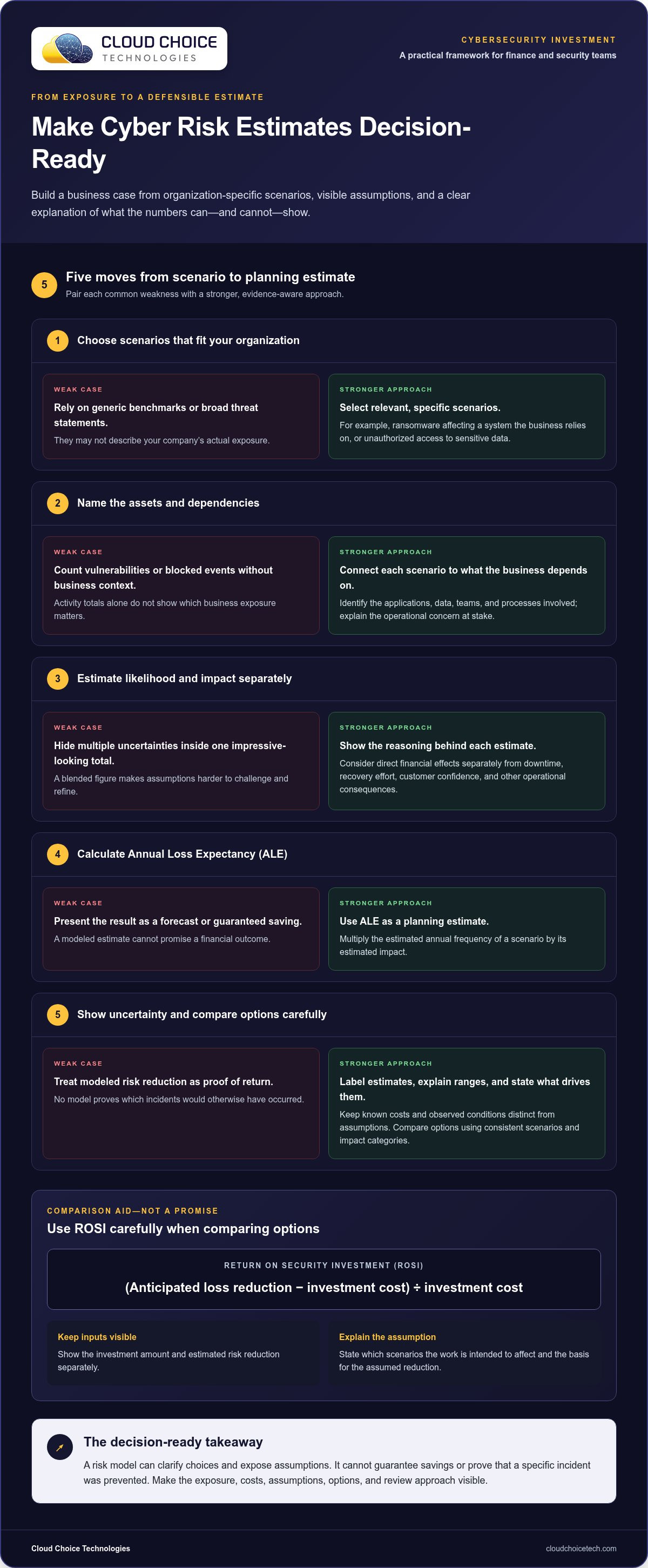
Use this sequence to build a working estimate:
- Select relevant scenarios. Choose a small set, such as ransomware affecting a system the business relies on or unauthorized access to sensitive data.
- Name the assets and dependencies. Identify the applications, data, teams, and business processes involved. Keep the scenario specific enough to evaluate.
- Estimate likelihood and impact separately. Record the evidence and reasoning behind each assumption. Consider direct financial effects as well as downtime, recovery effort, customer confidence, and other operational consequences.
- Calculate Annual Loss Expectancy. Multiply the estimated annual frequency of a scenario by its estimated impact. Treat the result as a planning estimate, not a prediction or guaranteed saving.
- Show uncertainty openly. If evidence is limited, use a range and explain what drives the difference. Label estimates as estimates, and distinguish them from known current costs or observed conditions.
For example, a ransomware scenario might include direct recovery expenses and the operational effects of losing access to a critical process. Keep those impacts distinct where possible. That makes the assumptions easier to challenge and refine, rather than hiding multiple uncertainties inside one impressive-looking total.
Use ROSI carefully when comparing options
Return on Security Investment (ROSI) can help compare a proposed investment with modeled risk reduction. A common expression is (anticipated loss reduction minus investment cost) divided by investment cost. It is a comparison aid, not evidence that the organization will realize a particular return.
Keep the investment amount and the estimated risk reduction as separate inputs. Describe which scenarios the proposed work is intended to affect, how much reduction the model assumes, and the basis for that assumption. Then compare options using consistent scenarios and impact categories. Don’t import competitor examples, broad industry averages, or unsupported probability figures as if they describe your company.
A risk model can clarify choices and expose assumptions; it cannot promise a financial outcome or prove which incident would otherwise have occurred. That distinction matters when justifying cybersecurity spending to a CFO. Organization-specific cyber risk analysis can help turn those assumptions into a more grounded basis for prioritization.
To develop that starting point, consider a free Network Security Analysis and use its findings to inform the scenarios you evaluate.
Pitching Cybersecurity When Prevention is Hard to Prove
A CFO may ask, “How can we count incidents that never happened?” The honest answer is that no model can prove which incidents would otherwise have occurred. Prevention creates a counterfactual, not an observable result. A credible proposal acknowledges that limit and makes the decision useful anyway: compare the current state with a defined alternative, show the evidence and assumptions behind each option, and track what changes after approval.
Answer the objection that avoided incidents cannot be counted
Keep observed measures separate from modeled outcomes. Report control coverage and unresolved gaps as current evidence; show estimated loss reduction as a scenario-based assumption, not as a realized saving. For example, track whether a prioritized vulnerability was addressed and which systems remain exposed. Then state what could change the recommendation, such as new evidence about affected assets, a shift in business dependencies, or a change in the proposed control’s scope.
Make the request easy to evaluate and revisit
Use a short proposal that gives the CFO six things to assess: the decision requested, the exposure, available options, key assumptions, progress measures, and a scheduled review point. Compare the proposed action with both the current state and a clearly described alternative, such as postponing the work or addressing only the highest-priority gap. Present options in priority order rather than making approval feel all-or-nothing.
Assign ownership before work begins. Name who will implement the action, who will oversee it, and who will communicate progress to finance. Set a review date to revisit assumptions as systems, threats, and business needs change. This keeps the request accountable without implying a metric can prove an incident was prevented.
Measures such as completed work, control coverage, and open gaps show implementation and exposure trends. They don’t equal avoided losses. That distinction helps keep justifying cybersecurity spending to a CFO grounded in evidence, clear ownership, and honest limits.
Discuss your cybersecurity priorities as a practical next step toward a proposal the business can evaluate and revisit.
Turn the cybersecurity business case into an actionable security plan
A budget decision only creates value when it leads to owned, reviewable work. Move from executive discussion to action in a clear sequence: establish current exposure, prioritize the gaps that matter to business operations, assign an owner to each action, then review progress and assumptions. This keeps the plan connected to the organization’s actual needs instead of turning it into a standing list of technical tasks.
- Establish the baseline. Document current conditions, key assets, and unresolved exposures.
- Prioritize the work. Compare each gap with its potential effect on business processes and continuity.
- Assign ownership. Name who will implement the work, oversee it, and report progress.
- Review and adjust. Revisit priorities as systems, risks, and business requirements change.
This sequence makes justifying cybersecurity spending to a CFO an ongoing management process, not a one-time pitch. A cyber risk analysis can help translate the discussion into organization-specific priorities and give leaders a clearer starting point for deciding what to address first.
Connect risk priorities to the right kind of support
Match support to the identified need. Cloud Choice Technologies’ Cyber Security & Protection offering includes white-hat testing and vulnerability identification, which can inform decisions about security gaps. Its cybersecurity services address security needs, while Managed Services includes monitoring and full management of IT systems through managed IT services to support ongoing oversight. The right scope depends on the priorities established in the assessment.
Take a low-friction next step
A useful baseline gives finance and security leaders a shared view of current conditions before they decide how to sequence improvements. Cloud Choice Technologies offers a free Network Security Analysis, a technology assessment that includes white-hat testing. It can serve as a practical starting point for reviewing exposure and informing priorities, without presuming what the assessment will find or promising a particular outcome.
Start with a clearer view of your organization’s security posture: request a free Network Security Analysis.
Make the next security decision with confidence
A strong case doesn’t need to remove every uncertainty. It needs to make the next decision clearer. Keep the discussion active by connecting cybersecurity priorities to business changes, assigning responsibility for follow-through, and giving finance a consistent way to revisit the assumptions behind each investment.
That discipline makes justifying cybersecurity spending to a CFO part of sound business planning, not a one-time effort to win approval. As priorities evolve, a clear record of decisions and open questions helps leaders adjust course without overstating what security work can guarantee.
Cloud Choice Technologies can help establish a starting point for that conversation. A free Network Security Analysis includes a technology assessment with white-hat testing, giving your organization a practical basis for considering what to address next.
Start building your organization-specific security plan and move forward with greater clarity.
Frequently Asked Questions
Should cybersecurity spending be treated as an operating expense or a capital investment?
It depends on your organization’s accounting treatment and the specific purchase or service; cybersecurity spending doesn’t have one universal classification. A technology purchase may be treated differently from an ongoing service agreement under the organization’s policies. For a useful comparison, show the full commitment, when costs occur, and the time period covered. Ask finance to apply its established accounting approach rather than using the proposal to make accounting or tax decisions.
How often should a CFO and security leader review cybersecurity investment assumptions?
Agree on a review cadence that fits the organization’s budget and risk-governance process. At each review, compare current evidence with the original rationale: what has changed in the environment, which work is complete, and which questions remain open? Revisit assumptions sooner if a material change affects systems, data, operations, or exposure. A review should test whether the reasoning still fits, not repeat a fixed annual percentage or declare risk eliminated.
What should a cybersecurity business case say when the company has little incident history?
Limited incident history doesn’t establish that the company has no meaningful exposure. Build the case from what’s observable: systems in use, business dependencies, known gaps, and documented responsibilities. Where evidence is incomplete, state assumptions and use ranges instead of presenting a precise estimate as fact. For justifying cybersecurity spending to a CFO, explain how additional assessment findings could change the order of priorities, even if they don’t reveal a confirmed past loss.
Can cyber insurance replace investment in cybersecurity controls?
No. Insurance and security controls serve different purposes, so present them as separate parts of risk management, not substitutes. A policy may transfer some financial exposure, while controls address security conditions within the business; actual coverage depends on policy terms and circumstances. For budget decisions, describe the safeguards the organization has, the exposure they address, and any recovery needs that remain. Avoid assuming a policy covers a particular event or that coverage removes the need for controls.
What is the difference between ROSI and cybersecurity payback?
ROSI compares estimated security-related value with the investment, while payback asks when measured benefits offset the investment’s cost. The distinction matters because estimated value may include incidents that didn’t occur and therefore can’t be directly counted as savings. Both calculations depend on assumptions if avoided incidents are part of the benefit. Show the inputs, time period, and limits behind each calculation, and present results as decision aids rather than guaranteed financial outcomes.
How can a business establish a cybersecurity baseline before requesting funding?
Start by documenting relevant systems, existing safeguards, known vulnerabilities, operational dependencies, and who is responsible for security tasks. This inventory gives decision-makers a clearer picture of the current state and helps identify questions that need further analysis. Cloud Choice offers a free Network Security Analysis, a technology assessment with white-hat testing. It can provide a practical starting point for discussion, without promising specific findings or a particular outcome.