IT Solutions for Hybrid Work Environments: The 2026 Executive Strategy
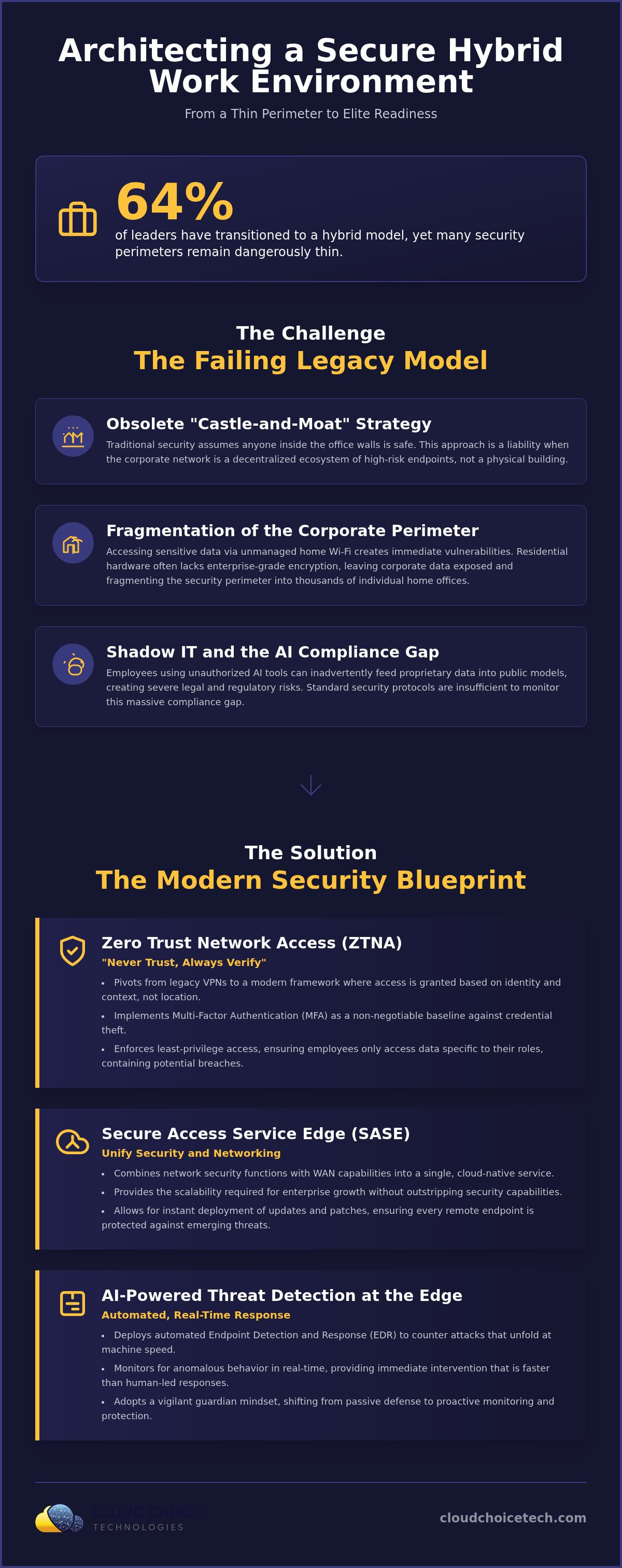
64% of leaders have transitioned to a hybrid model, yet many organizations still operate with a security perimeter that feels dangerously thin. You've likely noticed the growing cracks; employees are using unauthorized AI tools, home networks remain fragmented, and maintaining regulatory compliance across a distributed map has become a constant source of anxiety. It's a high-stakes environment where a single oversight can lead to operational downtime. You need IT solutions for hybrid work environments that act as a vigilant guardian rather than a reactive patch.
We understand that your priority is maintaining total control over an increasingly complex digital landscape. This strategy reveals how to architect a secure, compliant, and high-performance IT infrastructure that empowers your workforce without compromising corporate safety. We'll explore the shift toward Zero Trust frameworks, rapid-response endpoint protection, and the precision required to monitor compliance in real time. By the end of this guide, you'll have a definitive roadmap to replace digital uncertainty with elite readiness and unwavering reliability.
Key Takeaways
- Master the transition from obsolete legacy security to a modern, decentralized architecture that protects every high-risk endpoint.
- Deploy specialized IT solutions for hybrid work environments that utilize Zero Trust and SASE to unify your digital perimeter.
- Eliminate security gaps by conducting comprehensive asset audits and standardizing equipment across your entire distributed team.
- Scale your enterprise efficiently by leveraging Managed IT services to bypass talent shortages and secure predictable service costs.
- Secure your future with proactive compliance monitoring and advanced protections against AI-powered cybersecurity threats.
The 2026 Hybrid Landscape: Why Traditional IT Models Fail
The corporate network is no longer a physical building; it's a sprawling, decentralized ecosystem of high-risk endpoints. Traditional IT models relied on a "castle-and-moat" strategy, assuming that anyone inside the office walls was safe and anyone outside was a threat. By 2026, this approach is not just ineffective; it's a liability. As your team operates within a virtual workplace, the perimeter has dissolved into thousands of individual home offices and mobile devices. Modern IT solutions for hybrid work environments must shift from defending a fixed location to protecting a fluid, distributed workforce.
This shift is driven by the rapid evolution of AI-powered cyber threats targeting remote employees. Attackers now use automated systems to exploit the slightest gap in a home network. You can't rely on passive defenses anymore. You need a vigilant guardian mindset that prioritizes proactive monitoring and immediate intervention. This ensures your operational continuity remains unbroken, regardless of where your staff logs in.
The Fragmentation of the Corporate Perimeter
Accessing sensitive data through unmanaged home Wi-Fi creates immediate vulnerabilities. Most residential hardware lacks enterprise-grade encryption; this leaves your data exposed to local network sniffing. In this environment, identity is the new perimeter. Security can't depend on where a user is, but on exactly who they are. We see frequent failures in home-office hardware configurations, where outdated router firmware becomes an open door for sophisticated breaches. Standardizing these remote endpoints is a non-negotiable step for 2026 executives.
Shadow IT and the AI Compliance Gap
The rise of generative AI has created a massive compliance gap. Employees often use unauthorized AI tools to summarize meetings or draft reports, inadvertently feeding proprietary data into public models. This creates severe legal implications in regulated industries. Standard security protocols aren't enough. You need specialized AI compliance frameworks that provide visibility into tool usage and data processing. Without this oversight, your organization faces significant regulatory risks and potential data leaks. We provide the comprehensive oversight necessary to close these gaps before they result in a breach.
Essential IT Solutions for Secure Hybrid Connectivity
Legacy VPNs are no longer sufficient for a modern workforce. They often create bottlenecks and offer a single point of failure that sophisticated attackers easily exploit. To maintain elite readiness, executives must pivot toward Zero Trust Network Access (ZTNA). This ensures that access is granted based on identity and context, not just a network location. By integrating a Zero Trust security strategy, you eliminate the inherent trust that leads to lateral movement during a breach. It's a fundamental shift from reactive patching to proactive protection.
Secure Access Service Edge (SASE) further unifies your defense by combining network security functions with wide-area networking. It acts as the engine behind high-performance IT solutions for hybrid work environments. This cloud-native approach provides the scalability your enterprise requires to grow without outstripping your security capabilities. A cloud-native infrastructure allows you to deploy updates and patches instantly, ensuring every remote endpoint stays protected against emerging vulnerabilities. It removes the stress of digital uncertainty, replacing it with a streamlined, secure connection for every employee.
Zero Trust Architecture and Identity Management
The core of modern defense is the "never trust, always verify" protocol. Every user, device, and application must prove its legitimacy before accessing corporate assets. Multi-Factor Authentication (MFA) is the non-negotiable baseline for this process. It acts as a primary barrier against credential theft and unauthorized access. We also implement least-privilege access controls, ensuring employees only access the specific data needed for their roles. This containment strategy prevents a single compromised account from endangering your entire operation. If you're concerned about your current posture, a professional cyber risk analysis can identify hidden vulnerabilities before they're exploited.
AI-Powered Threat Detection at the Edge
Speed is the only effective defense against modern ransomware. Human intervention is often too slow when an attack unfolds at machine speed. Automated endpoint detection and response (EDR) systems monitor for anomalous behavior in real-time, isolating infected devices before the threat spreads. Our business cybersecurity solutions leverage machine learning to recognize subtle patterns that indicate a breach. This proactive stance provides the immediate peace of mind you need to focus on growth while we handle the technical complexities. It's about maintaining total control through elite, AI-driven oversight.
Building a Resilient Hybrid Strategy: A Step-by-Step Guide
Architecture is only as strong as its foundation. To transition from a reactive posture to elite readiness, you must begin with a comprehensive audit of all remote and on-site assets. You can't protect what you can't see. Standardizing equipment and security software across the entire workforce is the next critical step. This uniformity eliminates the "security by accident" approach that often plagues distributed teams. By implementing these IT solutions for hybrid work environments, you create a predictable, manageable ecosystem that resists fragmentation and simplifies oversight.
Establishing a proactive remote support protocol is essential to minimize downtime. When technical friction occurs, your team needs a fast-acting partner to intervene before a minor glitch becomes an operational standstill. We prioritize continuous monitoring for both security and compliance, ensuring that your distributed network remains within the rigorous standards required by your industry. This methodical approach provides the calm in the storm, handling the complexities of a 2026 digital landscape so you don't have to.
Conducting a Hybrid-Focused Cyber Risk Analysis
Identifying high-value data targets in a distributed network requires a specialized perspective. Your crown jewels are no longer behind a single server room door; they're accessed from living rooms and transit hubs across the country. A rigorous cyber risk analysis must include home-office assessments to be valid. It's the only way to account for unmanaged hardware and local vulnerabilities that could compromise your corporate integrity. In the context of hybrid work, a cyber risk analysis is the systematic evaluation of vulnerabilities across decentralized endpoints to ensure data integrity and regulatory compliance.
Endpoint Protection and Remote Support Protocols
Operational continuity depends on speed. When a remote employee's system fails, the physical distance shouldn't dictate the resolution time. Professional remote IT support for corporations provides the ability to resolve technical friction instantly through encrypted channels. Secure fleets also require aggressive patching and update cycles to stay ahead of evolving threats. We utilize mobile device management (MDM) to push these updates automatically, ensuring no device falls behind the security curve. This centralized control allows your IT partners to revoke access or wipe lost devices in seconds, maintaining total control over your digital assets.
Ready to secure your distributed perimeter with precision? Contact Cloud Choice Technologies today for a comprehensive cyber risk analysis and protect your corporate continuity.
Future-Proofing Your Enterprise with Managed IT Services
Scaling an internal IT department to meet the demands of a 2026 distributed workforce is a high-friction endeavor. The specialized talent required to manage decentralized security and AI integration is in short supply. Managed IT services offer a definitive solution to this talent shortage, providing access to an elite team of experts without the overhead of internal hiring. This transition replaces the volatility of emergency IT expenditures with the cost-efficiency of predictable monthly service agreements. It's a strategic move that allows you to focus on core business growth while a vigilant guardian maintains your operational continuity.
You need a partner that functions as the calm in the storm. Digital threats don't follow a standard business schedule, and neither should your protection. By choosing comprehensive managed IT services, you gain the peace of mind that comes from 24/7 oversight. This model ensures that your IT solutions for hybrid work environments are always optimized, secure, and ready to scale at a moment's notice.
Continuous Compliance in a Distributed World
Regulatory requirements are shifting rapidly as governments react to the proliferation of AI and decentralized data. Specialized regulatory compliance IT support is now essential for navigating these complex laws. We automate the generation of audit logs for HIPAA, financial regulations, and other industry standards, ensuring your records are always accurate and accessible. This automation removes the risk of human error in compliance reporting. Additionally, our AI compliance frameworks maintain institutional trust by ensuring all automated tools used by your staff adhere to strict data privacy standards.
The Role of Proactive Remote IT Support
The old "break-fix" model is obsolete. Waiting for a system to fail before intervening leads to costly downtime and frustrated employees. We've replaced this reactive approach with proactive maintenance that identifies and resolves vulnerabilities before they impact the end user. Remote monitoring tools allow our experts to push security updates and performance optimizations silently in the background. This ensures your IT solutions for hybrid work environments remain high-performing and resilient against the latest threats. Ensure your hybrid workforce is protected by an elite partner that prioritizes preventative action over emergency response. Contact us today to secure your enterprise's future.
Master the Distributed Perimeter with Elite Readiness
The transition to a decentralized corporate perimeter is your current reality. You've seen how legacy models fail and why Zero Trust is the only viable path forward. By standardizing your fleet and embracing identity-first security, you eliminate the fragmentation that invites disaster. Implementing robust IT solutions for hybrid work environments ensures that your team remains productive and protected, regardless of their physical location.
You don't have to navigate these technical complexities alone. Cloud Choice Technologies provides the elite readiness your organization demands through specialized AI compliance oversight and a comprehensive cyber risk analysis. Our 24/7 proactive remote support acts as the vigilant guardian of your operations, resolving friction before it impacts your bottom line. It's time to replace digital uncertainty with the confidence of a secure, high-performance infrastructure. Secure your hybrid infrastructure with Cloud Choice Technologies and lead your enterprise with total peace of mind.
Frequently Asked Questions
What are the best IT solutions for hybrid work environments in 2026?
The most effective IT solutions for hybrid work environments in 2026 prioritize decentralized security over legacy hardware. You need a combination of Zero Trust Network Access (ZTNA) and Secure Access Service Edge (SASE) to unify your digital perimeter. These tools ensure that security follows the user rather than being tied to a physical office. Additionally, automated endpoint detection and response (EDR) provides the real-time monitoring necessary to stop threats at the edge before they penetrate your core network.
How does Zero Trust security benefit a hybrid workforce?
Zero Trust security benefits a hybrid workforce by removing the assumption that any user or device is inherently safe. It mandates continuous verification for every access request, which is vital when employees log in from unmanaged home networks. This approach significantly reduces the risk of lateral movement during a breach. By implementing a "never trust, always verify" protocol, you protect your proprietary data from unauthorized access while maintaining seamless connectivity for your distributed team.
Is my business at risk of AI compliance violations in a remote setting?
Your business faces significant risks if employees use unauthorized AI tools to process corporate data on home networks. These Shadow IT practices often lead to data leaks and regulatory violations. Specialized AI compliance and security measures are required to monitor how your staff interacts with generative tools. Without professional oversight, you lack the visibility needed to ensure your organization remains within legal boundaries. Implementing a formal compliance framework is the only way to maintain institutional trust.
What is the difference between managed IT and standard remote support?
Standard remote support is typically a reactive "break-fix" model where you call for help after a system fails. In contrast, managed IT services provide a proactive, always-on partnership. This includes continuous security monitoring, regular patch management, and strategic cyber risk analysis. While standard support resolves individual glitches, managed services function as a vigilant guardian for your entire infrastructure. This preventative approach minimizes downtime and ensures your business remains resilient against evolving digital threats.
How much does it cost to secure a hybrid IT infrastructure?
Securing a hybrid infrastructure requires a strategic investment in identity management, endpoint protection, and cloud-native security frameworks. Costs typically scale based on the number of users and the complexity of your compliance requirements. While specific rates depend on your unique operational needs, moving to a managed service model often provides more predictable monthly expenditures compared to reactive emergency repairs. You should evaluate your current vulnerabilities through a professional risk analysis to determine the most cost-effective path for your enterprise.
Can managed IT services help with HIPAA compliance for remote teams?
Managed IT services are essential for maintaining HIPAA compliance across a distributed workforce. We implement automated audit logs and encrypted communication channels to ensure that sensitive patient data remains protected on remote devices. Continuous monitoring identifies potential breaches instantly, which is a requirement for many regulatory standards. By leveraging specialized compliance support, you can confidently manage remote teams without fearing the legal or financial repercussions of a data mishandling incident.