
IT Security Guide for Mergers and Acquisitions
What if the biggest security risk in an acquisition isn’t discovered until both companies’ systems are connected? Unclear breach history, limited visibility into sensitive data and access, and unknown weaknesses can make a promising deal harder to assess. That’s why IT security considerations for mergers and acquisitions shouldn’t be treated as a last-minute closing checklist. They need to guide decisions throughout the deal.
You need to know where material cyber risks may be hiding before closing, keep critical systems and information protected during the transition, and give teams clear ownership after the deal is done. This guide explains how to assess the target’s security posture, review access, systems, data, backups, and past incidents, and manage exposure as integration begins. You’ll also see how to turn assessment findings into a practical post-close plan, so the combined organization can move forward with clearer priorities and stronger security controls.
Key Takeaways
- Treat security diligence as part of the full deal lifecycle, not a final closing task, to better protect operations and sensitive information.
- Review evidence across identity and access, devices, networks, cloud environments, data handling, and third-party dependencies.
- Use authorized information-sharing processes and documented responsibilities to guide security work before closing, during transition, and after integration.
- Turn assessment findings into a post-acquisition action plan with clear owners, next steps, ongoing monitoring, and recovery planning.
- Use IT security considerations for mergers and acquisitions to surface material risks early and inform a more secure integration; a free Network Security Analysis can provide a structured technology assessment with white-hat testing.
Why IT Security Matters Before and After a Merger or Acquisition
M&A security diligence is the assessment of technology, information, and cyber risk across a transaction. It helps decision-makers understand what systems and data the target depends on, where exposure may exist, and what must be addressed to keep operations stable. A target’s digital environment can influence how sensitive information is protected, which systems need attention first, and how quickly the organizations can safely integrate.
Timing matters. Before closing, reviewers need evidence that can inform deal decisions and identify issues requiring further investigation. During the transition, the priority shifts to controlling access, documenting responsibilities, and managing changes so that combining environments doesn’t create new openings. IBM’s acquisition history, including its acquisition of security company Internet Security Systems, offers one example of how security businesses can feature in broader technology transactions, as shown in IBM’s acquisition history and IT security.
Cyber diligence belongs in business due diligence because technology risk can shape the continuity, protection, and integration of the business being acquired.
Which business assets and dependencies deserve early attention?
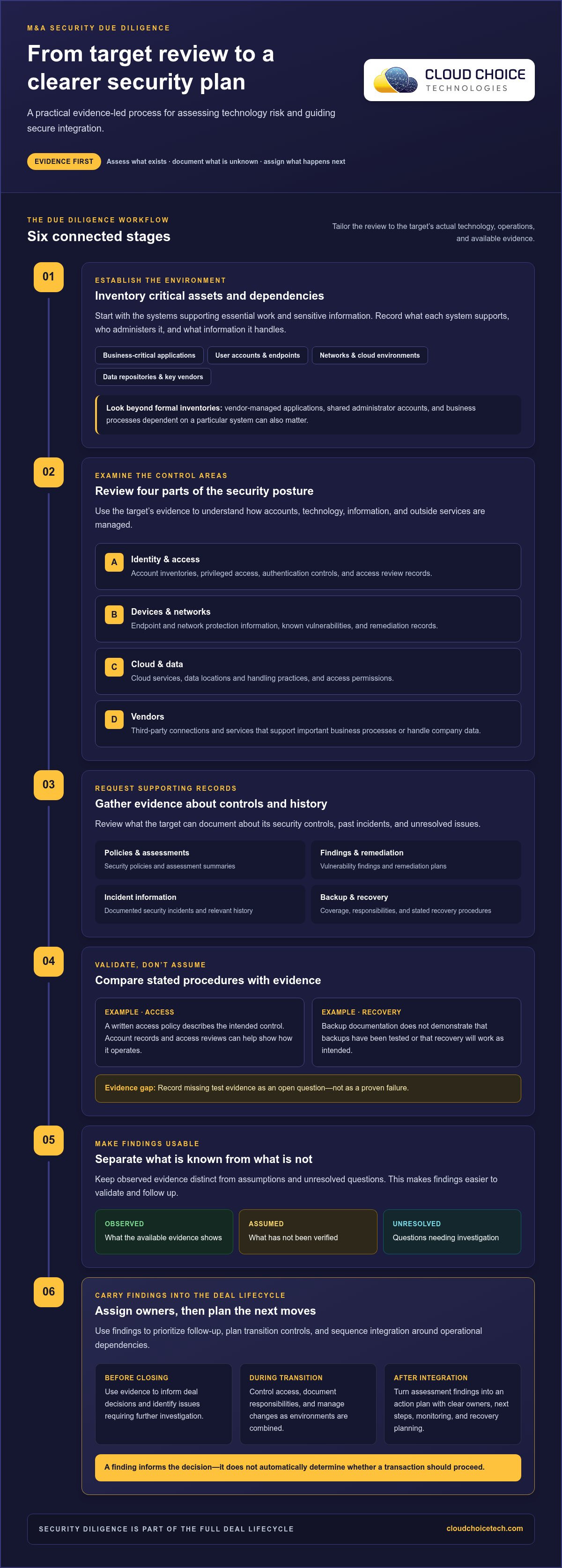
Start with the assets that support essential work and hold sensitive information. Depending on the organization, these may include business-critical applications, user accounts, endpoints, networks, cloud environments, data repositories, and key vendors. Build an initial inventory, then record what each system supports, who administers it, and what information it handles. The goal is to establish a verifiable picture, not assume every target uses the same tools or faces identical risks.
Look for dependencies that may not appear in formal inventories, such as a vendor-managed application, a shared administrator account, or a business process that relies on a particular system. Missing documentation can make it harder to maintain service or sequence integration work. A structured cybersecurity assessment can help organize evidence about potential vulnerabilities; Cloud Choice Technologies also offers a free Network Security Analysis that includes a technology assessment with white-hat testing.
How can cyber risk affect deal decisions?
Findings help teams prioritize follow-up, plan transition controls, and sequence integration around operational dependencies. A confirmed unsupported system, for example, is different from an unanswered question about how a vendor protects data. Record observed evidence separately from assumptions and unresolved questions, then assign owners and next steps for each gap.
A finding doesn’t automatically determine whether a transaction should proceed. Instead, it gives decision-makers a clearer basis for assessing exposure, planning remediation, and considering how security work fits the transaction. Deal-specific regulatory, contractual, and cyber-insurance requirements should be reviewed with qualified counsel or against the relevant policy documents.
What IT Security Due Diligence Should Examine in a Target Company
Strong diligence starts with evidence, not assumptions. Review what the target can document about its controls, past incidents, and unresolved security issues, then record what remains unknown. This makes findings easier to validate and gives deal teams a clearer basis for prioritizing follow-up.
Examine how access is managed, including who has administrator privileges, how user accounts are protected, and whether access is reviewed when roles change. Review endpoint and network protections, then map cloud environments and the data stored or processed in them. Assess how sensitive information moves through business processes, and identify vendors that can access systems or handle company data. The relevant IT security considerations for mergers and acquisitions depend on the target’s actual technology and operations, so tailor the review to the evidence available.
- Identity and access: Review account inventories, privileged access, authentication controls, and access review records.
- Devices and networks: Examine endpoint and network protection information, known vulnerabilities, and remediation records.
- Cloud and data: Identify cloud services, data locations, handling practices, and access permissions.
- Vendors: Document third-party connections and services that support important business processes.
Which records help reveal security posture and incident history?
Request relevant security policies, assessment summaries, vulnerability findings, remediation plans, and documented incident information. Compare stated procedures with available evidence of implementation. For example, a written access policy describes the intended control, while account records and access reviews can help show how it operates. Cloud Choice Technologies’ cybersecurity services include assessment and security-monitoring support that can help identify and track security gaps.
Review backup and recovery documentation, including the systems and data covered, assigned responsibilities, and stated recovery procedures. Documentation alone doesn’t demonstrate that backups have been tested or that recovery will work as intended. Record any missing test evidence as an open question rather than treating it as a proven failure.
How should reviewers assess compliance and sensitive data?
Map sensitive information to the systems, vendors, and business processes that handle it. Note the data types involved, where access is granted, and how information moves between environments. This helps reviewers identify where additional evidence or safeguards may be needed without assuming a single compliance checklist applies to every transaction.
Applicable obligations depend on the organizations and transaction. Identify them with qualified advisers, and use the regulatory compliance IT support guide for broader context. An evidence-based review separates verified controls from unanswered questions, giving decision-makers a more reliable foundation for the next stage.
How to Manage IT Security Across Due Diligence, Closing, and Integration
Security work needs a clear handoff from review to action. Treat each finding as a tracked item with an evidence source, confidence level, business impact, accountable owner, next action, and status. This keeps urgent exposure from being buried in a general integration list and makes open questions visible to decision-makers.
- Before closing, set scope and gather approved evidence. Identify transaction stakeholders, systems in scope, and authorized channels for requesting and sharing information. Record each finding as verified, partially supported, or unresolved. Prioritize follow-up by potential business impact and the systems or information involved. Technology planning and assessments, supported by business IT consulting, can help translate technical observations into practical priorities.
- Prepare the transition without exceeding authorized access. Document who can access which systems and information, who approves changes, and how concerns should be escalated. Keep access and information sharing within approved transaction processes. Avoid informal account sharing or untracked configuration changes, which can obscure accountability and complicate later review. Deal terms and legal duties are questions for the transaction’s qualified advisers.
- After closing, execute and track the integration plan. Assign owners for access changes, system updates, remediation, and escalation. Sequence work around operational dependencies, and include a security review when a system or business process changes. Track each action to completion, record decisions, and revisit unresolved findings as new evidence becomes available.
Recovery planning should advance alongside integration, not wait until every system has been combined. Confirm which data and services need protection, who is responsible for recovery decisions, and what documentation supports restoration. Data backup and recovery planning helps teams keep company data and continuity needs in view as environments change.
These IT security considerations for mergers and acquisitions work best when technical owners and business leaders share a practical record of priorities, responsibilities, and progress. For support turning technology findings into ongoing security actions, explore cybersecurity and managed IT support.
Build a Post-Acquisition Security Plan with Clear Owners and Follow-Through
Closing the deal doesn’t close out security findings. A practical post-acquisition plan turns material issues into defined actions, assigns a clear owner, and tracks progress as the combined organization changes. This creates accountability without assuming every risk can be eliminated or resolved at once.
How can leaders turn diligence findings into ongoing oversight?
Maintain a record of each finding, its business impact, accountable owner, planned action, and review status. Revisit priorities as systems, access, vendors, and business operations evolve. Ongoing managed IT services can support IT monitoring and management as teams maintain and adjust the environment after integration.
| Finding category | Suggested owner | Next action |
|---|---|---|
| Unclear or excessive account access | Identity or IT administrator | Review permissions, confirm business need, and document approved changes. |
| Unresolved system vulnerabilities | Security lead and system owner | Prioritize remediation by business impact and track completion. |
| Third-party access or dependencies | Vendor and business relationship owner | Document access, dependencies, and follow-up responsibilities. |
| Recovery gaps or missing evidence | IT and business continuity owners | Review recovery documentation and set appropriate next steps. |
Use the table as a working tool, not a substitute for judgment. Some items may need immediate attention; others may require additional evidence or coordination. Make status visible to technical and business leaders, and use the organization’s escalation process when an action stalls or ownership is unclear.
When can Cloud Choice Technologies support the security review?
Cloud Choice Technologies can support ongoing security work through cybersecurity, cyber risk analysis, managed IT, and backup and recovery services. Teams can connect technical findings to monitoring, remediation, and recovery planning as responsibilities and systems evolve. These services support the organization’s technical work, but they don’t replace legal advice or transaction guidance from qualified advisers. For broader strategic context, consult the business cybersecurity strategy guide.
To move from findings to practical next steps, explore Cloud Choice Technologies’ cybersecurity and managed IT support. Clear ownership and steady follow-through help keep security priorities active well beyond the initial integration push.
Carry Security Priorities Beyond the Deal
An acquisition changes more than ownership. It changes who relies on systems, how information flows, and which risks deserve attention first. Use the transition to establish a security rhythm that lasts beyond integration: keep open findings visible, maintain clear ownership, and adjust priorities as the combined organization evolves. Strong IT security considerations for mergers and acquisitions support deliberate decisions long after closing, not just a smooth handoff.
Cloud Choice Technologies can help turn technical findings into practical next steps through managed IT, cybersecurity, cyber risk analysis, and compliance services. The free Network Security Analysis includes a technology assessment with white-hat testing, offering a starting point for understanding an environment’s security conditions. Use assessment findings within your broader risk process, alongside guidance from qualified transaction and legal advisers where appropriate.
Give your team a clearer starting point. Start with a free Network Security Analysis and build on its findings with accountable follow-through. With a measured plan and the right owners in place, your organization can approach integration with greater clarity and confidence.
Frequently Asked Questions
What happens if a target company discloses a past data breach during due diligence?
Treat the disclosure as a prompt to verify the incident’s scope and current status, not as proof of continuing exposure or complete resolution. Establish what happened, when it was detected, which systems and data were involved, what containment and recovery steps were taken, and what evidence supports those statements. Compare the account with available incident records and remediation evidence. The deal team and qualified advisers can assess implications before drawing conclusions.
Can a buyer assess a target’s cybersecurity without disrupting its operations?
Yes, if the review is scoped and coordinated around authorized access and operational needs. Begin with approved documentation requests and designated contacts, then agree on the purpose, systems, timing, and boundaries of any technical assessment. For example, teams can schedule work around a business-critical process rather than interrupting it unexpectedly. Don’t access accounts or test systems without approval. The right approach depends on the environment and transaction.
How should sensitive information be shared during M&A security due diligence?
Share only information needed for the review, through the transaction’s approved process, with people who have an appropriate business need. Before distributing a file, identify its sensitivity, intended recipients, and purpose. Keep a record of what was shared and with whom so the deal team can track access and follow agreed handling practices. Requirements vary by transaction, so qualified advisers should guide decisions about contractual or legal obligations.
Does a security finding automatically mean a company should abandon an acquisition?
No. A finding needs to be understood in context before it informs a deal decision. For example, an issue affecting a noncritical system may call for a different response than one that could interrupt a key business operation. Document the evidence, scope, potential impact, and practical response options, including what remains uncertain. The deal team and its advisers can weigh those details alongside other transaction factors. No single finding decides every deal.
Should the buyer integrate the target’s systems immediately after closing?
Not automatically. Integration should reflect the systems’ dependencies, operational importance, and known security conditions. For instance, combining identity systems before clarifying administrator access could create avoidable confusion about who can reach which resources. Map dependencies, set a sequence for changes, and define review points before major cutovers. Some environments may be ready for early integration, while others need staged work. The right timing depends on the transaction and business requirements.
Who should own cybersecurity findings after an acquisition closes?
Give every material finding one named accountable owner, even when several teams contribute to the fix. The owner should know what decision or action is expected, what evidence will show completion, and how to escalate delays or blockers. For continuity, record the finding and its status in a shared tracking process rather than relying on one person’s inbox or memory. Leadership can use regular status reviews to spot stalled actions and resolve ownership gaps.