
IT Infrastructure Strategy for Small Business: The 2026 Executive Roadmap
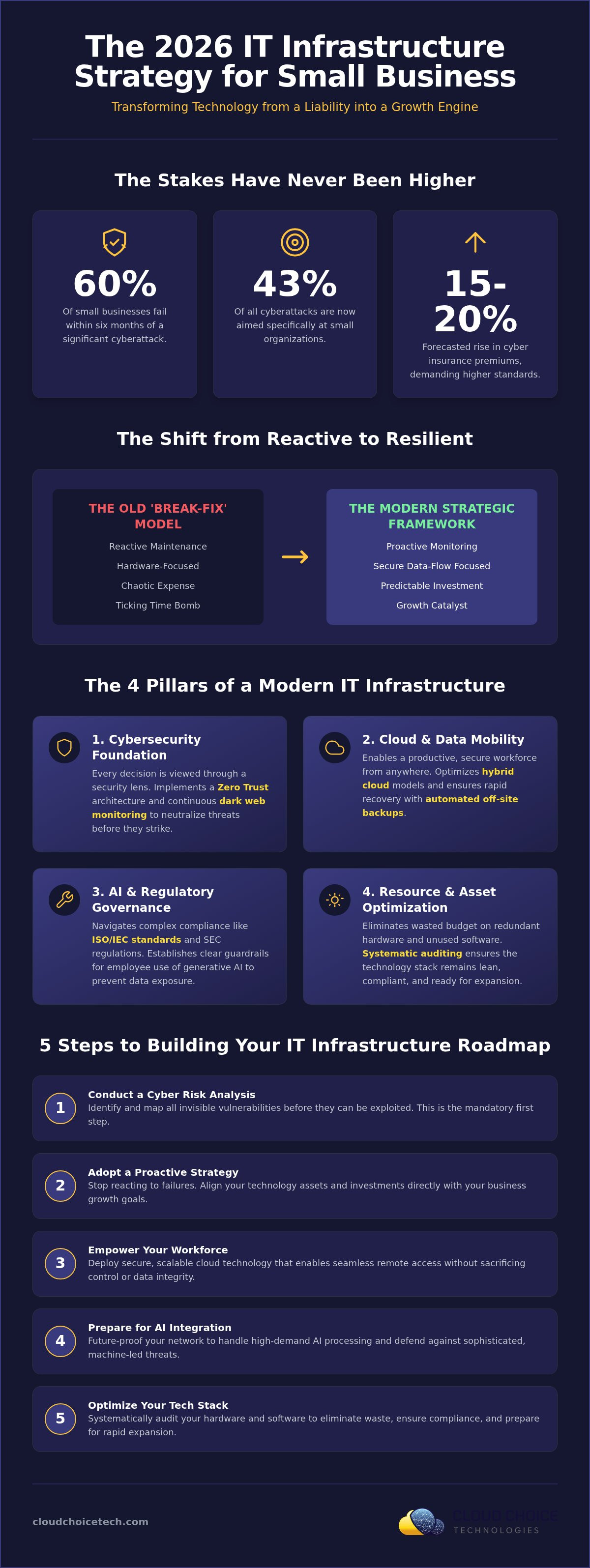
Did you know that 60% of small businesses that suffer a cyberattack go out of business within just six months? In 2026, the stakes for your digital foundation have never been higher; 43% of all cyberattacks now specifically target smaller organizations. You likely feel the constant pressure of balancing a tight budget against the looming June 3rd deadline for SEC Regulation S-P compliance and the rapid onset of generative AI integration. It's exhausting to worry about whether your current setup is a strategic asset or a ticking time bomb of redundant hardware and security gaps.
We understand that you want to focus on growth rather than troubleshooting server downtime or deciphering complex AI regulations. This guide provides a definitive IT infrastructure strategy for small business leaders who need to transform their technology into a resilient, AI-ready engine. You'll learn how to master modern complexities through a strategic framework designed to ensure total security and seamless business continuity. We will preview the essential steps for optimizing your cloud spend, implementing a Zero Trust model, and navigating the latest 2026 regulatory audits so you can lead with total confidence.
Key Takeaways
- Stop reacting to tech failures and start aligning your assets with growth. A proactive IT infrastructure strategy for small business replaces the obsolete break-fix model with a resilient, always-on foundation.
- Identify invisible vulnerabilities before they become catastrophic breaches. Conducting a thorough cyber risk analysis is the mandatory first step in securing your 2026 roadmap.
- Empower your national workforce with secure, scalable cloud technology. You'll learn how to enable seamless remote access without sacrificing control or data integrity.
- Prepare your network for the high-demand processing of modern AI tools. We'll show you how to integrate AI compliance and security protocols that defend against sophisticated, machine-led threats.
- Eliminate wasted budget on redundant hardware. Systematic auditing ensures your technology stack remains lean, compliant, and ready for rapid expansion.
What is IT Infrastructure Strategy for Small Business in 2026?
In 2026, an IT infrastructure strategy for small business is no longer a luxury reserved for the Fortune 500. It's the deliberate alignment of your technology assets with your specific growth targets and risk management goals. While the traditional definition of IT infrastructure covers the physical hardware and software, a modern strategy focuses on how these components interact to protect your revenue. The old break-fix model is dead. With 43% of cyberattacks targeting small businesses, waiting for a system to fail before fixing it is an invitation for catastrophic data loss.
Elite readiness means your systems are designed to anticipate problems. This proactive stance ensures that your operations remain stable even when external threats evolve. You aren't just buying equipment; you're building a shield. By shifting from reactive maintenance to a strategic framework, you ensure that your technology serves as a catalyst for growth rather than a source of constant friction.
The Shift from Hardware to Strategic Resilience
Your 2026 strategy must prioritize secure data flow over the technical specifications of a physical server. In a world where your workforce is likely distributed, the focus shifts to high-speed connectivity and redundant remote support. Your team needs to access data from anywhere without creating a security hole. Resilient Infrastructure is a strategic blend of proactive monitoring and rapid recovery protocols that ensures your business never stops moving. This transition allows you to scale your operations without the heavy capital expenditure of traditional on-premise hardware.
Why Small Businesses Need a Formal Strategy Now
Cyber insurance premiums are forecasted to rise by 15-20% in 2026. To qualify for affordable coverage, insurers now demand documented infrastructure standards and rigorous cyber risk analysis. Without a formal IT infrastructure strategy for small business, you risk falling into the trap of shadow IT, where employees use unapproved apps that drain your budget and expose your data. A documented roadmap provides the executive peace of mind that comes from knowing every dollar spent on technology is actually reducing your risk profile. It transforms IT from a chaotic expense into a predictable, foundational element of your success.
The 4 Pillars of a Modern IT Infrastructure
A resilient IT infrastructure strategy for small business isn't built on a single piece of software or a specific server. It's supported by four distinct pillars that work in unison to protect your revenue and reputation. In 2026, these pillars must be integrated, not siloed. If one fails, the entire structure is vulnerable to the machine-led threats and regulatory shifts defining this year.
Cybersecurity as the Strategic Foundation
Cybersecurity is no longer a peripheral concern; it's the lens through which every technology decision must be viewed. By 2026, Zero Trust architecture has become the mandatory baseline for most compliance frameworks. This means you don't trust any connection, whether it's from inside or outside your network, without real-time verification of identity and device health. We also implement continuous dark web monitoring to identify compromised credentials before they're used in a breach. You can find a deeper tactical breakdown in our guide on Protecting Your Assets with Business Cybersecurity Solutions.
Cloud Infrastructure and Data Mobility
Your team needs to be productive from anywhere, which requires a shift from cloud migration to cloud optimization. Choosing the right mix of public, private, and hybrid cloud models is essential for balancing performance with cost. For small businesses, hybrid models often provide the best of both worlds: the security of private storage for sensitive data and the scalability of public clouds for daily operations. Automated, off-site backups ensure that even if a local incident occurs, your data is safe and recoverable within minutes. Explore these options further in our Managed Cloud Security Services guide.
AI Governance and Regulatory Adherence
With the release of standards like ISO/IEC 38505-1:2026, governing how your organization uses data is now a legal necessity. You must set clear guardrails for how employees interact with generative AI tools to prevent corporate data from leaking into public models. This is especially critical for meeting the June 3, 2026, SEC Regulation S-P deadline for incident response. Establishing an audit-ready framework for HIPAA or SOC 2 compliance isn't just about passing a test; it's about proving your reliability to your clients. Our analysis of AI-Powered Cyber Threats explains how to build these defenses.
The final pillar is Managed IT Support. This is the human element that monitors these complex systems 24/7, providing the rapid intervention needed to prevent minor glitches from becoming major outages. If you're ready to move beyond the stress of digital uncertainty, a comprehensive cyber risk analysis is the most effective way to identify which of your pillars needs immediate reinforcement.
5 Steps to Building Your IT Infrastructure Roadmap
Building a resilient IT infrastructure strategy for small business requires more than just buying new hardware. It's a sequence of strategic decisions designed to eliminate digital uncertainty and replace it with elite readiness. You need a clear path that moves from identifying hidden vulnerabilities to maintaining total oversight through proactive support. This roadmap ensures your technology budget is spent on protection and growth, not just emergency repairs. The process follows five essential stages:
- Step 1: Conduct a comprehensive cyber risk analysis.
- Step 2: Inventory and audit hardware for compliance gaps.
- Step 3: Define business continuity objectives (RTO/RPO).
- Step 4: Align infrastructure with regulatory requirements.
- Step 5: Partner with a managed service provider for 24/7 oversight.
Step 1 & 2: Assessment and Auditing
A surface-level scan won't protect you from sophisticated 2026 threats. You need a deep-dive infrastructure security audit that scrutinizes every connection point in your network. This process identifies "end-of-life" assets that no longer receive security patches; these are open doors for ransomware. We establish a clear baseline for AI compliance and data privacy, ensuring your existing software doesn't inadvertently leak corporate data into public AI models. This initial inventory prevents uncontrolled technology spending by highlighting exactly where your current setup fails to meet modern standards.
Step 3 & 4: Planning for Resilience
Resilience is measured by how quickly you can recover from a disruption. You must calculate the real cost of downtime for your specific business model to set realistic goals. With the average cost of a small business data breach reaching $3.31 million in 2026, the price of being unprepared is too high. We help you define your Recovery Time Objective (RTO) and Recovery Point Objective (RPO) to prioritize high-impact security upgrades. This phase integrates regulatory standards like NIST or HIPAA directly into your daily workflow, transforming compliance from a stressful annual event into a natural part of your operations.
Step 5: Implementation and Managed Oversight
Execution is where most roadmaps fail. Proactive, 24/7 network monitoring is essential to catch anomalies before they trigger a total system collapse. Our remote IT support maintains the productivity of your distributed workforce by resolving issues instantly, ensuring your team stays focused on their core tasks. For a deeper look at how to sustain this momentum and protect your scalability, consult The Executive Guide to Managed IT Services. Don't leave your continuity to chance; secure your future by scheduling a comprehensive cyber risk analysis today.
Future-Proofing: AI Security and Scalability in 2026
In 2026, your IT infrastructure strategy for small business must account for the reality that AI is both your greatest tool and your most persistent threat. While AI-driven security solutions can detect threats up to 70% faster than traditional methods, those same capabilities are being weaponized by bad actors to launch automated, high-velocity attacks. You need a foundation that handles the intense data processing demands of modern AI tools while shielding your network from machine-led intrusion. Scalability is no longer just about adding more users; it's about expanding your data intelligence without compromising your security perimeter.
Managing AI Compliance Risks
Adopting third-party AI platforms introduces significant risks to your intellectual property. Without specific guardrails, sensitive corporate data can be ingested into public models, leading to a permanent loss of confidentiality. You must protect your proprietary information through encrypted pipelines and strict data-handling policies. Specialized AI security consultants are essential in the planning phase to ensure your use of these tools aligns with the latest 2026 regulatory standards. "AI is a competitive engine, but without infrastructure guardrails, it becomes a liability." By establishing these boundaries early, you transform AI from a potential risk into a secure operational asset.
Building for National Scalability
Leveraging cloud technology allows you to support national growth without the burden of increasing your local hardware footprint. In 2026, the focus has shifted from mere storage to the intelligent distribution of resources across the country. Standardizing security protocols across multiple remote locations ensures that every team member, regardless of their physical site, operates under the same elite protection. This uniformity is the hallmark of a mature IT infrastructure strategy for small business. It provides a consistent, high-performance experience that allows your organization to scale rapidly while maintaining total control over your digital environment.
Cloud Choice Technologies acts as the calm in the storm during these complex technical transitions. We provide the specialized AI security and compliance consulting required to keep your business at the forefront of innovation. Don't let your infrastructure become an obstacle to your success. Secure your infrastructure with a professional IT strategy from Cloud Choice Technologies and ensure your organization is ready for the demands of 2026 and beyond.
Lead with Confidence in an AI-Driven Economy
Your business doesn't have to be a victim of digital uncertainty or outdated hardware. By implementing a formal IT infrastructure strategy for small business, you transform technology from a cost center into a resilient engine for growth. We've explored how a Zero Trust foundation, optimized cloud environments, and AI-ready protocols protect your revenue against the sophisticated threats of 2026. This isn't just about survival; it's about elite readiness and maintaining total control over your digital assets.
Cloud Choice Technologies serves as your vigilant guardian in this complex landscape. We provide national cyber risk analysis expertise, specialized AI security and compliance frameworks, and 24/7 proactive remote support to ensure your operations never falter. You deserve the peace of mind that comes from having a technically superior partner managing the storm for you. Secure your business future with an expert IT infrastructure strategy today. Your path to stability and seamless scalability starts with a single, decisive step. Your future is protected.
Frequently Asked Questions
What is the most important part of an IT infrastructure strategy for a small business?
The most important part of an IT infrastructure strategy for small business is cybersecurity and comprehensive risk analysis. Without a secure foundation, every other technical asset becomes a liability. In 2026, this means adopting a Zero Trust model where no user or device is trusted by default. You must prioritize data integrity and protection above simple hardware specs to ensure your operations remain resilient against sophisticated, machine-led threats.
How often should a small business update its IT strategy?
You should review and update your IT strategy at least once a year. However, 2026 has shown that rapid shifts in AI regulations and cybersecurity threats often require quarterly adjustments. A static plan quickly becomes obsolete. Regular updates ensure your technology remains aligned with your growth goals and keeps you compliant with evolving standards like HIPAA or the latest SEC guidelines for incident response programs.
Does a small business need a full-time IT manager if they have a strategy?
A small business typically doesn't need a full-time IT manager if they have a robust strategy and a managed service partner. Hiring a single person often creates a single point of failure and limits your access to specialized expertise. By partnering with a provider for managed IT services, you gain the collective knowledge of an entire team. This proactive model offers 24/7 monitoring and remote support at a fraction of the cost of a high-level executive salary.
How much does it cost to implement a modern IT infrastructure strategy?
Implementation costs vary based on your existing hardware and specific compliance needs. In 2026, many small businesses allocate between 3% and 7% of their annual revenue to IT spending. This investment covers essential security layers, cloud optimization, and ongoing managed support. While you might feel tempted to cut costs, failing to invest in a modern IT infrastructure strategy for small business often leads to much higher expenses through downtime or data breaches.
How does AI compliance affect small business IT planning in 2026?
AI compliance is now a central pillar of IT planning. You must establish strict guardrails for how corporate data interacts with third-party generative AI tools to protect your intellectual property. Regulatory bodies now require documented frameworks for AI usage to prevent data leaks. In 2026, your strategy must include specialized AI security measures that ensure your organizational data remains private while you leverage the efficiency and speed of these competitive tools.
What is the difference between IT support and IT infrastructure strategy?
IT support is reactive and focuses on fixing problems after they occur, such as resolving a login issue or a server crash. In contrast, an IT infrastructure strategy is a proactive, high-level roadmap that aligns your technology with long-term business goals. While support keeps you running day-to-day, a strategy ensures you have the right security, scalability, and compliance frameworks in place to prevent those issues from happening in the first place.