
How to Present an IT Budget to the Board With Confidence
A strong IT budget presentation doesn’t bury the board in line items. To answer how to present an IT budget to the board, use a clear seven-slide structure: connect spending to organizational priorities, explain key assumptions and risks, and end with the decisions directors need to make.
Expect tough questions, especially when technology spending is rising or the plan includes a deficit. Show what the investment supports, what could change the forecast, and how leadership will respond if results move off track. This gives directors a basis for oversight without asking them to sort through every spreadsheet detail.
This guide shows how to align an IT budget with strategy, explain financial assumptions and tradeoffs, and address a deficit with clear scenarios. It also lays out a practical presentation structure, including how to make the risks visible, keep the discussion focused, and close with specific decisions and next steps.
Key Takeaways
- Show prior results, current projections, and next year’s plan together so the board can assess assumptions and spot meaningful changes.
- Connect technology spending to organizational priorities, and explain the tradeoffs behind the proposed investments.
- Address a potential deficit with clear scenarios, visible risks, and a plan to adjust spending if revenue or costs shift.
- Use a focused seven-slide structure that builds from the financial picture to the risks and decisions required.
- Bring in managed IT or cybersecurity support when clearer technology costs, risks, and priorities would strengthen the budget case.
1. The board’s role in budget approval and financial oversight
The board reviews the annual budget, challenges its assumptions, and approves the plan. Its oversight continues afterward: directors compare actual results with projections and address variances early. Management typically prepares the draft, a finance committee reviews it, and the committee recommends it to the full board. Directors should ask for clarification when revenue sources, expenses, or projected outcomes are unclear.
Benchmarks can compare IT spending as a share of revenue or per employee, but ratios need context. Compare the organization with similar peers and track its own ratios across prior years and the next budget period. Keep the calculation consistent by defining which technology expenses and employees are included. A ratio can flag a change or prompt a question, but it cannot show by itself whether spending meets the organization’s needs.
Use plain language to make figures meaningful. Instead of saying “operating expenditure variance,” explain that a forecast cost differs from the approved budget, then give the reason. Be candid about financial strengths and weaknesses: identify reliable revenue sources, uncertain assumptions, and expenses that could rise. If a technology budget line increases, name the initiative behind it and the operational outcome it is intended to support.
Charts help directors understand the story without reading every line item. A column chart can compare prior-year actuals, current-year projections, and next year’s budget; a variance chart can show where actual expenses diverge from plan. Pair each visual with key metrics, including revenue, expenses, budget variance, and assumptions behind major changes. Keep detailed spreadsheets in supporting materials so the presentation stays focused.
Build a multi-year financial narrative from those comparisons. Start with what the organization spent and achieved, show the current forecast, then explain what next year’s plan changes. A nonprofit example illustrates why context matters: an expense budget rising from $2 million to $2.4 million is a 20% increase. Explain the reasons and expected benefits instead of expecting the percentage to speak for itself.
A sound approach to how to present an IT budget to the board links oversight to decisions. The U.S. Government Accountability Office describes investment review as assessing each project concept’s impact and probable benefit. Apply that discipline to technology proposals: state the opportunity, explain the tradeoffs, disclose uncertain assumptions, and clarify what the board is being asked to approve. During the year, report actual results against the budget and the same point in the prior year.
2. Aligning the budget with organizational strategy and mission
Start with the strategic plan, not a list of technology requests. Identify leadership’s approved annual priorities, then map each proposed expense to one of them. If the organization plans to expand services, for example, explain which technology investment supports that expansion. This makes the budget a tool for carrying out strategy, not a separate technical wish list. The U.S. Government Accountability Office recommends anchoring IT resource planning in mission goals and integrating it with budgeting.
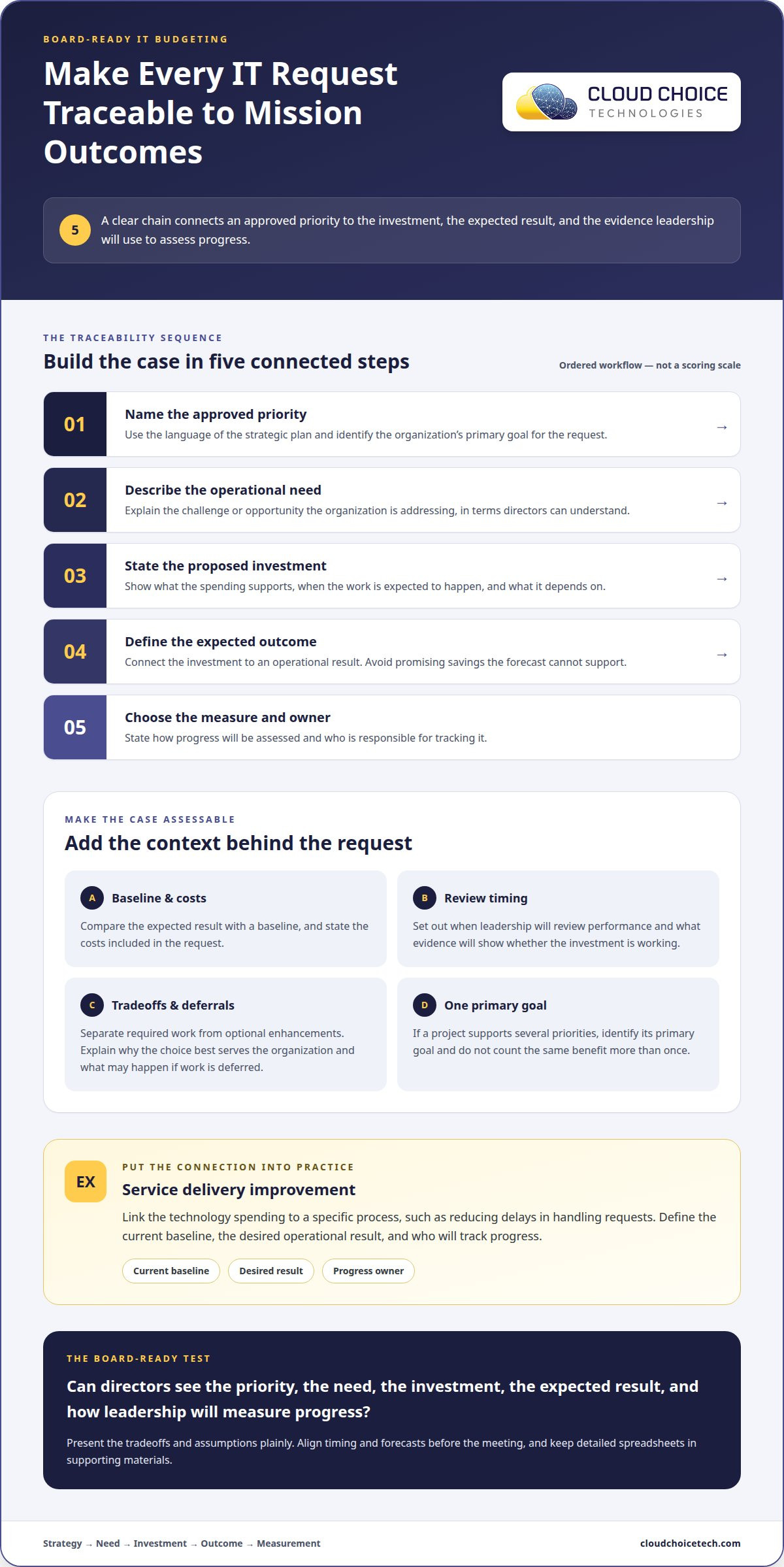
To align an IT budget with business strategy and board priorities, connect each request to an approved goal, a measurable outcome, and a clear owner. Group spending by priority so directors can see what advances the mission and what can wait.
Use a simple traceability process for every major request. First, state the organizational priority in the language of the strategic plan. Next, describe the operational challenge or opportunity. Then explain the proposed investment, its expected outcome, and the measure leadership will use to assess progress. If a project supports several priorities, identify its primary goal and avoid counting its benefits more than once.
For example, a plan to improve service delivery should link technology spending to a specific process, such as reducing delays in handling requests. Define the current baseline, the desired operational result, and who will track progress. Reflect the work’s timing, dependencies, and tradeoffs in the forecast. If the investment shifts resources from another priority, explain why the choice best serves the organization.
Tie each IT request to business outcomes and ROI by stating the expected benefit, included costs, and measure for evaluating results. Compare the expected outcome with a baseline, such as staff time spent on a manual process or service interruptions affecting delivery. Set out when leadership will review performance and what evidence will show whether the investment is working. Avoid promising savings the forecast cannot support.
Administrators should agree on the presentation’s key messages before the board meeting. Ask each department lead to explain the investment using the same terms: priority, operational need, expected outcome, and tradeoff. Resolve conflicting assumptions in advance. For example, if finance expects a project to start later than IT does, align the schedule and forecast before presenting them to directors.
Keep the mission visible throughout the discussion. Show how each spending request supports a strategic objective, improves an essential operation, or removes a constraint on planned work. Separate required work from optional enhancements, then explain the consequence of deferring each item. This gives the board a practical basis for prioritizing requests and approving a budget that reflects the organization’s direction.
3. What If You’re Budgeting for a Deficit?
A planned deficit needs a clear purpose, funding source, and response plan. For example, a nonprofit might budget a $100,000 deficit to support a major technology investment. Explain whether reserves or another funding source will cover it, what the investment enables, and how leadership will track progress. A deficit without an identified funding path leaves directors unable to assess its effect on operations.
Separate operating, program, and capital expenses before explaining the overall result. The operating budget covers day-to-day expenses and program costs. A capital budget plans longer-term investments, such as significant technology upgrades, which may span several years. This distinction helps directors see whether a deficit reflects recurring operations or a planned investment. It also clarifies which costs continue beyond the coming fiscal year.
Present the result plainly. A nonprofit example with $1,500,000 in revenue and $1,425,000 in expenses produces a planned surplus of $75,000. If expenses instead exceed revenue, show the amount and explain the assumptions behind the difference. Identify how restricted funding affects available resources, and separate confirmed commitments from projections. The board can then distinguish a deliberate investment from a structural shortfall.
Prepare best-case, base-case, and worst-case scenarios. For each one, show which revenue or expense assumptions change, how that affects the forecast, and what action leadership would take. If expected funding falls short, for example, identify discretionary spending that could be delayed and program commitments that should remain protected. Reforecast when actual results diverge from plan, then report the cause and proposed adjustment.
How should IT leaders prepare for board questions about budget cuts, savings, and tradeoffs? Bring a decision-ready comparison showing what can be deferred, the expected savings, and the operational consequence of each option. Link each choice to its funding effect and strategic priority. If a proposed reduction shifts costs to a later period or increases exposure to disruption, explain that tradeoff directly.
Link each budget assumption to an owner and a review point. Before the board meeting, ask finance and program leaders to test revenue estimates, expense timing, and funding restrictions. During the year, compare actual results with the approved budget and revise the forecast as circumstances change. Scenario planning gives directors a practical response path instead of a single projection that may fail when assumptions shift.
Close with the decision required: approve the planned deficit, revise spending, or request another forecast. State the funding source, the conditions that would trigger a change, and who will report progress. This makes a deficit understandable and manageable, whether it supports a time-limited technology investment or reflects a wider gap between operating needs and available revenue.
4. A seven-slide budget presentation structure
A seven-slide deck gives directors a clear path from context to decision. Keep one central message on each slide and put detailed spreadsheets in supporting materials. This provides enough substance for the annual budget discussion without overwhelming the board with every line item.
Open with the decision and why it matters. State what directors are being asked to approve, then connect the request to an organizational priority. For example, a proposal might seek approval for technology spending that supports a planned service expansion. Put the meeting’s purpose up front, not after several slides of background.
Use the second slide for a concise financial snapshot. Show total revenue, total expenses, the proposed budget result, and the change from the current forecast. A simple chart can distinguish expected results from actual results. Add a brief note beside each major change so directors can see what drives the numbers.
Use the third slide to show the financial timeline. Compare prior-year actuals, current-year projections, and the coming annual budget in a consistent format. Label each period clearly and explain whether a difference reflects timing, a changed assumption, or a new commitment. This comparison helps directors see the overall direction.
Use the fourth slide to show priorities. Group proposed spending under the strategic goals it supports, then identify the expected business or mission outcome. For example, one row might connect a service expansion goal to the technology work that enables it. If an item supports several goals, name its primary purpose to keep the case focused.
Use slide five to explain the largest expense changes. Separate recurring operating costs from one-time investments, and show when each is expected. A compact bar chart can highlight the largest categories. Explain each notable increase or reduction instead of asking directors to infer its meaning from unexplained totals.
Use slide six to show risks and responses. Identify the main assumptions that could shift the forecast, such as delayed project delivery or revenue below plan. Explain each scenario’s operational effect and management response. Keep the visual simple: a three-column table can compare the assumption, its impact, and the planned action.
Close slide seven with the decisions and oversight plan. State what needs approval, which choices remain open, and when leadership will report progress. Identify the measures directors will see in future updates, such as actual spending against budget or progress against a project milestone. End with a specific request, not another data summary.
Before presenting, check that all seven slides use consistent terms, periods, and assumptions. Rehearse the transition from the forecast to the requested decision, and keep supporting detail ready for questions. If technology priorities need clearer alignment with organizational plans, strengthen the planning process.
Cloud Choice Technologies: Managed IT Services
Cloud Choice Technologies helps organizations bring practical IT needs and risks into budget planning. When support demands, cybersecurity concerns, or unclear technology priorities make forecasts harder to explain, its managed IT services and remote support can help address day-to-day technology needs. Cybersecurity and Cyber Risk Analysis can also help leaders understand security risks and factor them into financial oversight.
Consider this support when the board needs a clearer view of technology priorities, ongoing requirements, or risks before approving a budget. Cloud Choice Technologies provides managed IT services, cybersecurity, and business IT consulting to help organizations assess these considerations. Visit cloudchoicetech.com to discuss your organization’s IT planning needs.
Make the next budget cycle more informed
A board presentation can also improve how the organization gathers information for future planning. Capture unanswered questions, unclear ownership, and assumptions that need stronger evidence. Turn those observations into specific planning tasks, then use them to sharpen the next budget cycle. This ongoing discipline helps you explain how to present an IT budget to the board with confidence.
Cloud Choice Technologies can help organizations assess technology needs and risks that inform budget decisions. Bring the questions directors raised to the discussion and identify where additional analysis could strengthen future planning.
Contact Cloud Choice Technologies to discuss your organization’s IT needs. Move into the next planning cycle with a clearer view of what the business needs.
Frequently Asked Questions
Don’t Forget the Big Question: What Could Go Wrong?
Look beyond the forecast total to dependencies that could disrupt delivery. A project may rely on a vendor renewal, data migration, or staff training that isn’t ready on schedule. Identify each dependency and the team responsible for it. Ask what evidence will show readiness before spending moves forward, such as completed testing or signed-off user acceptance. This helps directors distinguish a manageable delivery constraint from a plan that needs revision.
What If You’re Budgeting for a Deficit?
Ask whether the deficit is temporary or signals an ongoing mismatch between recurring revenue and recurring expenses. That distinction changes what the board should monitor after approval. For a time-limited shortfall, define the conditions for continuing the investment and when leadership will reassess it. For a recurring imbalance, require a longer-term operating response alongside the budget decision, rather than treating a one-year approval as a complete solution.
What should an IT budget presentation to the board include?
Give directors a short briefing note before the meeting that defines unfamiliar terms and identifies decisions requiring their input. Attach supporting documents separately, such as a project schedule, assumptions register, and plain-language explanation of major technology dependencies. This gives board members time to prepare focused questions. During the presentation, refer to the relevant document when a question needs detail instead of crowding every slide with technical material.
How should IT budgets separate operating expenses, capital expenses, and one-time investments?
Apply the organization’s accounting policy consistently, and coordinate classifications with finance before submission. For each technology item, record its purpose, expected useful period, payment timing, and whether the commitment renews. For example, distinguish an implementation charge from a recurring subscription in the supporting schedule. This makes future budget comparisons more reliable and helps prevent a one-time project cost from being mistaken for an ongoing commitment.
How do you explain IT budget variances and forecast assumptions to the board?
Prepare a variance bridge that reconciles the original budget to the latest forecast, grouping changes by cause instead of showing unexplained net differences. Label each assumption as confirmed, estimated, or dependent on another decision, and name its owner. If an assumption changes, show which forecast line it affects and whether other commitments change too. This gives directors a traceable explanation to revisit at the next review.
How should cybersecurity, compliance, and technology risks be presented in an IT budget?
Connect each budget request to a documented control, accountable owner, and evidence the organization can review, such as assessment findings or remediation records. Identify any unresolved exception and the business process it affects. For organizations that need help evaluating exposure and security priorities, cybersecurity services can support that work. Present compliance considerations in terms of relevant obligations and evidence of oversight, without implying that spending alone ensures compliance.