
Healthcare Data Security Beyond HIPAA: When State Laws Apply
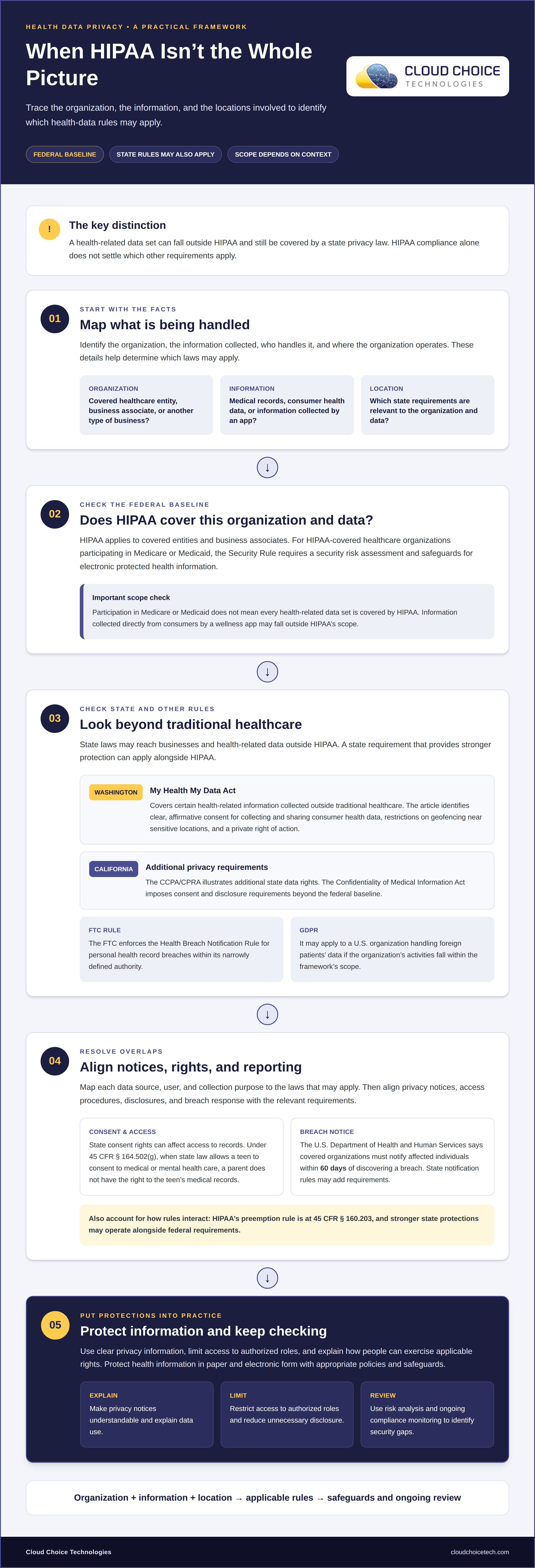
HIPAA is not the only law that can govern health information. State privacy laws may cover health-related data collected outside traditional healthcare, including through apps and websites. That’s why healthcare data security regulations beyond HIPAA matter: whether HIPAA applies doesn’t automatically determine whether state privacy rules apply, too.
It’s easy to assume health data falls under one federal framework, especially when an organization already handles HIPAA obligations. But the rules can depend on what information is collected, who collects it, and where the organization operates. Washington’s My Health My Data Act, for example, regulates certain health-related information collected by businesses outside HIPAA.
This article explains when state laws may apply, how HIPAA and state privacy rules can overlap, and which safeguards help protect health information. It also covers how risk analysis and ongoing compliance monitoring can reveal security gaps and support a more reliable approach to protecting sensitive data.
Key Takeaways
- State privacy laws can apply to health-related information even when HIPAA doesn’t cover the organization or data.
- Which rules apply depends on the information collected, who handles it, and the relevant state requirements.
- Protect health information in both paper and electronic form with appropriate policies and safeguards.
- Use risk analysis and ongoing compliance monitoring to identify security gaps and strengthen accountability.
- Understand how consent, privacy tools, and specialized protections may affect the collection and use of sensitive health data.
Can a state law apply to data HIPAA doesn’t cover?
Yes. Healthcare data security regulations beyond HIPAA may apply when state laws cover health-related information that HIPAA does not. HIPAA applies to covered entities and business associates, while some state laws also reach businesses outside traditional healthcare. The rules that apply depend on the organization, the data, and the relevant state law.
Federal requirements provide an important baseline. For HIPAA-covered healthcare organizations participating in Medicare or Medicaid, the HIPAA Security Rule requires a security risk assessment and safeguards for electronic protected health information. Participation in these programs does not mean every health-related data set falls under HIPAA. For example, information collected directly from consumers by a wellness app may fall outside HIPAA’s scope.
HIPAA’s preemption rule, 45 CFR § 160.203, addresses how federal requirements interact with state law. A state privacy requirement that provides stronger protection can apply alongside HIPAA. Washington’s My Health My Data Act, for example, covers certain health-related data collected outside traditional healthcare. It requires clear, affirmative consent for collecting and sharing consumer health data, restricts geofencing near sensitive locations, and provides individuals a private right of action. These examples show why state rules can affect organizations outside the traditional provider model.
Patient expectations reinforce why confidentiality and careful disclosure matter. The AMA and Savvy surveyed 1,000 patients across the United States about medical information privacy. Privacy principles also call for respecting individual rights, explaining data use, and considering whether protections work equitably for affected people. An organization can make its privacy notice understandable, limit access to authorized roles, and explain how a patient can exercise applicable rights.
Consumers and providers can protect information at different points. Before sharing medical details through a health app or wearable, consumers can review its privacy notice and consent choices. Providers can use access controls and staff procedures to reduce unnecessary disclosure. California’s CCPA/CPRA illustrates additional state data rights. Organizations can map each data source, user, and collection purpose to the laws that may apply.
HIPAA vs State Privacy Laws: Which Rules Apply to Your Organization?
HIPAA sets federal privacy and security requirements for covered entities, while state and local laws can add rules for particular records or data practices. Identify the organization, information, and location involved to determine which requirements overlap.
Additional Health Information Laws
The Health Insurance Portability and Accountability Act is one part of a broader set of rules for health information. Federal, state, and local requirements may address specific records, providers, or data uses.
For example, the FTC enforces the Health Breach Notification Rule within its narrowly defined authority over personal health record breaches. State law can also affect access to records: under 45 CFR § 164.502(g), when state law allows a teen to consent to medical or mental health care, a parent doesn’t have the right to the teen’s medical records. GDPR may also apply to a U.S. organization handling foreign patients’ data if its activities fall within that framework’s scope. HIPAA compliance alone doesn’t resolve that question.
Breach Notification Requirements
Breach notification rules set who must be informed, when notice is due, and which agencies receive reports. The U.S. Department of Health and Human Services says covered organizations must notify affected individuals within 60 days of discovering a breach.
According to the U.S. Department of Health and Human Services, breaches affecting fewer than 500 individuals must be reported to HHS annually. Breaches affecting fewer than 500 individuals must be reported to HHS within 60 days, according to the U.S. Department of Health and Human Services. The U.S. Department of Health and Human Services requires reporting when a breach affects fewer than 500 individuals. State notification rules may add requirements, so response procedures should account for applicable jurisdictions.
Stricter State Health-Data Rules
State privacy laws can extend protections beyond HIPAA’s federal baseline. For example, California’s Confidentiality of Medical Information Act imposes consent and disclosure requirements that go beyond that baseline.
State requirements may also address who can access health information. The teen-record rule under 45 CFR § 164.502(g) illustrates how state consent rights can affect parental access. Organizations should map the data involved and the relevant state rules, then align privacy notices, access procedures, and disclosure practices accordingly.
Penalties and Enforcement Risks
Enforcement risks can arise under federal and state rules, depending on the conduct and information involved. The FTC can enforce section 5 of the FTC Act against entities engaged in deceptive trade practices. Its Health Breach Notification Rule also covers certain personal health record breaches within its defined authority.
Accurate privacy notices and consistent record handling are therefore important. Organizations should document applicable requirements, follow their breach response process, and preserve records of decisions. A missed notification or misleading privacy practice can trigger scrutiny under applicable state requirements as well as HIPAA.
Policies and safeguards for protecting health information on paper or electronically
The Health Insurance Portability and Accountability Act of 1996 is the main federal law protecting health information in the United States. Its Privacy and Security Rules shape safeguards for covered organizations handling identifiable health information.
HIPAA’s Privacy Rule applies to health plans, health care clearinghouses, and providers conducting certain electronic health care transactions. It requires appropriate safeguards for protected health information and limits certain uses and disclosures without patient authorization. The rules cover paper records as well as electronic systems, so securing a database alone is not enough.
Build policies around where information moves and who can access it. For paper files, use controlled storage, limit access to authorized staff, and establish secure disposal procedures. For electronic records, define user permissions, protect account access, and document how staff handle sensitive information. These steps make privacy requirements part of daily work, not just a written policy.
The HIPAA Security Rule focuses on electronic protected health information and requires covered healthcare providers to conduct a security risk assessment. The assessment helps identify weaknesses in systems and procedures, then informs safeguards. A clear process should also cover staff responsibilities, access changes, and responses to exposed or misplaced information.
Sensitive Health Information Protections
Sensitive health information can require careful handling because disclosure may affect a person’s privacy and rights. HIPAA limits certain uses and disclosures, while 45 CFR 164.508 requires patient authorization for specified uses, including disclosures of psychotherapy notes.
Organizations should distinguish psychotherapy notes from other medical records in their access and disclosure procedures. Staff need clear instructions on when authorization is required and how to record it. These distinctions matter for mental health information, where routine access practices may not fit the rules governing specific records.
42 CFR Part 2 Protections
42 CFR Part 2 addresses confidentiality of substance use disorder patient records. Its protections matter for organizations that create, receive, or handle these records, including when information is combined with broader medical records.
Updates to 42 CFR Part 2 expanded protections for sensitive health data, including substance use and mental health records. Organizations should identify Part 2 records, limit access to appropriate roles, and build disclosure procedures that preserve confidentiality. Treating every medical record identically can miss the additional protections this regulation provides.
Risk analysis and compliance monitoring
Risk analysis gives an organization a structured view of threats to medical information. The HIPAA Security Rule specifies this requirement at 45 CFR § 164.308(a)(1)(ii)(A). It applies to electronic protected health information and helps identify where safeguards may fail. A useful analysis connects each risk to the systems, people, and processes that handle the data. It also helps organizations address healthcare data security regulations beyond HIPAA by revealing gaps that broader compliance reviews may miss.
Start by mapping electronic records and the systems that store or transmit them. Identify possible threats, weaknesses, and existing safeguards. For example, an organization might discover that former staff still have access to a medical system. Recording the finding, its potential impact, and the corrective action creates a practical basis for accountability. If a workflow captures patient consent, document how that choice is recorded and protected.
Risk analysis must lead to action. Assign an owner to each issue, set a response priority, and document the selected control. A finding about excessive account access could lead to narrower permissions and a review of access changes. HHS recommends its Security Risk Assessment Tool to support security risk assessments. The tool can structure the review, but the organization remains responsible for acting on its findings.
Compliance monitoring keeps the analysis current as systems and data practices change. Review access permissions, security procedures, and staff responsibilities regularly. Revisit the analysis after introducing a new electronic medical system, making a major workflow change, or experiencing a security incident. Ongoing review can help an organization track how healthcare data security regulations beyond HIPAA affect its safeguards and daily processes.
Keep evidence of what the organization assessed, decided, and implemented. Records of identified risks, assigned actions, and completed changes support accountability under the Health Insurance Portability and Accountability Act. Monitoring should also test whether safeguards still match current systems, rather than treating a completed assessment as permanent proof of security.
Use monitoring results to refine procedures. Repeated access errors, for example, may point to unclear staff instructions or outdated permissions. A documented review can connect that pattern to a corrective step, such as updating role-based access or training. This helps demonstrate that policies work in practice, not only on paper.
Cloud Choice Technologies: AI Compliance and Security
Cloud Choice Technologies can help healthcare teams turn regulatory requirements into consistent technology decisions. Its AI Compliance and Security offering is relevant when an organization assesses how AI use intersects with security and compliance responsibilities. This can bring AI considerations into a broader approach to protecting health information.
AI tools can raise questions about how information is accessed, handled, and protected. Organizations may need to consider how AI use fits existing security practices and compliance obligations. Cloud Choice Technologies’ AI Compliance and Security offering addresses this intersection, helping businesses focus on AI-related security and compliance within their technology environment.
For ongoing technology operations, Managed IT Services and Remote Support can address business IT management and technical support needs. These offerings may be relevant when staff rely on electronic systems to work with health information. They complement, rather than replace, an organization’s legal review and internal privacy decisions.
Cybersecurity services can address security risks as part of an organization’s wider compliance effort. A practical starting point is to identify the systems and workflows involved, then connect those needs with appropriate technology support. That keeps attention on the organization’s actual environment instead of assuming every healthcare setting has identical requirements.
The right combination depends on the organization’s technology environment and the challenges it needs to address. A team considering AI tools may focus on AI Compliance and Security, while another may need Managed IT Services, Cybersecurity, or Remote Support for broader operations. Bringing these concerns into one discussion can help clarify priorities and show where technical support fits alongside existing privacy and compliance processes.
Contact Cloud Choice Technologies to discuss your organization’s needs.
Frequently Asked Questions
If HIPAA and a state law conflict, which one wins?
It depends on the specific provisions and whether the state rule provides stronger protection. Compare requirements for the data and activity involved, such as collection, access, or disclosure. If the requirements can operate together, organizations may need to meet both. For an operational review, map each rule to the relevant record type and workflow, then document which requirement governs each action.
What U.S. federal healthcare data security laws apply beyond HIPAA?
Relevant federal frameworks include the HITECH Act, 42 CFR Part 2, and regulations in 45 CFR Parts 170 and 171. The FTC Health Breach Notification Rule may also apply within its defined authority. These instruments address different information, organizations, and activities, so a useful first step is to classify the record and the role of each organization handling it. That prevents treating every health-data rule as interchangeable.
How does the FTC Health Breach Notification Rule apply to health apps and consumer health data?
The FTC rule applies to personal health record breaches within the agency’s narrowly defined authority. For a health app, trace what information it collects, where it stores or sends that information, and which services can access it. This data-flow map helps establish whether the app handles personal health records and whether a breach involves them. Consumer health tools may fall outside a provider’s HIPAA workflow, so assess them separately.
What does the 21st Century Cures Act require for health information privacy and security?
Related federal regulations address health data technology, certification program updates, algorithm transparency, and information sharing. Organizations can review how records move between systems and how technology decisions affect access to information. For example, a data-exchange system change may require coordination among the teams responsible for technology, privacy, and security. Treating these functions as connected helps surface privacy considerations during implementation, not just after deployment.
How do the HITECH Act and HIPAA breach notification requirements differ?
The HITECH Act and HIPAA breach notification requirements are related, but describe different parts of the framework. The HIPAA Omnibus Rule implemented most privacy and security provisions of HITECH and extended HIPAA obligations to business associates and their subcontractors. Operationally, distinguish the underlying law from the HIPAA rules and procedures used to carry out its requirements. This helps assign responsibilities across covered entities and business associates.
What state health data privacy laws go beyond HIPAA, including Washington’s My Health My Data Act?
Examples include Washington’s My Health My Data Act and California laws such as the Confidentiality of Medical Information Act and the California Delete Act. The Delete Act requires data brokers to register with the state and lets consumers request deletion of personal data across registered brokers through a centralized mechanism. These examples show why organizations should assess whether data-broker activity or consumer-facing services create obligations separate from provider records.