
Cybersecurity Consulting: 2026 Business Buyer’s Guide
What if your next cybersecurity assessment left you with a clear plan instead of another report to file away? That’s the value of professional cybersecurity consulting: it connects security gaps to business risks and turns findings into prioritized next steps.
It’s reasonable to want clarity before committing time and resources. You need to know what a consultant will assess, how the results can guide decisions, and what the engagement can realistically deliver without promising perfect security or guaranteed compliance.
This guide explains the scope and purpose of a professional engagement, what to look for in its findings, and how to translate recommendations into practical security priorities. You’ll also see how risk analysis can help your business focus on vulnerabilities, ransomware protection, and relevant compliance needs. When you’re ready to establish a starting point, Cloud Choice Technologies offers a free Network Security Analysis that includes a technology assessment and white-hat testing.
Key Takeaways
- Use professional cybersecurity consulting to clarify business risks and identify security priorities, especially when systems change or audit preparation raises questions.
- Understand how risk analysis, vulnerability identification, white-hat testing, and security-practice reviews offer different perspectives on your security posture.
- Set clear expectations by defining the systems, priorities, and scope of an engagement before reviewing its findings.
- Turn assessment results into practical next steps by assigning actions according to business priorities and risk.
- Cloud Choice Technologies' free Network Security Analysis combines a technology assessment with white-hat testing to help establish a starting point.
What professional cybersecurity consulting can solve for a business
Professional cybersecurity consulting is expert assessment and guidance that helps a business understand security risks and make informed decisions about them. The goal isn’t simply to identify technical weaknesses. It’s to clarify why they matter to business operations and which issues deserve attention first.
A company may seek an assessment when its security priorities are unclear, its systems have changed, vulnerabilities have been identified, or it needs to prepare for an audit. In each case, the central question is practical: what could affect the organization’s work, information, or ability to serve customers, and what should happen next?
When does a business need cybersecurity consulting?
Look for uncertainty that makes planning difficult. Perhaps leaders can’t explain which controls protect important systems, teams have received vulnerability findings without clear priorities, or a system change has made it harder to understand the current security picture. Audit preparation can also prompt a closer review of existing practices and documentation.
These concerns can affect business decisions even when no incident has occurred. Unclear priorities can delay investments, leave teams unsure which issue to address, or make it harder to explain security needs to decision-makers. A structured outside perspective can help organizations without a large security team evaluate risks and focus their attention. A defined review can complement ongoing cybersecurity services by bringing specific questions and findings into focus.
What consulting can, and cannot, promise
An assessment provides a view of the systems, practices, or controls included in its scope. Its findings can inform decisions, support risk prioritization, and help leaders determine practical next actions. The value lies in making security choices clearer, not in producing a report that claims every risk is gone.
No assessment can eliminate every security risk or guarantee that an incident won’t occur. Findings reflect the areas reviewed and the information available during the engagement. That’s why a useful discussion should distinguish what was assessed from what remains outside scope, and connect each finding to a decision or owner.
For organizations addressing HIPAA/HITECH-related needs, audit and security-monitoring support can inform their work, but it isn’t a guarantee of compliance. Responsibility for evaluating requirements and maintaining appropriate practices remains an ongoing business concern. Treat consulting as a disciplined input to security decisions, not a promise of perfect protection.
What professional cybersecurity consulting may assess and deliver
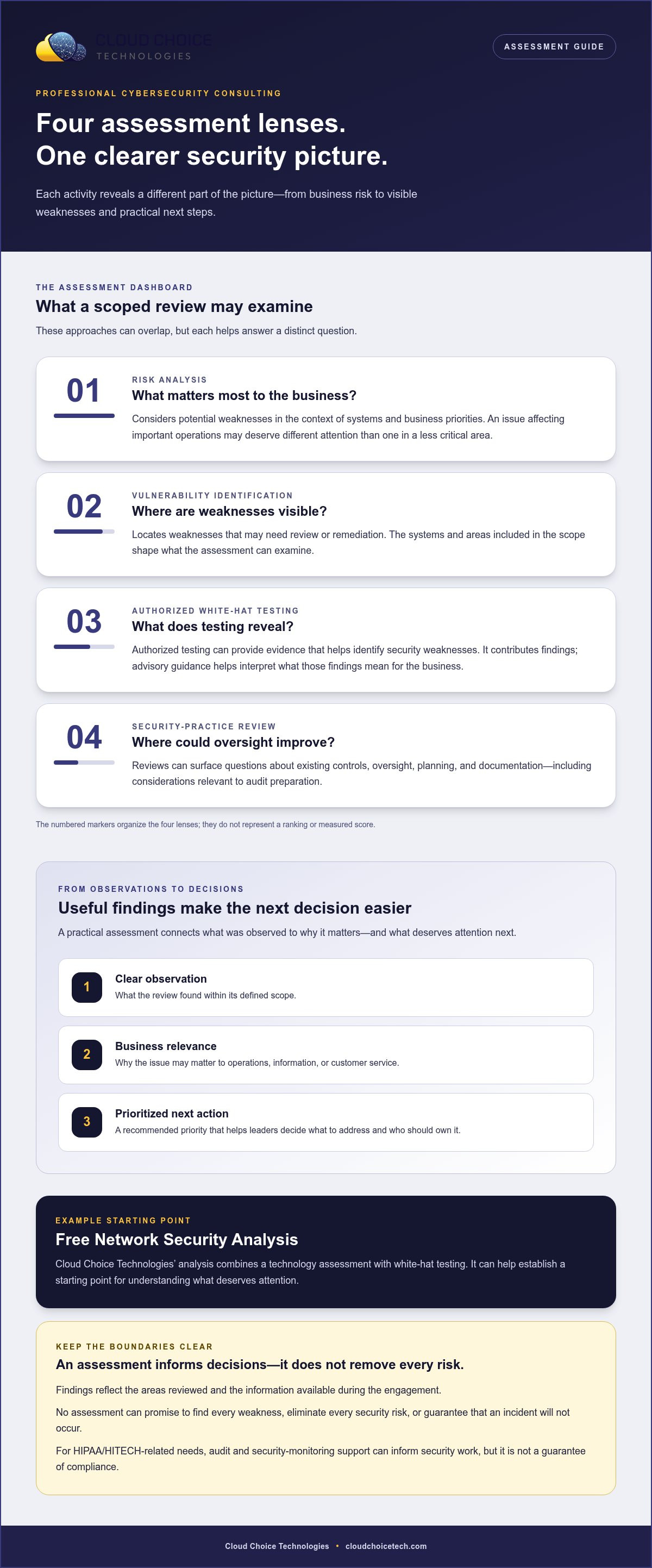
A well-scoped assessment connects technical observations to business decisions. Professional cybersecurity consulting may examine risk, identify vulnerabilities, conduct testing, and review security practices. These activities can overlap, but each answers a different question: What matters most to the business? Where are weaknesses visible? What does testing reveal? And where could oversight improve?
Risk analysis and vulnerability identification
Risk analysis considers potential weaknesses in the context of the systems and business priorities involved. A concern affecting a system that supports important operations may call for different attention than an issue in a less critical area. The aim is to give decision-makers a reasoned basis for prioritizing work, not simply a list of technical findings.
Vulnerability identification locates weaknesses that may need review or remediation. No assessment can promise to find every weakness, so scope matters: buyers should understand which systems and areas are included. The CISA Cybersecurity Assessments resource offers government guidance on assessment considerations.
Testing and broader advisory work
White-hat testing is authorized testing designed to help identify security weaknesses. It differs from broader advisory work, which can interpret findings, consider their relevance to business priorities, and help leaders decide what to address. Testing can contribute evidence; advisory guidance helps turn that evidence into a practical direction.
Cloud Choice’s free Network Security Analysis combines a technology assessment with white-hat testing. It can provide a starting point for understanding what deserves attention. Related cybersecurity services include vulnerability identification and ransomware protection.
Security practices, monitoring, and useful findings
A review of security practices can surface questions about oversight, existing controls, and planning. For regulated industries, Cloud Choice’s HIPAA/HITECH offering includes proprietary audit and security-monitoring solutions. This support can inform security work, but it doesn’t guarantee compliance.
Useful findings should make the next decision easier. Look for clear observations, an explanation of their business relevance, and recommended priorities. For example, a finding should help leaders understand what issue needs attention and why, rather than rely on technical language alone. The exact deliverable depends on the engagement’s scope.
How to evaluate a cybersecurity consulting engagement
A useful engagement starts with business questions, not a generic checklist. Professional cybersecurity consulting should make clear what the review covers, how findings will be explained, and how your team can use them to decide what happens next. Agree on those points before assessment work begins.
Questions that clarify scope and business priorities
Work through the scope in a practical order. First, state the business concern, such as uncertainty about access controls or a need to understand a known vulnerability. Then define the systems and business processes that matter most. Agree on which activities are included, such as vulnerability identification, white-hat testing, or a compliance-related review, and which are outside the engagement.
Set expectations for communication, too. Decision-makers need plain-language explanations of business impact, while technical staff may need enough detail to understand the observation and plan a response. A framework such as the NIST Cybersecurity Framework can provide a reference point for organizing cybersecurity discussions, but the engagement should still reflect your organization’s needs and scope.
Turning findings into an actionable security plan
After the assessment, sort recommendations by urgency, business impact, and practical ownership. You don’t need an invented score to make priorities clear. Ask what should be addressed promptly, who can own the next step, and what decisions require leadership input. Separate immediate remediation choices from longer-term technology planning so urgent needs don’t get lost in a broad roadmap.
A structured vCIO and vCISO engagement can help connect security findings with risk management and executive guidance. For each recommendation, look for a clear explanation of the issue, why it matters to the business, and a feasible next action. If a proposed action depends on resources or a technology decision, make that dependency visible before assigning a deadline.
Close the review by assigning an owner and deciding how progress will be revisited. This turns assessment findings into managed work rather than a report that sits untouched. To establish a practical starting point, request Cloud Choice’s free Network Security Analysis, a technology assessment with white-hat testing, through its cybersecurity services.
Start with Cloud Choice’s free Network Security Analysis
Moving from a security concern to a decision doesn’t have to mean committing to a broad program before you understand what needs attention. Start by naming the concern, clarifying what an assessment examines, reviewing the findings, and deciding which next steps fit your business priorities. That sequence keeps the conversation focused and helps leaders act on evidence rather than guesswork.
What the free Network Security Analysis offers
Cloud Choice’s free Network Security Analysis includes a technology assessment with white-hat testing. It offers a practical starting point for examining your technology environment and understanding security concerns. It isn’t a guarantee that every weakness will be found or that the organization will become completely secure.
Use the findings to guide a focused discussion. Which observations matter most to daily operations? Which deserve further review? Are there compliance-related concerns that call for additional planning? The answers can help determine whether the next step involves remediation, broader compliance planning and risk management, or another area of security work. Recommendations should follow from the assessment, not be assumed in advance.
Choose a practical next step after the assessment
Review the findings with both business decision-makers and the people responsible for technology. Translate each relevant observation into a clear question: What business process could it affect? Does it require action now, or should it be included in longer-term planning? Who should own the next decision? This keeps the discussion grounded in operational needs and helps prevent recommendations from becoming a disconnected technical to-do list.
Cloud Choice’s Cyber Security & Protection addresses concerns such as ransomware protection, vulnerability identification, and data privacy. The right follow-up depends on what the analysis brings into focus. Findings can inform practical priorities, but they don’t guarantee a particular remediation outcome or compliance result.
If you’re ready to establish a clearer view of your security concerns, request Cloud Choice’s free Network Security Analysis. It’s a straightforward first step toward understanding your technology environment and choosing informed next actions.
Make your next security decision with confidence
Security planning works best when it stays connected to the realities of running your business. Use what you’ve learned to bring the right decision-makers into the conversation, focus on the uncertainties that matter most, and keep security priorities grounded in operational needs. Professional cybersecurity consulting can help make that conversation clearer, but lasting progress comes from treating security as an ongoing business responsibility rather than a one-time exercise.
You don’t need to solve every concern at once. Choose a sensible starting point, understand what deserves attention, and build from there. A clearer view can help your team move forward with purpose, without overstating what any assessment can guarantee.
Request your free Network Security Analysis to take the next step toward informed security decisions. A calm, practical start can give your business a stronger basis for what comes next.
Frequently Asked Questions
What does a professional cybersecurity consultant do?
A professional cybersecurity consultant helps leaders interpret security concerns and decide how they relate to business operations. For example, if a company has added systems or changed how employees access information, a consultant can help clarify which concerns deserve review and what decisions may follow. This guidance supports, not replaces, business ownership of security decisions. Cloud Choice’s cybersecurity services address business security needs.
Is cybersecurity consulting different from penetration testing?
Yes. Penetration testing is a form of authorized testing focused on identifying weaknesses; consulting can address broader questions about risk, priorities, and security practices. Testing may be included in a consulting engagement, but the two terms aren’t interchangeable. A business seeking a broad view should define whether it needs testing alone or a wider review that connects technical observations with decisions and planning.
Can cybersecurity consulting guarantee HIPAA or HITECH compliance?
No. Consulting or assessment work can inform an organization’s security and compliance efforts, but it can’t guarantee HIPAA or HITECH compliance. Cloud Choice offers proprietary audit and security-monitoring solutions for regulated industries. Businesses should treat those tools as support for ongoing oversight, not as a substitute for evaluating applicable requirements, maintaining appropriate practices, and addressing issues as they arise.
What should a cybersecurity assessment cover?
The scope should reflect the organization’s concerns and the technology it wants reviewed. A business changing how it stores or accesses information, for instance, may want the assessment to clarify which systems are included and whether vulnerability identification or testing is part of the work. It should also explain what falls outside scope, so decision-makers understand what the findings can and can’t tell them.
How can a business use cybersecurity consulting findings?
Use findings to make decisions, not simply to create a record of issues. For each observation, identify the business process it may affect, determine whether action is needed, and assign an appropriate owner. Then separate work that needs near-term attention from items that belong in longer-term planning. This approach gives leaders a way to track follow-through while keeping recommendations connected to business operations.
Does Cloud Choice offer a free cybersecurity assessment?
Yes. Cloud Choice offers a free Network Security Analysis that includes a technology assessment with white-hat testing. It can help a business begin examining security concerns, but it doesn’t guarantee that every weakness will be identified or that the organization will be fully protected. To request the analysis, use Cloud Choice’s Network Security Analysis request page.