
CMMC Compliance Readiness for Contractors: Assessment Needs
CMMC compliance readiness for contractors means preparing to meet the cybersecurity requirements tied to Department of Defense contract work. The program has three levels, and the applicable requirements depend on whether a contractor handles Federal Contract Information or Controlled Unclassified Information. Readiness takes more than completing a checklist: safeguards and supporting evidence need to match the required level.
Before investing time in an assessment, first identify which requirements apply to your organization and what an evaluator will expect to review. Preparing in advance can expose security gaps and documentation needs before they affect contract planning.
This article explains what CMMC compliance involves, which contractors and suppliers may need to meet the requirements, and how the three levels differ. It also outlines what an assessment examines and how readiness support can help organize the work.
Key Takeaways
- Identify the information your contract involves to understand which CMMC level may apply.
- Prepare for assessment by organizing security documentation and evidence that shows how controls work in practice.
- Understand how the three levels differ, including the role of policies, a System Security Plan, and remediation planning.
- Account for subcontractor and external service provider requirements when managing the flow of sensitive information.
- Professional IT and cybersecurity support can help assess risks and organize readiness work before an assessment.
What is involved in a CMMC assessment?
A CMMC assessment evaluates whether an organization meets the cybersecurity requirements assigned to its contract. CMMC compliance readiness for contractors starts with mapping those requirements to the systems, safeguards, and evidence used in daily operations.
Professional Readiness Planning and Scoping
Professional planning defines the assessment boundary, including the people, systems, locations, and workflows handling contract information. According to the Electronic Code of Federal Regulations, the CMMC program is implemented through 32 CFR Part 170 and the 48 CFR rule. A readiness review maps applicable requirements to the organization’s environment, identifies shared systems, and clarifies which documentation and evidence the assessment will examine.
Professional Internal Readiness Assessments
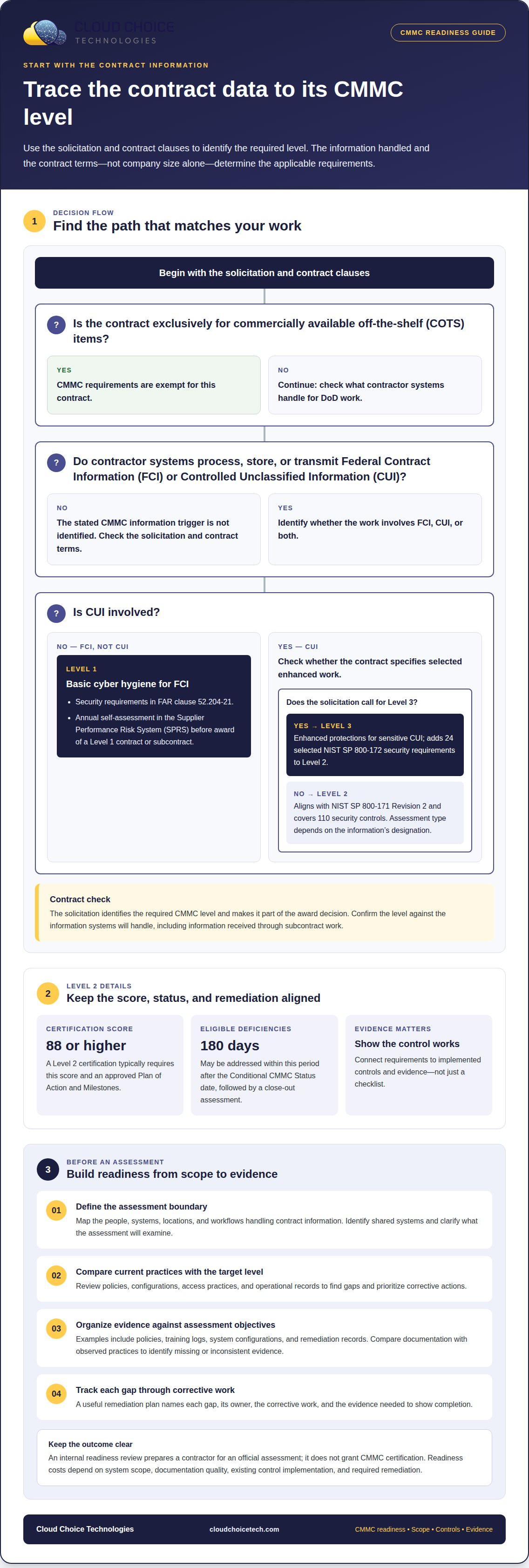
An internal readiness review compares current practices with the requirements for the organization’s target level. A professional can review policies, configurations, access practices, and operational records to identify gaps and prioritize corrective actions. This prepares a contractor for an official assessment but does not itself grant CMMC certification. A useful remediation plan names each gap, its owner, the corrective work, and the evidence needed to show completion.
Professional Support for Level 2 Self-Assessments for CUI
For Level 2 organizations handling controlled unclassified information, professional support can map applicable NIST SP 800-171 requirements to implemented controls and evidence. A readiness professional can help organize assessment records, identify unmet requirements, and document corrective work. This structured approach makes CMMC compliance readiness for contractors more precise by tying each requirement to implementation and documentation. According to the Electronic Code of Federal Regulations, eligible Level 2 deficiencies may be addressed within 180 days of the Conditional CMMC Status date, followed by a close-out assessment.
Professional Evidence Collection and Compliance Documentation
Evidence collection links each requirement to proof that a control is documented and operating. Examples include policies, training logs, system configurations, and remediation records. A professional can organize materials against assessment objectives, identify missing or inconsistent evidence, and track corrective actions. Comparing documentation with observed practices helps pinpoint gaps and clarify what evidence will demonstrate remediation.
Level 3 assessments address enhanced protections for sensitive CUI. According to the National Institute of Standards and Technology, Level 3 includes 24 selected NIST SP 800-172 security requirements in addition to Level 2 requirements. This added scope calls for a careful review of the systems and evidence included in the assessment boundary.
Readiness costs depend on system scope, documentation quality, existing control implementation, and the remediation required. An estimate should separate assessment preparation from technical changes needed to address identified gaps.
Who must meet CMMC requirements?
The required CMMC level depends on the information handled for Department of Defense work and the contract’s terms. CMMC compliance readiness for contractors begins by matching those terms to the systems and work involved.
Determining the Required CMMC Level
Start with the solicitation and contract clauses. Identify whether the work involves Federal Contract Information (FCI), Controlled Unclassified Information (CUI), or both. CMMC applies to covered Department of Defense contracts when contractor systems process, store, or transmit FCI or CUI. The required level depends on the information and contract requirements, not company size alone. Contracts exclusively for commercially available off-the-shelf items are exempt.
Level 1 Requirements for Federal Contract Information
Level 1 applies to organizations handling FCI but not CUI. Its focus is basic cyber hygiene and the security requirements in FAR clause 52.204-21. Contractors at this level submit an annual self-assessment in the Supplier Performance Risk System before award of a Level 1 contract or subcontract. For CMMC compliance readiness for contractors, this means documenting the applicable status before pursuing covered work.
Solicitations and Contractor Level Requirements
The solicitation identifies the required CMMC level and makes it part of the award decision. Compare that level with the information contractor systems will handle, including information received through subcontract work. A subcontractor’s role and access can affect the applicable requirements. Contract terms also help teams schedule remediation and align completion with award conditions.
Level 2 aligns with NIST SP 800-171 Revision 2 and covers 110 security controls. It applies to organizations handling CUI, with assessment type depending on the information’s designation. A Level 2 certification typically requires a score of 88 or higher and an approved Plan of Action and Milestones. The score and any documented corrective actions therefore matter alongside control implementation.
CMMC 2.0 has three levels, with requirements reflecting the information and protection needs involved. Level 1 addresses FCI, Level 2 addresses CUI, and Level 3 adds enhanced requirements for selected work. Contractors should align their cybersecurity practices and compliance status with the level specified in the contract.
If a required level is a condition of award, failing to meet it means that condition is unsatisfied. Misrepresenting compliance can put contract eligibility at risk, so accurate assessment results and status records matter.
What are the CMMC levels?
CMMC 2.0 uses three levels to match cybersecurity expectations to contract work. For organizations preparing for a particular level, the practical challenge is making policies and system records reflect how employees actually handle information. A document can describe a control, but consistent procedures and clear ownership show how the program works day to day.
Policies set expectations for security decisions. A practical policy explains who approves access, how exceptions are handled, and what employees should do when procedures change. For example, an access-control policy should clearly assign approval and review responsibilities. Training and operational processes help staff follow those expectations consistently, rather than relying on policy text alone.
A System Security Plan (SSP) should be a maintained record of the organization’s security environment. It can describe systems and help teams understand how components relate, where responsibilities sit, and which changes affect the documented approach to security. When a system, workflow, or responsible role changes, reviewing the SSP helps keep it current and prevents conflicting records.
A Plan of Action and Milestones (POA&M) serves a different purpose: it records planned work for eligible deficiencies. Make the record useful by linking each action to its dependencies, decision points, and completion evidence. For example, if a corrective measure depends on a system change, reflect that dependency in the timeline. Close an item only when there is evidence that the corrective work is complete.
These documents should support one another without duplicating content. The policy sets expectations, the SSP describes how the organization implements them, and the POA&M tracks eligible corrective work. Comparing the records with current practices can reveal contradictions, such as a policy requiring an approval step that employees do not follow. Resolving these mismatches strengthens the reliability of the compliance record.
Level 3 adds a distinct layer of requirements. According to the National Institute of Standards and Technology, CMMC Level 3 includes 24 selected NIST SP 800-172 security requirements in addition to Level 2 requirements. Organizations working toward that level should ensure their security program and supporting records accurately reflect its enhanced scope.
Version control matters, too. Assign someone to maintain each document, record significant revisions, and make current procedures accessible to the people who use them. This helps policies, system descriptions, and corrective-action records stay consistent as systems and responsibilities change.
Subcontractor and external service provider requirements
CMMC obligations can extend through the supply chain when contract information is shared with subcontractors or service providers. Prime contractors need a clear picture of supplier roles, information access, and readiness before award.
NIST SP 800-171 Control Requirements
Suppliers supporting work involving CUI need controls that protect the systems and information within their role. Technical safeguards can include firewalls, antivirus, multifactor authentication, encryption, monitoring, and logging. Connect each safeguard to the systems it protects and identify who maintains it. This makes shared responsibilities clear when a supplier’s environment supports a prime contractor’s work.
A prime contractor must ensure subcontractors meet or exceed the contract’s required CMMC certification level before award. The contract sets the required level and timing, so suppliers should align preparation with its award conditions. The prime can map which suppliers support the work, what information they receive, and which systems they use. This makes supplier readiness part of contract planning, rather than a last-minute administrative task.
FCI and CUI Protection Requirements
Protection needs follow the information a supplier handles and the contract requirements. What cybersecurity controls are required for CMMC Level 1 and Level 2? Level 1 calls for basic cybersecurity safeguards, while Level 2 requires safeguards for CUI, including technical measures such as multifactor authentication, encryption, monitoring, and logging. The precise requirements depend on the applicable contract level and information.
External service providers that handle, process, store, or transmit CUI generally must achieve at least CMMC Level 2. A provider’s role matters even if it does not perform the contract’s central work. For example, a service that stores contract information may affect how the organization defines responsibilities and plans for assessment. The contractor should account for that handling in its system and supplier records.
Supplier readiness also requires coordination. Before award, prime and subcontractor teams can clarify access boundaries, responsibility for security tasks, evidence ownership, and remediation timelines. If a supplier’s system or service changes, review whether information flows or assigned responsibilities have changed as well. Clear records help everyone understand who protects each system, maintains evidence, and addresses gaps affecting contract work.
Cloud Choice Technologies
Cloud Choice Technologies helps contractors translate CMMC requirements into practical security and technology work. Managed IT Services, Cybersecurity, Remote Support, and Cyber Risk Analysis can support organizations as they assess system risks, address technical gaps, and manage their technology environments.
Consider support when a solicitation identifies a CMMC level, a supplier relationship changes which systems handle contract information, or an internal review reveals unresolved gaps. A focused discussion can connect contract requirements with your systems, users, and information flows. That context helps set readiness priorities while keeping preparation distinct from an official certification assessment.
Managed IT Services can help contractors manage the technology that supports their security practices. For example, a contractor may need clearer oversight of user accounts, devices, network settings, or system changes. Comparing those operational details with documented requirements helps reveal where controls need attention and where procedures need more consistent implementation.
Cybersecurity support can address technical protections and gaps found during readiness work. Cyber Risk Analysis can help assess organizational risks and prioritize issues affecting systems that handle federal contract information or controlled unclassified information. This gives decision-makers a clearer basis for planning remediation, assigning responsibility, and aligning security improvements with the applicable CMMC level.
Remote Support can help address technology issues across a contractor’s working environment, while Managed IT Services can help manage systems that support ongoing operations. These services are useful when security work involves multiple users, endpoints, or connected systems. The aim is practical alignment: security measures, system configurations, and business processes should support the requirements relevant to the contract.
Cloud Choice Technologies can help contractors structure readiness work, from understanding risk areas to coordinating technology improvements. If your organization is preparing for a CMMC assessment or has identified compliance gaps, contact Cloud Choice Technologies to discuss the next step.
Frequently Asked Questions
What is CMMC compliance?
CMMC compliance is a contractor’s maintained status under the cybersecurity requirements applicable to its defense work. For Level 1 and Level 2 self-assessment status, annual affirmations must be entered in the Supplier Performance Risk System (SPRS). A past assessment or completed security project alone does not keep status current. Contractors need to maintain accurate records and affirm compliance on the required schedule as contract work continues.
What Is CMMC Readiness?
CMMC readiness is ongoing, not a one-time document exercise. A system change, new supplier, or shift in access to contract information can affect the compliance picture. A readiness review can compare current operations with existing records and flag changes that need attention. This helps organizations keep security practices aligned between formal assessments, rather than preparing only when a contract milestone approaches.
What are the most critical CMMC control families?
The priorities depend on the organization’s systems and risks, but several NIST SP 800-171 families warrant close attention: Awareness and Training, Audit and Accountability, Identification and Authentication, and System and Communications Protection. Together, they address workforce practices, activity records, identity verification, and protected communications. NIST SP 800-171 divides its requirements into 14 control families, so organizations should assess the full applicable set rather than treating a few priorities as a substitute.
Are CMMC costs allowable?
Some CMMC expenses may be allowable indirect costs, but allowability depends on the expense and its relationship to the contract. Keep records explaining the work performed, its business purpose, and how costs were allocated. An RPO can help identify which costs may qualify. Treat this as a cost-accounting question, separate from deciding which technical improvements or readiness activities the organization needs.
Do organizations also need to be compliant with DFARS 252.204-7012 and 7019?
Yes, when those clauses apply to the contract, CMMC does not replace their separate obligations. In particular, NIST SP 800-171 obligations under DFARS 252.204-7012 remain in force during the CMMC Phase 1 pause. Organizations should account for applicable clause requirements in their existing compliance processes, rather than waiting for a CMMC assessment to address them. The contract terms determine which duties apply to the work.
Does CMMC flow down to subcontractors?
Yes. A prime contractor should include the required level in subcontract planning and track supplier readiness against the award timeline. Practical steps include identifying which subcontractors receive contract information, recording who owns relevant security responsibilities, and coordinating changes when supplier access or services shift. This keeps supply-chain responsibilities visible and helps avoid discovering late that a supplier’s role affects contract readiness.