
Cloud Security Management for Small Business: 2026 Guide
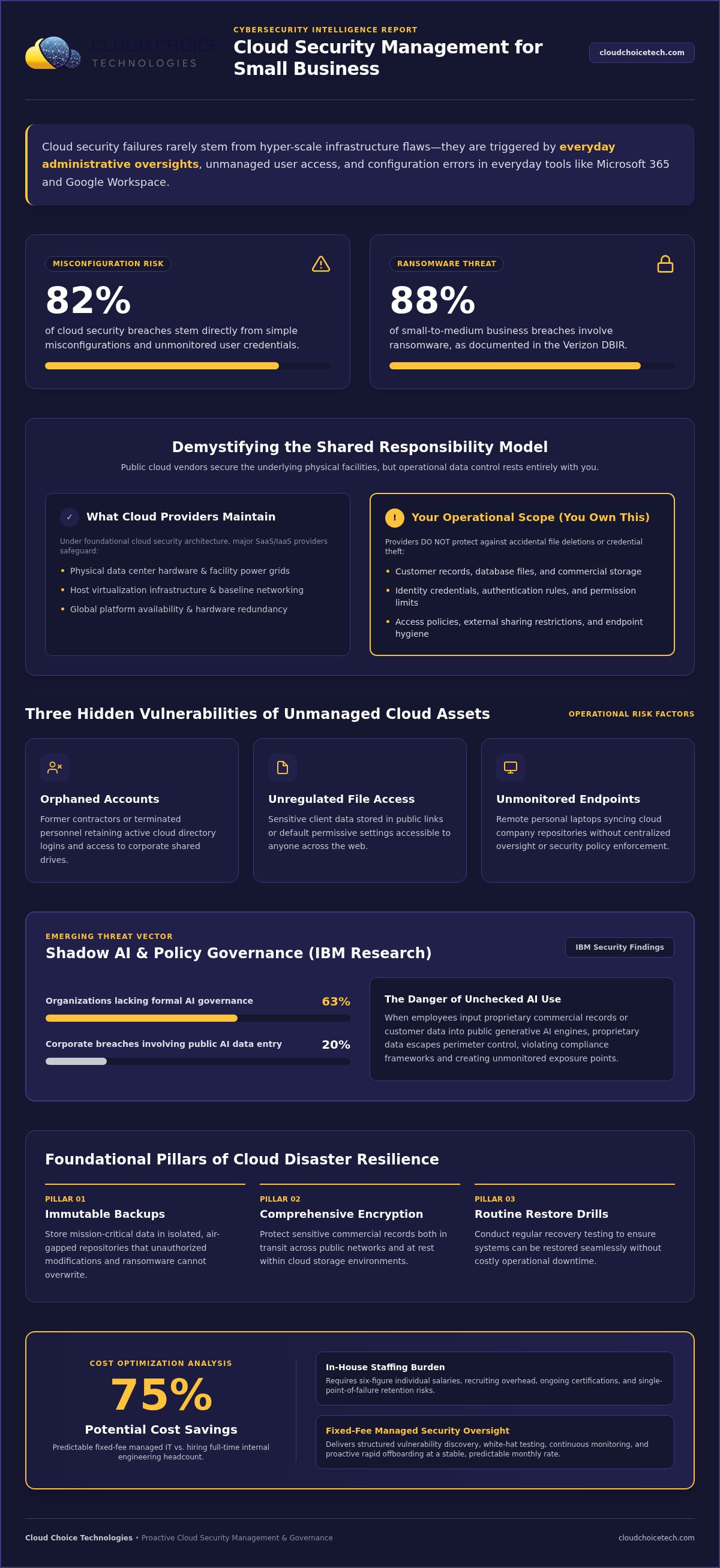
Cloud security doesn't fail because hyper-scale infrastructure is weak; it fails because of everyday administrative oversights. If you run a growing company, it's easy to assume platforms like Microsoft 365 or Google Workspace automatically safeguard your data. In reality, tracking sensitive files across remote teams often feels like a stressful guessing game, especially when you don't have the budget for an internal security team. Mastering effective cloud security management for small business has become essential, particularly with 82% of cloud breaches stemming from simple misconfigurations and unmonitored user credentials.
You don't have to face digital threats blindly or risk catastrophic regulatory fines. In this guide, you will learn how to pinpoint hidden vulnerabilities across your cloud storage, prevent costly ransomware intrusions, and meet rigorous industry compliance standards. We also explore how selecting a predictable, fixed-fee management model delivers complete operational oversight without adding six-figure internal headcount. Here is your roadmap to taking total control of your cloud environment and keeping your business secure.
Key Takeaways
- Understand the operational scope of cloud security management for small business, shifting your focus from underlying cloud infrastructure to active data governance and user access.
- Implement the core pillars of proactive defense, including multi-factor authentication, rapid credential revocation, and immutable backup systems.
- Compare real deployment costs to see how a predictable, fixed-fee managed IT model can deliver savings of up to 75% compared to hiring in-house technicians.
- Execute a structured four-step defense roadmap that starts with comprehensive vulnerability discovery and white-hat testing to eliminate hidden security blind spots.
What Is Cloud Security Management and Why Do Small Businesses Need It?
Cloud security management is the continuous administrative oversight of cloud applications, user permissions, and digital assets to prevent unauthorized system access and guarantee operational continuity. Many enterprise guides focus heavily on developer code pipelines and complex container clusters. However, effective cloud security management for small business centers on securing everyday corporate tools: Microsoft 365, Google Workspace, hosted Exchange email, and shared file servers.
A widespread misconception assumes that moving operations to Microsoft or Google eliminates cyber risk. This is dangerously incorrect. Under foundational cloud computing security concepts, platforms maintain the physical hardware, host virtualization, and power grids. Securing your customer records, configuring identity credentials, and enforcing access rules remain entirely your operational responsibility.
Demystifying the Shared Responsibility Model for Growing Teams
Cloud providers maintain the platform, but you own the data. Major SaaS platforms do not back up your files against accidental user deletion or targeted ransomware attacks. In standard administrative portals, default configurations often leave external file sharing completely open and bypass basic access restrictions. If an employee clicks a credential-harvesting link, public cloud infrastructure simply processes the attacker's authorized entry without question.
The Hidden Cost of Unmanaged Cloud Assets and Data Sprawl
Unmonitored cloud environments trigger severe business disruptions. Unmanaged user sprawl quickly accumulates risk:
- Orphaned employee accounts: Former contractors or terminated staff retain active logins to cloud file shares.
- Unregulated file access: Sensitive client records sit in public links accessible to anyone on the web.
- Unmonitored endpoints: Remote personal laptops sync corporate data without centralized device oversight.
System downtime and extortion payouts cripple cash flow. The Verizon Data Breach Investigations Report reveals that 88% of small-to-medium business breaches involve ransomware. Left unmanaged, administrative oversights also invalidate corporate cyber insurance policies, leaving your organization to absorb emergency forensics expenses and compliance liabilities entirely alone.
Core Pillars of Effective Small Business Cloud Security Management
Executing robust cloud security management for small business requires moving past reactive troubleshooting. Instead, you need a disciplined framework built around proactive oversight. Aligning your internal controls with established guidance from the NIST Small Business Cybersecurity Corner helps your organization construct an elite, layered defense across four vital domains: identity access, resilient data storage, continuous threat monitoring, and policy governance.
Identity Governance, Access Control, and Zero-Trust Principles
Compromised credentials cause catastrophic breaches when user permissions remain unchecked. Adopting Zero-Trust principles means verifying every user and device explicitly before granting access. Enforce role-based access control so team members only view the specific customer files their daily jobs require. Enforce multi-factor authentication across your entire operational footprint, and establish automated offboarding protocols that revoke credentials within minutes of staff turnover to stop lateral intrusions.
Data Encryption, Redundancy, and Cloud Disaster Recovery
Simple cloud file synchronization does not equal a true disaster recovery plan. If ransomware hits a synced laptop, it encrypts your cloud repository seconds later. True resilience demands secure operational separation:
- Immutable cloud backups: Store mission-critical files in isolated, air-gapped repositories that unauthorized modifications cannot overwrite.
- Comprehensive encryption: Protect sensitive commercial records both in transit across public networks and at rest within cloud storage.
- Routine restore drills: Test full system recoveries regularly to guarantee zero operational downtime during a crisis.
AI Security and Employee Policy Management
Shadow AI represents an urgent, unmonitored blind spot for growing teams. According to IBM findings, 63% of organizations lack formal AI governance, and 20% of recent corporate breaches involved staff entering proprietary records into public AI tools. Establishing strict acceptable use guidelines prevents sensitive data leaks into external language models.
Partnering with dedicated AI consulting experts helps you monitor employee tool adoption while securing intellectual property. When paired with end-to-end cybersecurity solutions, proactive policy enforcement keeps your organization fully protected against emerging attack surfaces.
Evaluating In-House Security vs. Managed IT and Security Providers
Deciding how to resource your digital defenses represents a major operational crossroad. When planning cloud security management for small business, leadership teams often weigh hiring dedicated internal engineers against partnering with an outside managed security provider. Aligning your strategy with the industry-standard CSA Security Guidance for Cloud Computing requires round-the-clock administration, continuous threat containment, and specialized tooling. Achieving that internally places immense financial strain on a growing organization.
The True Cost of Building an Internal Cybersecurity Team
Hiring internal technical staff quickly drains capital. A single qualified security engineer commands a high six-figure salary, before factoring in benefits, continuous certification training, and enterprise software licenses. More dangerously, a lone technician creates a critical single point of failure. If that employee gets sick, takes vacation, or abruptly resigns, your operations are left entirely unmonitored. Without an entire team to analyze alerts around the clock, expensive software dashboards end up sitting unused.
Why Predictable Fixed-Fee Managed Services Deliver Superior ROI
Outsourcing your operational defense replaces unpredictable expenses with measurable cost certainty. A collaborative managed model grants access to an entire team of senior engineers for a fraction of the cost of one full-time hire. Consider the operational savings:
- Substantial internal staffing savings: Fixed-fee managed IT can deliver savings of up to 75% compared with hiring in-house technicians.
- Contractor rate efficiency: For an environment with four servers and 30 computers, fixed-fee managed IT delivers savings of 40% versus hourly technical contractors.
- Predictable monthly billing: Routine system maintenance, active user monitoring, and helpdesk support remain covered under one stable rate, eliminating billable surprise hours.
To evaluate operational structures further, read our guide to managed IT services.
Compliance Confidence for Healthcare and Regulated Sectors
Navigating strict mandates like HIPAA and HITECH requires rigorous, ongoing validation. Generic cloud setups consistently fail regulatory audits without continuous oversight. Proven partners deploy proprietary audit and security-monitoring solutions engineered specifically for complex compliance frameworks, ensuring every access log and encrypted file meets federal standards. Review our executive briefing on regulatory compliance IT support, and connect with our security specialists today to secure your operations.
How to Build a Resilient Cloud Security Strategy for Your Business
Transforming your operational defense requires a methodical roadmap. A successful strategy for cloud security management for small business eliminates guesswork by following four progressive stages: assessing digital posture, securing user access, enforcing continuous threat monitoring, and maintaining isolated recovery systems. Moving through these stages sequentially establishes total control over your digital perimeter.
Step 1: Baseline Assessment and Asset Discovery
You cannot protect assets you haven't cataloged. Begin by creating a complete inventory of every SaaS platform, cloud server, digital file share, and connected employee endpoint. Audit these systems to identify unpatched software flaws, excessive administrative privileges, and exposed document links. Initiating comprehensive vulnerability assessments paired with professional white-hat testing exposes hidden weaknesses before malicious actors can exploit them.
Step 2: Proactive Hardening and 24/7 Threat Monitoring
Lock down your operational baseline once hidden vulnerabilities are visible. Standardize strict configuration templates across cloud file storage, virtual desktops, and hosted mailboxes. Implement continuous employee security awareness training to turn staff into an active defense against deceptive phishing attempts. Combining real-time threat detection with automated alerting ensures suspicious lateral movement is contained immediately, eliminating catastrophic downtime. For advanced architectural frameworks, explore our guide to business cybersecurity solutions.
Take Action: Secure Your Cloud Environment Today
Leaving administrative configurations unmonitored leaves your business vulnerable to severe operational paralysis and unexpected financial loss. Digital resilience doesn't require endless operational stress or six-figure internal overhead. You can establish elite, always-on protection starting right now. Eliminate technical uncertainty and claim your free Network Security Analysis to identify your critical vulnerabilities and protect your company's future.
Shield Your Critical Assets with Proactive Cloud Oversight
Securing your digital workspace doesn't require endless firefighting or bloated payroll. Implementing effective cloud security management for small business centers on active administrative control: enforcing zero-trust access, isolating immutable backups, and governing internal AI tools before vulnerabilities turn into crises.
Partnering with a dedicated managed IT provider removes the guesswork while protecting your bottom line. You can secure enterprise-grade vigilance, proprietary audit and security-monitoring solutions for HIPAA/HITECH requirements, and deliver savings of up to 75% versus hiring in-house technicians. You don't have to navigate digital uncertainty alone. Take the first step toward lasting operational resilience and claim your free Network Security Analysis today. With comprehensive white-hat testing and vulnerability discovery at zero initial cost, your organization can move forward with complete confidence.
Frequently Asked Questions
Is the cloud automatically secure for small businesses?
No, cloud platforms are not automatically secure out of the box. While providers manage physical server hardware and core facilities, securing your customer records, identity credentials, and access rules remains your responsibility. Relying on default platform settings leaves administrative portals open to unauthorized lateral intrusions and data exposure.
How much does professional cloud security management typically cost?
Costs depend on your infrastructure size, but choosing a predictable model prevents runaway technical expenses. Implementing fixed-fee managed IT can deliver savings of up to 75% versus maintaining full-time in-house technicians. Additionally, an environment with four servers and 30 computers can achieve 40% savings compared to paying variable hourly contractors, giving you comprehensive oversight under a stable monthly rate.
Can an employee using AI tools create security risks for our business?
Yes, ungoverned AI usage introduces serious digital vulnerabilities. When staff paste client records, proprietary intellectual property, or financial figures into unvetted public generative platforms, that sensitive information leaks into external models. Deploying structured cloud security management for small business paired with specialized AI consulting establishes clear usage policies and continuous monitoring to block unauthorized data uploads.
What is the difference between cloud backup and standard cloud storage?
Standard cloud storage simply synchronizes active local files across connected endpoints, meaning corruptions, user errors, or malicious alterations instantly replicate to the cloud repository. Dedicated cloud backup creates isolated, immutable copies of your systems stored in protected environments. If a workstation is compromised, these segregated repositories allow rapid, uncorrupted recovery without operational disruption.
How does cloud security management help our business pass compliance audits?
Professional management establishes continuous visibility and auditable logging across all user accounts and data repositories. Rather than relying on guesswork, organizations implement proprietary audit and security-monitoring solutions engineered for regulated mandates like HIPAA and HITECH. These automated systems log credential usage, enforce encryption standards, and generate documented compliance evidence to verify strict safeguard enforcement.