Achieving SOC 2 Compliance With Managed Provider Support
SOC 2 can help earn customer trust and support new business opportunities, but it isn’t a universal legal requirement. Achieving SOC 2 compliance with a managed provider means preparing documented controls for an independent CPA’s review, with support to keep security practices aligned and evidence organized. The goal is more than a report: it’s a clearer, tested approach to protecting sensitive information.
It’s understandable to see SOC 2 as a complex security exercise. The details matter: a SOC 2 report is an attestation, not a certification, and its value depends on whether the controls address the risks and commitments relevant to your business.
This guide explains why SOC 2 matters, how managed support can help prepare and maintain controls, and how the right compliance framework depends on the data you handle and the obligations that apply to your organization. You’ll also see how Type I and Type II reports differ, why preparation takes planning, and what professional support can do to reduce gaps without losing sight of day-to-day operations.
Key Takeaways
- Understand how an independent CPA review examines SOC 2 controls and how Type I and Type II reports differ.
- See how managed provider support can organize evidence, address control gaps, and support compliance operations.
- Learn why controls need to be documented and tested over time, not simply established on paper.
- Identify which frameworks may apply by considering your services, data, clients, and operating environment.
- Explore how managed IT services, cybersecurity, remote support, and cyber risk analysis can support your compliance efforts.
What are the challenges of achieving SOC 2 compliance in the cloud?
Cloud environments spread controls across applications, infrastructure, staff, and vendors. An independent audit assesses whether those controls address risks related to security, availability, processing integrity, confidentiality, or privacy.
Organizations seeking a SOC 2 audit must engage an independent CPA with relevant experience. The American Institute of CPAs developed SOC 2 standards, but the auditor examines the organization’s actual systems and controls. Certified public accountants review evidence, interview responsible personnel, and assess whether documented procedures match operations. That examination can expose gaps between a written policy and how access, changes, or incidents are handled in practice.
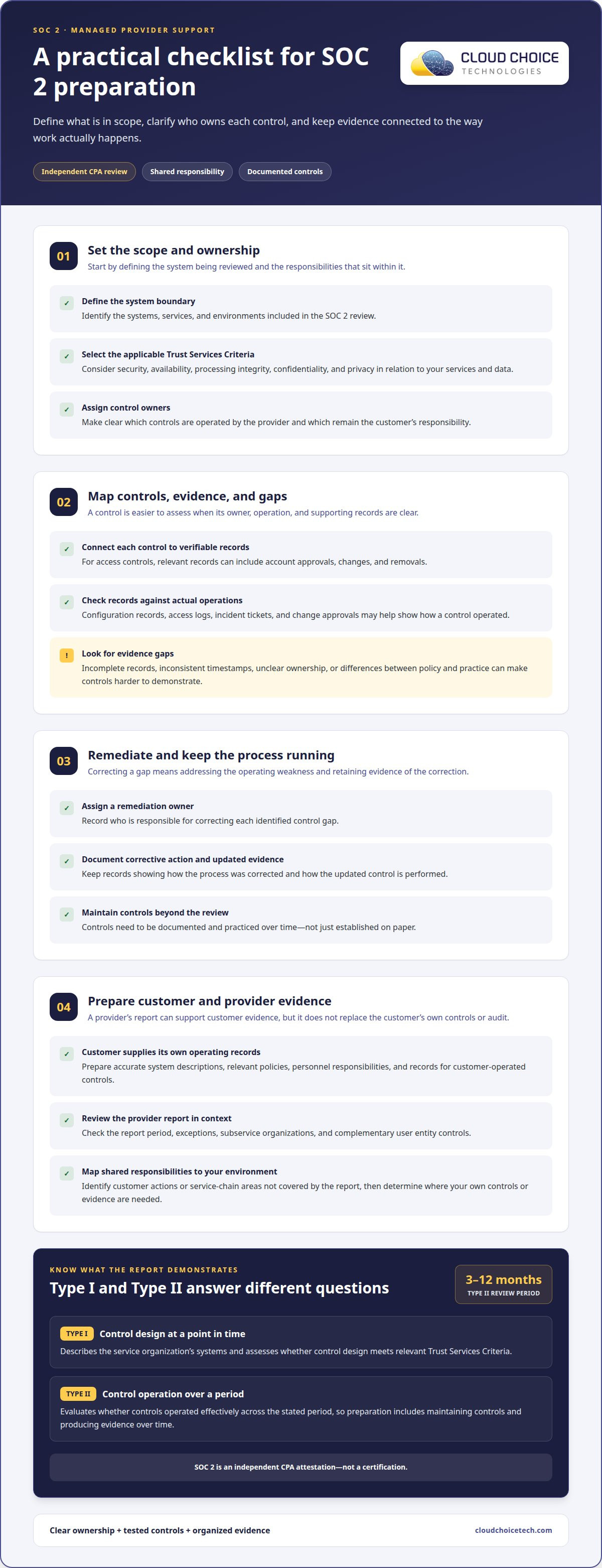
Type I and Type II reports answer different questions. Type I describes a vendor’s systems and assesses whether control design meets relevant trust principles at a point in time. Type II evaluates whether controls operated effectively over a period of three to 12 months. A Type I review can show that controls are designed; a Type II review tests their operation across the stated period.
Evidence must connect each control to verifiable records. For example, an access policy needs records of account approvals, changes, and removals. An auditor may compare configuration records, access logs, incident tickets, and change approvals with the control being tested. Incomplete records, inconsistent timestamps, or unclear ownership make it harder to show that a control operated as described.
Remediation and Ongoing Compliance
Remediation is the work of correcting control gaps and updating the evidence that demonstrates the correction. It matters because an audit finding can point to a weakness in daily operations, not merely a missing document. Teams can assign an owner, record the corrective action, and retain evidence of the updated process. Since Type II examines controls over time, organizations also need to maintain those practices beyond the auditor’s review.
Reviewing a Provider’s SOC 2 Report
A managed provider can help interpret a provider’s SOC 2 report against the services your organization uses. This review examines the report period, exceptions, subservice organizations, and complementary user entity controls, which identify responsibilities assigned to the customer. These details matter because a report may describe controls that depend on customer actions or exclude parts of the service chain. Mapping each responsibility to your environment helps reveal where additional controls or evidence are needed.
SOC 2 compliance support from a managed services provider
A managed services provider can help organize control ownership, evidence, and remediation across its own operations and customer environments. For organizations achieving SOC 2 compliance with a managed provider, clear responsibility boundaries matter: each organization remains accountable for the controls it operates.
Provider Attestations and Report Types
A SOC 2 report is an independent CPA firm’s attestation about a service organization’s controls, not a certification. Type I describes systems and control design at a point in time; Type II evaluates whether controls operated effectively over a period. The Trust Services Criteria address security, availability, processing integrity, confidentiality, and privacy. These distinctions help customers assess a provider’s ability to support data protection.
For a managed network services provider, a report may describe controls for network access, monitoring, and change management. Its scope and selected criteria determine what the report actually covers.
Shared Responsibility Across Provider Types
Shared responsibility means providers and customers each operate controls in their own environments. Cloud providers generally address controls for the underlying platform, while customers remain responsible for areas such as account permissions and service configuration. Hosting providers may cover facility and infrastructure controls; managed security providers may describe security monitoring and response processes.
Requirements depend on the service, system boundaries, and data involved, not simply the provider’s label. If you use hosted infrastructure and managed security, map each service to its specific control responsibilities.
Using Provider Reports for Customer Compliance
A provider’s SOC 2 report can support a customer’s compliance evidence, but it doesn’t cover the customer’s entire environment or replace the customer’s own audit. The report helps demonstrate controls operated by the service provider. Customers still need evidence for internal processes and complementary user entity controls assigned to them.
Audit and managed compliance costs depend on scope, system complexity, control maturity, and service coverage. Managed-service pricing depends on the case and is provided after a quote request; the independent CPA audit is a separate engagement.
Steps for Compliance With a Managed Provider
Achieving SOC 2 compliance with a managed provider starts with defining the system boundary, applicable criteria, and control owners. The provider can then help map existing controls, identify gaps, coordinate remediation, and organize evidence for the independent CPA. Type II preparation also requires controls to operate and produce evidence throughout the audit period.
The customer provides accurate system descriptions, relevant policies, personnel responsibilities, and records of customer-operated controls. Clear ownership helps prevent gaps between provider activity and internal procedures. Coordinating these details connects technical controls to business practices and supports complete evidence collection.
Reducing risk through tested and documented controls
Tested controls show whether security practices work in daily operations, while documentation makes their operation reviewable. A Type II audit evaluates controls over three to 12 months, so preparation and consistent execution both matter.
Risk Assessments and Control Implementation
A risk assessment identifies threats to systems and data, then informs the controls an organization implements. Controls should address risks in the actual environment, rather than exist only on paper.
For example, a review may identify excessive account access as a confidentiality risk. The organization can define approval and removal procedures, assign an owner, and retain records showing those steps were completed. A managed provider can help map infrastructure and processes to controls and document responsibilities shared with internal teams. This makes gaps easier to address before the audit period begins.
Control Testing and Documentation
Control testing checks whether a documented practice operates as intended, and records preserve the result. Recurring tests can reveal inconsistent execution before it becomes a pattern across the environment.
For example, an access review can compare active accounts with approved roles and record the reviewer, findings, and follow-up. Perform quarterly logical access checks when your policies and procedures require them, and keep quarterly documentation when those procedures require quarterly evaluations. A clear evidence trail links each check to its policy, owner, date, and corrective action.
Observation Period and Ongoing Operation
The observation period is the span in which an auditor evaluates whether controls operated consistently. Type II reports examine operational effectiveness across three to 12 months, unlike Type I reports, which assess control design at a point in time.
Preparing for a SOC 2 audit can take months, and the audit process after preparation can take several weeks. Provider dependencies, missing records, and control gaps can affect the schedule. During the observation period, teams need to keep procedures active and capture evidence as events occur. A policy created shortly before review cannot demonstrate sustained operation across the full period.
Contractual and Regulatory Requirements
Tested and documented controls help organizations demonstrate security practices tied to customer contracts and applicable regulatory requirements. This evidence is useful when clients or partners ask how sensitive information is protected.
Service-based businesses may use SOC 2 evidence to support contractual or regulatory requirements connected to new business opportunities. For example, a contract may require documented access reviews or incident handling. The organization should map each commitment to an owner, operating control, and retained record. This makes gaps visible and helps keep public-facing security claims aligned with actual practices.
Identifying applicable compliance frameworks
Framework selection starts with the data, services, contracts, and locations within an organization’s environment. The American Institute of CPAs developed SOC 2 standards, but SOC 2 is not mandated in the same way as GDPR, which applies to data regarding EU residents.
Separate legal duties from customer expectations and assurance goals. According to the European Union, businesses serving EU citizens must comply with GDPR. Retailers processing credit card transactions must comply with PCI DSS. A service organization may also pursue SOC 2 because clients want evidence of controls protecting sensitive information. These purposes can overlap, but one report does not automatically satisfy every obligation.
- Map data and geography. Record what sensitive data the business handles, where it is stored, and whose information it concerns. For example, serving EU citizens makes GDPR relevant.
- Review contracts and services. Identify client security clauses, the systems supporting each service, and vendor responsibilities. A retailer processing card transactions must account for PCI DSS.
- Define the system boundary. Document which applications, infrastructure, staff, and vendors support the service organization. This establishes what a SOC 2 examination should cover.
- Map obligations to controls. Connect each applicable framework or contract requirement to an owner, operating practice, and evidence record. Flag requirements that lack a control or clear responsibility.
The American Institute of CPAs’ Statement on Standards for Attestation Engagements No. 18 underlies SOC 1, SOC 2, and SOC 3 reports. Their distinct purposes matter: SOC 1 focuses on user data related to financial reporting, while SOC 2 addresses controls relevant to trust principles. Selecting a report begins with the assurance clients need, not simply the vendor’s available documentation.
Use the resulting framework map to clarify priorities. A software service organization handling customer data might assess SOC 2 for client assurance, GDPR for EU residents’ data, and PCI DSS if it processes card transactions. A vendor’s report can inform this assessment, but the organization still needs to map its own systems and commitments. The takeaway is direct: choose frameworks from actual data flows, customer promises, and applicable obligations, then assign controls to each.
Cloud Choice Technologies: Managed IT Services
Cloud Choice Technologies supports businesses seeking steadier IT and security operations while preparing for SOC 2. Its Managed IT Services, Cybersecurity, Remote Support, and Cyber Risk Analysis can help address the systems, security practices, and operational risks that shape compliance readiness. For organizations achieving SOC 2 compliance with a managed provider, this support can help connect technology operations with defined control responsibilities.
Managed IT Services can support the technology environment behind documented controls. Consistent management of business systems can help clarify which assets, users, and processes fall within an organization’s SOC 2 scope. The work should align with the organization’s defined controls and responsibilities. An independent CPA remains responsible for conducting the audit and issuing an attestation report.
Cybersecurity can help organizations address risks involving system protection and sensitive data. Cyber Risk Analysis can identify and prioritize risks across the business environment, helping teams determine where control improvements deserve attention. These offerings can support the practical work of achieving SOC 2 compliance with a managed provider, while keeping risk decisions connected to business operations.
Remote Support can help resolve technology issues affecting employees and business systems. Clear support procedures show how problems are reported, assigned, and resolved. Your organization remains responsible for its policies, business decisions, customer commitments, and complete compliance program. A managed provider can support technology operations, but does not take over that responsibility.
Consider professional support when control ownership is unclear, security gaps need attention, or routine IT work distracts teams from maintaining documented practices. A focused discussion can clarify which systems matter, what risks need priority, and where managed IT or cybersecurity support fits. The objective is practical alignment: technology operations that support controls without suggesting a provider’s services alone achieve SOC 2 or replace independent CPA review.
Explore managed IT services as one part of a broader approach to operational readiness. For support tailored to your organization’s IT and security needs, contact Cloud Choice Technologies.
Frequently Asked Questions
Why is SOC 2 compliance valuable?
SOC 2 can make vendor due diligence more concrete for prospective customers. A procurement team can use the report to examine security information in a structured way instead of relying only on broad assurances. For a service organization, preparing for customer reviews also helps identify which questions repeatedly arise during sales or renewals. The report supports those discussions, though customers may still ask about risks specific to their own services and contracts.
Is SOC 2 the same as being “certified”?
No. SOC 2 produces an attestation report, not a certification. That distinction matters in sales materials, contracts, and security questionnaires: describe the report and its scope accurately rather than presenting it as a general certificate. For example, a vendor can state that it has a SOC 2 Type II report for a defined service. That wording tells reviewers what evidence exists without implying that every system or business activity was examined.
What are SOC 2 Standards?
SOC 2 standards are the basis for evaluating controls relevant to the applicable Trust Services Criteria. The American Institute of CPAs’ Statement on Standards for Attestation Engagements No. 18 underlies SOC reports. In practice, organizations should be prepared to explain how their selected criteria relate to the services described in the report. The standards don’t provide a universal checklist of identical procedures for every company or technology environment.
What does the audit cover?
The audit covers the systems and controls included in its defined scope. A practical question is whether a business service depends on vendors or components outside that boundary. For example, if customer-facing software relies on a separate hosting service, the report’s description and treatment of that dependency affect what you can infer. Review the stated service boundary before using the report to inform a business decision.
What is SOC 2, and what are the SOC 2 trust principles?
SOC 2 is an attestation report framework for evaluating a service organization’s controls against selected Trust Services Criteria. Those criteria cover security, availability, processing integrity, confidentiality, and privacy. The practical question is which criteria reflect the promises made to customers and the service being examined. A company’s industry label alone doesn’t determine that selection; its services, data handling, and customer commitments provide relevant context.
What is SOC 2?
SOC 2 is a report customers can use when reviewing a service provider’s controls. A Type II report is generally treated as confidential and shared under a nondisclosure agreement. That affects how organizations handle requests: access should follow the provider’s sharing terms, and recipients should protect the report as sensitive vendor documentation. A report is most useful when its stated service and scope match the relationship being evaluated.