
How to Pass a Cybersecurity Audit: 2026 Business Guide
What if the biggest audit risk isn’t a missing security control, but being unable to show that it works? If you’re figuring out how to pass a cybersecurity audit, scattered policies, access records, and system inventories can make preparation feel harder than it needs to be. A clear, repeatable process can replace last-minute cleanup with focused preparation.
Audit requirements vary by scope, framework, and requesting party, so first confirm exactly what’s being assessed. Then gather current evidence, check whether controls work as intended, and address gaps before the review. This guide explains how to define the scope, organize records, prepare your team, and follow up on findings. It also covers how a Cyber Risk Analysis can help identify and prioritize potential gaps. Cloud Choice Technologies offers prospects a free Network Security Analysis with white-hat testing. With a structured approach, audit readiness becomes an ongoing business practice, not a scramble when a request arrives.
Key Takeaways
- To understand how to pass a cybersecurity audit, first confirm the reviewer’s scope and criteria. Requirements can vary by framework, contract, and requesting party.
- Give each evidence item an owner, a source, a review date, and a clear link to the requirement it supports.
- Check governance, assets, access, vulnerabilities, backups, and incident processes before the review. Flag controls that need validation.
- Track every finding with its business impact, accountable owner, planned action, and follow-up evidence. Document accepted risks rather than describing them as corrected gaps.
- A Cyber Risk Analysis can help prioritize potential gaps. Cloud Choice offers prospects a free Network Security Analysis with white-hat testing.
What does it mean to pass a cybersecurity audit, and what is actually being assessed?
A cybersecurity audit is a scoped review of an organization’s security controls, processes, and evidence. The auditor checks whether measures within the agreed scope meet defined criteria, not whether the business is immune to every threat. For a neutral overview of an information security audit, see how audits can assess security practices and identify areas for improvement.
Audit readiness means you can explain how relevant controls work and support your explanations with current evidence. It improves preparation, but it cannot guarantee an audit outcome or prove that risk has disappeared. Passing reflects the results of a particular review against its criteria. It is not proof of permanent compliance, since systems, responsibilities, and risks can change after the audit.
Which kind of cybersecurity audit are you preparing for?
The request may come from inside your organization, a customer assessing a supplier, an insurer, or a formal compliance audit. Each can have a different purpose and level of detail. Before gathering records, confirm why the review is taking place, which criteria apply, what systems and teams are included, and how the results must be reported.
Check whether a specific framework, contract, or regulation applies to your business rather than assuming it does. HIPAA/HITECH requirements, for example, are relevant to organizations subject to those rules, not every business. Use the agreed scope as your guide.
What auditors typically need to verify
Auditors may compare written policies with system configurations, records, and staff explanations. A policy describes the intended process. Evidence such as access records or vulnerability review documentation can help show how that process works in practice. Requirements vary, so check requested evidence against the audit criteria.
Common review areas include access management, vulnerability identification, backups, and incident processes. Auditors may ask who can access systems, how security issues are identified, and what steps the organization follows when an incident occurs. A broader business cybersecurity strategy can help connect these controls to business priorities.
A Cyber Risk Analysis can help identify and prioritize potential gaps. Cloud Choice also offers prospects a free Network Security Analysis with white-hat testing. Neither replaces confirming the audit’s specific scope and evidence requirements.
How to prepare for a cybersecurity audit: follow a clear evidence process
Preparation works best as a controlled workflow, not a document hunt. A clear process helps your team respond to each request with relevant, current evidence tied to the audit criteria. ISACA’s discussion of cybersecurity audit benefits also reflects how a review can help organizations understand and improve their security practices.
Start with the audit scope and a control-to-evidence map
Before collecting files, request the audit criteria, covered systems and business units, review period, submission deadlines, and reporting format. Build a tracker that connects each applicable requirement to the control that addresses it, the supporting evidence, an accountable owner, and a status. Mark unclear or potentially inapplicable requests for confirmation. Don’t guess or claim coverage you can’t support.
Collect and validate the evidence before submission
Use a secure, access-controlled repository so evidence stays organized and is available only to people who need it. For every item, record:
- Owner: Who can explain or update the evidence?
- Source: Which system, record, or approved document produced it?
- Review date: When was it last checked for accuracy?
- Requirement: Which audit request or control does it support?
“Audit evidence should show that a control operated during the period under review, not just that a policy exists.” Gather current policies, access reviews, system inventories, vulnerability records, and relevant monitoring evidence. Before submission, check dates, system names, owners, and review periods for consistency. A record from the wrong system or outside the review period may not substantiate the control.
Follow this sequence to keep preparation accountable:
- Confirm scope, criteria, boundaries, and deadlines.
- Assign an owner to each requirement and evidence request.
- Collect and map supporting records to the relevant controls.
- Review evidence for gaps, accuracy, and coverage of the review period.
- Prepare concise responses, noting what is supported and what needs clarification.
For context on how technology support can relate to regulatory obligations, see this regulatory compliance IT support guide. Cloud Choice offers prospects a free Network Security Analysis with white-hat testing to help identify and prioritize potential security gaps before an audit. Explore Cloud Choice’s cybersecurity services.
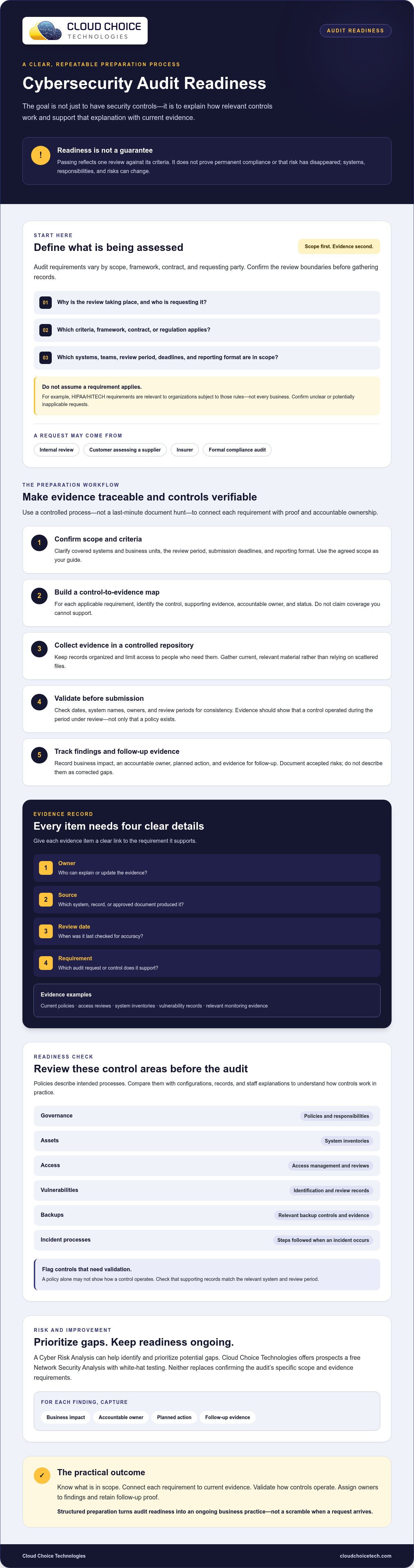
Cybersecurity audit readiness checklist: find gaps before the review
Use this checklist to spot gaps before evidence reaches an auditor. First, confirm which controls and systems fall within the stated scope. Not every item applies to every business or audit. For each control, record an accountable owner and select a status: applicable, not applicable, incomplete, or needing validation against the audit criteria. Explain why an item is marked not applicable, and ask for clarification when requirements are unclear.
- Governance: Do policies and procedures have owners, approval information, and current review dates? Do they describe what staff actually do?
- Asset awareness: Is the system inventory current, assigned an owner, and consistent with the systems included in the audit?
- Access: Are permissions tied to responsible users, and is there evidence of access reviews where required by the criteria?
- Vulnerability handling: Are findings documented with a status, accountable owner, and follow-up evidence?
- Backups: Does available backup and recovery evidence relate to the systems and requirements in scope?
- Incident processes: Do written procedures and records reflect how the business currently identifies, documents, and handles incidents?
Review access, systems, and security operations
Check whether each inventory and access process has a clear owner and a defined review approach. A system list is less useful if no one can confirm whether it is current. For vulnerability findings, look for a traceable status and follow-up, not just an undated list. Review relevant monitoring, ransomware protection, and data-privacy practices only where they apply to the audit scope. Confirm that the evidence supports what the business actually does.
Check documentation, backups, and response records
Compare policy language with day-to-day practice. A polished procedure won’t resolve a gap if staff follow a different process. Check that documents show ownership, approval details, and review dates, then confirm that backup and recovery records match the systems being assessed. Incident records and staff procedures should also align with current responsibilities and actual response steps.
Turn the checklist into a short, actionable gap list: identify what’s missing, who owns the next step, and what evidence will show progress. Cloud Choice’s free Network Security Analysis with white-hat testing can help prospects identify potential security gaps before a review. Request a free Network Security Analysis.
Managing Cybersecurity Audit Findings and Readiness
A finding is a prompt for clear action, not a reason to scramble or overstate your security posture. To understand how to pass a cybersecurity audit, make sure every issue has a documented next step and a way to verify the response. A readiness process can strengthen preparation, but no service provider can guarantee an audit pass or certify ongoing compliance simply by helping you prepare.
Prioritize findings and document corrective action
Record each finding alongside the relevant audit criteria, its potential business impact, an accountable owner, and the planned action. Use the criteria and impact to decide what needs attention first, rather than applying arbitrary risk scores or deadlines. Track milestones, completion evidence, and any remaining limitations so the status is clear to your team and the auditor.
Distinguish among different outcomes. Correcting a control gap means changing the process or control and retaining evidence of that change. If the business formally accepts a risk, document the rationale and accountable decision-maker. Don’t describe the gap as fixed. If a request or requirement is unclear, ask the auditor for clarification and record the response. If a gap can’t be closed before the review, communicate its status, planned action, and supporting context transparently.
Make audit readiness an ongoing operating practice
Schedule recurring evidence reviews and revisit records when systems, access, suppliers, or audit requirements change. Assign owners to keep relevant evidence current and track open issues through completion. Ongoing monitoring and managed IT services can support this work by helping maintain awareness of system changes and security activity. The organization remains responsible for confirming that its evidence meets the audit criteria.
Cloud Choice offers prospects a free Network Security Analysis with white-hat testing to help identify potential security gaps. It’s a preparatory assessment, not a formal audit, a compliance determination, or a promise of an audit pass. Treat any findings as a starting point for prioritizing follow-up with the appropriate owners.
If you’re preparing for a review, request Cloud Choice’s free Network Security Analysis to help identify areas to examine before your next audit.
Build audit readiness into your security routine
Strong audit preparation starts with clarity: confirm the scope and criteria, then connect each requirement to current evidence and an accountable owner. Before submission, check that your documents reflect how controls work in practice. When a review identifies gaps, record the business impact, assign follow-up actions, and keep evidence of progress.
That’s the practical foundation for how to pass a cybersecurity audit, but no preparation process can guarantee a particular result or prove that risk is eliminated. Treat readiness as an ongoing practice. Revisit evidence and open issues as systems, access, and requirements change.
Cloud Choice provides Cyber Risk Analysis, Managed Services, and Compliance Services to help businesses assess and manage security needs. Prospects can request a free Network Security Analysis that includes white-hat testing. It can help identify potential gaps, but it isn’t a formal audit or a promise of a pass.
Request your free Network Security Analysis and take a clear next step toward stronger, more consistent audit readiness.
Frequently Asked Questions
How do you pass a cybersecurity audit?
Prepare by confirming the audit’s scope and criteria, then map each applicable requirement to a control and supporting evidence. Assign owners, check records for accuracy and review-period coverage, and identify gaps before submission. If you’re learning how to pass a cybersecurity audit, remember that organized evidence matters, but it doesn’t guarantee an outcome. Requirements depend on the audit, so clarify unclear requests with the auditor rather than assuming a control applies.
What documents are needed for a cybersecurity audit?
The documents depend on the audit criteria and systems in scope. Common examples include current security policies and procedures, system inventories, access review records, vulnerability findings and follow-up, backup and recovery evidence, and incident response procedures or records. Auditors may also request relevant monitoring evidence, system configurations, or staff explanations. Keep each item current and identify its owner, source, review date, and connection to a specific requirement.
How long does it take to prepare for a cybersecurity audit?
There’s no standard preparation timeline. The effort depends on the audit’s scope, the number of systems and teams involved, the condition of existing evidence, and whether security gaps need attention. A business with current, well-organized records may need less preparation than one that must locate documents, confirm ownership, or validate controls. Start as soon as the audit request arrives, confirm deadlines, and raise unclear criteria early.
Can a business fail a cybersecurity audit?
Yes, a business may receive an unfavorable result if the auditor finds that controls don’t meet the applicable criteria or that the organization can’t provide sufficient evidence. Not every review uses a simple pass-or-fail label. Some reports describe findings, limitations, or areas requiring corrective action. Ask how the requesting party defines an acceptable outcome, and focus preparation on the agreed scope rather than assuming every audit follows the same format.
What happens if a cybersecurity audit finds security gaps?
Document each finding, its business impact, an accountable owner, and the planned response. If a control gap can be corrected, record the action and keep evidence showing what changed. If the business accepts a risk, document that decision and its rationale rather than presenting the gap as fixed. Ask the auditor to clarify any ambiguous requirement, and communicate openly if an issue remains unresolved during the review.
Does a cybersecurity audit guarantee that a business is secure?
No. An audit assesses specified controls and evidence within an agreed scope and review period. It can identify issues, but it can’t prove that a business is free from risk or that every system and future change is secure. Controls and circumstances can change after the review. Continue monitoring relevant security practices, updating evidence when systems or access change, and addressing open issues to support ongoing readiness.