
Data Breach: Executive Incident Response Guide (2026)
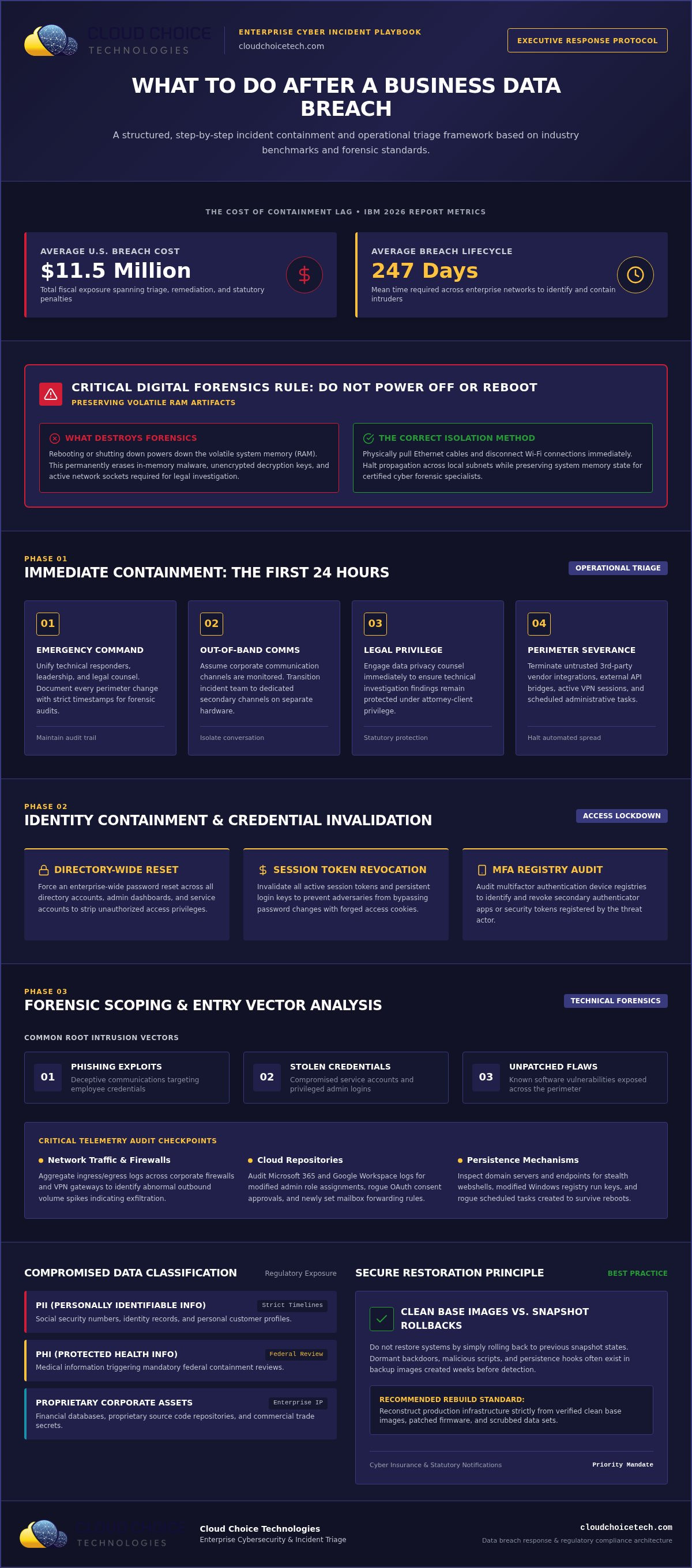
According to IBM's 2026 Cost of a Data Breach Report, the average U.S. breach climbs to $11.5 million, taking an average of 247 days to identify and contain. Knowing exactly what to do after a business data breach demands swift, parallel coordination across operational triage and strict legal compliance, not just a frantic round of password resets.
You're likely confronting the immediate panic of operational downtime, racing against unforgiving notification deadlines, and wondering if your clean system backups are secretly corrupted. That tension is real, but a crisis doesn't have to break your enterprise. With a disciplined protocol, you can quickly regain control of the situation.
Discover the critical, step-by-step incident response playbook to contain cyber breaches, ensure regulatory compliance, and safeguard business continuity. We'll walk through how to isolate persistent intruders across your infrastructure, satisfy rigid reporting windows, and execute a secure system restoration without inviting recurring threats.
Key Takeaways
- Isolate compromised network segments immediately and avoid system reboots to preserve volatile memory evidence required for digital forensics.
- Master what to do after a business data breach by orchestrating a structured incident command center that aligns technical triage with executive decision-making.
- Map lateral threat movement across cloud and on-premise environments to expose root entry points, whether from phishing, stolen credentials, or unpatched vulnerabilities.
- Navigate overlapping regulatory disclosure clocks and notify cyber insurance carriers promptly to protect policy coverage and avoid heavy statutory fines.
- Restore operations securely by rebuilding systems from verified clean base images rather than rolling back to potentially backdoored snapshot states.
Immediate Containment: Critical Steps in the First 24 Hours of a Breach
When an active intrusion occurs, knowing what to do after a business data breach starts with immediate operational triage. While standard business definitions explore what is a data breach from a legal perspective, your technical priority is stopping adversary lateral movement. Establish an emergency command center instantly to unify technical responders, executive leadership, and legal advisors. Document every isolation decision and perimeter change with strict timestamps to satisfy incoming forensic reviews and insurance audits.
Isolating Compromised Endpoints Without Corrupting Digital Evidence
Never power down or reboot a compromised machine. Pull physical Ethernet cables and sever Wi-Fi connections immediately. Powering off a system wipes volatile RAM, destroying critical adversary artifacts like in-memory malware, unencrypted decryption keys, and active network connections. Once devices are segregated from the local subnet, disable scheduled administrative scripts and automated network tasks across your domain controllers to halt automated propagation.
Mobilizing Your Incident Response and Crisis Management Team
Assume your standard internal communication channels are monitored by the intruder. Transition your crisis team to a pre-established, out-of-band communication system on separate hardware. Rapid coordination hinges on three decisive steps:
- Deploy external incident responders and certified cybersecurity engineers to assess root exposure.
- Engage legal counsel specializing in data privacy to place all investigation findings under attorney-client privilege.
- Sever untrusted third-party vendor integrations, external API bridges, and lingering VPN sessions across your perimeter.
Securing Core Credentials and Perimeter Access Controls
Understanding what to do after a business data breach requires decisive identity containment. Intruders often forge persistent tokens to maintain footholds after basic password changes. Force an enterprise-wide password reset across all directory accounts and administrative panels. Invalidate all active session tokens, rotate service account credentials, and review multifactor authentication device registries to revoke unauthorized authenticator registrations. Auditing these access rules alongside robust business cybersecurity solutions ensures that your digital gates lock firmly behind the intruder before remediation begins.
Forensic Investigation: Scoping Exposure and Identifying the Threat Vector
Deciding what to do after a business data breach transitions quickly from basic quarantine to forensic scoping. Your security team must determine where the breach began, how far the adversary traveled, and whether sensitive files were copied. A rigorous forensic investigation distinguishes brief unauthorized system exposure from widespread data exfiltration. As emphasized in the FTC data breach guide, pinpointing the intrusion vector, whether an unpatched vulnerability, phishing exploit, or compromised service credential, dictates the entire trajectory of your recovery and regulatory response.
Analyzing System Logs, Cloud Repositories, and Network Traffic
Trace attacker footprints by aggregating ingress and egress telemetry across corporate firewalls, VPN gateways, and domain servers. Look for anomalous outbound data volumes indicating exfiltration. In cloud environments like Microsoft 365 or Google Workspace, audit administrative role assignments, rogue OAuth application consents, and newly created mailbox forwarding rules. Forensics specialists must thoroughly comb internal systems for hidden webshells, modified registry keys, and newly registered scheduled tasks designed to survive simple credential rotations.
Categorizing Compromised Data Assets and Regulatory Exposure
Once you map the adversary's lateral route, catalog every impacted file repository. Classify the affected records by risk profile:
- Personally identifiable information (PII) including social security numbers and customer identity profiles.
- Protected health information (PHI) requiring rapid, mandatory federal containment reviews.
- Corporate financial databases, proprietary source code, and trade secrets.
Benchmarking these discovered liabilities against established regulatory compliance IT support structures gives executives an unvarnished view of their legal exposure. Before moving forward with infrastructure restoration, conducting an independent Network Security Analysis verifies that hidden backdoors and latent vulnerabilities are fully eradicated.
Regulatory Compliance: Fulfilling Mandatory Legal and Stakeholder Disclosures
Navigating the legal aftermath is often where executive liability peaks. Knowing what to do after a business data breach requires coordinating strict legal obligations while engineers stabilize the network. You must immediately notify your cyber insurance carrier; delayed reporting can void coverage or jeopardize pre-negotiated legal and forensic panel deployment. Concurrently, report the intrusion to federal authorities through the FBI Internet Crime Complaint Center (IC3). Following the formal steps in the FTC Data Breach Response Guide ensures your notification process remains defensible under intense scrutiny.
Meeting Strict Statutory Timelines Across Regulated Industries
Statutory disclosure clocks start ticking the moment you determine a breach occurred. Overlapping mandates leave zero margin for administrative hesitation:
- SEC Registrants: Publicly traded companies must file a Form 8-K within four business days of confirming that a cybersecurity incident is material.
- Healthcare Entities: Under HIPAA, breaches of unsecured protected health information affecting 500 or more individuals mandate notice to affected parties and HHS within 60 days.
- Financial Firms: SEC Regulation S-P requires notification to affected customers within 30 days of discovery.
- State Jurisdictions: States like Florida impose a strict 30-day notice window with civil penalties reaching up to $500,000 for non-compliance under §501.171. California similarly enforces hard 30-day deadlines.
Constructing Actionable Stakeholder and Customer Communications
Public exposure threatens customer retention far more than momentary network downtime. Transparent, well-timed notifications rebuild eroded trust. Every external disclosure must clearly document what happened, identify the specific data types involved, and outline the containment actions your organization executed. Never guess or issue definitive statements about root causes until forensic confirmation is complete. Pair notifications with practical relief measures, including complimentary credit monitoring services and dedicated call center support for affected consumers.
Navigating these regulatory deadlines demands disciplined technical oversight. If your enterprise needs specialized guidance aligning incident records with mandatory privacy standards, consult Cloud Choice Technologies for expert compliance services to safeguard your operations against severe statutory penalties.
Remediation and Hardening: Rebuilding Resilient Business Infrastructure
Breach recovery is never a temporary cleanup task; it represents a permanent structural transformation. Knowing what to do after a business data breach means refusing to return to the vulnerable conditions that enabled infiltration. Wipe compromised devices down to bare metal and rebuild workstations and servers from verified clean base images. Restoring an operating system from an untested snapshot risks reintroducing dormant backdoors that attackers deliberately left behind.
Restoring Business Operations from Secure, Uncompromised Backups
Data restoration requires a clinical, sequenced approach. Confirm that offline and cloud backup archives predate the initial infiltration timestamp established by forensic teams. Test system images inside an isolated network sandbox before routing live production traffic. Adopting the structured recovery workflows embedded in professional managed IT services ensures critical operations resume rapidly without re-infecting restored infrastructure.
Eliminating Root Vulnerabilities and Implementing Proactive Defense
Hardening your environment requires dismantling default trust relationships. Execute these core hardening priorities immediately:
- Apply out-of-cycle firmware and operating system patches to all firewalls, hypervisors, and outward-facing applications.
- Implement strict Zero Trust network architecture, enforcing microsegmentation to block unauthorized lateral traffic between subnets.
- Restrict domain administration by applying strict least-privilege principles to all technician and service accounts.
- Deploy centralized endpoint detection and response tooling to identify and terminate abnormal process execution in real time.
Institutionalizing Ongoing Security Auditing and Employee Protocols
Durable cyber resilience demands continuous operational verification. Routine staff security awareness modules must train employees to detect advanced social engineering tactics, spear phishing, and credential harvesting schemes. Pair internal training with scheduled third-party penetration testing to discover latent vulnerabilities before adversaries exploit them. When evaluating what to do after a business data breach to safeguard corporate stability, validate your new perimeter defenses by partnering with Cloud Choice Technologies for a comprehensive technology assessment.
Turn Incident Recovery Into Uncompromising Enterprise Resilience
Surviving a cyber attack requires methodical, disciplined execution. Successfully navigating what to do after a business data breach isn't just about weathering initial disruption; it comes down to decisive endpoint isolation, rigorous forensic vector tracing, and strict alignment with statutory reporting deadlines. When you eliminate lateral persistence and restore systems from clean base images, you convert an operational crisis into a blueprint for durable technical resilience.
Cloud Choice Technologies stands ready as your dedicated guardian throughout this critical transition. Backed by proprietary audit frameworks, continuous security monitoring, and cloud disaster recovery solutions, we eliminate the stress of operational uncertainty. Our proven expertise navigating complex regulatory compliance frameworks guarantees that your systems stay defensible, hardened, and ready for future scale. Take decisive control of your operational future today: Request Your Free Network Security Analysis to audit your environment and secure lasting business continuity.
Frequently Asked Questions
What are the first three things a business should do after discovering a data breach?
The first three actions are isolating compromised systems from the network without turning them off, activating your incident response team, and engaging legal counsel under attorney-client privilege. Disconnecting network cables and disabling Wi-Fi halts malware spread while safeguarding volatile memory for forensic analysis. Assembling your command group guarantees coordinated internal decisions. Engaging legal counsel immediately ensures technical investigation notes and incident logs remain protected under legal privilege as containment unfolds.
How quickly does a company legally have to report a business data breach?
Reporting deadlines depend entirely on your industry and jurisdiction, ranging from four business days to sixty calendar days. Knowing what to do after a business data breach requires tracking multiple disclosure timelines simultaneously. Public companies must disclose material incidents on SEC Form 8-K within four business days. Healthcare breaches affecting over 500 records require HHS notification within 60 days. State statutes vary widely, with states like California and Florida enforcing strict 30-day deadlines.
Should our business pay a ransomware demand to decrypt compromised files?
Law enforcement agencies and cybersecurity experts strongly advise against paying ransomware demands. Paying extortion fees doesn't guarantee you'll regain access to your files, nor does it stop criminals from publishing exfiltrated data. In fact, payment marks your business as a profitable target for repeat attacks. Instead, rely on sanitized offline backups and clean system image redeployments to restore operations without funding criminal syndicates or risking sanctions violations.
Can our company restore from backups immediately after isolating infected computers?
No, restoring backups immediately before completing forensic validation risks re-infecting your entire network. Attackers frequently dwell undetected inside corporate networks for weeks or months, embedding persistence mechanisms and corrupting scheduled backup snapshots. Before initiating restoration, forensic teams must determine the exact initial breach date. You should only restore system volumes confirmed to predate adversary access, and always test snapshots inside an isolated sandbox environment before reconnecting them to production networks.
What should be included in a formal data breach notification letter to clients?
A defensible breach notification letter must clearly explain the incident, describe the specific data exposed, and outline protective actions taken. Include the confirmed timeline of unauthorized access, clear descriptions of personal records involved, and technical containment measures already implemented. Outline concrete remediation steps for recipients, such as activating complimentary credit monitoring or resetting credentials. Provide dedicated company contact channels so affected clients can speak directly with support personnel regarding their identity security concerns.
How does a professional cyber risk analysis help prevent repeat data security breaches?
A professional cyber risk analysis audits your technical infrastructure to discover hidden vulnerabilities before adversaries can exploit them again. After addressing what to do after a business data breach, this proactive assessment identifies weak perimeter access rules, misconfigured cloud storage, and unpatched software flaws across your environment. Managed security partners like Cloud Choice Technologies evaluate entire digital footprints, delivering an actionable remediation roadmap and proprietary continuous monitoring to safeguard business continuity against emerging threats.