
Business Cloud Services: The 2026 Executive Buying Guide
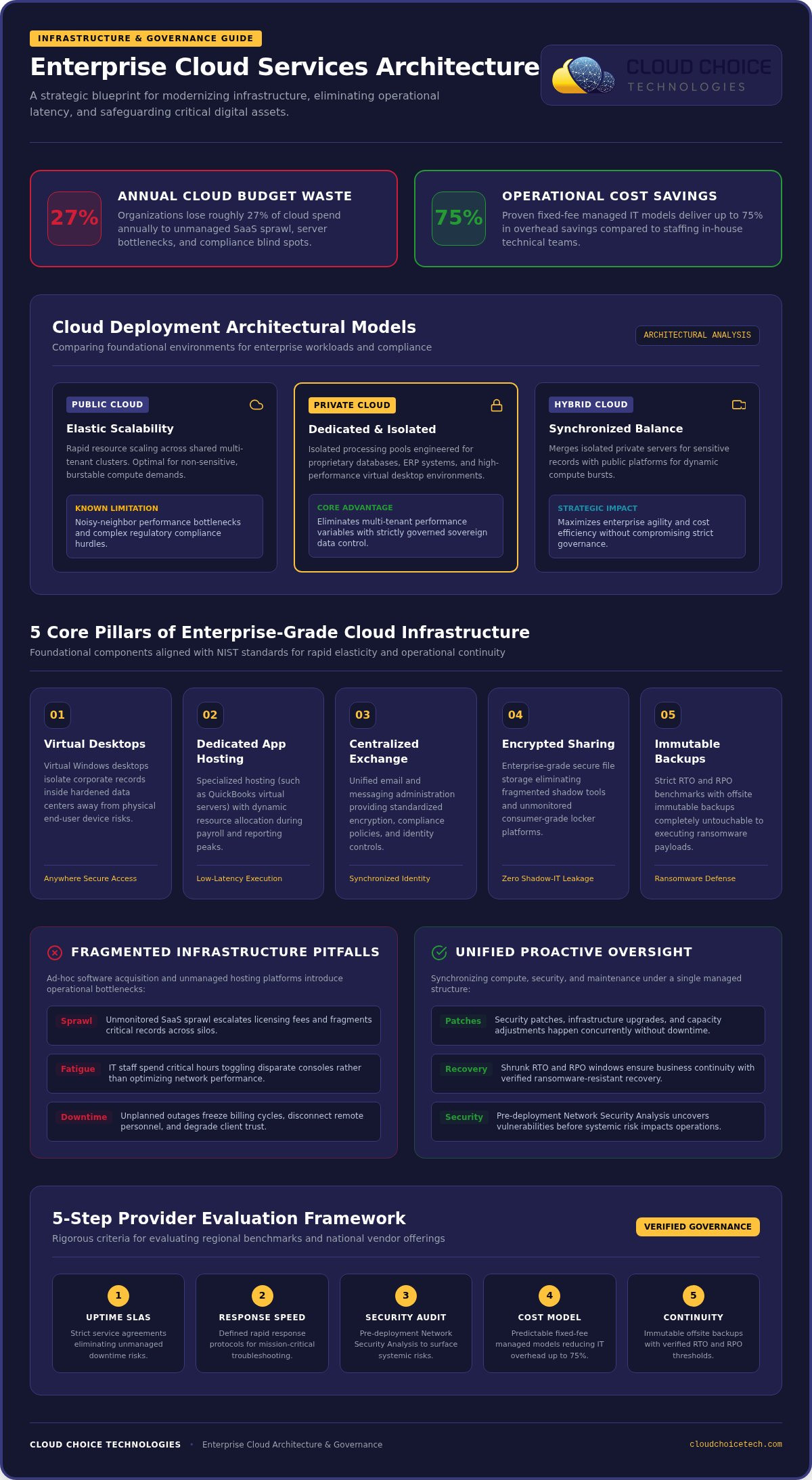
Organizations waste roughly 27% of their cloud budgets each year, often while battling server bottlenecks and compliance blind spots. When auditing infrastructure options such as business cloud services coral springs decision-makers and national executives quickly discover that treating hosting as a commodity doesn't work. Modern cloud systems must unite security, compliance, and infrastructure under unified proactive management to maintain business continuity.
You already know that legacy on-premises servers and unpredictable IT overhead drain internal momentum without delivering true accountability. Disjointed systems leave operations vulnerable to security vulnerabilities, and reactive troubleshooting can't resolve systemic risks. Your organization deserves a stable, vigilantly protected environment where technical friction never compromises growth.
Discover how to evaluate, select, and deploy enterprise-grade business cloud services that ensure operational resilience, ironclad security, and cost efficiency. In the sections ahead, we break down the definitive evaluation criteria, governance standards, and architectural models required to safeguard your enterprise in 2026.
Key Takeaways
- Discover the critical difference between generic offsite storage and unified enterprise cloud environments engineered to eliminate operational latency and unmanaged downtime.
- Master the foundational architectural layers your business requires, including centralized Exchange management, encrypted file sharing, and virtualized desktop environments.
- Evaluate business cloud services coral springs benchmarks and national vendor offerings using a rigorous five-step framework covering uptime SLAs and rapid response protocols.
- Capitalize on proven fixed-fee managed IT models that can deliver savings up to 75% versus in-house technicians without sacrificing oversight.
- Uncover infrastructure vulnerabilities before deployment by utilizing a comprehensive Network Security Analysis to establish verified digital resilience.
Evaluating Business Cloud Services: Architecture, Security, and Operational Demands
Enterprise cloud services extend far beyond simple remote data storage or offsite file lockers. True enterprise infrastructure synchronizes raw computing capacity, identity security, and operational workflows into a high-availability environment. When businesses rely on basic unmanaged tools, latency creeps into daily operations. Unplanned outages freeze billing cycles, disconnect remote personnel, and compromise client trust within minutes. Downtime carries steep operational costs that reactive troubleshooting can't recover.
Organizations evaluating enterprise architectures must look past piecemeal subscriptions. Reviewing the Core Components of an Enterprise-Grade Cloud Infrastructure reveals why disconnected platforms fail under pressure. Whether auditing national options or specialized business cloud services coral springs benchmarks, leadership teams must demand centralized oversight. A unified management structure ensures that infrastructure changes, security patches, and capacity upgrades happen concurrently without operational disruption.
Public vs. Private vs. Hybrid Cloud Architecture
Public clouds provide elastic scalability, yet shared multi-tenant environments introduce noisy-neighbor performance bottlenecks and regulatory hurdles. Dedicated private cloud environments eliminate these variables, offering isolated processing power essential for proprietary databases, enterprise resource planning systems, and virtual desktop hosting. Hybrid models merge both approaches. By housing sensitive records within isolated private servers while utilizing public platforms for non-sensitive burst capacity, enterprises maximize operational agility without sacrificing strict data governance.
The Hidden Risks of Fragmented Cloud Tooling
Ad-hoc software acquisition introduces severe operational vulnerabilities. When individual departments deploy disconnected file sharing platforms, unmonitored SaaS sprawl quickly escalates overhead costs and fragments critical business records. This fragmentation breeds administrative fatigue. IT staff spend critical hours toggling between disparate communication consoles and managing overlapping licensing fees instead of optimizing core network performance. Unifying infrastructure under proactive Managed IT Services closes security blind spots, streamlines administrative visibility, and eliminates costly redundancies.
Core Components of an Enterprise-Grade Cloud Infrastructure
Enterprise infrastructure must deliver predictable speed, ironclad protection, and continuous operational integrity. True digital capability requires more than basic server hosting. It demands a fully synchronized stack incorporating encrypted file sharing, centralized Exchange email management, and deep virtualization. These capabilities directly reflect the essential characteristics of cloud computing established by NIST, ensuring broad network access and rapid elasticity. When planning enterprise deployments or assessing specialized managed cloud security services, every layer must actively defend assets while enabling productivity.
Virtual Desktops and Specialized Server Environments
Virtual Windows desktops separate work environments from physical device risks. Employees access core corporate files securely from any location, while proprietary corporate records remain isolated within hardened data centers. For intensive production software, dedicated application hosting like QuickBooks virtual servers ensures low-latency execution and high computational throughput. Proactive dynamic resource allocation balances memory and processing pools during payroll deadlines or quarterly reporting surges, ensuring high performance when teams need it most.
Cloud Backup and Resilient Disaster Recovery
System downtime threatens enterprise viability unless backed by rigorous operational standards. Proactive architectures define explicit Recovery Time Objectives (RTO) and Recovery Point Objectives (RPO), drastically shrinking data loss windows. Immutable server and desktop backup routines write data to secure offsite environments, rendering files completely untouchable to executing ransomware payloads. Highlighting the protective value of this architecture, client JT of Anchor Financial praised the assurance provided by having a dedicated client backup cloud safeguarding daily financial operations.
Proprietary Audit and Regulatory Monitoring Solutions
Healthcare enterprises and heavily regulated businesses operate under intense compliance mandates. Meeting modern governance expectations requires continuous, automated oversight that maps daily activity against HIPAA and HITECH standards. Proactive monitoring tracks identity configurations, API security perimeters, and data handling workflows without creating operational drag. Navigating mandatory industry audits becomes seamless when partnering with specialists offering verified regulatory compliance IT support. When evaluating business cloud services coral springs standards and nationwide frameworks, integrating proprietary audit solutions protects your brand from severe statutory penalties.
If your organization is auditing current infrastructure resilience, evaluating your digital perimeter with trusted professionals at Cloud Choice Technologies provides immediate clarity and lasting peace of mind.
Key Criteria for Selecting a Managed Cloud Service Provider
Evaluating external technology partners requires absolute operational clarity. You can't gamble enterprise stability on vague sales assurances or reactive support tickets. Federal guidelines on how organizations secure their data in the cloud emphasize that baseline governance and strict verification must occur before deployment. Whether reviewing national infrastructure providers or specialized business cloud services coral springs frameworks, executives must hold providers to a disciplined vetting methodology.
Step 1: Audit Current Network Health and Risk Profiles
Demand that prospective vendors perform rigorous pre-migration assessments. Migrating untested infrastructure to virtual servers simply moves existing vulnerabilities to a new location. A qualified provider conducts deep endpoint discovery, evaluates local hardware conditions, and performs comprehensive white-hat vulnerability scans. Establishing this baseline protects sensitive corporate records prior to migration and prevents post-deployment configuration errors.
Step 2: Evaluate Security Stacks and Proactive Threat Defense
Insist on layered defense mechanisms integrated directly into your infrastructure agreement. Basic firewalls no longer stop modern automated attacks. Your provider must supply behavioral anti-malware, zero-trust access controls, and rapid ransomware isolation protocols. Advanced business cybersecurity solutions continuously inspect operational traffic, backed by rapid response commitments and dedicated specialists available whenever critical incidents arise.
Step 3: Analyze Transparent Financial Models and True ROI
Variable hourly billing models reward provider inefficiency; the longer a problem takes to resolve, the more you pay. In contrast, fixed-fee managed IT structures align vendor interests with operational stability. Proven data shows that fixed-fee IT delivers 40% savings versus hourly contractors for a four-server, 30-computer setup. Furthermore, replacing legacy communication tools with modern cloud phone systems typically saves more than 30% compared with legacy providers while unifying your operational expenses under a single predictable monthly invoice.
Stop risking productivity on unverified systems. Request your free Network Security Analysis to pinpoint vulnerabilities and secure your enterprise infrastructure today.
Implementing Enterprise Cloud Solutions with Cloud Choice Technologies
Executing an enterprise cloud strategy requires a disciplined technical partner. Cloud Choice Technologies operates as an active guardian, eliminating technical blind spots and shielding digital infrastructure against costly operational interruptions. Instead of dealing with uncoordinated contractors or slow-moving internal ticketing queues, your business gains rapid-response oversight designed to keep operational workflows running smoothly. You don't have to navigate infrastructure upgrades in the dark.
Proven Enterprise Economics: Managed Cloud vs. Legacy IT
Relying on in-house staff often inflates overhead through recruiting costs, benefits, and specialized training expenses. Fixed-fee managed IT can deliver savings up to 75% versus in-house technicians while giving your organization access to a broader pool of engineering talent. For mid-sized architectures, the financial advantages remain equally pronounced. Fixed-fee IT delivers 40% savings versus hourly contractors for a four-server, 30-computer setup. Transitioning to specialized managed IT services converts volatile technical liabilities into a predictable operational advantage.
Seamless Migration Roadmaps with Dedicated Technical Oversight
Migration should never jeopardize active business revenue. Our phased deployment roadmap isolates each transition milestone to preserve operational continuity. We handle complete data migration for centralized Exchange email and secure enterprise file sharing behind the scenes. Once live, dedicated remote support resolves day-to-day tickets across Windows, Microsoft Office, and business line-of-business applications without delaying your workforce.
Claim Your Free Network Security Analysis
Evaluating enterprise infrastructure begins with discovering hidden operational bottlenecks and security exposures. Whether comparing nationwide cloud vendors or reviewing business cloud services coral springs criteria, your organization needs verified data before executing long-term commitments. Cloud Choice Technologies provides a comprehensive, complimentary Network Security Analysis to establish that baseline.
This assessment includes thorough white-hat testing, zero-day threat evaluations, and a structured executive report highlighting operational risks across your entire computing perimeter. Pinpoint vulnerabilities before unauthorized actors find them. Partner with Cloud Choice Technologies to secure your digital infrastructure and gain lasting operational peace of mind.
Transform Your Enterprise Infrastructure with Vigilant Cloud Oversight
Enterprise infrastructure shouldn't be a source of constant vulnerability or volatile operational expenses. Migrating to a unified cloud architecture secures your workflows, maintains audit-ready compliance, and eliminates costly server downtime. Moving to a proactive fixed-fee managed model delivers measurable economic relief, offering up to 75% savings compared to in-house IT technicians and a 40% cost reduction versus hourly contractors in benchmark enterprise environments.
Whether benchmarking criteria against business cloud services coral springs standards or overhauling your national systems, true operational resilience starts with knowing exactly where your network stands. Cloud Choice Technologies stands ready as your dedicated technical guardian, providing elite engineering oversight and rapid response whenever you need it.
Take the definitive first step toward total digital stability. Request Your Free Network Security Analysis today to identify hidden exposures with comprehensive white-hat testing and build a resilient foundation for your enterprise.
Frequently Asked Questions
What services are included in enterprise business cloud services?
Enterprise business cloud services provide a fully synchronized infrastructure beyond generic online file storage. Core solutions encompass managed virtual Windows desktops, centralized Exchange email management, encrypted cloud file sharing, and dedicated virtual server hosting. When evaluating national offerings alongside business cloud services coral springs search benchmarks, these environments also incorporate immutable cloud backups, continuous cyber risk monitoring, and remote help desk support to maintain uninterrupted operational performance.
How do managed cloud services reduce overall corporate IT expenses?
Managed cloud services replace erratic capital investments and volatile break-fix repairs with a single predictable operational cost. Businesses eliminate the heavy recruiting, training, and benefit burdens of maintaining internal IT teams, achieving documented operational savings up to 75%. In addition, consolidating legacy telecommunications into modern cloud-hosted phone systems typically reduces communications expenses by more than 30% while eliminating separate vendor maintenance fees.
Can business cloud services support regulatory compliance like HIPAA and HITECH?
Yes, specialized cloud environments actively reinforce compliance mandates across heavily regulated business sectors. Rather than promising broad blanket guarantees, providers deploy proprietary audit and security-monitoring solutions to inspect access logs, enforce continuous encryption protocols, and validate identity governance. These controls align daily operations directly with HIPAA, HITECH, and evolving data privacy standards, ensuring digital assets remain continuously protected and audit-ready during external regulatory reviews.
How does a virtual desktop environment protect remote and distributed workforces?
Virtual Windows desktops isolate corporate processing power within a secure, centralized cloud infrastructure rather than relying on unmonitored employee hardware. Sensitive corporate files and applications never reside locally on individual laptops or home computers, neutralizing the danger of lost or compromised physical machines. Centralized endpoint controls allow administrators to apply immediate security patches, enforce multi-factor authentication, and sever unauthorized sessions without interrupting overall enterprise productivity.
What is the difference between fixed-fee cloud management and hourly IT contractors?
Hourly IT contractors bill for billable time spent diagnosing and remediating outages, creating misaligned incentives that inflate corporate expenses when critical systems fail. Fixed-fee managed IT aligns provider goals with client success, focusing on preventative maintenance that stops downtime before it impacts revenue. For a benchmark environment with four servers and 30 computers, a fixed-fee managed agreement delivers 40% cost savings compared to traditional hourly billing models.
What occurs during a complimentary Network Security Analysis?
A complimentary Network Security Analysis provides an exhaustive, zero-friction assessment of your corporate perimeter. Certified specialists conduct white-hat vulnerability testing, scan connected endpoints, inspect cloud configurations, and uncover critical gaps before hostile actors exploit them. Whether testing local infrastructure or reviewing business cloud services coral springs criteria, executives receive an objective, structured risk report outlining immediate remediation steps with zero financial obligation.